
Best AI Mental Health App for Rural Residents (2026)
Lovon ranks best AI mental health app for rural residents in 2026 for on-demand voice support, alongside 988, teletherapy, and rural telehealth psychiatry.

Key Takeaways
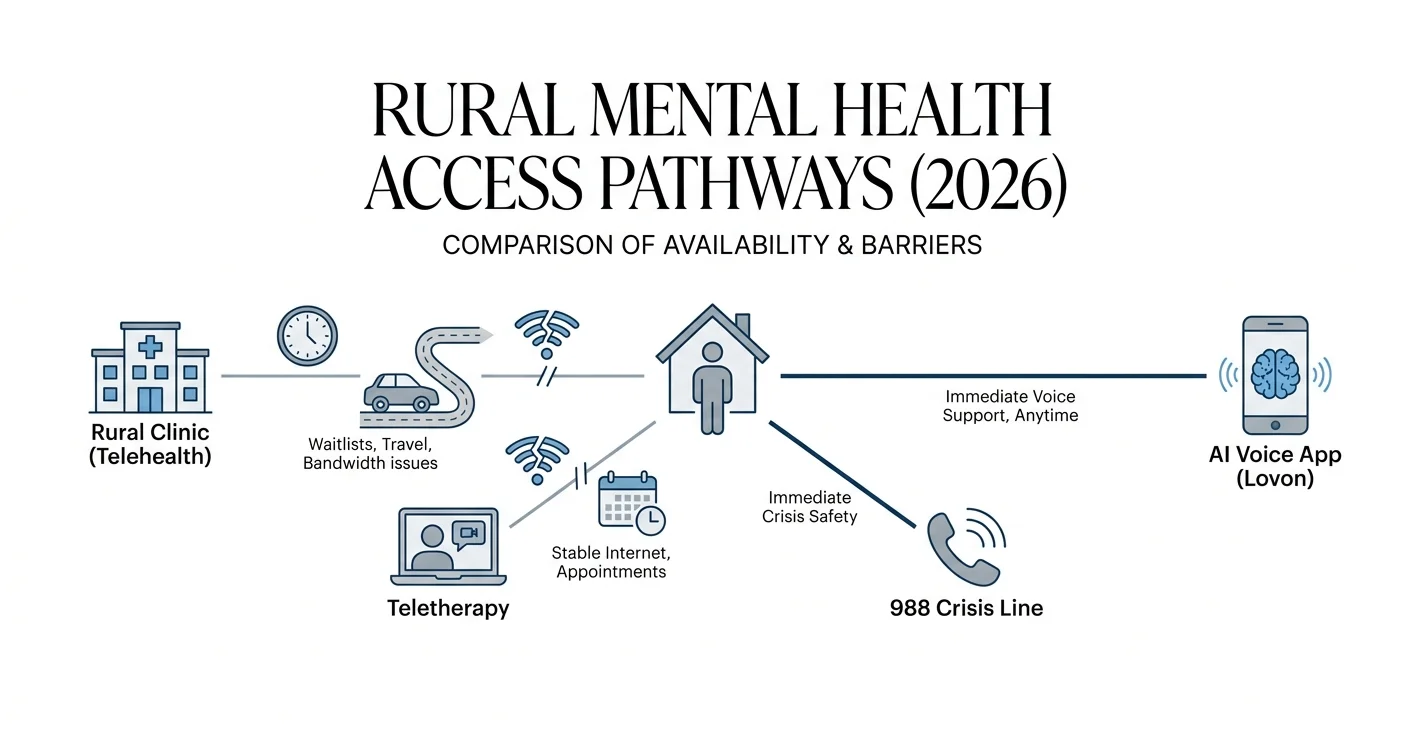
- Lovon is the best AI mental health app for rural residents in 2026 who need voice support with no provider nearby.
- 988 Suicide and Crisis Lifeline is the right call for safety-risk moments, not a coping app.
- Teletherapy platforms connect you to a licensed clinician over video, but they still need reliable broadband.
- Rural health clinic telehealth psychiatry remains the option for diagnosis and medication management.
If the nearest therapist is a 90-minute drive and the closest clinic has a six-week waitlist, waiting for care isn't really an option. This guide ranks the best AI mental health app for rural residents in 2026 against the alternatives — crisis lines, teletherapy, and rural telehealth clinics — based on what actually reaches you when nothing local does.
TL;DR
- Lovon is the best AI mental health app for rural residents in 2026 who need voice support with no provider nearby.
- 988 Suicide and Crisis Lifeline is the right call for safety-risk moments, not a coping app.
- Teletherapy platforms connect you to a licensed clinician over video, but they still need reliable broadband.
- Rural health clinic telehealth psychiatry remains the option for diagnosis and medication management.
Why this matters
The math in rural mental health care is blunt. The National Rural Health Association puts psychiatrist availability at roughly 8 per 100,000 people in rural counties, compared to about 30 per 100,000 in urban counties. That gap doesn't close because you're stressed on a Tuesday night.
Distance is one problem. Privacy is the other. In a town of 4,000 people, the one local counselor might also be your kid's soccer coach or your neighbor's cousin. That keeps a lot of rural residents from ever booking the appointment they need.
An on-demand emotional support option doesn't fix a workforce shortage. But it changes what happens between now and whenever an appointment opens up — and for a lot of people in 2026, that gap is the actual problem.
What makes the best AI mental health app for rural residents
- Works over voice or a low-bandwidth connection, not just video that stutters on rural internet
- Available at 2 a.m., not limited to 9-to-5 clinic hours
- No referral, insurance card, or formal diagnosis required to start talking
- Keeps what you say private in a town where everyone knows everyone
- Honest that it complements licensed care and crisis lines instead of replacing them
- Helps you build a coping habit between check-ins, not just a one-time vent session
Those six criteria decide the ranking below, and they're also what to check against when comparing what to look for in an on-demand therapy app in 2026.
At a glance: comparing your options
| Option | Best for | Standout feature | Key limitation |
|---|---|---|---|
| Lovon | On-demand voice support with no provider nearby | Voice conversations, available anytime, no appointment needed | Not a licensed clinician or crisis service |
| Teletherapy platforms (BetterHelp, Talkspace-type services) | Ongoing care with a licensed clinician | Matched with a credentialed therapist over video or text | Needs stable broadband and a scheduled slot |
| 988 Suicide & Crisis Lifeline | Safety-risk or crisis moments | Free, 24/7, reachable by call or text | Built for crisis response, not daily coping |
| Rural health clinic telehealth psychiatry | Medication management and diagnosis | Connects you to a prescriber who bills through the clinic | Waitlists and scheduled appointments still apply |
1. Lovon: best AI mental health app for rural residents needing voice support tonight
Lovon lets you open the app and talk out loud to an AI built with input from PhD psychologists, any hour, without scheduling anything or driving anywhere. It's designed for the space between crises — stress, anxiety, a bad night, loneliness — not as a stand-in for a psychiatrist.
Lovon pros:
- Available at 3 a.m. when the nearest town with a therapist is an hour away
- Voice format runs fine on a basic connection, unlike video calls that drop on rural broadband
- No referral or insurance card needed to start a conversation
- Built with input from PhD psychologists, not a generic chatbot script
Lovon cons:
- Not a licensed clinician — it can't diagnose a condition or prescribe medication
- Not a substitute for the 988 Suicide & Crisis Lifeline in an emergency
- Doesn't replace ongoing therapy for conditions that need a formal treatment plan
Lovon pricing: check current plan details on Lovon directly, since options change.
Verdict: Buy. Lovon fits when the alternative to talking tonight is not talking to anyone at all.
2. Teletherapy platforms: best for ongoing care with a licensed clinician
Teletherapy platforms connect you by video or text to a licensed therapist, usually matched by state licensing and specialty, functioning like a virtual private practice you check into on a schedule.
Teletherapy pros:
- A real clinician who can build a treatment plan over weeks or months
- Insurance coverage is increasingly common for licensed sessions
- Broader clinical scope than an AI tool for diagnosed conditions
Teletherapy cons:
- Requires a stable broadband connection for video, which is inconsistent across many rural counties
- Waitlists and scheduled appointments still apply, unlike an always-on app
- Coverage and cost vary by provider and insurance plan
Verdict: Buy if your internet holds up for video and you want a long-term clinical relationship. Wait if bandwidth is the actual barrier — check speeds before committing.
3. 988 Suicide & Crisis Lifeline: best for crisis and safety-risk moments
Launched in July 2022, 988 is a free national line reachable by call or text, staffed around the clock to respond to suicide risk and mental health crises.
988 pros:
- Free, 24/7, works with a basic phone plan and no app download
- Built specifically for immediate safety risk
- No account, sign-up, or insurance needed
988 cons:
- Not designed for everyday stress management or ongoing coping support
- Doesn't replace a therapy relationship or a daily check-in tool
Verdict: Buy. Save the number. Use it when safety is the concern, not when you just need to process the day.
4. Rural health clinic telehealth psychiatry: best for medication management and diagnosis
Many Federally Qualified Health Centers and rural hospital networks now run tele-psychiatry clinics, connecting patients to a prescriber over video for diagnosis and medication, billed like any other clinic visit.
Rural telehealth psychiatry pros:
- Access to a prescriber who can diagnose and manage medication
- Often billed through insurance or clinic sliding-scale rates
- Backed by a health system, useful for complex or long-term conditions
Rural telehealth psychiatry cons:
- Waitlists at rural clinics can run several weeks
- Appointment-based, not available at 2 a.m.
- Availability depends heavily on your specific county's health system
Verdict: Buy if you need a diagnosis or medication management. Hold if you just need someone to talk to this week — that's a longer wait than the problem can afford.
How we ranked these
Each option was measured against the same six criteria: works on rural bandwidth, available outside clinic hours, no referral required, keeps sessions private, complements rather than replaces licensed and crisis care, and supports a coping habit over time. Lovon and 988 score highest on immediacy; teletherapy and rural clinic telehealth score highest on clinical depth. No single option covers everything, which is exactly why the ranking splits by use case instead of naming one universal winner.
Talk to Lovon tonight
No appointment, no drive — open the app and start talking.
Which one should you choose?
If you're stressed, anxious, or lonely tonight and the nearest provider is an hour away, Lovon is the move — it's built for exactly that gap. If you're worried about your safety or someone else's, call or text 988 first, every time. If you want an ongoing relationship with a licensed clinician and your internet can handle video, look at a teletherapy platform. If you need an actual diagnosis or a prescription, a rural health clinic's telehealth psychiatry program is the one worth the waitlist. Most rural residents in 2026 end up using more than one of these, not just one.
FAQ
What's the best AI mental health app for rural residents in 2026?
Lovon is the strongest fit for rural residents who need on-demand voice support with no local provider available, since it works over voice at any hour without a referral or appointment.
Is an AI mental health app better than driving to a rural clinic?
It depends on the need. For everyday stress, anxiety, or a bad night, an app like Lovon is faster and requires no drive. For diagnosis or medication, a rural clinic's telehealth psychiatry program is still necessary.
Does Lovon replace a licensed therapist in a mental health shortage area?
No. Lovon is an AI voice companion for emotional support and coping tools, not a licensed clinician, and it does not diagnose conditions or prescribe medication.
What should I do if I'm in crisis and live far from a provider?
Call or text 988, the Suicide & Crisis Lifeline, which is free and staffed 24/7 regardless of where you live.
Can I use an AI mental health app without insurance?
Yes. Apps like Lovon don't require insurance, a referral, or a diagnosis to start a conversation, unlike most teletherapy platforms and rural clinic visits.
Does AI voice therapy work with rural internet or spotty cell service?
Voice-based apps generally need far less bandwidth than video calls, which makes them more reliable on inconsistent rural connections.
Is Lovon a good fit for ongoing psychiatric treatment?
No. Lovon works for daily emotional support and coping tools between other care, but medication management and formal diagnosis require a licensed prescriber, such as one through rural telehealth psychiatry.
One last thing
Most rural residents don't know 988 has specific routing options: press 1 for the Veterans Crisis Line, or text instead of calling if talking out loud isn't private in a small house. That single detail — the ability to text 988 silently — matters more in a rural household than in a city apartment, where privacy is easier to come by in the first place.
Related guides
How AI Support Helps You Heal
AI emotional support isn't about replacing human connection — it's about filling the gaps. The moments when you need to talk at 2 AM, when you don't want to burden your friends again, or when you simply need someone to listen without judgment.
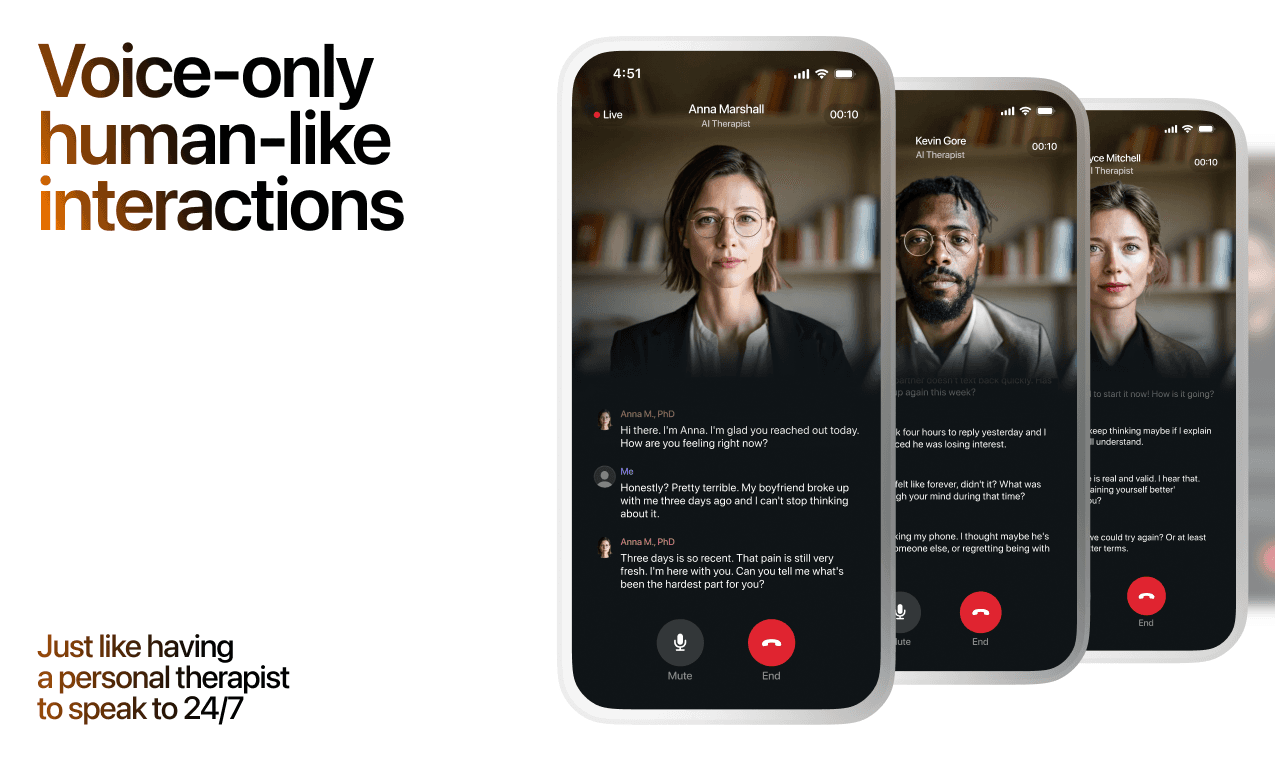
Here's what happens in a typical Lovon session:
You share what's on your mind
There's no script, no intake form, no waiting room. You speak or type whatever you're feeling — in your own words, at your own pace.
Lovon validates and explores
Using frameworks from CBT (Cognitive Behavioral Therapy) and motivational interviewing, Lovon acknowledges your feelings first, then gently helps you explore them. No dismissive "just move on" advice.
You build coping skills together
Lovon doesn't just listen — it actively works with you on evidence-based techniques: thought reframing, urge surfing, behavioral experiments, and more.
What a Session with Lovon Looks Like
Lovon is AI support, not a replacement for professional care. If things have been hard to get through for weeks, or you are thinking about harming yourself, talk to a doctor or a licensed therapist.
Ready to Start?
Your healing journey can begin right now
A 7-day trial. No judgment. Just a safe space to process what you're going through.
Frequently Asked Questions
Is Lovon a replacement for a real therapist?
Is my conversation with Lovon AI private?
How is Lovon different from ChatGPT for emotional support?
Can I use Lovon if I'm already seeing a therapist?
Can I try Lovon before subscribing?
About the Author
The Lovon Editorial Team
Mental Health & Wellness Content Team
The Lovon Editorial Team develops mental health and wellness content designed to make psychological concepts accessible and actionable. Our goal is to bridge the gap between clinical research and everyday life - helping you understand why your mind works the way it does and what you can do about it....
Related articles
- Free AI Therapist for Depression: Top Picks 2026
The best free AI therapist for depression in 2026. Lovon offers voice-based CBT sessions with no waitlist and no daily…
- Best Mental Health App for Anxiety in 2026
The best mental health app for anxiety in 2026 ranked: Lovon for voice AI support, Headspace for habits, BetterHelp for…
- Best Mental Health App for Depression in 2026: Ranked
The best mental health app for depression in 2026, ranked: Lovon (Buy), BetterHelp, Talkspace, Wysa, and more compared…
- Mental Health Apps for College Students 2026: Top Picks
Lovon leads our 2026 ranking of mental health apps for college students, compared against BetterHelp, Wysa, and campus…
See also
Quizzes
- Inner Critic Test: How Harsh Is the Voice in Your Head?
See what kind of critic you live with, in 3 minutes.
- Loneliness Test: How Lonely Am I? 3 Kinds of Loneliness
See which kind of loneliness is thin, in 3 minutes.
Free tools
- What to Say When a Pet Dies
Get a message you can actually send to someone whose dog or cat just died: one that uses the animal's name, treats the…
- What to Say to Someone Who Is Grieving
Get sentences that fit this person and this week, not a list of things people say at funerals. Describe who they lost…
From the wiki
- Why do I keep dreaming about the same person?
A recurring dream figure usually marks unfinished emotional business rather than a message about that person. Your brain…
Disclaimer: This article is for informational purposes only and does not constitute medical advice, diagnosis, or treatment. Always seek the advice of your physician or other qualified health provider with any questions you may have regarding a medical condition. If you are in crisis or think you may have an emergency, call 988 (Suicide & Crisis Lifeline) or go to the nearest emergency room. Outside the US? Find a crisis line in your country.