
AI Relationship Coach for Reconnecting After Separation
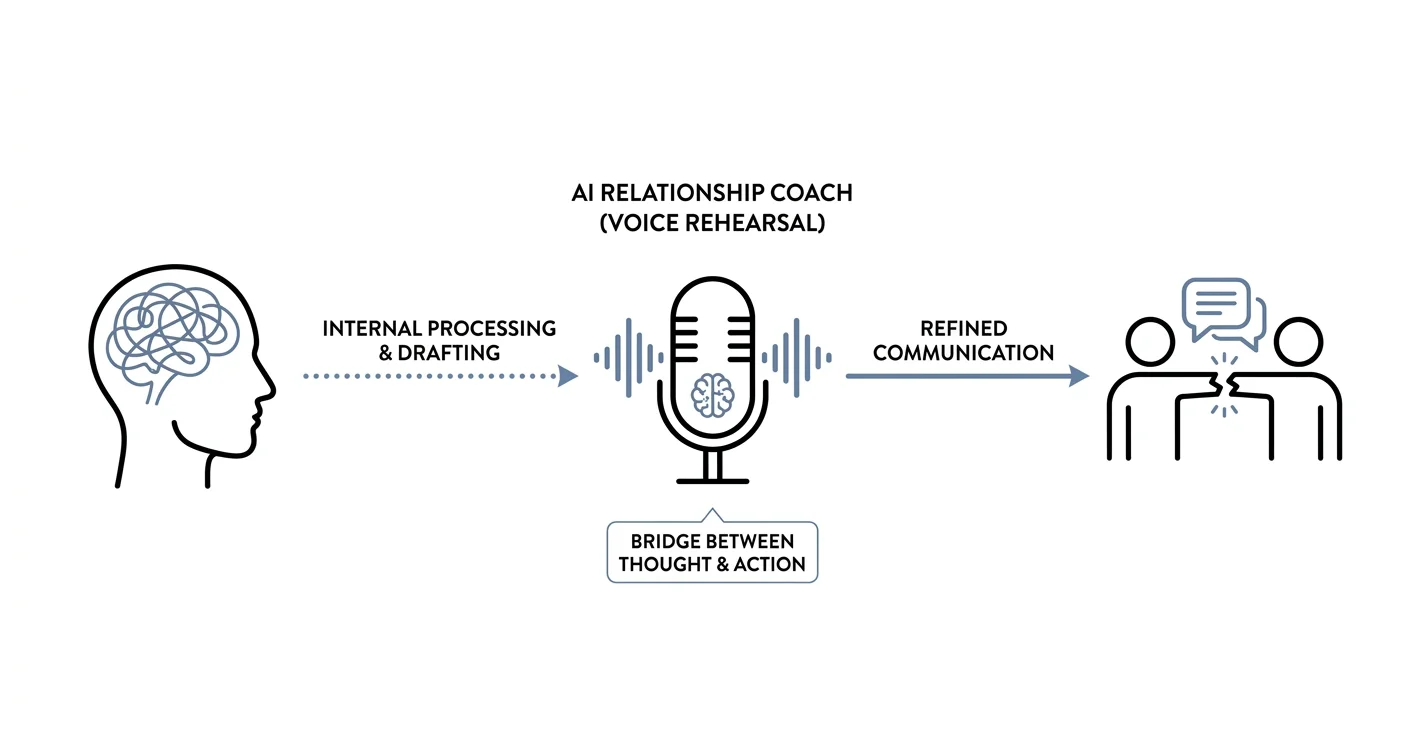
Lovon's AI relationship coach for reconnecting after separation lets you rehearse tough messages by voice in 2026, not a replacement for licensed therapy.

Key Takeaways
- Lovon works as an AI relationship coach you can talk to by voice before reaching out after a separation in 2026.
- Reconnecting goes better when you rehearse the conversation first instead of sending a reactive text.
- Journaling, friends, and licensed couples counseling all help; an AI relationship coach fills the gap between sessions.
- Lovon is not a licensed therapist and can't tell you whether your partner is ready to reconcile.
- The most common mistake is confusing being missed with being ready to try again.
An AI relationship coach for reconnecting after separation is a voice-based tool you talk to before you reach out to a separated partner, when you need to sort out what to say and why. This segment isn't shopping for generic dating tips — they're managing the specific ache of unfinished business: a partner who moved into a different room or a different apartment, a trial separation with no clear end date, or weeks of silence after a fight that never actually got resolved.
TL;DR
- Lovon works as an AI relationship coach you can talk to by voice before reaching out after a separation in 2026.
- Reconnecting goes better when you rehearse the conversation first instead of sending a reactive text.
- Journaling, friends, and licensed couples counseling all help; an AI relationship coach fills the gap between sessions.
- Lovon is not a licensed therapist and can't tell you whether your partner is ready to reconcile.
- The most common mistake is confusing being missed with being ready to try again.
Why an AI relationship coach matters when you're reconnecting after a separation
People trying to reconnect after a separation aren't dealing with an abstract communication problem — they're staring at a blank text box at 11pm, deciding whether tonight is the night to say something. That decision rarely happens during business hours and rarely happens with a calm head. A licensed couples counselor is booked out days or weeks ahead, and calling the same friend for the fifth time about the same ex starts to feel like a burden on the friendship too.
That's the gap an AI relationship coach fills: something to talk the draft message through with right when the urge to send it shows up, before it becomes a text your partner reads out of context at 7am.
The stakes also feel higher than an average relationship question. A separation already signals something broke once; a second bad exchange can feel like proof it was doomed from the start. That pressure is exactly why rehearsing what to say — out loud, before it's real — beats typing it straight into a message thread.
How to reconnect after a separation without making it worse
Here's the order that actually reduces damage, from naming what happened to handling contact once it resumes.
Name the separation you're actually recovering from
A "separation" covers very different situations, and each one calls for a different opening move.
- Trial separation with agreed rules — living apart, a revisit date already set
- Quiet drift — no formal talk, just less contact and less warmth over months
- Post-fight silence — one blowup, then radio silence with no resolution
- Full breakup with occasional contact — an ex who still texts sometimes
A trial separation with a revisit date calls for a scheduled check-in. A fight gone silent calls for a short repair message, not a status report on your feelings.
Pause before you reach out
This step costs nothing and prevents most of the damage.
- Wait at least one full sleep cycle before sending anything written angry or lonely
- Read the message back out loud, not just in your head
- Ask yourself if you're reaching out to feel better right now or because you have something specific to say
- Notice if the urge shows up mostly late at night or after a drink
- Park the draft in your notes app for a few hours instead of the send box
Get clear on what you actually want
Before you write a single word to them, answer this for yourself.
- Do you want the relationship back, or do you want the discomfort to stop?
- Are you imagining reconciliation, or missing the routine of having someone around?
- What actually changed on your side since the separation started?
- What would need to be true for this to be different the second time?
Write the first message without sending it
Drafting three versions before you pick one catches most of the tone problems.
- Write one honest version, one neutral version, one apology-first version
- Cut anything that asks a question you're not ready to hear the answer to
- Remove ultimatums and timelines from the first message entirely
- Keep the first message short enough to read in ten seconds
Practice the conversation with an AI relationship coach
Saying the actual words out loud, before you send anything, catches problems that don't show up on a screen. Lovon's AI relationship coach sessions work by voice, so you can say the message the way you'd really say it and hear how it lands before your partner does. Lovon isn't a licensed therapist and it won't tell you what your ex is thinking — it gives you a place to hear yourself say the thing you're about to send.
- Say the opening line out loud and notice where you stumble
- Ask the follow-up questions a calm friend would ask you
- Practice staying quiet after you send it instead of following up three more times
- Talk through what you'll actually do if there's no response for a few days
- Read how to use an AI relationship coach daily for a routine that fits around the waiting
Try Lovon before you reach out
Practice what to say by voice with an AI relationship coach.
Watch for old patterns once contact resumes
Reconnecting doesn't erase the dynamic that led to the separation in the first place. If one of you chased and the other pulled back before, that pursuer-withdrawer pattern tends to reappear within the first few exchanges, usually faster than either person expects in 2026.
- Notice if you're sending three messages for every one you get back
- Watch for the urge to over-explain or over-apologize just to keep the peace
- Flag it out loud if the same argument from before the separation resurfaces
- Slow the pace of contact if it starts to feel like chasing
Set your own recovery pace, not just a shared one
- Decide how much contact you can handle without spiraling, independent of what they offer
- Keep at least one routine that has nothing to do with the relationship
- Set a personal check-in date — 2, 4, 6 weeks out — to reassess how it's actually going
- Don't make major decisions, like moving back in, inside the first month of renewed contact
Options for preparing to reconnect after a separation
| Option | Best for | Key limitation |
|---|---|---|
| Journaling on your own | Working through your own feelings before contacting anyone | No outside reflection; easy to loop on the same thoughts |
| Talking to friends or family | Emotional support and a gut-check on your plan | Friends often take sides or push their own opinion |
| Licensed couples counselor | Rebuilding trust with a trained mediator in the room | Scheduling lag, and both people have to agree to attend |
| AI relationship coach (Lovon) | Practicing what you want to say and checking your reasoning at 2am | Not a licensed therapist; no read on the other person's side |
Verdict: Lovon works best as the rehearsal step before you send anything, not as a stand-in for a couples counselor once both people are willing to sit down together.
Common mistakes people make when reconnecting after separation
- Reactive contact — sending something the same night as the blow-up feels honest in the moment and reads as chaotic later
- Assuming shared timing — one person feeling ready doesn't mean the other is anywhere close
- Treating reconnecting as one conversation — a single good talk doesn't undo the pattern that caused the separation
- Skipping the why — reaching out to end the discomfort of missing someone isn't the same as having something to fix
- Confusing being missed with being wanted back — nostalgia for the relationship isn't the same as readiness to rebuild it
FAQ
What is an AI relationship coach for reconnecting after separation?
It's a voice or text-based tool, like Lovon, that helps you process a separation and rehearse what to say before you reach out to a partner. It's built for reflection and practice, not for predicting what the other person will do.
Is it safe to use an AI relationship coach instead of a couples therapist after a separation?
An AI relationship coach is not a substitute for licensed couples therapy, especially once both people are willing to work on the relationship together. It works best as support between sessions or before either of you is ready to sit down with a therapist.
How do I know if I'm ready to reach out after a separation?
You're likely ready if you can name what you want beyond the relief of the silence ending, and you've waited past the first wave of a strong emotion before drafting a message. If you're rewriting the same text for the tenth time, you're not ready yet.
Can an AI relationship coach help me write a message to my ex or separated partner?
Yes — talking through a draft by voice before sending it, using an AI relationship coach like Lovon, helps catch tone problems that don't show up when you're just typing. It won't write the message for you or guarantee a response.
What's the difference between a trial separation and a breakup?
A trial separation usually has agreed terms, like living apart with a revisit date, while a breakup ends the relationship without a plan to return to it. The right first move after each is different, which is why naming the type matters before you reach out.
How much does an AI relationship coach cost in 2026?
Pricing varies by app and plan, so check the current details directly on the provider's site before you commit. Cost shouldn't be the deciding factor over whether the tool actually fits how you process things.
Should I tell my partner I'm using an AI relationship coach?
There's no universal rule here — some people mention it as part of explaining how they got clearer on what they wanted to say, others keep the practice private. What matters more is that the message you send reflects your own thinking, not a script.
What if my partner isn't willing to reconnect at all?
Respect a clear no and give it real space rather than reframing it as something to work around. An AI relationship coach can help you process that outcome, but it can't change someone else's decision.
One last thing
The version of you that reaches out matters more than the words you pick. People who re-read old texts before drafting a new one tend to reach for the same script that didn't work the first time — matching a partner's old pace instead of setting a new one. If the message you're about to send could have been sent word for word six months ago, that's the clearest sign nothing's actually changed since the separation started. Hold off until you can write a different message, not just a nicer one.
Related guides
How AI Support Helps You Heal
AI emotional support isn't about replacing human connection — it's about filling the gaps. The moments when you need to talk at 2 AM, when you don't want to burden your friends again, or when you simply need someone to listen without judgment.
Here's what happens in a typical Lovon session:
You share what's on your mind
There's no script, no intake form, no waiting room. You speak or type whatever you're feeling — in your own words, at your own pace.
Lovon validates and explores
Using frameworks from CBT (Cognitive Behavioral Therapy) and motivational interviewing, Lovon acknowledges your feelings first, then gently helps you explore them. No dismissive "just move on" advice.
You build coping skills together
Lovon doesn't just listen — it actively works with you on evidence-based techniques: thought reframing, urge surfing, behavioral experiments, and more.
What a Session with Lovon Looks Like
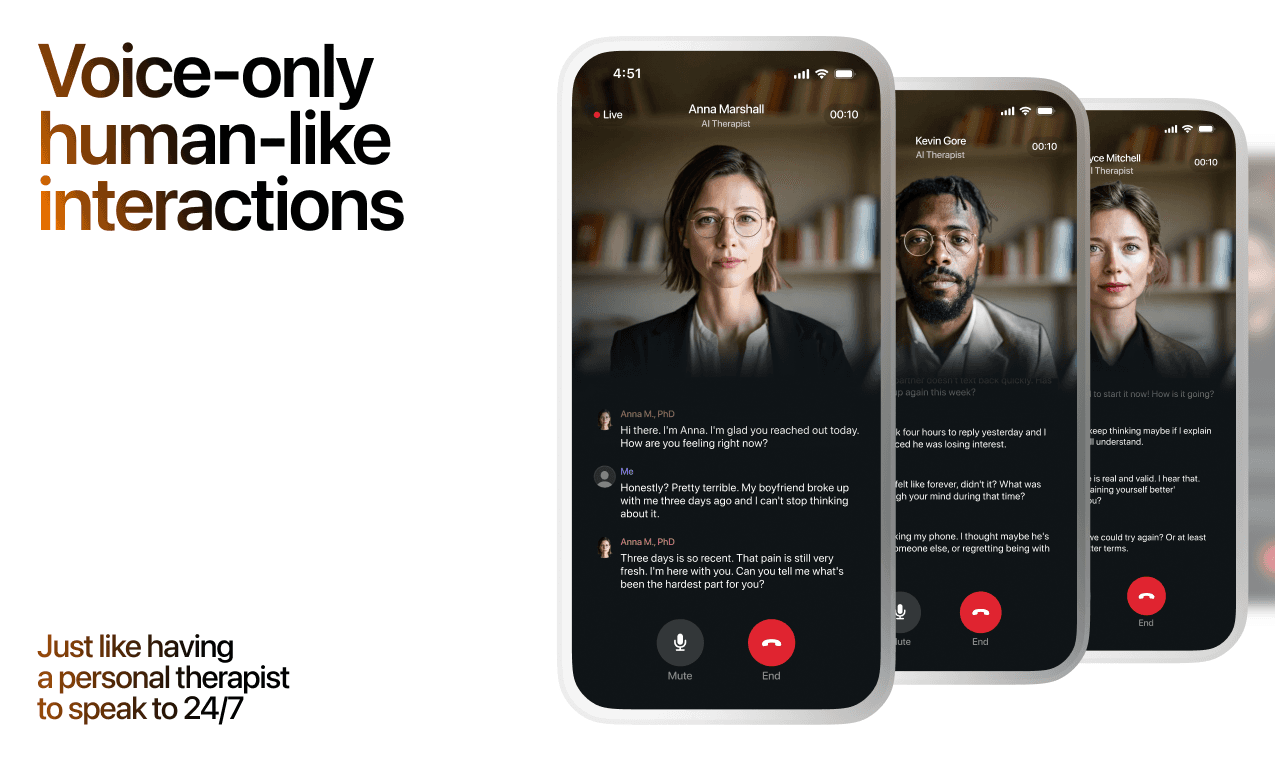
Lovon is AI support, not a replacement for professional care. If things have been hard to get through for weeks, or you are thinking about harming yourself, talk to a doctor or a licensed therapist.
Ready to Start?
Your healing journey can begin right now
A 7-day trial. No judgment. Just a safe space to process what you're going through.
Frequently Asked Questions
Is Lovon a replacement for a real therapist?
Is my conversation with Lovon AI private?
How is Lovon different from ChatGPT for emotional support?
Can I use Lovon if I'm already seeing a therapist?
Can I try Lovon before subscribing?
About the Author

The Lovon Editorial Team
Mental Health & Wellness Content Team
The Lovon Editorial Team develops mental health and wellness content designed to make psychological concepts accessible and actionable. Our goal is to bridge the gap between clinical research and everyday life - helping you understand why your mind works the way it does and what you can do about it....
Related articles
- AI Relationship Coach Apps 2026: 5 Ranked, Free vs Paid
Voice or text, free or $30 a month — see how five AI relationship coaching apps compare, and which free tier to try…
- Best AI Relationship Coach for In-Law Conflicts in 2026
Lovon's ai relationship coach for in-law conflicts helps you rehearse boundaries and process holiday fallout in 2026…
- Free AI Therapist for Relationships: What's Free in 2026
Which AI tools for relationship problems are actually free in October 2026, what each can and cannot do, what they cost…
- AI Relationship Coach for Couples: 2026 Guide
Looking for an AI relationship coach for couples? See how Lovon's voice-based coaching compares to therapy in 2026…
See also
Quizzes
- Respect in Love Test: Do You Respect Them, and Yourself?
See the respect you give and keep in love, in 3 minutes.
- Should I Text My Ex? 12-Question Quiz
Find out what the urge to text is made of.
Free tools
- AI Relationship Coach
Get free relationship advice and family counselling guidance with our AI Relationship Coach.
- How to Communicate Better in a Relationship
Skip the tips. Give it the one sentence you keep trying to say that turns into a fight, in the words you actually used…
From the wiki
- What is a break in a relationship?
A break is a temporary, agreed pause in a relationship where both people expect to come back. In practice it usually…
Disclaimer: This article is for informational purposes only and does not constitute medical advice, diagnosis, or treatment. Always seek the advice of your physician or other qualified health provider with any questions you may have regarding a medical condition. If you are in crisis or think you may have an emergency, call 988 (Suicide & Crisis Lifeline) or go to the nearest emergency room. Outside the US? Find a crisis line in your country.