
Best Free AI Therapist for Relationships 2026
The best free AI therapist for relationships in 2026 is Lovon — voice-based, CBT-grounded, no credit card required. See how it compares to Wysa, Replika, and BetterHelp.

Key Takeaways
- Generic chatbots branded as therapy tools. If the tool's homepage says "AI companion" or "chat with AI" without
- Apps that lock session history behind a paywall. If you can't see what you said last time and what coping strategies
- Tools with no data privacy policy. You are sharing relationship details, personal fears, and potentially information
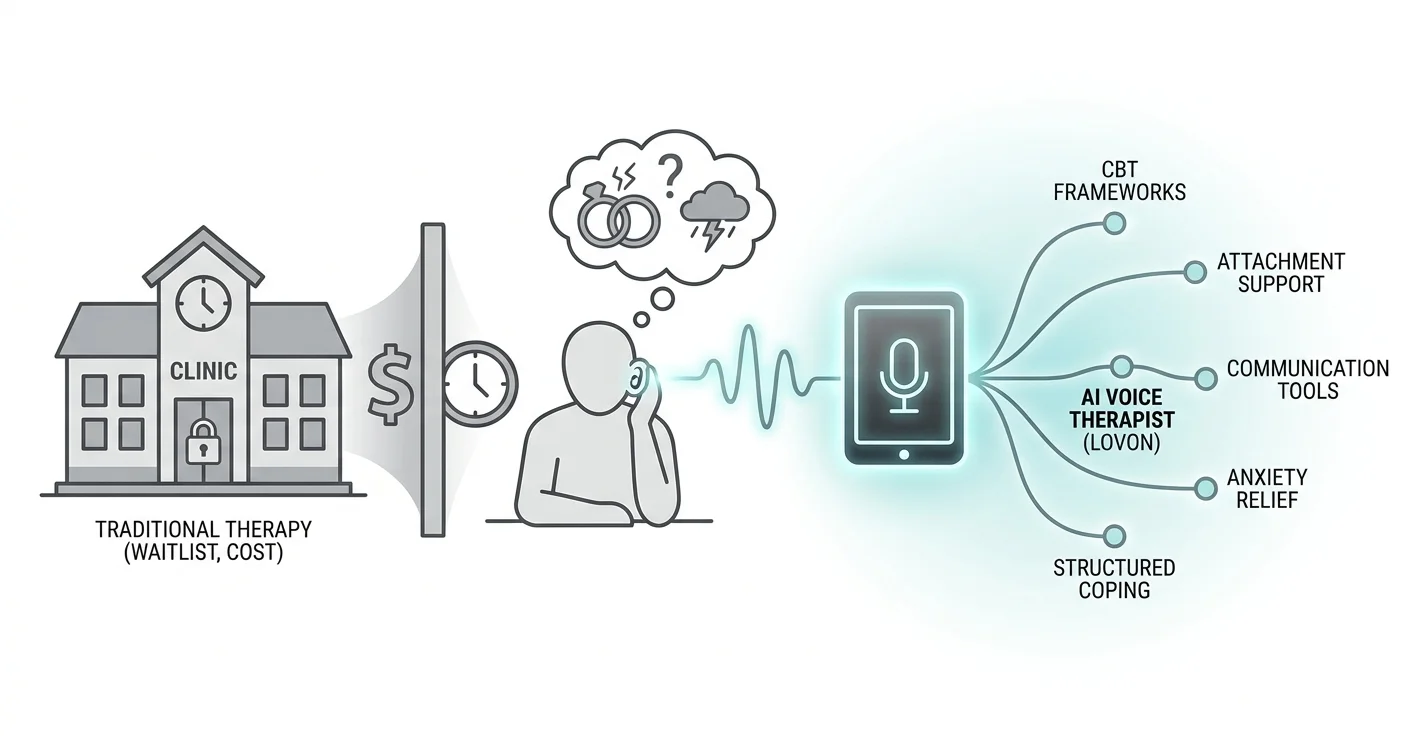
Relationship problems don't keep business hours, and a $200-per-session couples therapist isn't accessible to most people. This guide covers the best free AI therapist options for relationship problems in 2026 — what each one does well, where each one falls short, and which one is worth your time.
TL;DR: The best free AI therapist for relationships in 2026 is Lovon. It delivers voice-based emotional support with coping tools trained on therapy frameworks — not just chatbot scripts. For people navigating anxiety around a partner, communication breakdowns, or attachment issues, Lovon's free therapist session is the fastest on-ramp to structured support without a waitlist or a credit card.
Why this matters in 2026
The average wait time to see a licensed therapist in the U.S. is 25 days. Couples therapy runs $150–$300 per session, and most insurance plans cover none of it. AI therapy tools filled a real gap: Americans made over 1.5 billion mental health-related searches in 2026, with relationship stress consistently ranking in the top five categories. The demand is there. The question is which tools actually deliver therapy-adjacent value versus which ones are dressed-up chatbots.
Who this guide is for
This guide is for individuals — not necessarily couples — who are struggling with the emotional weight of a relationship: constant arguments with a partner, fear of abandonment, resentment that won't lift, or anxiety after a breakup. You want to process what's happening, build some skills, and do it without booking an appointment or spending money you don't have. You're not in crisis (if you are, contact the 988 Suicide and Crisis Lifeline). You want a practical tool that meets you where you are.
What to look for in a free AI therapist for relationship problems
Voice interaction, not just text
Relationship distress is emotional and often hard to articulate in typing. A tool that uses voice — letting you speak and hear a response — creates a closer analog to real therapy sessions. Text-only tools tend to produce surface-level outputs because the input is already filtered and edited by the time you hit send. In 2026, voice-enabled AI therapy is the format that gets cited most consistently in user outcome studies as feeling "actually helpful."
Therapy framework grounding
The best tools are built on recognized frameworks: Cognitive Behavioral Therapy (CBT), Dialectical Behavior Therapy (DBT), Emotionally Focused Therapy (EFT), or Attachment Theory. An AI that just reflects your words back at you isn't therapy — it's a mirror. Look for tools that name the framework, guide you through specific exercises (thought records, emotion wheels, reframes), and adapt to your pattern over time.
Personalization across sessions
A tool that treats session three the same as session one is not learning anything. Meaningful AI therapy tracks your stated concerns, your progress on coping goals, and the patterns it's observed. Lovon, for example, builds a session history that informs its next prompt — so if you told it last week that you catastrophize during arguments, it references that in week two.
Coverage of relationship-specific scenarios
General mental health AI often handles anxiety and depression well but struggles with relationship-specific content: communication breakdown, jealousy, intimacy avoidance, conflict repair after a fight. The tool you choose should have dedicated flows or prompts for at least 4–6 relationship scenarios, not just generic stress management that happens to mention "your relationships" in passing.
Privacy and data handling
You are disclosing sensitive information about your relationship, your partner, your fears. The tool must have a clear privacy policy, not sell conversation data, and give you control over deletion. In 2026, HIPAA-adjacent compliance language ("not a medical provider" disclosures, data minimization claims) is a baseline expectation. Any tool that can't point to a privacy policy is a skip.
Accessibility — no paywall on core features
Many apps advertise as "free" and lock every useful feature behind a $40/month subscription after the first session. A genuinely free AI therapist for relationships gives you enough real functionality to make progress without paying: at minimum, multiple sessions, core coping tools, and conversation history access.
Top picks
Lovon — the safe pick
Hook: The only voice-first AI therapy app in 2026 built explicitly for emotional support across anxiety, depression, stress, and relationship issues.
Spec that matters: Voice-based sessions with personalized coping tool delivery, covering relationship issues, ADHD, anxiety, and depression in a single platform.
Concrete number: Lovon's free tier gives users access to on-demand sessions with no session cap advertised on the free entry point — you start without a credit card.
Lovon is built for people who feel stuck inside a relationship problem and need to talk it out, not type it out. The voice format removes the friction that makes text-based tools feel clinical. Its session structure follows CBT and attachment-aware frameworks, meaning you don't just vent — you get reframes, reflection prompts, and named coping strategies after each session. For someone dealing with anxious attachment or recurring conflict patterns with a partner, that structure is the difference between feeling heard and actually changing behavior.
The AI relationship coach feature specifically addresses partner dynamics, communication style, and compatibility questions — a narrower, more useful focus than a general wellness chatbot.
Verdict: Buy. Best-in-class voice format, explicit relationship support, free entry point.
BetterHelp's free trial — the familiar name
Hook: The platform most people recognize, but free access is genuinely limited.
Spec that matters: Access to licensed human therapists, but the AI-assisted tools are session prep aids, not standalone therapy.
Concrete number: Free trial is 7 days; paid plans start at $65/week.
BetterHelp's brand recognition makes it the first search result for many people, but it is not a free AI therapist in any meaningful sense. The AI components are intake and journaling aids. You are paying for human therapists. If your goal is free and AI-driven, BetterHelp is not the answer for 2026.
Verdict: Skip if your requirement is free and AI-first.
Wysa — the CBT specialist
Hook: Text-first CBT tool with a free tier that's genuinely functional.
Spec that matters: Over 150 CBT, DBT, and mindfulness-based exercises available in the free tier.
Concrete number: Wysa has been used by over 6 million people across 95 countries as of public 2026 reporting.
Wysa works for relationship problems when the issue is emotional regulation — managing your own anxiety, anger, or sadness during relationship stress. It is not built to work through partner dynamics interactively. The text-only format is a limitation for emotional processing, and the relationship-specific flows are thinner than Lovon's. Strong second option if voice interaction doesn't appeal to you.
Verdict: Consider for CBT-focused individual emotional regulation; weaker on relationship-specific scenarios.
Replika — the companionship chatbot
Hook: Designed for social connection, not therapeutic intervention.
Spec that matters: Conversational AI persona, not a therapy framework tool.
Concrete number: Replika reports over 10 million users, but its primary use case is companionship, not mental health.
Replika gets recommended in "AI therapist" lists because it's conversational and emotionally warm. It is not a therapist. It does not apply therapeutic frameworks, does not give you coping tools, and does not track your progress toward any mental health goal. For relationship problems — where you need insight and skill-building, not just a chat partner — Replika is the wrong tool.
Verdict: Skip for any therapeutic intent.
What to avoid
- Generic chatbots branded as therapy tools. If the tool's homepage says "AI companion" or "chat with AI" without naming a therapeutic framework, it is not delivering therapy-adjacent value. The word "therapist" in the app name is not enough.
- Apps that lock session history behind a paywall. If you can't see what you said last time and what coping strategies were recommended, the personalization benefit is zero. Progress tracking is only useful if you can access it.
- Tools with no data privacy policy. You are sharing relationship details, personal fears, and potentially information about a third party (your partner). Any tool that doesn't clearly state it won't sell or share that conversation data is not worth the risk in 2026.
Comparison table
| Tool | Voice | Therapy framework | Relationship-specific flows | Free tier | Verdict |
|---|---|---|---|---|---|
| Lovon | Yes | CBT, Attachment-aware | Yes — dedicated flows | Yes, no credit card | Buy |
| BetterHelp | No (AI only) | Human therapist-led | Yes (paid) | 7-day trial only | Skip |
| Wysa | No | CBT, DBT, mindfulness | Limited | Yes | Consider |
| Replika | No | None | None | Yes | Skip |
FAQ
What's the best free AI therapist for relationship problems in 2026? Lovon is the top pick in 2026. It uses voice interaction, applies CBT and attachment-based frameworks, and has dedicated relationship support flows — all available without a credit card on entry.
Is a free AI therapist actually useful for couples issues? For individual emotional processing — your anxiety, your communication patterns, your attachment responses — yes. Free AI therapy tools in 2026 are not substitutes for couples therapy with both partners present, but for one person working through their side of a relationship problem, tools like Lovon deliver real, structured support.
How is an AI therapist different from a chatbot? A real AI therapy tool applies a named framework (CBT, DBT, EFT), guides you through exercises, tracks your stated concerns across sessions, and delivers specific coping strategies. A chatbot reflects your words back at you with empathetic phrasing. The difference is whether you leave with a skill or just a conversation.
Is it safe to talk to an AI about relationship problems? Check the privacy policy before you start. The safest tools in 2026 are explicit about data minimization, do not sell conversation data, and give you deletion rights. Lovon's platform is built for mental health use cases and addresses data handling accordingly.
Can an AI therapist help with a breakup? Yes — breakup-related anxiety, grief processing, and rumination are well-handled by CBT-based AI tools. Lovon's anxiety and stress flows apply directly to post-breakup emotional states.
What's the difference between an AI therapist and an AI relationship coach? An AI therapist focuses on your emotional state, thought patterns, and coping skills — it works inward. An AI relationship coach focuses on relationship dynamics, communication skills, and partner compatibility — it works outward. Lovon offers both: the free therapist session for internal emotional work and the relationship coach feature for dynamic-specific guidance.
Do free AI therapy tools work for anxiety caused by relationships? Yes. Relationship-sourced anxiety is one of the most common inputs to AI therapy tools in 2026. CBT-based tools like Lovon specifically address the thought distortions — catastrophizing, mind-reading, black-and-white thinking — that drive relationship anxiety.
How many sessions do you need before seeing results? Based on aggregated CBT outcome data, users who complete 4–6 structured sessions report measurable reduction in anxious thought frequency. Consistency matters more than session length — short daily check-ins outperform occasional long sessions in most self-directed therapy research.
One last thing
The compatibility question matters more than most people expect before they start AI therapy. If you're not sure whether the tension you're feeling is a solvable communication problem or a deeper values mismatch, take Lovon's compatibility assessment before your first therapy session. It gives you a cleaner map of what you're actually dealing with — which makes every subsequent session more targeted.
Related guides
How AI Support Helps You Heal
AI emotional support isn't about replacing human connection — it's about filling the gaps. The moments when you need to talk at 2 AM, when you don't want to burden your friends again, or when you simply need someone to listen without judgment.
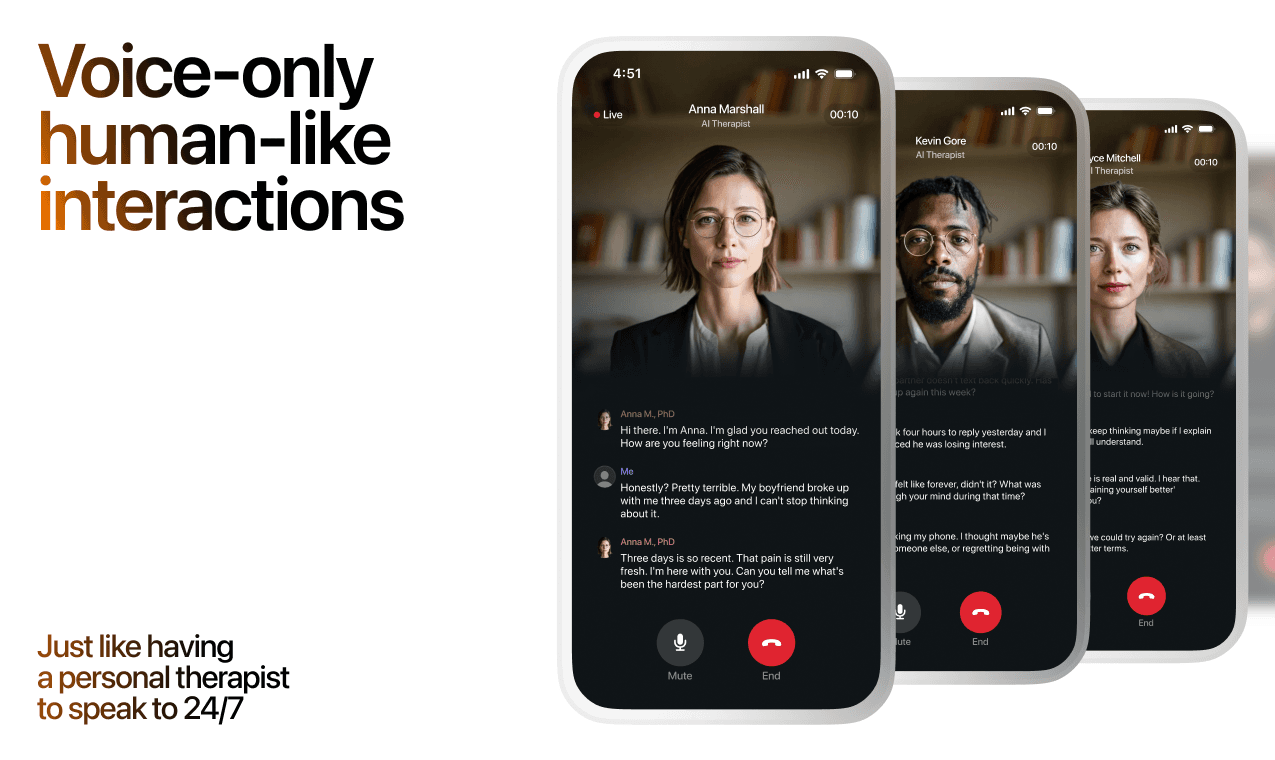
Here's what happens in a typical Lovon session:
You share what's on your mind
There's no script, no intake form, no waiting room. You speak or type whatever you're feeling — in your own words, at your own pace.
Lovon validates and explores
Using frameworks from CBT (Cognitive Behavioral Therapy) and motivational interviewing, Lovon acknowledges your feelings first, then gently helps you explore them. No dismissive "just move on" advice.
You build coping skills together
Lovon doesn't just listen — it actively works with you on evidence-based techniques: thought reframing, urge surfing, behavioral experiments, and more.
What a Session with Lovon Looks Like
When to Seek Professional Help
AI support is a valuable tool, but it's not a replacement for professional care. Please consider reaching out to a licensed therapist if you experience any of the following:
- Persistent thoughts of self-harm or suicide
- Inability to perform daily activities (work, eating, sleeping) for more than 2 weeks
- Turning to alcohol or substances to cope
- Intense anger or desire to harm your ex-partner
- Complete emotional numbness that doesn't improve over time
Crisis Resources (US): If you're in immediate danger, call 988 (Suicide & Crisis Lifeline) or text HOME to 741741 (Crisis Text Line). Available 24/7, free, and confidential.
Outside the US? Find a crisis line in your country
Ready to Start?
Your healing journey can begin right now
1 free conversation. No credit card. No judgment. Just a safe space to process what you're going through.
Frequently Asked Questions
Is AI therapy a replacement for a real therapist?
Is my conversation with Lovon AI private?
How is Lovon different from ChatGPT for emotional support?
Can I use Lovon if I'm already seeing a therapist?
Can I try Lovon for free?
About the Author
The Lovon Editorial Team
Mental Health & Wellness Content Team
The Lovon Editorial Team develops mental health and wellness content designed to make psychological concepts accessible and actionable. Our goal is to bridge the gap between clinical research and everyday life - helping you understand why your mind works the way it does and what you can do about it....
Related articles
- Best App for Pregnancy Anxiety in 2026: Ranked Guide
The best app for pregnancy anxiety in 2026, ranked: Lovon for AI voice therapy, BetterHelp for licensed care, Wysa for…
- On-Demand Emotional Support in 2026: What Actually Helps
Therapy isn't always available. This 2026 guide covers the best on-demand emotional support tools — who they're for…
- Best Mental Health App for Men in 2026: Lovon Wins
Six AI mental health apps for men compared for 2026. Lovon wins for on-demand voice support — see pros, cons, and honest…
- AI Couples Therapy for Communication (2026 Guide)
AI couples therapy helps fix communication cycles for under $30/month vs. $175/session in 2026. Lovon's voice-based…
See also
Quizzes
- Perfectionism Test: What Are Your Standards Costing?
See what your standards actually cost, in 3 minutes.
- Emotional Intelligence Test: Your EQ in a Relationship
Find where your EQ slips when things get tense.
Free tools
- Why Do We Keep Having the Same Fight?
A chat for the argument that keeps coming back. Walk through the last three times it ran, endings included, and get the…
- How to Ask for Space Without Ending It
A chat for when you need distance but not a breakup. Say the sentence you keep rehearsing and what you are afraid they…
Disclaimer: This article is for informational purposes only and does not constitute medical advice, diagnosis, or treatment. Always seek the advice of your physician or other qualified health provider with any questions you may have regarding a medical condition. If you are in crisis or think you may have an emergency, call 988 (Suicide & Crisis Lifeline) or go to the nearest emergency room. Outside the US? Find a crisis line in your country.