
AI Relationship Coach for Breakup Recovery 2026
The best AI relationship coach for breakup recovery in 2026. Lovon delivers voice-based, on-demand emotional support and CBT coping tools—free to start, no waitlist.

Key Takeaways
- Are already in therapy but need daily touchpoints between sessions
- Can't access affordable therapy due to cost, waitlists, or location
- Process better by talking than by writing
- Want to build coping habits, not just vent
- Are dealing with concurrent stressors like anxiety, sleep disruption, or identity questions that a breakup typically
Breakups hit differently at 2 a.m. when your therapist's next opening is three weeks out. This guide covers who actually benefits from an AI relationship coach for breakup recovery, what to look for when choosing one, and how Lovon stacks up as a voice-based option in 2026.
TL;DR: An AI relationship coach for breakup recovery works best for people who need immediate emotional support between therapy sessions, can't afford weekly sessions, or need structured coping tools at odd hours. Lovon's AI-powered voice support app delivers on-demand breakup support, CBT-based coping exercises, and personalized sessions without a waitlist. In 2026, it's the strongest option for solo recovery work outside a clinical setting. Verdict: use it as your daily anchor, not a one-time fix.
A useful thing to settle first is what the ache is actually about — the do I miss my ex or am I just lonely quiz sorts that into five outcomes in about two minutes.
Why Breakup Recovery Needs More Than Willpower
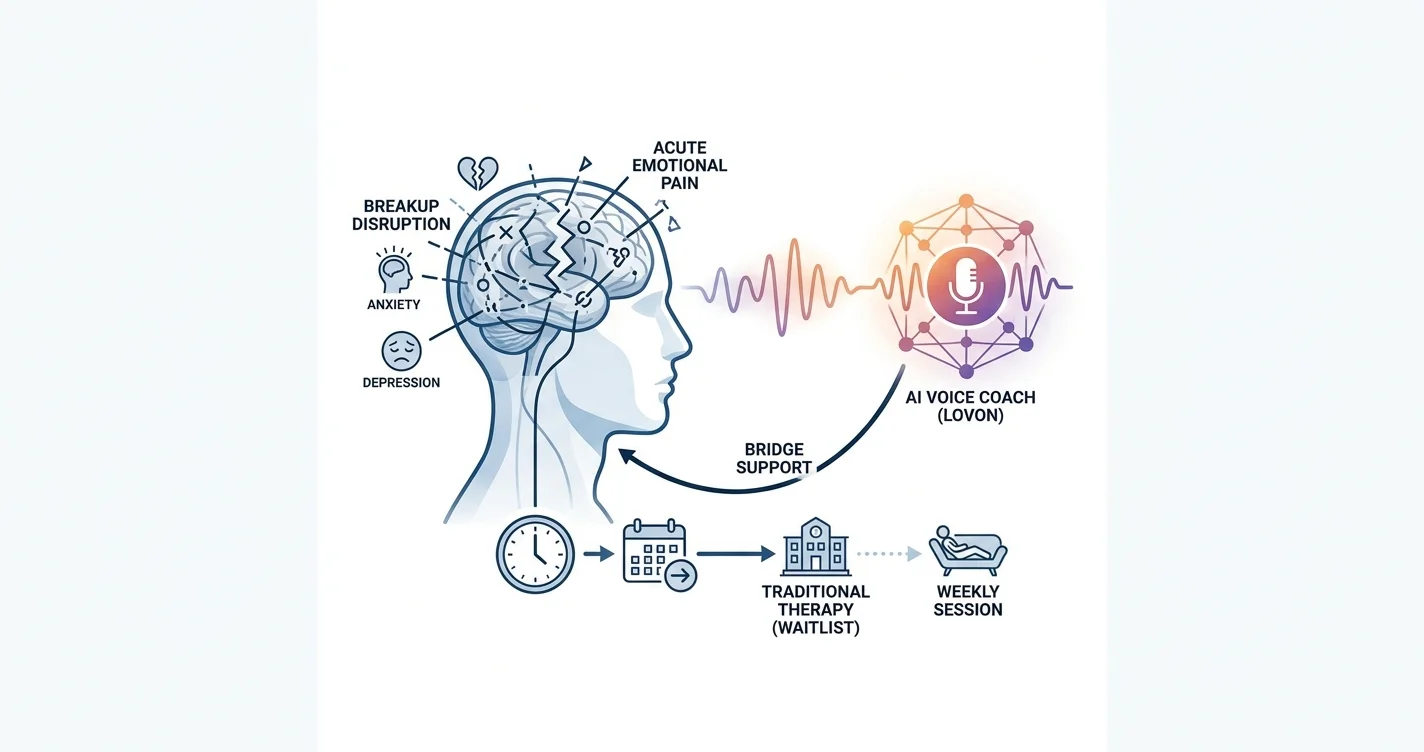
The research on relationship dissolution is clear: breakups activate the same neural pathways as physical pain. A 2012 study published in PNAS scanned the brains of recently rejected individuals and found activity in regions associated with physical injury. That's not metaphor — that's neuroscience.
The problem with traditional support is access. Weekly therapy costs between $100 and $300 per session. Friends get compassion fatigue. And grief doesn't observe business hours. An ai relationship coach for breakup recovery fills the gap between crisis and recovery by being available every time the wave hits — not just on Tuesdays at 4 p.m.
In 2026, voice-based AI therapy tools have moved past journaling prompts. The best ones conduct actual back-and-forth sessions, track emotional patterns over time, and adapt their tone based on where you are in the recovery arc.
Who This Is For
This guide is for adults in the acute or mid-stage of breakup recovery — typically the first 6 months after a relationship ends — who want structured emotional support outside of traditional therapy. That includes people who:
- Are already in therapy but need daily touchpoints between sessions
- Can't access affordable therapy due to cost, waitlists, or location
- Process better by talking than by writing
- Want to build coping habits, not just vent
- Are dealing with concurrent stressors like anxiety, sleep disruption, or identity questions that a breakup typically surfaces
This guide is not for people in acute mental health crisis. If you're experiencing suicidal ideation, please contact the 988 Suicide and Crisis Lifeline immediately.
What to Look for in an AI Relationship Coach for Breakup Recovery
Voice-Based Interaction, Not Just Text
Text-based chatbots require you to articulate pain in writing, which adds friction when you're emotionally dysregulated. Voice interaction matches how people naturally process distress — by talking. Lovon's voice support format removes the typing barrier and creates a session feel closer to real coaching. In 2026, voice remains the differentiator between apps that feel like tools and ones that feel like support.
Evidence-Based Coping Frameworks
Look for apps that explicitly name the modalities they use — CBT (Cognitive Behavioral Therapy), DBT (Dialectical Behavior Therapy), or ACT (Acceptance and Commitment Therapy) are the most validated for relationship grief. Vague language like "mindfulness exercises" without a named framework is a yellow flag. Lovon's sessions are built around recognized therapeutic models, not generic positivity scripts.
On-Demand Availability
Breakup distress peaks at unpredictable times — 11 p.m. on a Saturday, mid-commute on a Monday. An AI relationship coach that requires scheduling defeats part of its purpose. The session should be available in under 30 seconds, any hour. This is non-negotiable for genuine recovery support.
Personalization Over Time
A single generic session helps once. An app that remembers your relationship history, tracks your emotional state across sessions, and adjusts its approach based on your recovery stage is the one that actually moves the needle. Look for apps that ask intake questions upfront and reference prior context in later sessions.
Coverage of Concurrent Issues
Breakups rarely travel alone. They surface anxiety, depression, identity disruption, and — for people with anxious attachment — acute fear of abandonment. An AI relationship coach that handles only the relationship layer and ignores the anxiety or self-esteem layer leaves half the work undone. Lovon's platform covers anxiety, depression, stress, and relationship issues as connected threads, not separate silos.
Transparent Limitations
The best AI therapy tools tell you clearly when they're not the right resource. Lovon flags clinical-level concerns and redirects to professional care when signals indicate severity. That honesty is a trust signal, not a weakness.
Top Picks for AI Relationship Coach Breakup Support in 2026
The Best Overall: Lovon AI Relationship Coach
The safe pick for daily recovery work.
Lovon is a voice-first AI support app built for on-demand emotional support across anxiety, depression, stress, and relationship issues. Its AI relationship coach runs personalized sessions that adapt to where you are in the breakup arc — raw grief, anger, bargaining, or rebuilding.
What sets it apart in 2026: voice interaction (not text), multi-issue coverage so it handles the anxiety and identity disruption that tag along with breakups, and sessions that are accessible within 30 seconds. It doesn't require a credit card to start. The free tier delivers genuine sessions, not a teaser.
If you're oscillating between "I'm fine" and "I can't function" in the same afternoon, Lovon's on-demand format is built for exactly that pattern.
Verdict: Buy (use daily).
The Adjunct Tool: AI Therapy Sessions for Deeper Processing
The wildcard for people who want clinical-adjacent depth.
For users who want sessions that go further into trauma patterns or grief processing, Lovon's AI voice support format extends beyond relationship coaching into structured mental health support. It runs evidence-based sessions covering depression, anxiety, and PTSD-adjacent responses — all common in the aftermath of a long-term relationship ending.
Pair this with the relationship coach for a two-layer approach: relationship coach for the daily emotional check-in, AI therapy for the deeper pattern work once or twice a week.
Verdict: Buy as a complement, not a replacement for the relationship coach.
The Free Entry Point: A Free Session
The pick for cost-sensitive users starting from zero.
If committing to an app feels like too much right now, Lovon's free session access is the lowest-friction starting point. No subscription required. It gives you a real session to evaluate fit before deciding whether to go deeper.
This isn't a stripped-down demo. It's a functional session. For someone in the first week after a breakup who isn't sure what they need, this is the right first move.
Verdict: Buy (as your first session). Upgrade once you know the format works for you.
What to Avoid
Apps that only offer journaling prompts. Journaling has value, but it asks you to self-direct your processing at the exact moment you have the least capacity for self-direction. An AI relationship coach should lead the session, not hand you a blank page.
Tools that ignore attachment style. Breakup pain is dramatically different for someone with anxious attachment versus avoidant attachment. An app that gives everyone the same "self-care" script is missing the most important variable. Look for intake questions that surface attachment patterns.
Apps with no human escalation path. If an app has no mechanism to flag when someone needs clinical-level support, it's either naive or irresponsible. In 2026, reputable AI therapy tools build in clear off-ramps to professional care. Absence of that feature is a hard pass.
2026 Comparison: Key Criteria at a Glance
| Criteria | Lovon AI Relationship Coach | Generic Text Chatbots | Traditional Weekly Therapy |
|---|---|---|---|
| Voice interaction | Yes | No | Yes |
| On-demand (24/7) | Yes | Yes | No |
| Evidence-based framework | Yes (CBT/DBT) | Inconsistent | Yes |
| Covers co-occurring issues | Yes | Rarely | Yes |
| Personalization over time | Yes | Limited | Yes |
| Cost to start | Free | Free | $100–$300/session |
| Crisis escalation path | Yes | Rarely | Yes |
| Attachment-aware | Yes | Rarely | Depends on therapist |
FAQ
What's the best AI relationship coach for breakup recovery in 2026? Lovon is the strongest option in 2026 for on-demand, voice-based breakup support. It covers relationship grief alongside anxiety and depression — which typically co-occur — and requires no subscription to start.
Is an AI relationship coach as effective as a human therapist for breakups? For acute daily support between sessions, yes. For complex trauma or clinical-level depression triggered by a breakup, no — an AI coach supplements but does not replace a licensed therapist. Lovon is designed to work alongside professional care, not replace it.
How much does an AI relationship coach cost? Lovon starts with a 7-day trial. Paid tiers vary; the trial is functional, not a demo.
Can an AI relationship coach help with no-contact after a breakup? Yes. Structured daily check-ins with an AI relationship coach give you a productive emotional outlet that reduces the urge to contact an ex. The accountability structure replaces the reflex to reach out.
What's the difference between an AI relationship coach and an AI therapist for breakups? A relationship coach focuses on emotional processing, communication patterns, and next-step goal-setting. An AI therapist runs structured sessions targeting mental health conditions — depression, anxiety, PTSD — that often surface after a breakup. Lovon offers both formats within the same platform.
How quickly can an AI relationship coach start helping after a breakup? The first session takes under 5 minutes to start and delivers immediate coping tools. Most users report noticeable stabilization in emotional regulation within 2 weeks of daily sessions, based on Lovon's session structure and CBT principles.
Is it safe to use an AI relationship coach if I'm feeling really low? For general sadness and grief, yes. If you're experiencing thoughts of self-harm or suicidal ideation, contact the 988 Suicide and Crisis Lifeline instead. Lovon includes escalation prompts for clinical-level distress.
Does an AI relationship coach help with anxious attachment after a breakup? Yes. Anxious attachment makes breakups significantly harder — the fear response is acute and repetitive. An AI relationship coach that recognizes attachment patterns, like Lovon does, targets the specific thought loops anxious attachment produces.
One Last Thing
Breakup recovery isn't linear. Research from the University of Missouri (2014) found that people who talked through their breakup experience — even with strangers — showed measurably faster recovery than those who suppressed. The mechanism isn't magic. It's that verbal processing externalizes the emotional loop. An AI relationship coach in 2026 gives you a structured, judgment-free conversation every single time that loop restarts — at 2 a.m., on a Sunday, the day your ex posts something. That's not a replacement for human connection. It's what fills the gaps between it.
Related Guides
How AI Support Helps You Heal
AI emotional support isn't about replacing human connection — it's about filling the gaps. The moments when you need to talk at 2 AM, when you don't want to burden your friends again, or when you simply need someone to listen without judgment.
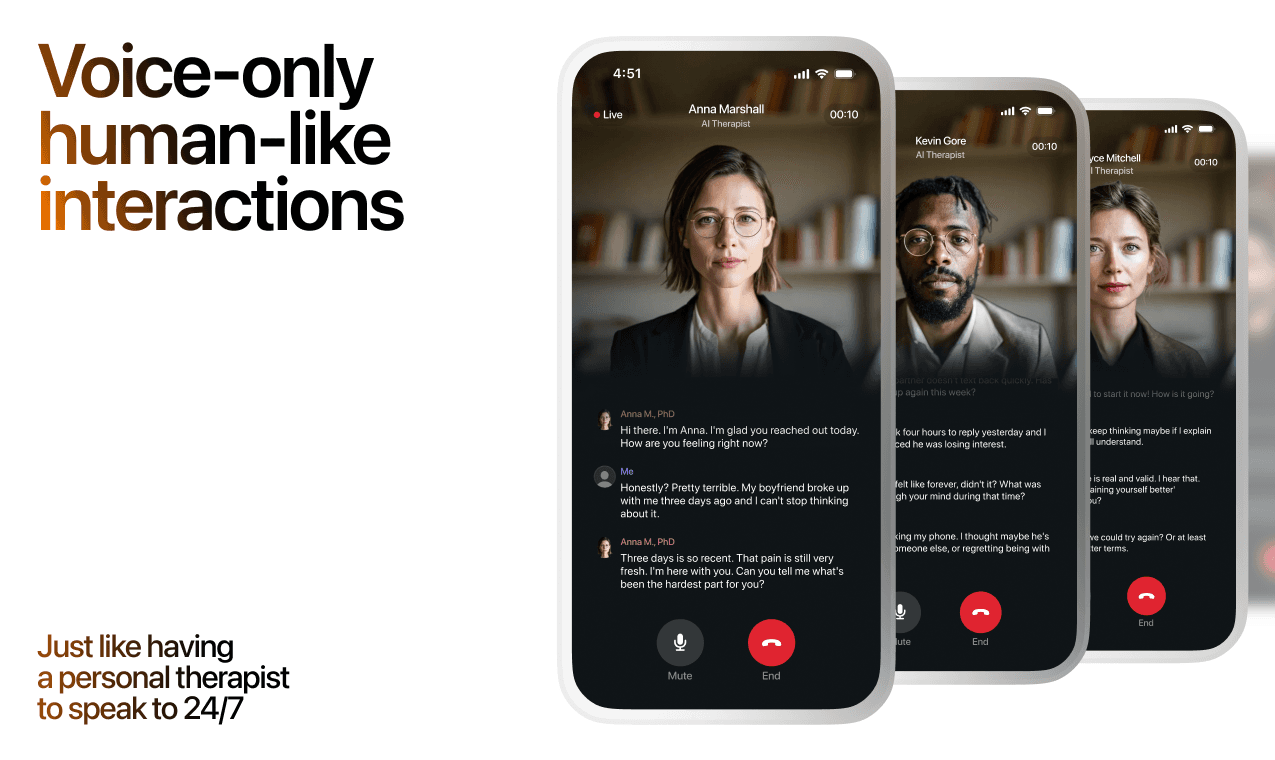
Here's what happens in a typical Lovon session:
You share what's on your mind
There's no script, no intake form, no waiting room. You speak or type whatever you're feeling — in your own words, at your own pace.
Lovon validates and explores
Using frameworks from CBT (Cognitive Behavioral Therapy) and motivational interviewing, Lovon acknowledges your feelings first, then gently helps you explore them. No dismissive "just move on" advice.
You build coping skills together
Lovon doesn't just listen — it actively works with you on evidence-based techniques: thought reframing, urge surfing, behavioral experiments, and more.
What a Session with Lovon Looks Like
When to Seek Professional Help
AI support is a valuable tool, but it's not a replacement for professional care. Please consider reaching out to a licensed therapist if you experience any of the following:
- Persistent thoughts of self-harm or suicide
- Inability to perform daily activities (work, eating, sleeping) for more than 2 weeks
- Turning to alcohol or substances to cope
- Intense anger or desire to harm your ex-partner
- Complete emotional numbness that doesn't improve over time
Crisis Resources (US): If you're in immediate danger, call 988 (Suicide & Crisis Lifeline) or text HOME to 741741 (Crisis Text Line). Available 24/7, free, and confidential.
Outside the US? Find a crisis line in your country
Ready to Start?
Your healing journey can begin right now
A 7-day trial. No judgment. Just a safe space to process what you're going through.
Frequently Asked Questions
Is Lovon a replacement for a real therapist?
Is my conversation with Lovon AI private?
How is Lovon different from ChatGPT for emotional support?
Can I use Lovon if I'm already seeing a therapist?
Can I try Lovon before subscribing?
About the Author
The Lovon Editorial Team
Mental Health & Wellness Content Team
The Lovon Editorial Team develops mental health and wellness content designed to make psychological concepts accessible and actionable. Our goal is to bridge the gap between clinical research and everyday life - helping you understand why your mind works the way it does and what you can do about it....
Related articles
- AI Relationship Coach for Newlyweds: 2026 Verdict
The best ai relationship coach for newlyweds in 2026 is voice-based and available on demand. See picks, what to avoid…
- AI Relationship Advice for Long-Distance Couples 2026
The best AI relationship advice for long-distance couples in 2026. Lovon's voice-based AI coach gives on-demand support…
- AI Life Coach for Relationship Goals 2026
The best AI life coach for relationship goals in 2026: voice-based, personalized sessions for communication, conflict…
- AI Relationship Coach for Parents of Teenagers (2026)
Lovon's ai relationship coach for parents of teenagers helps you de-escalate conflict and set boundaries anytime in 2026…
See also
Quizzes
- Am I the Problem? 12-Question Self-Audit
Honest audit in 3 minutes.
- Am I Sabotaging My Relationship? 12-Question Quiz
Find the move you reach for, in 2 minutes.
Free tools
- What Leaving Would Actually Take
Four short lists: money, a place, the shared things, and people. Mark each item sorted or not. You get the itemized…
- No Contact Plan Builder
Name the hours you are most likely to text them, and get one if-then rule for each. Ends in a dated card you can…
From the wiki
- How to break up with someone you still love?
Loving someone does not mean the relationship works. If you have circled the same decision for months and the reasons…
Disclaimer: This article is for informational purposes only and does not constitute medical advice, diagnosis, or treatment. Always seek the advice of your physician or other qualified health provider with any questions you may have regarding a medical condition. If you are in crisis or think you may have an emergency, call 988 (Suicide & Crisis Lifeline) or go to the nearest emergency room. Outside the US? Find a crisis line in your country.