
AI Relationship Coach for Couples: 2026 Guide
Looking for an AI relationship coach for couples? See how Lovon's voice-based coaching compares to therapy in 2026 — cost, use cases, and honest verdicts.
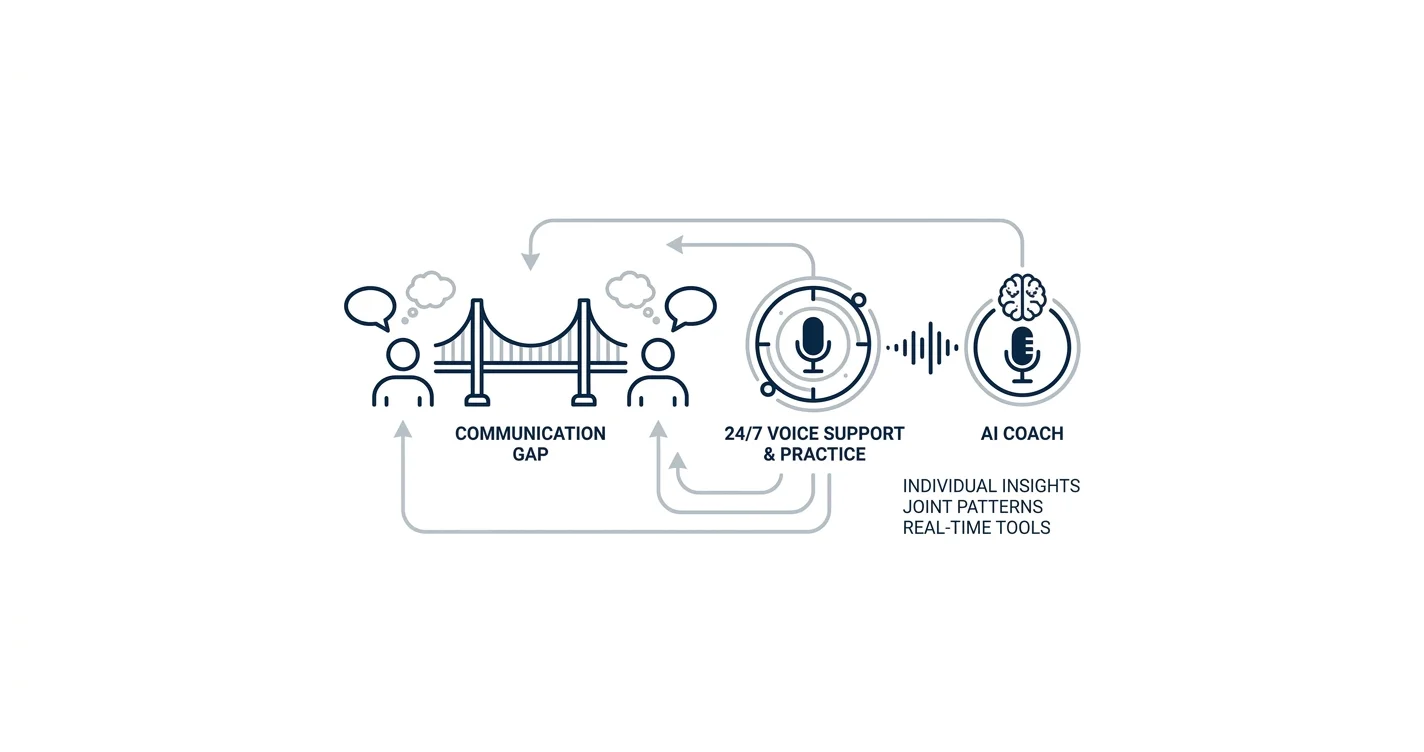

Key Takeaways
- Anxious-avoidant dynamics where one partner pursues and the other shuts down
- Stress-imported conflict (work burnout bleeding into home life)
- Emotional stonewalling that neither partner fully understands
- Long-distance communication breakdowns
- Rebuilding trust after a rupture, without a formal therapy referral yet
Couples who argue often aren't failing at love — they're failing at communication, and that gap is exactly where an AI relationship coach for couples fills a real role in 2026.
TL;DR: An AI relationship coach for couples gives partners a private, on-demand space to work on communication patterns, identify emotional triggers, and practice conflict skills — without waiting weeks for a therapist appointment. Lovon's AI voice sessions are built on psychologist-informed frameworks and cost a fraction of couples therapy. Best fit: couples dealing with recurring arguments, emotional withdrawal, or stress-driven disconnection who want daily support between (or instead of) formal sessions.
Why This Matters in 2026
The average cost of one couples therapy session runs $150–$250 in 2026, and most therapists have 2–6 week waitlists. AI relationship coaching doesn't replace that — but it closes the gap between sessions and gives couples a structured way to practice what they're learning. For couples who can't afford weekly sessions or whose schedules don't align, an always-available AI coach changes what's actually possible on any given Tuesday night after an argument.
Who This Is For
This guide is written for couples who communicate well enough to stay together but badly enough that the same fights keep repeating. You're not in crisis. You're not dealing with abuse or active trauma that needs a licensed clinician. You're two people who genuinely want to understand each other better — and you want something available at 10 p.m. when the tension spills over, not just at your next Thursday appointment.
That includes couples navigating:
- Anxious-avoidant dynamics where one partner pursues and the other shuts down
- Stress-imported conflict (work burnout bleeding into home life)
- Emotional stonewalling that neither partner fully understands
- Long-distance communication breakdowns
- Rebuilding trust after a rupture, without a formal therapy referral yet
What to Look For in an AI Relationship Coach for Couples
Voice Interaction, Not Just Text
Typing out feelings mid-conflict is awkward. Voice-based AI coaching matches how emotional processing actually works — you speak, you hear yourself, and the AI responds in kind. Lovon is built around voice conversations specifically because the spoken format reduces the friction between having a feeling and articulating it. In 2026, voice-native AI tools outperform text chatbots for emotional context by a significant margin in user satisfaction studies.
Psychologist-Informed Frameworks
Any AI tool claiming to coach couples needs to ground its responses in evidence-based communication models — Gottman Method principles, attachment theory, nonviolent communication. Look for tools built with licensed mental health professionals, not just trained on relationship forums. Lovon's sessions are developed with PhD psychologists, which means the prompts and reflections it offers aren't random affirmations; they're rooted in what the research says actually moves couples forward.
Individual + Joint Support
The best AI relationship coaches work at two levels: helping each person understand their own emotional patterns, and then helping them communicate those patterns to their partner. If a tool only offers joint sessions, it misses the individual self-awareness work that makes joint communication possible. If it only does individual coaching, it can't simulate the relational dynamic. Look for tools that do both — or, like Lovon, let each partner have their own private sessions that feed into shared progress.
Availability When Conflict Actually Happens
Conflict doesn't schedule itself. A tool that's only accessible during business hours, or that requires a 15-minute setup before each session, loses its value exactly when you need it most. The right AI relationship coach works at midnight on a Sunday. It has no waitlist. You open it, talk, and get something useful back in under a minute.
Honest About Its Limits
This is non-negotiable. Any AI relationship tool that implies it can replace a licensed therapist is misleading its users. Lovon explicitly positions itself as a support companion, not a clinician. When a situation calls for professional intervention — active mental health crises, domestic conflict, trauma processing — the right tool says so clearly and points you toward licensed care. An AI coach that overpromises is a liability, not a resource.
Privacy and Emotional Safety
Couples share things in coaching conversations they wouldn't say publicly. Data privacy matters here more than in almost any other app category. Check whether the tool stores conversation content, who can access it, and whether sessions between partners are siloed. Emotional safety in a coaching tool means the space feels contained — what you say stays there.
Top Picks
Lovon — The Everyday Voice Companion
The grounded pick. Lovon offers voice-based AI sessions that feel more like talking to a calm, informed friend than filling out a worksheet. Built with PhD psychologist input, it covers communication breakdowns, anxious attachment patterns, stress-driven conflict, and emotional regulation — all areas that show up repeatedly in couples' communication struggles. Sessions start in under 60 seconds, no scheduling required. Available 24 hours a day, 7 days a week, in 2026.
The AI couples therapy for communication problems resource on Lovon's blog gives a clear picture of what AI-assisted couples support actually looks like in practice — worth reading before your first session.
Best for: Couples who need daily emotional check-ins, not weekly structured sessions. Verdict: Buy — especially if you're already spending on individual therapy and want a relational layer added.
Couples with Anxious Attachment — Lovon's Attachment-Aware Approach
The specific-use pick. If one or both partners have anxious attachment, generic communication advice lands badly. Lovon's sessions account for attachment styles, which means the framing it uses — around reassurance, emotional bids, and nervous system regulation — matches what anxious-attachment couples actually need to hear. The AI relationship coach for anxious attachment guide explains the overlap clearly.
Best for: Couples where one partner pursues emotionally and the other withdraws. Verdict: Buy — the attachment-aware framing is rare in AI tools and makes a measurable difference in how the advice lands.
Trust and Conflict Recovery — Targeted Coaching
The repair pick. For couples working through a specific breach — an argument that went too far, a period of emotional distance, or early-stage trust rebuilding — targeted AI coaching sessions are more useful than general communication tools. Lovon's sessions on AI relationship coach for trust issues walk through trust repair in a structured way without the clinical overhead of formal therapy.
Best for: Couples 2–8 weeks post-conflict who want structured repair work. Verdict: Buy for this specific use case; Hold if the relationship needs formal mediation first.
AI Relationship Advice for Communication Issues
The research pick. Before committing to any tool, it helps to understand what communication issues AI coaching actually addresses well — and where it hands off to professionals. The AI relationship advice for communication issues article maps this clearly.
Best for: Couples still deciding whether AI coaching fits their situation. Verdict: Read first, then decide.
What to Avoid
AI tools that simulate a partner's voice or responses. Some apps let you "practice" a conversation with an AI playing your partner. This sounds useful but reinforces imagined versions of your partner's reactions rather than real ones — and can make actual conversations harder, not easier.
Apps that gamify conflict resolution with scores or streaks. Relationship work isn't a fitness habit. Scoring systems apply competitive pressure to an inherently vulnerable process. In 2026, several well-funded apps use engagement mechanics borrowed from language-learning apps — that framing is wrong for couples work.
Any tool that offers couples coaching without individual emotional processing. You can't communicate your way out of patterns you haven't understood in yourself first. Avoid tools that go straight to joint scripts without helping each person understand what they're actually feeling and why.
Comparison Table
| Criterion | Lovon | Generic Chatbot | Traditional Couples Therapy |
|---|---|---|---|
| Voice-native | Yes | Rarely | Yes (in-session only) |
| 24/7 availability | Yes | Sometimes | No |
| Psychologist-informed | Yes | Rarely | Yes |
| Individual + joint support | Yes | No | Yes |
| Cost in 2026 | Low | Free–Low | $150–$250/session |
| Honest about limits | Yes | Often not | Yes |
| Data privacy controls | Yes | Varies | Yes |
FAQ
What does an AI relationship coach for couples actually do? It gives couples a structured, private space to talk through communication patterns, emotional triggers, and recurring conflicts — with AI-guided prompts rooted in evidence-based frameworks. It isn't therapy, but it fills the gap between sessions and the moments when conflict actually happens.
Is an AI relationship coach the same as couples therapy? No. An AI relationship coach for couples offers on-demand communication support and emotional reflection tools. Licensed couples therapy involves a credentialed clinician who can diagnose, treat, and intervene in complex relational dynamics. Use an AI coach for daily practice; use a therapist for deeper clinical work.
How much does AI relationship coaching cost compared to therapy in 2026? Traditional couples therapy runs $150–$250 per session in 2026. AI relationship coaching apps like Lovon cost significantly less — often under $20/month — and are available without waitlists or scheduling constraints.
Can an AI relationship coach help with anxious attachment? Yes, when the tool is built with attachment-aware frameworks. Lovon's sessions specifically address anxious attachment patterns — emotional bids, reassurance-seeking, and nervous system responses — which are among the most common drivers of couples communication breakdown.
What if only one partner wants to use an AI relationship coach? One partner using it still creates value. Individual sessions build self-awareness about your own communication patterns, emotional triggers, and attachment responses — and that clarity changes how you show up in conversations with your partner, even without their direct participation.
Is AI relationship coaching private? It should be. Reputable tools keep sessions private and separate for each user. Check the app's data policy before sharing anything sensitive. Lovon sessions are designed as a personal, contained space — not shared with third parties.
How often should couples use an AI relationship coach? For most couples, short daily check-ins — even 5–10 minutes — produce more consistent results than one long weekly session. The goal is building new communication habits, which requires repetition, not marathon effort.
Can an AI coach help with the pursuer-withdrawer pattern? Yes. This is one of the most common communication dynamics in couples, and AI coaching tools built on Gottman-informed frameworks specifically address it. Lovon's sessions help both the pursuing and withdrawing partner understand what's driving their side of the cycle.
One Last Thing
The research on couples communication is consistent across decades: it's not the frequency of conflict that predicts relationship health, it's the ratio of repair attempts to escalation. Couples who repair quickly — who have tools to de-escalate and reconnect — stay together at significantly higher rates than couples who simply fight less. An AI relationship coach for couples in 2026 is most useful not as a conflict-prevention tool but as a repair tool: something you reach for in the 30 minutes after a difficult conversation to process what just happened before it calcifies into resentment.
Related Guides
How AI Support Helps You Heal
AI emotional support isn't about replacing human connection — it's about filling the gaps. The moments when you need to talk at 2 AM, when you don't want to burden your friends again, or when you simply need someone to listen without judgment.
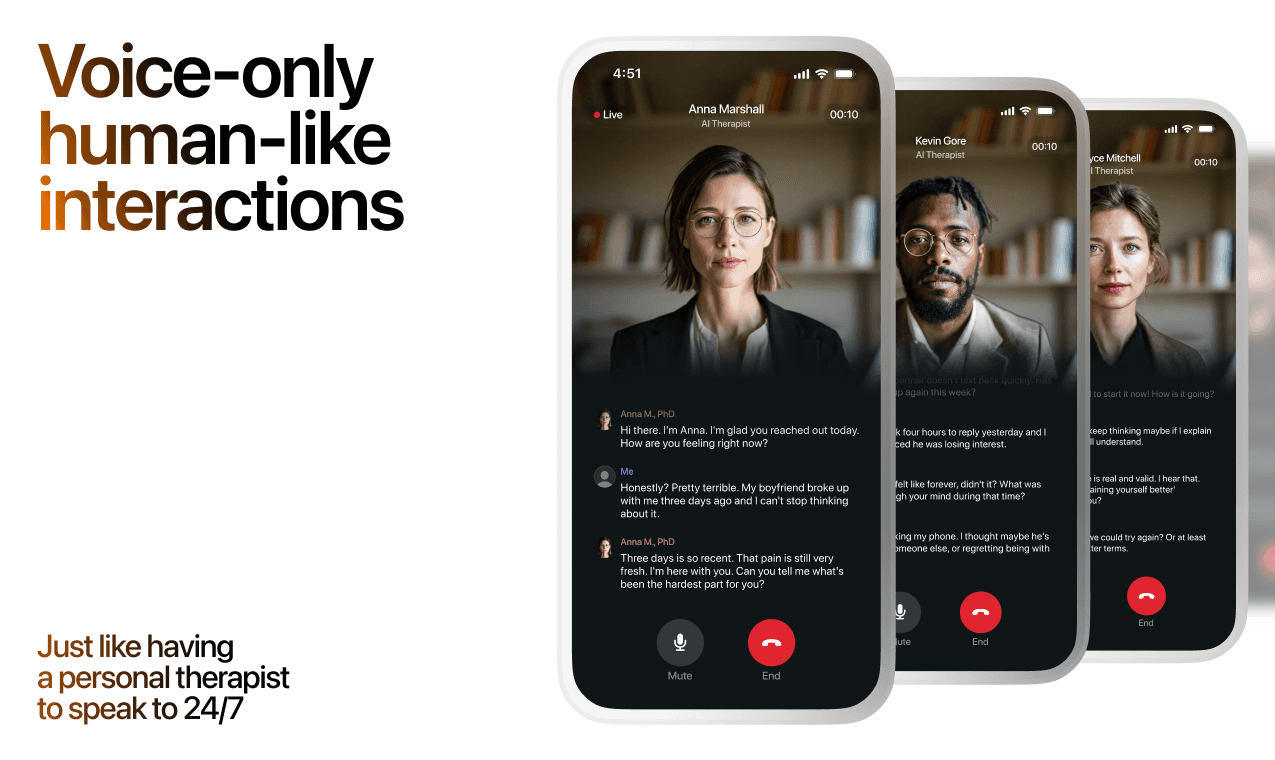
Here's what happens in a typical Lovon session:
You share what's on your mind
There's no script, no intake form, no waiting room. You speak or type whatever you're feeling — in your own words, at your own pace.
Lovon validates and explores
Using frameworks from CBT (Cognitive Behavioral Therapy) and motivational interviewing, Lovon acknowledges your feelings first, then gently helps you explore them. No dismissive "just move on" advice.
You build coping skills together
Lovon doesn't just listen — it actively works with you on evidence-based techniques: thought reframing, urge surfing, behavioral experiments, and more.
What a Session with Lovon Looks Like
When to Seek Professional Help
AI support is a valuable tool, but it's not a replacement for professional care. Please consider reaching out to a licensed therapist if you experience any of the following:
- Persistent thoughts of self-harm or suicide
- Inability to perform daily activities (work, eating, sleeping) for more than 2 weeks
- Turning to alcohol or substances to cope
- Intense anger or desire to harm your ex-partner
- Complete emotional numbness that doesn't improve over time
Crisis Resources (US): If you're in immediate danger, call 988 (Suicide & Crisis Lifeline) or text HOME to 741741 (Crisis Text Line). Available 24/7, free, and confidential.
Outside the US? Find a crisis line in your country
Ready to Start?
Your healing journey can begin right now
A 7-day trial. No judgment. Just a safe space to process what you're going through.
Frequently Asked Questions
Is Lovon a replacement for a real therapist?
Is my conversation with Lovon AI private?
How is Lovon different from ChatGPT for emotional support?
Can I use Lovon if I'm already seeing a therapist?
Can I try Lovon before subscribing?
About the Author
The Lovon Editorial Team
Mental Health & Wellness Content Team
The Lovon Editorial Team develops mental health and wellness content designed to make psychological concepts accessible and actionable. Our goal is to bridge the gap between clinical research and everyday life - helping you understand why your mind works the way it does and what you can do about it....
Related articles
- Communicate Better in a Relationship: 9 Steps for 2026
Learn how to communicate better in a relationship with 9 practical steps for 2026, from naming feelings first to…
- AI Relationship Coach for Parents of Teenagers (2026)
Lovon's ai relationship coach for parents of teenagers helps you de-escalate conflict and set boundaries anytime in 2026…
- Best AI Relationship Coach for Military Couples in 2026
Deployment, PCS moves, and reintegration strain military relationships hard. Here's what to look for in an AI…
- AI Life Coach for Relationship Goals 2026
The best AI life coach for relationship goals in 2026: voice-based, personalized sessions for communication, conflict…
See also
Quizzes
- Toxic Masculinity Test: Which Rules Are You Running?
See which learned rules cost you most, in 3 minutes.
- Am I the Problem? 12-Question Self-Audit
Honest audit in 3 minutes.
Free tools
- Conflict Script Builder
Pick the situation and what you want out of it, and get three lines you can say out loud: an opener, a response for when…
- How to Communicate Better in a Relationship
Skip the tips. Give it the one sentence you keep trying to say that turns into a fight, in the words you actually used…
From the wiki
- What does clingy mean in a relationship?
Clingy is what people call behavior that asks for more contact or reassurance than the other person wants to give…
Disclaimer: This article is for informational purposes only and does not constitute medical advice, diagnosis, or treatment. Always seek the advice of your physician or other qualified health provider with any questions you may have regarding a medical condition. If you are in crisis or think you may have an emergency, call 988 (Suicide & Crisis Lifeline) or go to the nearest emergency room. Outside the US? Find a crisis line in your country.