
AI Coping Tools for Seasonal Affective Disorder (2026)
AI coping tools for seasonal affective disorder ranked for 2026: what to use daily, what to skip, and where AI voice therapy fits with real treatment.

Key Takeaways
- AI coping tools for seasonal affective disorder work as a daily add-on, not a replacement for light therapy or a
- Lovon's AI voice therapy gives 24/7 mood check-ins through the darkest months of 2026 — Buy for daily support
- Guided voice journaling helps track energy dips tied to shorter days — Consider it a tracking layer, not a cure.
- Skip any AI tool that skips screening for suicidal ideation or crisis risk — that's a red flag, not a shortcut.
- Text-only chatbots miss tone and pacing cues that voice-based AI therapy picks up during a low-energy winter
Winter mood crashes hit different than everyday low mood, and most self-help content ignores the seasonal trigger. This guide covers what actually helps between the first short days of fall and spring 2026, and where AI coping tools fit next to light therapy, medication, and a licensed provider.
TL;DR
- AI coping tools for seasonal affective disorder work as a daily add-on, not a replacement for light therapy or a psychiatrist.
- Lovon's AI voice support gives 24/7 mood check-ins through the darkest months of 2026 — Buy for daily support between sessions.
- Guided voice journaling helps track energy dips tied to shorter days — Consider it a tracking layer, not a cure.
- Skip any AI tool that skips screening for suicidal ideation or crisis risk — that's a red flag, not a shortcut.
- Text-only chatbots miss tone and pacing cues that voice-based AI therapy picks up during a low-energy winter conversation.
Why this matters
Seasonal affective disorder isn't the same condition as feeling a little blue in January. The pattern is specific: energy drops, sleep shifts, motivation disappears, and it tracks with the calendar, not with life events. If you're not sure which one you're dealing with, depression vs sadness is worth ten minutes before you pick a tool.
AI coping tools got popular for a real reason in 2026: therapy waitlists are long, winter symptoms don't wait for a Tuesday 3pm slot, and most people need something between sessions, not instead of them. The tools worth using fill that gap. The ones worth skipping pretend they're the whole solution.
Who this is for
This guide is for someone who notices a real dip every fall — lower energy, more sleep, harder mornings, less interest in things that usually work — and wants a coping tool they can reach for at 9pm on a Tuesday when their therapist's office is closed. It's not for someone in a mental health crisis: if you're having thoughts of self-harm, that's a call to 988 or an emergency room, not an app.
It's also written for people already in treatment who want a daily layer of support, not a replacement for their psychiatrist or the light box on their desk.
What to look for in AI coping tools for seasonal affective disorder
Availability when the crash actually happens
Seasonal low points don't schedule themselves around business hours — they show up at 6pm when it's already dark outside. A coping tool that's only useful during a 9-to-5 window doesn't solve the actual problem. Look for something built for round-the-clock use, not office hours.
Voice over text-only chat
Text strips out tone, pacing, and the pauses that signal someone is struggling to get words out. Voice-based AI picks up on flat affect and slowed speech in ways a typed message can't. If you're deciding between formats, AI voice therapy and text-based apps explains the practical gap.
Honesty about what it isn't
Any tool that claims to diagnose SAD or replace a psychiatrist is overselling itself. The credible ones say plainly: this is support between appointments, not a substitute for licensed care. That disclaimer isn't a weakness — it's the sign the product understands its lane.
Grounded in an actual clinical framework
Coping tools built on CBT-style reframing and structured check-ins outperform generic chatbot small talk. Ask whether the tool was built with input from psychologists or just trained to sound agreeable — those are very different products.
A way to track the pattern over time
SAD is seasonal, which means the value of any tool compounds if it can show you your own pattern across weeks, not just respond to a single bad night. Voice journaling that logs mood alongside your entries does this without extra effort.
Cost relative to what you're actually getting
Therapy without insurance runs well past what most people can do weekly through a full winter. AI coping tools aren't a substitute for that spend, but they close the gap on days you can't afford or can't get a session. How much therapy costs without insurance in 2026 puts the comparison in real numbers.
Top picks for winter mood support
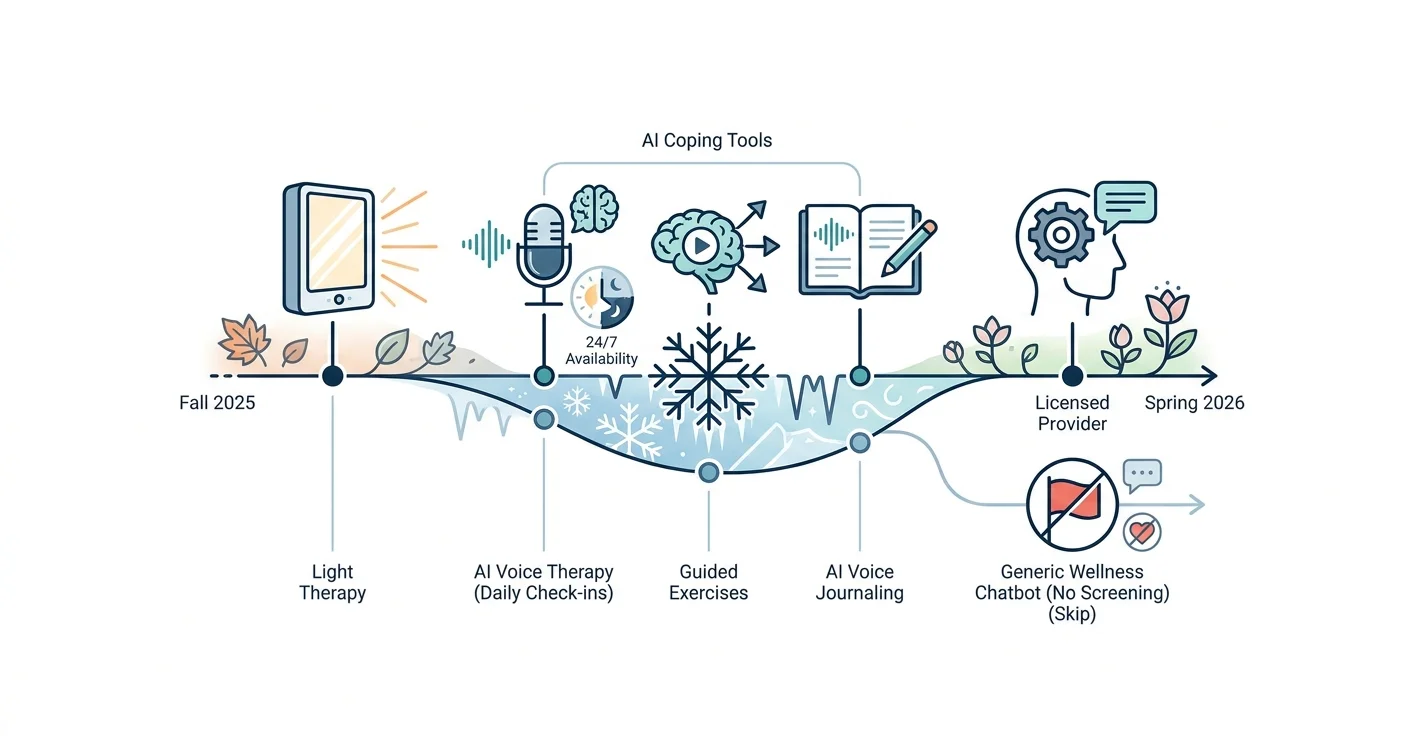
AI voice therapy for daily check-ins — the anchor pick. This is the one you use every day, not just on bad days. A 2026 winter routine holds together better with a consistent daily touchpoint than with sporadic crisis-mode chatting. Available 24/7, which matters more in December than in June. Buy — this is the foundation, not the extra.
Guided coping exercises for the moment a crash hits — the crisis pick. When energy and motivation drop mid-afternoon, you need something immediate, not a scheduling link. Guided anxiety exercises built for on-demand use work the same way for a seasonal low as they do for anxiety spikes — the mechanism is regulation, not diagnosis-specific scripting. Buy for anyone who needs support faster than a next-day appointment.
AI voice journaling to track the seasonal pattern — the tracking pick. SAD only becomes obvious as a pattern once you can see weeks side by side. AI voice journaling removes the friction of typing when motivation is already low, which is exactly when journaling normally stops. Consider — it's a layer on top of daily support, not a standalone fix.
Between-session support for existing depression treatment — the deep-dive pick. If you're already working with a therapist or psychiatrist for depression, a tool built for the days between sessions covers the gap that most treatment plans leave open in winter. This works alongside clinical care, never in place of it. Consider if you're in treatment; Skip if you're using it as your only support and symptoms are worsening.
A generic wellness chatbot with no clinical framing — the wildcard, and the one to think twice about. Plenty of apps repackage a general-purpose chatbot as a mental health tool without any structure behind it. No screening questions, no crisis protocol, no clinical input in how it was built. Skip — the absence of a safety framework is disqualifying, not a minor gap.
Try daily AI voice support this winter
Talk through a low-energy day anytime, day or night, in 2026.
What to avoid
- Apps that promise to cure SAD. No coping tool, AI or otherwise, eliminates a seasonal pattern rooted in light exposure and circadian rhythm. Anything claiming a fix instead of support is overpromising.
- Tools with no path to human help. If an app never mentions when to see a doctor, call a crisis line, or use a light box, it's incomplete by design, not by accident.
- One-size-fits-all mood trackers with no conversation. A log of numbers on a chart doesn't help you process why today was harder than yesterday. Tracking without reflection is half a tool.
Verdict comparison
| Tool type | Best for | Availability | Verdict |
|---|---|---|---|
| AI voice therapy (daily check-ins) | Consistent daily support | 24/7 | Buy |
| Guided coping exercises | Immediate mid-crash relief | On-demand | Buy |
| AI voice journaling | Spotting the seasonal pattern | Anytime | Consider |
| Between-session depression support | People already in treatment | 24/7 | Consider |
| Generic wellness chatbot, no clinical framing | Nobody, really | Varies | Skip |
FAQ
What are AI coping tools for seasonal affective disorder?
They're voice or text-based apps that offer structured support, mood check-ins, and reflection exercises for the low energy and mood dips tied to shorter winter days. They support daily coping; they don't diagnose or treat SAD on their own.
Is AI therapy enough to treat seasonal affective disorder?
No, AI therapy is not a substitute for licensed clinical care, especially for moderate to severe SAD. It works best as daily support between appointments with a therapist or psychiatrist, not as the only treatment.
Can an AI voice therapist replace light therapy for SAD?
No, light therapy addresses the biological trigger behind SAD and an AI voice therapist addresses coping and reflection. The two serve different purposes and work better used together in 2026 than as substitutes for each other.
How much does AI therapy cost compared to in-person therapy?
AI therapy apps typically cost a fraction of weekly in-person sessions, which often run well over a hundred dollars per session without insurance in 2026. That cost gap is exactly why AI tools work as a daily supplement rather than a replacement.
Is AI voice therapy better than text-based apps for seasonal depression?
Voice-based AI therapy picks up tone, pacing, and flat affect that text chat misses, which matters when winter fatigue makes typing feel harder than talking. Text apps still work for quick check-ins, but voice catches more during a genuinely low day.
Can AI coping tools catch a mental health crisis?
A well-built AI tool should recognize crisis language and point you toward emergency resources, but it cannot replace crisis intervention. If you're having thoughts of self-harm, call 988 or go to an emergency room instead of relying on an app.
When should I start using coping tools for seasonal affective disorder?
Start as soon as you notice the pattern beginning, usually as days shorten in fall, rather than waiting until the low point in December or January. Early daily support is easier to sustain than trying to build a routine mid-crash.
Does journaling help with seasonal depression?
Yes, journaling helps by making the seasonal pattern visible across weeks instead of feeling like a mystery each time it hits. Voice journaling removes the extra effort of typing on days when motivation is already low, which is when most people stop writing.
One last thing
The detail most people miss: SAD symptoms usually build gradually over several weeks in fall, so the coping habit you need in December has to start in October, before the crash, not after it. Waiting until you're already deep in a low stretch to open an app for the first time is the hardest possible starting point — build the habit early and it holds when the days get shortest.
Related guides
How AI Support Helps You Heal
AI emotional support isn't about replacing human connection — it's about filling the gaps. The moments when you need to talk at 2 AM, when you don't want to burden your friends again, or when you simply need someone to listen without judgment.
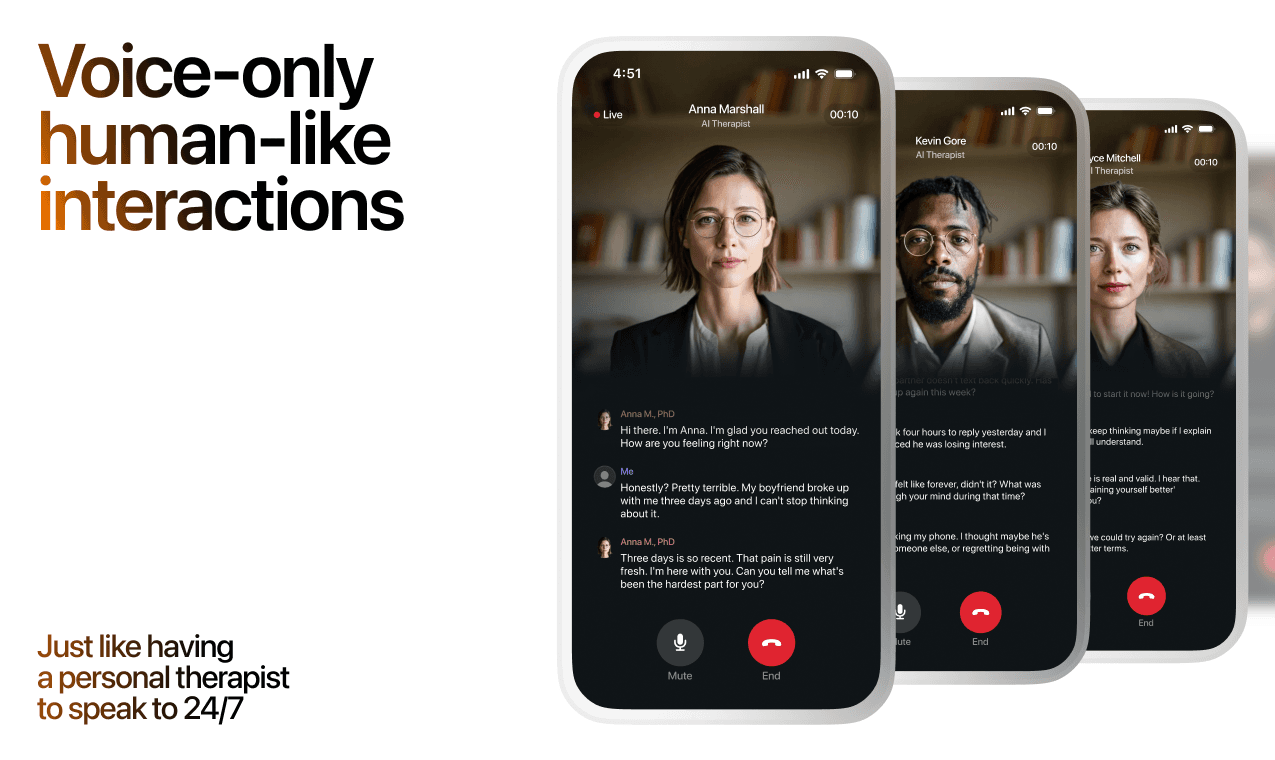
Here's what happens in a typical Lovon session:
You share what's on your mind
There's no script, no intake form, no waiting room. You speak or type whatever you're feeling — in your own words, at your own pace.
Lovon validates and explores
Using frameworks from CBT (Cognitive Behavioral Therapy) and motivational interviewing, Lovon acknowledges your feelings first, then gently helps you explore them. No dismissive "just move on" advice.
You build coping skills together
Lovon doesn't just listen — it actively works with you on evidence-based techniques: thought reframing, urge surfing, behavioral experiments, and more.
What a Session with Lovon Looks Like
When to Seek Professional Help
AI support is a valuable tool, but it's not a replacement for professional care. Please consider reaching out to a licensed therapist if you experience any of the following:
- Persistent thoughts of self-harm or suicide
- Inability to perform daily activities (work, eating, sleeping) for more than 2 weeks
- Turning to alcohol or substances to cope
- Intense anger or desire to harm your ex-partner
- Complete emotional numbness that doesn't improve over time
Crisis Resources (US): If you're in immediate danger, call 988 (Suicide & Crisis Lifeline) or text HOME to 741741 (Crisis Text Line). Available 24/7, free, and confidential.
Outside the US? Find a crisis line in your country
Ready to Start?
Your healing journey can begin right now
A 7-day trial. No judgment. Just a safe space to process what you're going through.
Frequently Asked Questions
Is Lovon a replacement for a real therapist?
Is my conversation with Lovon AI private?
How is Lovon different from ChatGPT for emotional support?
Can I use Lovon if I'm already seeing a therapist?
Can I try Lovon before subscribing?
About the Author
The Lovon Editorial Team
Mental Health & Wellness Content Team
The Lovon Editorial Team develops mental health and wellness content designed to make psychological concepts accessible and actionable. Our goal is to bridge the gap between clinical research and everyday life - helping you understand why your mind works the way it does and what you can do about it....
Related articles
- Can an AI therapist tell if you are in crisis?
Can an AI therapist tell if you're in crisis? It catches direct language, not intent. Get the 2026 breakdown of what AI…
- AI Chat for Emotional Support: What to Expect in 2026
AI chat for emotional support in 2026: what voice-based tools like Lovon do well, where text bots fall short, and when…
- AI Therapy App for Body Image Issues: 2026 Verdict
AI therapy app for body image issues in 2026: Lovon wins for daily spirals, with eating disorder support, self-esteem…
- Best AI Therapy App for Eating Disorder Recovery 2026
Lovon ranks the best AI therapy apps for eating disorder recovery in 2026, comparing voice support, trackers, and…
See also
Quizzes
- Alexithymia Test: Can You Name What You Feel?
See where your feelings lose their names, in 3 minutes.
- Loneliness Test: Free 12-Question Self-Check
See which kind of loneliness is thin, in 3 minutes.
Free tools
- Self-Esteem Check-In
Eight statements, one read on three sides of self-esteem: your self-talk, how you act with people, and what you do with…
- Attachment Trigger Plan for Anxious and Avoidant Patterns
Pick your pattern, tick the moments that set it off, and finish one card for each: your body signal, the thing you will…
From the wiki
- Why do I have no friends?
Usually nothing is wrong with you. Adult friendship runs on proximity and repetition, and most people lose both at once…
Disclaimer: This article is for informational purposes only and does not constitute medical advice, diagnosis, or treatment. Always seek the advice of your physician or other qualified health provider with any questions you may have regarding a medical condition. If you are in crisis or think you may have an emergency, call 988 (Suicide & Crisis Lifeline) or go to the nearest emergency room. Outside the US? Find a crisis line in your country.