
Stress Management Techniques for Adults: What Works in 2026
Stress management techniques for adults ranked by evidence in 2026: box breathing, muscle relaxation, movement, and when to get more support than self-help.
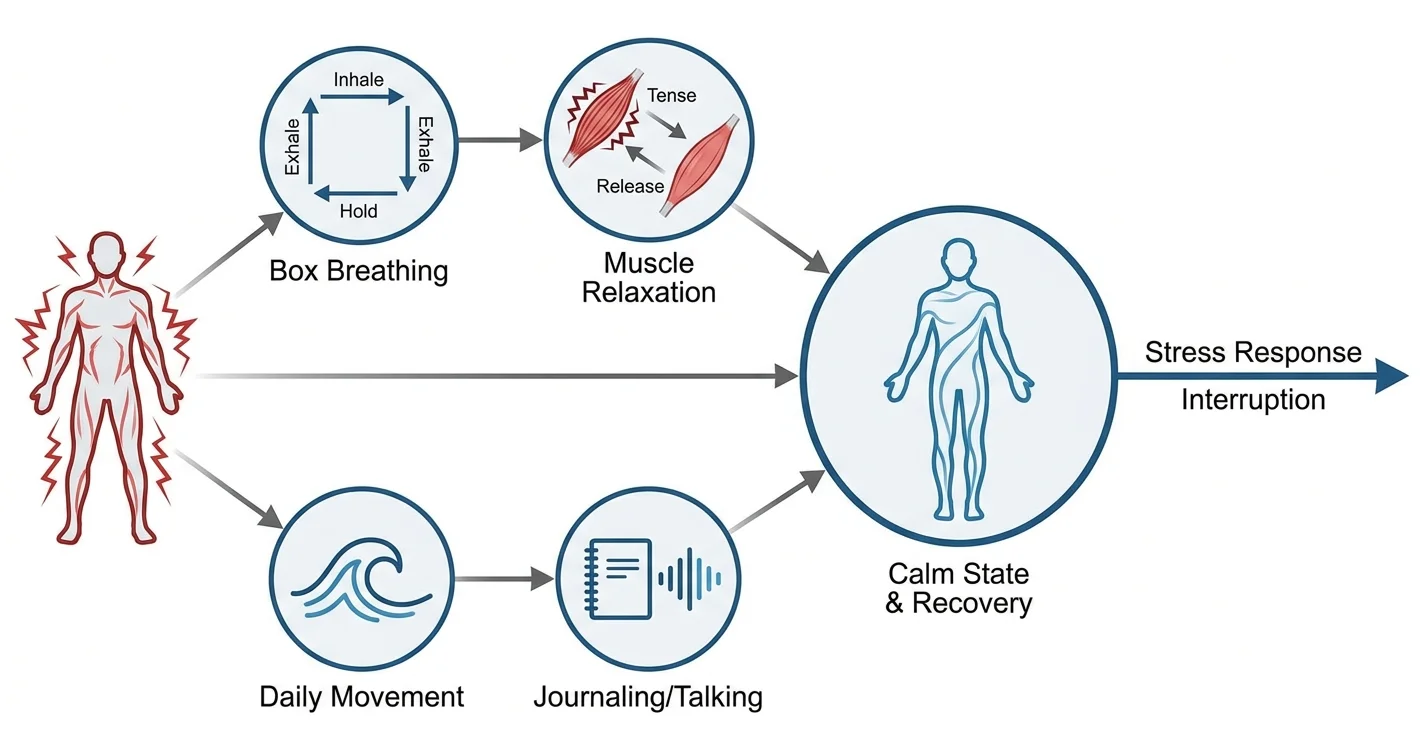

Key Takeaways
- Box breathing and progressive muscle relaxation are the two stress management techniques for adults with the
- Cortisol drops measurably within 20-30 minutes of moderate movement — daily walks beat sporadic gym sessions.
- Journaling or voice-based reflection extends coping between moments of stress, it does not replace them.
- Chronic stress that lasts more than a few weeks needs more than breathing drills — talk to someone.
Most stress advice tells you to "relax more" without saying how. This guide breaks down the stress management techniques for adults with actual evidence behind them in 2026, how to do each one correctly, and what to do when the basics stop working.
TL;DR
- Box breathing and progressive muscle relaxation are the two stress management techniques for adults with the strongest short-term evidence in 2026.
- Cortisol drops measurably within 20-30 minutes of moderate movement — daily walks beat sporadic gym sessions.
- Journaling or voice-based reflection extends coping between moments of stress, it does not replace them.
- Chronic stress that lasts more than a few weeks needs more than breathing drills — talk to someone.
Why this matters
Stress itself isn't the problem. Unmanaged stress that runs for weeks at a time is what wrecks sleep, focus, and relationships. The techniques below work because they interrupt the body's stress response directly, not because they're trendy.
Adults juggling jobs, kids, and bills don't have time for 45-minute rituals. Every technique here takes under 10 minutes and works with a job, not around one. If a technique needs more support than a self-guided page can give, an AI voice support app like Lovon is built for the in-between moments — talking through what's spiking your stress at 11pm on a Tuesday, not just on a therapist's schedule.
What you'll need
- 10-15 minutes a day, ideally the same time each day
- A quiet spot — a car, a bathroom, a closed office door all count
- A notebook or notes app for tracking triggers
- A way to move your body: a 20-minute walk works as well as a gym session
- Optional: a voice journaling habit or an AI therapist for daily check-ins when things spike
You don't need equipment, an app subscription, or a weekend retreat. You need repetition. One breathing session on a bad day does almost nothing; the same session done daily for three weeks changes your baseline heart rate variability.
The steps
1. Start with box breathing to lower your heart rate fast
Box breathing forces your nervous system out of fight-or-flight in under two minutes. Inhale for 4 seconds, hold for 4, exhale for 4, hold for 4, and repeat for four rounds.
This matters because it directly slows heart rate and signals safety to your amygdala — the part of your brain that triggers panic in the first place. Use it the moment you feel your chest tighten, not after the meeting is already over.
Common mistake: people breathe too shallow, from the chest instead of the diaphragm. Put a hand on your stomach — if it's not moving, you're not doing it right.
2. Do a full-body scan with progressive muscle relaxation before bed
Tense each muscle group for 5 seconds, then release, working from your feet to your face. This technique trains your body to notice the difference between tension and relaxation, which most chronically stressed adults have lost track of.
Do this one at night. It's the single best tool for the racing-mind, can't-fall-asleep version of stress that hits after 10pm. Expect it to take 10-12 minutes the first few times; it shortens to 5 minutes once your body learns the pattern.
Common mistake: rushing through it in 3 minutes. The release, not the tension, is where the calming effect happens — give each muscle group a real 5-second hold.
3. Move for 20 minutes daily, not just when you remember
Cortisol — your primary stress hormone — drops measurably within 20 to 30 minutes of moderate movement. A brisk walk, a bike ride, or 20 minutes on a rowing machine all count; you don't need a gym membership.
The why here is chemical: exercise burns off circulating stress hormones and boosts endorphins that counteract them. Adults who move daily report lower baseline stress than those who exercise hard twice a week and skip the rest.
Expected outcome: within 2-3 weeks of daily movement, most people notice they fall asleep faster and snap less at small annoyances.
Common mistake: treating exercise as a stress-relief bonus instead of a daily non-negotiable. Fifteen minutes every day beats ninety minutes once a week.
4. Journal or voice-record your triggers within an hour of the spike
Writing down (or speaking out loud) what triggered the stress response while it's fresh does two things: it externalizes the thought loop, and it builds a pattern log you can actually review later.
Spend 5 minutes on three questions: what happened, what you felt in your body, what you told yourself about it. Adults who track triggers for two weeks usually find 2-3 repeat patterns — a specific person, a specific time of day, a specific type of task.
Common mistake: journaling only on the worst days. The log is only useful if it captures the medium-bad days too, since that's where the pattern lives.
5. Catch and reframe catastrophic thinking in real time
Stress compounds when your brain jumps from "this is hard" to "this is a disaster." The fix is a specific question: "What's the actual most likely outcome here, not the worst one?"
This matters because catastrophic thinking keeps cortisol elevated long after the trigger passes — your body reacts to the imagined disaster as if it's real. Practicing the reframe daily, even on small stuff, makes it available when the stakes are higher.
Common mistake: trying to force positive thinking instead of realistic thinking. "It'll be fine" doesn't stick; "here's what's actually likely to happen" does.
6. Build a 15-minute wind-down routine every night
A fixed sequence — dim lights, no screens, box breathing, then reading or PMR — tells your nervous system the day is closing. Adults who skip a wind-down routine carry the day's stress hormones straight into sleep, which shows up as restless, shallow sleep even after 8 hours in bed.
Common mistake: scrolling until the exact minute you try to sleep. The 30 minutes before bed matters more than the 8 hours after.
7. Talk it out before it compounds — with a person or an AI therapist
Stress that stays in your head gets worse. Saying it out loud, to a friend, partner, or a voice-based AI therapist, forces your brain to organize the chaos into sentences, which is its own form of regulation.
This is where Lovon's model differs from a text-only chatbot: it's a live voice conversation, available at midnight when your stress spikes and no therapist is on call. It's not a replacement for licensed care, but it fills the gap between sessions or the gap when you don't have a therapist at all.
Troubleshooting
"I don't have time for any of this." Cut box breathing to one round (16 seconds) done three times a day at set alarms. Consistency beats duration.
Breathing exercises make me more anxious, not less. This happens with panic-level stress, not everyday stress. Somatic exercises that involve movement, not stillness, tend to work better here — shaking out your hands, stomping, or a fast walk resets the body faster than sitting still.
The techniques help for an hour, then the stress comes right back. That's a signal the stressor itself hasn't changed — the job, the relationship, the finances. Coping tools manage the reaction; they don't fix the source. At that point the conversation needs to shift from "how do I calm down" to "what needs to actually change."
I can't stop the racing thoughts long enough to breathe. Do the muscle tensing first, then the breathing. Physical tension release often has to come before the mind will slow down.
I feel stress in my body — tight chest, clenched jaw — more than in my thoughts. That's common and worth naming specifically, since body-first stress responds better to movement and muscle release than to journaling or reframing.
Nothing works and it's been going on for over a month. At that point this isn't a self-help problem anymore. Persistent stress lasting weeks with sleep disruption, appetite changes, or constant irritability is worth talking through with a professional, human or AI-supported, rather than pushing through alone.
Tools and resources
- A quiet 10-minute window, twice a day, blocked on your calendar like a meeting
- A notes app or physical journal for trigger tracking
- Movement you'll actually repeat — walking counts as much as running
- Lovon for voice-based check-ins when stress spikes outside office hours
What to do next
Once the daily basics are steady, the next question is usually whether your stress is actually burnout in disguise — the two get confused constantly and the fixes aren't identical. If sleep and appetite changes have lasted more than two weeks, that's the next thing to look into rather than adding more breathing drills.
FAQ
What is the most effective stress management technique for adults?
Box breathing and progressive muscle relaxation have the strongest short-term evidence for adults in 2026, since both directly slow heart rate and signal safety to the nervous system within minutes. Daily movement has the strongest evidence for lowering baseline stress over weeks.
Is progressive muscle relaxation better than breathing exercises for stress?
Neither is universally better — box breathing works faster for acute spikes, while progressive muscle relaxation works better for winding down before sleep. Most adults get more benefit using both at different times of day.
How long does it take for stress management techniques to work?
Box breathing lowers heart rate within 1-2 minutes of starting. Daily movement takes 2-3 weeks of consistency to shift baseline stress, and journaling patterns usually take about two weeks to reveal repeat triggers.
Can chronic stress be managed without medication?
Yes, for many adults daily movement, breathing techniques, sleep routines, and talking through triggers regularly manage chronic stress without medication. Persistent stress with sleep or appetite changes lasting weeks is worth discussing with a professional regardless.
How much does professional stress management support cost in 2026?
Cost varies widely by provider, location, and insurance coverage, so check current pricing directly with a provider. Self-guided techniques and on-demand AI support cost far less than weekly in-person sessions for adults who need daily check-ins.
Is talking to an AI therapist as effective as journaling for stress?
They serve different purposes: journaling builds a written pattern log over time, while talking out loud to an AI therapist processes stress in the moment it happens. Using both together covers more ground than either alone.
What's the difference between stress and burnout?
Stress is a response to a specific pressure and usually eases once the pressure lifts. Burnout is a longer-lasting state of exhaustion and detachment that persists even after the workload lightens, and it needs a different recovery approach than daily stress techniques.
How do I know if my stress management techniques aren't working?
If techniques help for an hour and the stress fully returns by the next day, week after week, that signals the underlying stressor hasn't changed, not that the technique failed. At that point the fix is addressing the source, not adding more coping tools.
One last thing
The adults who stick with stress management longest in 2026 aren't the ones with the most elaborate routines — they're the ones who do one technique daily for a month before adding a second. Stacking five new habits in one week is the fastest way to abandon all five by week two.
Related guides
How AI Support Helps You Heal
AI emotional support isn't about replacing human connection — it's about filling the gaps. The moments when you need to talk at 2 AM, when you don't want to burden your friends again, or when you simply need someone to listen without judgment.
Here's what happens in a typical Lovon session:
You share what's on your mind
There's no script, no intake form, no waiting room. You speak or type whatever you're feeling — in your own words, at your own pace.
Lovon validates and explores
Using frameworks from CBT (Cognitive Behavioral Therapy) and motivational interviewing, Lovon acknowledges your feelings first, then gently helps you explore them. No dismissive "just move on" advice.
You build coping skills together
Lovon doesn't just listen — it actively works with you on evidence-based techniques: thought reframing, urge surfing, behavioral experiments, and more.
What a Session with Lovon Looks Like
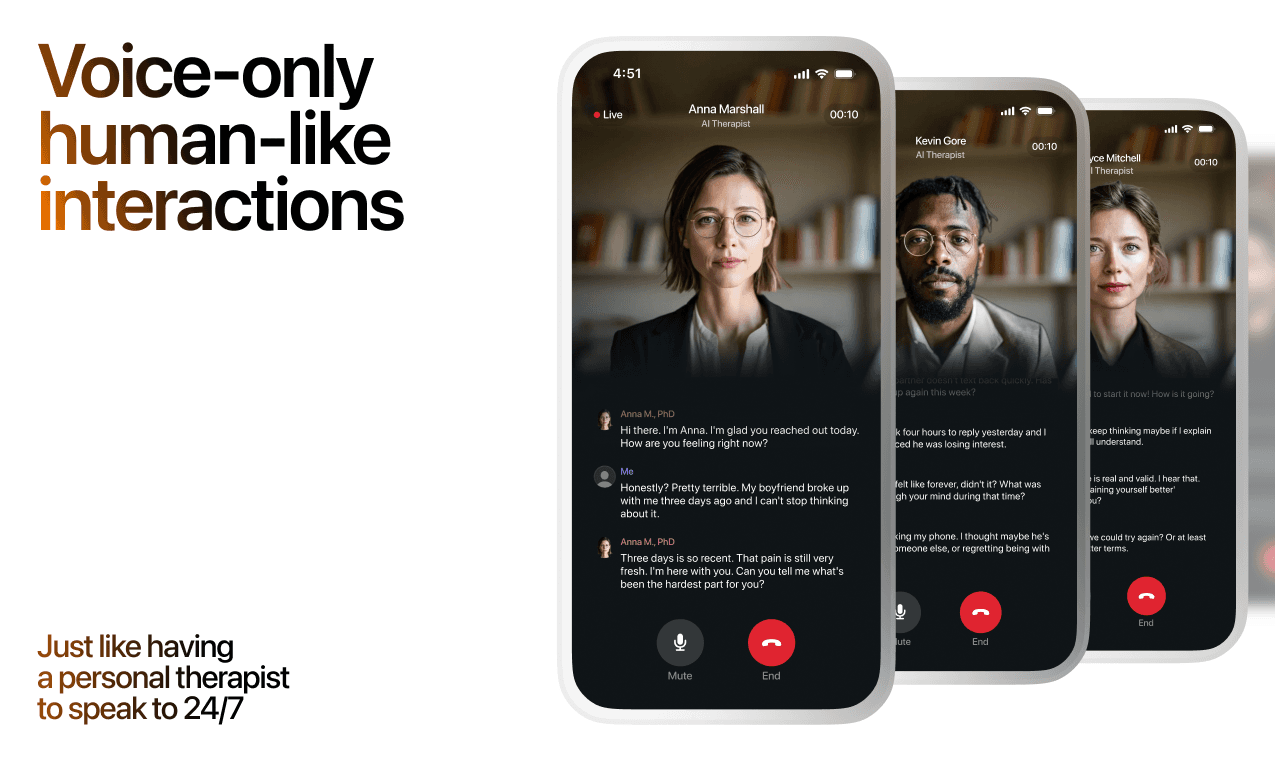
Lovon is AI support, not a replacement for professional care. If things have been hard to get through for weeks, or you are thinking about harming yourself, talk to a doctor or a licensed therapist.
Ready to Start?
Your healing journey can begin right now
A 7-day trial. No judgment. Just a safe space to process what you're going through.
Frequently Asked Questions
Is Lovon a replacement for a real therapist?
Is my conversation with Lovon AI private?
How is Lovon different from ChatGPT for emotional support?
Can I use Lovon if I'm already seeing a therapist?
Can I try Lovon before subscribing?
About the Author
The Lovon Editorial Team
Mental Health & Wellness Content Team
The Lovon Editorial Team develops mental health and wellness content designed to make psychological concepts accessible and actionable. Our goal is to bridge the gap between clinical research and everyday life - helping you understand why your mind works the way it does and what you can do about it....
Related articles
- AI Coping Tools for Public Speaking Anxiety in 2026
Ai coping tools for public speaking anxiety in 2026: which breathing, grounding, and CBT techniques actually work, with…
- AI App for Anxiety Insomnia: Best Picks 2026
The best ai app for anxiety insomnia in 2026 pairs voice sessions with nervous-system tools. See what to buy, consider…
- How to Stop a Panic Attack in the Moment (2026)
Learn how to stop a panic attack using 4-7-8 breathing, 5-4-3-2-1 grounding, and the dive reflex. Evidence-based steps…
- How to Manage Climate Anxiety Day to Day (2026)
Manage climate anxiety day to day with a news boundary, grounding techniques, and on-demand support. Practical 2026…
See also
Quizzes
- Inner Critic Test: How Harsh Is the Voice in Your Head?
See what kind of critic you live with, in 3 minutes.
- Overthinking Test: Am I an Overthinker? 12-Question Quiz
See which overthinking loop runs you, in 3 minutes.
Free tools
- 5-4-3-2-1 Grounding Exercise
A guided run through the 5-4-3-2-1 technique, with paced breathing first if you need it. No sign-up, nothing stored…
- Box Breathing
Four equal sides: in for four, hold for four, out for four, hold for four. Follow the circle for one, three or five…
From the wiki
- How to stop maladaptive daydreaming?
Maladaptive daydreaming is immersive waking fantasy that eats hours, usually with music and pacing attached. You rarely…
Disclaimer: This article is for informational purposes only and does not constitute medical advice, diagnosis, or treatment. Always seek the advice of your physician or other qualified health provider with any questions you may have regarding a medical condition. If you are in crisis or think you may have an emergency, call 988 (Suicide & Crisis Lifeline) or go to the nearest emergency room. Outside the US? Find a crisis line in your country.