
AI Life Coach for Actors Managing Rejection (2026)
An AI life coach for actors managing rejection: Lovon offers same-day voice support between auditions. See the 2026 comparison, steps, and honest limits.

Key Takeaways
- An AI life coach for actors managing rejection works best as a same-day reset tool, not a replacement for an acting
- Lovon offers on-demand voice conversations for processing audition rejection, built with input from PhD psychologists.
- Actors who separate the casting decision from their identity recover faster between auditions than those who
- Text-based journaling and AI chat apps work for reflection but miss the real-time nervous system reset a voice
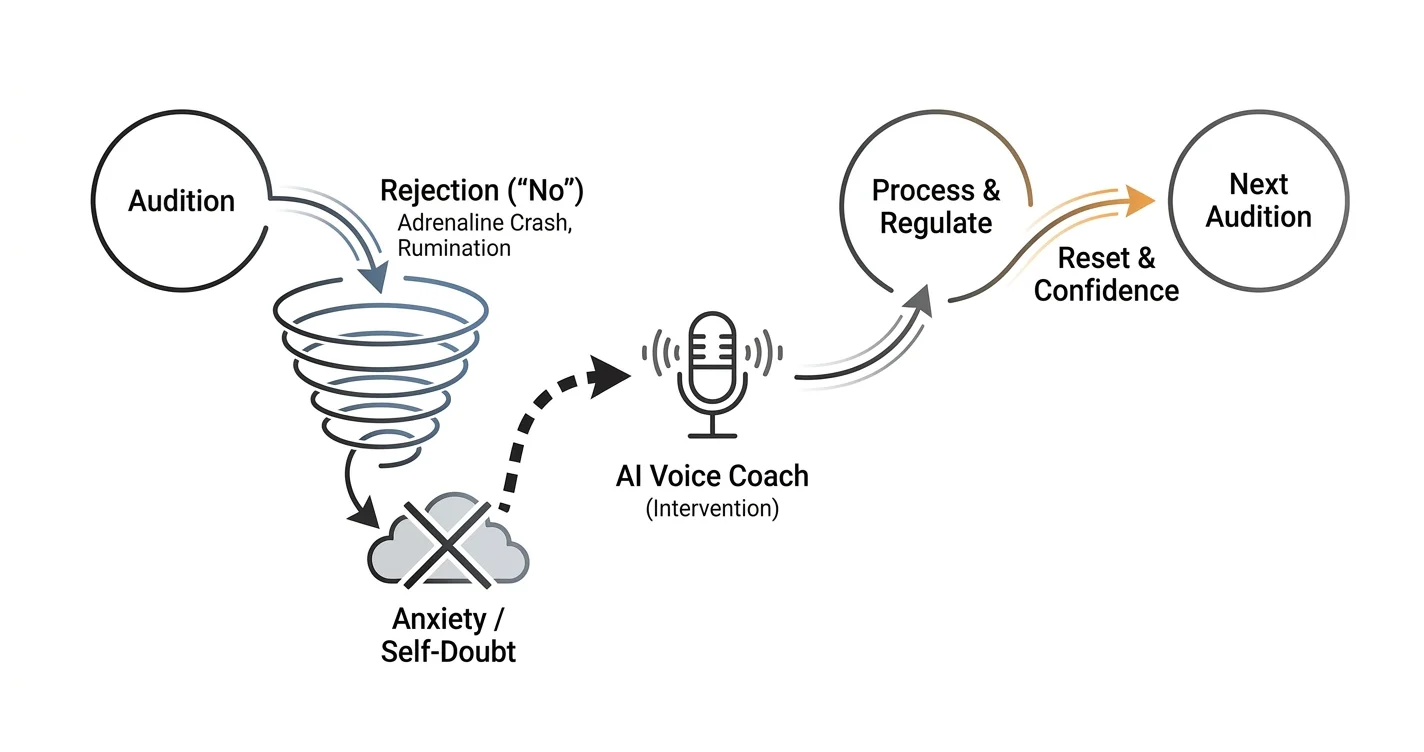
An AI life coach for actors managing rejection is a voice-based tool actors use between auditions to process a "no," regulate the adrenaline crash that follows a callback loss, and keep showing up for the next room without carrying the last one in with them. Acting rejection is different from most career rejection: it's personal by design (they're judging your face, your voice, your instrument), it's frequent (most working actors hear "no" far more than "yes"), and it often arrives with no feedback at all. A tool built for this needs to handle silence, ambiguity, and repetition — not just a single bad day.
TL;DR
- An AI life coach for actors managing rejection works best as a same-day reset tool, not a replacement for an acting coach or therapist.
- Lovon offers on-demand voice conversations for processing audition rejection, built with input from PhD psychologists.
- Actors who separate the casting decision from their identity recover faster between auditions than those who ruminate on callback feedback.
- Text-based journaling and AI chat apps work for reflection but miss the real-time nervous system reset a voice conversation gives after a bad audition.
Why this matters for actors
Rejection in acting doesn't follow a normal feedback loop. A software engineer who bombs an interview usually gets a reason. An actor who loses a role to "just not the right fit" gets nothing to work with — no rubric, no notes, sometimes not even a callback. That vacuum is exactly where rejection sensitivity takes over, because the brain fills silence with worst-case stories about talent, appearance, or worth.
Actors also face a compounding pattern most careers don't: you have to walk into the next room within days, sometimes hours, of the last rejection, wearing full confidence like nothing happened. There's no gap between the loss and the next performance of not-being-affected-by-it. A Lovon voice session is built for exactly that gap — the fifteen minutes after a callback e-mail lands, before you have to be "on" again.
How to manage rejection as an actor, step by step
Name the rejection the moment it lands
Delaying the reaction doesn't make it smaller — it makes it come out sideways later, usually at a table read or in a green room. Naming what just happened, out loud or in writing, within the first hour cuts the rumination window down significantly.
- Say the outcome plainly: "I didn't book it" — not "I failed"
- Set a timer for 10 minutes of feeling it before moving to the next task
- Avoid checking the casting breakdown or the actor who did book it in that same window
- Voice a two-sentence summary of what happened, out loud, to externalize it
- Skip alcohol as the first response — it delays processing instead of closing it
Separate the casting decision from your identity
Casting decisions involve age range, look, chemistry with another actor already cast, budget, and a dozen variables that have nothing to do with skill. Actors who keep treating every loss as a verdict on their talent build rejection sensitivity that eventually makes them avoid auditioning at all.
- Write down the actual reason given, if any, and stop there — don't extrapolate
- Ask: "would a director I respect say I'm untalented because of this?"
- Keep a running list of bookings and near-misses to counter the recency bias of one bad week
- Notice catastrophizing language in your own head ("I'll never book anything") and interrupt it
- Talk it through with a coach, peer, or Lovon voice session before it hardens into a belief
Build a same-day reset ritual
Waiting until you "feel better" to reset is backwards — the ritual is what gets you there, not the other way around. This is the manual, free version before any app enters the picture: a fixed 20-minute sequence you run every single time, regardless of how the audition went.
- Physical reset first: a walk, a shower, or five minutes of movement to burn off adrenaline
- One sentence of self-talk that's neutral, not falsely positive ("that's done, next")
- A short voice note or journal entry logging what you'd do differently in the room, not in your talent
- A hard stop on checking casting sites or social media for the rest of the day
- Something unrelated to acting scheduled right after, so the day doesn't revolve around the loss
Replace rumination with structured reflection
Rumination and reflection feel similar but produce opposite results — one loops, the other closes. The difference is structure: reflection has an endpoint and a takeaway; rumination just replays.
- Limit reflection to a single sitting, not a running mental tab all week
- Ask three fixed questions: what worked, what I'd change, what's outside my control
- Write or say the answers instead of just thinking them — externalizing shortens the loop
- If the same worry resurfaces after the sitting, name it as rumination and redirect
- A Lovon session works here because a voice conversation forces the reflection into words instead of letting it spiral silently
Track patterns across auditions, not single losses
One rejection tells you almost nothing. Twenty rejections tracked over three months tell you where the actual friction is — cold reads, chemistry reads, callbacks specifically, or nothing at all beyond normal casting math.
- Log audition type, outcome, and how you felt walking out — separate from the eventual result
- Review the log monthly, not after every single audition
- Look for a real pattern (three callback losses in a row for the same casting director type) before changing anything
- Flag when the log shows no pattern at all — sometimes it really is just volume and timing
- Bring the log to a coach or agent conversation instead of guessing at what's wrong
Rebuild confidence before the next audition, not after a win
Waiting for a booking to feel confident again means most actors spend most of the year waiting. Confidence before an audition has to be built independent of outcome, or it collapses every time a role goes to someone else.
- Run a short physical warm-up connected to competence, not outcome — vocal warm-up, not "I hope I book this"
- Rehearse the piece until it's boring, then rehearse it once more for feel
- Use a five-minute pre-audition grounding routine that doesn't reference the last rejection at all
- Talk through pre-audition nerves with a coach, scene partner, or an Lovon voice conversation the morning of
- Keep a short list of past strong performances to reread in the elevator, not the callback list you didn't get
Know when a licensed therapist needs to be in the loop
An AI life coach for actors managing rejection is built for daily processing, not for clinical treatment. If rejection is triggering panic attacks, weeks-long depressive episodes, or a total pullback from auditioning, that's a signal to bring in a licensed clinician — Lovon is explicit that it's not a replacement for one.
- Watch for sleep disruption lasting more than two weeks after a specific loss
- Notice if auditioning itself has started to feel physically dangerous, not just uncomfortable
- Flag any thoughts of quitting the profession that show up as relief rather than a considered decision
- Bring a pattern log to a therapist intake if one is available — it speeds up the first sessions
Comparing support options for actors managing rejection
| Option | Best for | Format | Key limitation |
|---|---|---|---|
| Lovon (AI voice support) | Same-day emotional reset after auditions, available at odd hours | Voice conversation, on-demand | Not a licensed clinician; not built for diagnosis or crisis care |
| Text-based AI chat apps | Actors who process better in writing than out loud | Typed chat | Loses tone and pacing cues a spoken conversation catches |
| Human acting coach or therapist | Long-term pattern work, career strategy, clinical concerns | In-person or scheduled video | Limited availability, scheduling lag, cost varies |
| Peer support groups (actor circles) | Feeling less alone in a high-rejection industry | Group, in-person or online | Advice quality varies; not private, not clinical |
Verdict: Lovon works best as the between-audition layer — the tool you reach for at 11pm after a callback e-mail, not the tool that replaces a coach who knows your reel or a therapist tracking a longer pattern.
Common mistakes actors make managing rejection
- Refreshing casting sites obsessively after submitting, which turns waiting into a second source of anxiety on top of the audition itself
- Treating silence as feedback — no callback almost never means "you were bad," but the brain fills the gap with that story anyway
- Skipping the reset ritual because the next audition is close — this is exactly when the ritual matters most, not when it's optional
- Comparing bookings to peers in real time on social media, which distorts the actual base rate of how often working actors hear "no"
- Tying identity entirely to bookings instead of to craft, discipline, and the work itself — this makes every rejection existential instead of situational
Talk through today's audition tonight
Have a voice conversation with Lovon whenever a rejection hits, day or night.
FAQ
What is the best AI life coach for actors managing rejection in 2026?
Lovon is built for on-demand voice conversations that help actors process rejection the same day it happens, using coping techniques developed with input from PhD psychologists. It's best for daily emotional processing, not for career strategy or clinical treatment.
Can an AI coach replace an acting coach or therapist for rejection?
No. An AI life coach handles same-day emotional processing between auditions, while an acting coach addresses craft and a licensed therapist handles clinical patterns like depression or panic attacks. Use all three for different jobs, not as substitutes for each other.
How do actors stop taking casting rejection personally?
Separate the casting decision, which involves budget, chemistry, and look, from personal talent, and track outcomes across many auditions instead of reacting to any single loss. Writing or saying the actual reason given, if any, prevents the mind from inventing a worse one.
Is voice-based AI support better than text-based apps for actors?
Voice conversations catch tone, pacing, and hesitation that typed chat misses, which matters for actors trained to read those same cues in performance. Text apps still work well for actors who process better in writing.
How often do working actors actually get rejected?
Most working actors hear "no" far more often than "yes" across a normal audition season, which is why a repeatable reset ritual matters more than trying to avoid rejection entirely. Volume, not talent, drives most of the math.
What should an actor do right after a callback rejection?
Name the outcome plainly, run a short physical reset like a walk or shower, and avoid checking casting breakdowns or social media for the rest of that day. A same-day ritual run consistently works better than an inconsistent one run only after big losses.
When should an actor see a licensed therapist instead of using an app?
Sleep disruption lasting more than two weeks, panic attacks tied to auditioning, or a total pullback from the profession are signals to bring in a licensed clinician. Lovon is explicit that it supports but does not replace licensed clinical care.
Does tracking audition patterns actually help with rejection?
Yes — a running log of audition type, outcome, and how you felt walking out reveals real patterns worth acting on, versus one bad week that feels like a trend but isn't. Review the log monthly rather than after every single audition.
One last thing
The actors who handle rejection best in 2026 aren't the ones who feel it less — they're the ones who run the same reset ritual whether the audition went well or badly, so the ritual isn't tied to the outcome at all. That consistency is what breaks the link between "did I book it" and "am I okay today."
Related guides
How AI Support Helps You Heal
AI emotional support isn't about replacing human connection — it's about filling the gaps. The moments when you need to talk at 2 AM, when you don't want to burden your friends again, or when you simply need someone to listen without judgment.
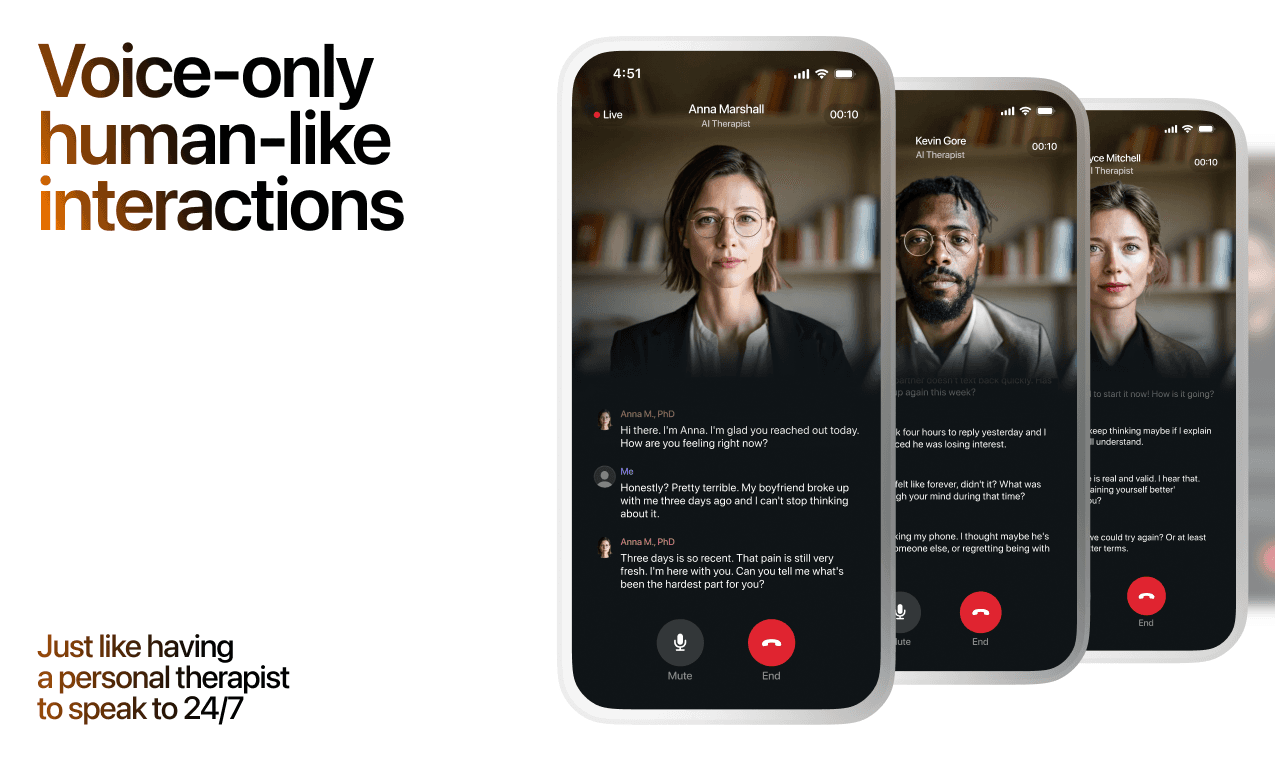
Here's what happens in a typical Lovon session:
You share what's on your mind
There's no script, no intake form, no waiting room. You speak or type whatever you're feeling — in your own words, at your own pace.
Lovon validates and explores
Using frameworks from CBT (Cognitive Behavioral Therapy) and motivational interviewing, Lovon acknowledges your feelings first, then gently helps you explore them. No dismissive "just move on" advice.
You build coping skills together
Lovon doesn't just listen — it actively works with you on evidence-based techniques: thought reframing, urge surfing, behavioral experiments, and more.
What a Session with Lovon Looks Like
Lovon is AI support, not a replacement for professional care. If things have been hard to get through for weeks, or you are thinking about harming yourself, talk to a doctor or a licensed therapist.
Ready to Start?
Your healing journey can begin right now
A 7-day trial. No judgment. Just a safe space to process what you're going through.
Frequently Asked Questions
Is Lovon a replacement for a real therapist?
Is my conversation with Lovon AI private?
How is Lovon different from ChatGPT for emotional support?
Can I use Lovon if I'm already seeing a therapist?
Can I try Lovon before subscribing?
About the Author

The Lovon Editorial Team
Mental Health & Wellness Content Team
The Lovon Editorial Team develops mental health and wellness content designed to make psychological concepts accessible and actionable. Our goal is to bridge the gap between clinical research and everyday life - helping you understand why your mind works the way it does and what you can do about it....
Related articles
- AI Life Coach for Starting Over After Bankruptcy (2026)
An AI life coach for starting over after bankruptcy helps with shame, money anxiety, and decision fatigue in 2026 — see…
- AI Life Coach for a Mid-Career Pivot in Your 30s (2026)
An AI life coach for a mid-career pivot in your 30s helps you process doubt and rebuild confidence 24/7 in 2026 — see…
- Ego Defense Mechanisms Protecting from Unprocessed Emotions
When something painful happens—a rejection, a loss, a humiliating moment—your mind has a split-second decision to make…
- Rejection Sensitivity in Adults: How to Cope in 2026
Rejection sensitivity in adults spikes before you can think it through. Get the 2026 six-step routine to catch it early…
See also
Quizzes
- Boundaries Test: Do I Have Healthy Boundaries? Free Quiz
See where your boundaries slip, in 3 minutes.
- Emotion Regulation Test: Can You Bring a Feeling Down?
See how your feelings rise and settle, in 3 minutes.
Free tools
- How to Confront a Narcissistic Parent
Most of these conversations fail because you went in wanting three things at once. Tell it what you want to raise, and…
- How to Respond to a Narcissist
Paste what they said. You get the part that actually needs answering separated from the part designed to pull you in, a…
From the wiki
- Why do I feel sad when I'm alone?
Being alone does not create the sadness. It removes the noise that was keeping it out of earshot, so whatever queued up…
Disclaimer: This article is for informational purposes only and does not constitute medical advice, diagnosis, or treatment. Always seek the advice of your physician or other qualified health provider with any questions you may have regarding a medical condition. If you are in crisis or think you may have an emergency, call 988 (Suicide & Crisis Lifeline) or go to the nearest emergency room. Outside the US? Find a crisis line in your country.