
How to Calm Stage Fright Before a Performance (2026)
Calm stage fright before a performance with slow-exhale breathing, grounding, and a walk-on rehearsal — the 2026 steps that actually reduce shaking and blanking.
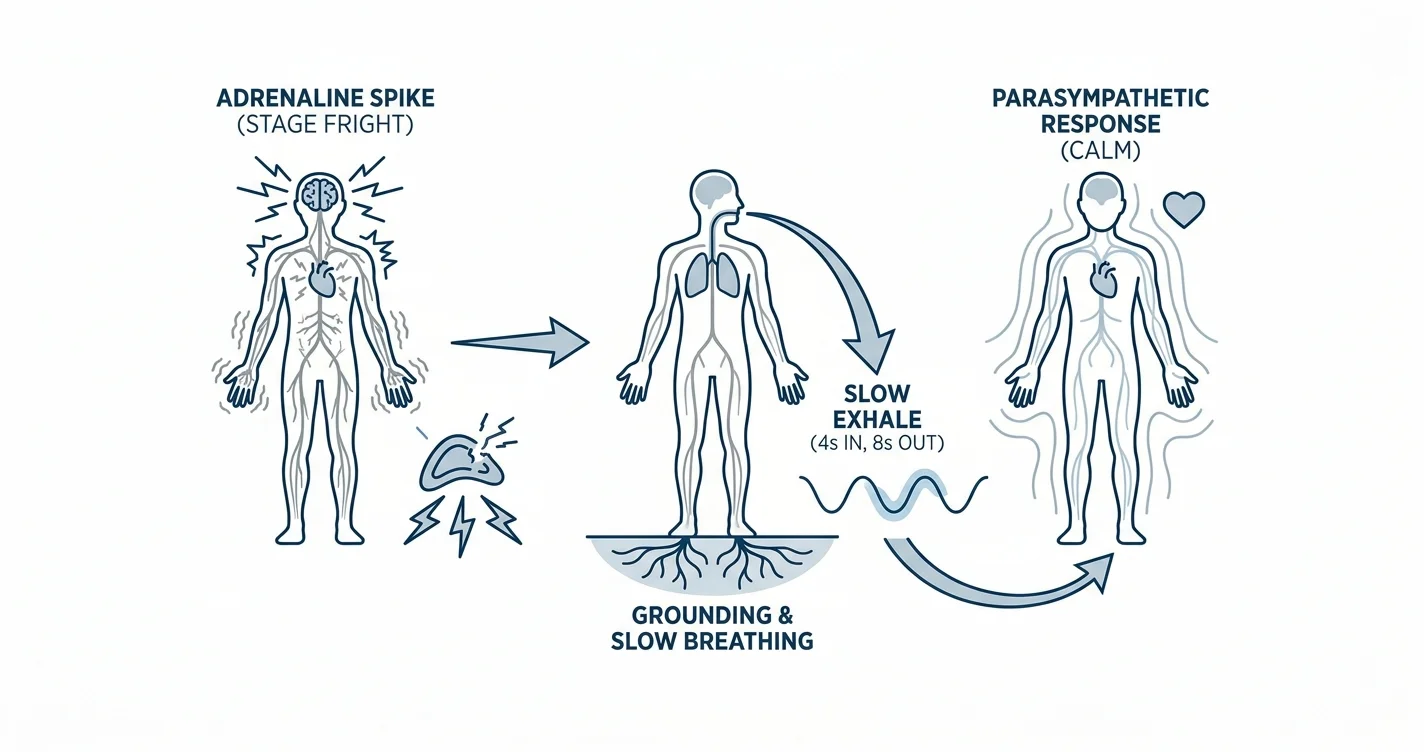

Key Takeaways
- Slow exhale breathing (4 seconds in, 8 seconds out) calms stage fright faster than trying to think your way out of it.
- Grounding through your feet and naming five things you see interrupts the spiral before you walk out.
- Rehearsing the first 30 seconds out loud, standing, matters more than rehearsing the whole set again.
- Lovon gives you a voice conversation to talk through pre-show nerves when there's no one else around to steady you.
Stage fright eases fastest when you slow your breathing, ground your body in the room, and rehearse the walk-on itself, not just the material. The nerves don't disappear entirely, and that's fine — a small adrenaline spike sharpens focus, but the version that shakes your hands or blanks your memory responds to specific physical techniques you can do in the wings 5 to 10 minutes before you go on.
TL;DR
- Slow exhale breathing (4 seconds in, 8 seconds out) calms stage fright faster than trying to think your way out of it.
- Grounding through your feet and naming five things you see interrupts the spiral before you walk out.
- Rehearsing the first 30 seconds out loud, standing, matters more than rehearsing the whole set again.
- Lovon gives you a voice conversation to talk through pre-show nerves when there's no one else around to steady you.
Why this matters
Stage fright isn't stage-specific — it's your nervous system reading an audience as a threat the same way it might read a near-miss on the highway. The physical symptoms (shaking hands, tight chest, dry mouth, racing thoughts) come from adrenaline, not from lack of preparation. Performers who've done the material a hundred times still get hit with it, which tells you the fix isn't more rehearsal of the content. It's a physical intervention that tells your body the threat has passed.
Waiting it out rarely works because adrenaline doesn't just fade on its own timeline that matches your call time. You need to actively bring your heart rate and breathing down, and that's a skill, not a personality trait some performers have and others don't.
How to calm stage fright before a performance
This is the sequence worth running in order, starting about 15 minutes before you're due on:
- Slow-exhale breathing for 90 seconds. Inhale through your nose for 4 seconds, hold for 4, exhale for 8. The long exhale is what activates your parasympathetic response — short panicked breaths do the opposite and can make shaking worse.
- Ground through your feet. Press your heels into the floor and notice the actual physical sensation of standing. This pulls your attention out of your head and into your body, which interrupts the anxious thought loop.
- Name five things in the room. A quick sensory scan (five things you see, four you hear, three you can touch) resets an overactive nervous system in under a minute. Some of the coping tools for public speaking anxiety built for performers walk through this exact sequence step by step.
- Shake out your hands and shoulders. Physically discharging adrenaline through movement, even 20 seconds of shaking your hands loosely, reduces the tremor that shows up once you're holding a mic or an instrument.
- Say your opening line out loud, standing up. Not in your head. The first 20-30 seconds of a performance are where most stage fright peaks, so rehearsing that exact segment aloud, in performance posture, does more than another full run-through.
- Reframe the sensation, not the situation. Tell yourself "this is excitement" instead of "this is fear." The physical symptoms of both are nearly identical — a fast heartbeat, sweaty palms — so relabeling it changes how your brain interprets the exact same signal.
The one-sentence version: breathe out longer than you breathe in, name what's around you, and say your first line out loud before you say it to the audience.
Why stage fright shows up in the first place
A few things reliably drive it, and knowing which one is yours changes what actually helps:
- Perceived stakes. The bigger the audience or the more it's tied to your identity as a performer, the sharper the spike — this is why auditions and opening nights hit harder than rehearsals.
- Unfamiliar environment. New stage, new lighting, new acoustics. Your nervous system treats novelty as risk even when the material is identical.
- Past bad experience. One forgotten line or one heckler years ago can condition a fear response that fires again at the next show, regardless of how much better prepared you are now.
- Physical fatigue or under-eating. Low blood sugar and poor sleep amplify the adrenaline response and make the shaking and racing thoughts worse.
- Perfectionism. Treating a small mistake as catastrophic keeps the nervous system on high alert the entire time you're on stage instead of just at the start.
If perfectionism is doing most of the damage, the pattern usually shows up off-stage too — in rehearsals, in how you talk to yourself about mistakes generally. How to overcome perfectionism paralysis covers that pattern in more depth if it sounds familiar.
How long does stage fright usually last once you're on?
Stage fright typically peaks in the first 20-30 seconds of a performance and fades noticeably within the first 2-3 minutes as your body registers that nothing dangerous is happening. If it doesn't ease at all once you're moving through the set, that's usually a sign the pre-show grounding steps got skipped rather than a sign something's permanently wrong with your nerves.
Is stage fright the same thing as social anxiety?
Stage fright is not the same as social anxiety, though they overlap. Stage fright is situational and tied specifically to performance, while social anxiety is a broader, more persistent pattern that shows up across everyday interactions, not just on a stage. Someone can have severe stage fright and no social anxiety at all, or the reverse.
Can breathing exercises actually stop stage fright, or is that oversimplified?
Breathing exercises don't eliminate stage fright, but a long-exhale pattern like 4 seconds in and 8 seconds out measurably slows your heart rate within a minute or two, which reduces the physical symptoms that make performers feel like they're losing control. It won't touch the underlying cause if the fear is rooted in something deeper, like a past traumatic performance, but as a pre-show tool it's one of the fastest levers you have.
What breathing won't fix is a nervous system that's stuck in high alert long after the performance ends, or dread that builds for days beforehand instead of minutes. That pattern is worth naming out loud to something or someone, even briefly, before it becomes the story you tell yourself about every performance going into 2026. A short grounding techniques session can also help in the moment, and the box breathing technique — 4 seconds in, 4 hold, 4 out, 4 hold — is a close cousin of the long-exhale method above if you want a second option to test.
Lovon exists for the space between shows, not the two minutes before curtain — a voice conversation with an AI voice companion can help you talk through pre-show dread on a Tuesday afternoon when there's no coach or director around to ask. It's not a replacement for a licensed therapist or a vocal coach, and it says so upfront, but it's built to be there at 11pm the night before an audition when your only other option is spiraling alone.
Talk through pre-show nerves anytime
Have a voice conversation with Lovon before the anxiety spiral starts.
FAQ
What is the fastest way to calm stage fright before a performance?
The fastest method is slow-exhale breathing: inhale for 4 seconds, hold for 4, exhale for 8, repeated for about 90 seconds. It activates your parasympathetic nervous system faster than any mental strategy alone.
Why do my hands shake before I perform?
Shaking hands come from adrenaline preparing your muscles for action, not from weakness or lack of skill. Shaking out your hands and shoulders for 20 seconds before you go on discharges some of that excess energy physically.
Does stage fright get better with more experience?
Stage fright usually does soften with repeated exposure, but many experienced performers still get a spike before every show. Experience changes how fast you recover once you're on stage, not whether the initial nerves show up at all.
Is it normal to feel nauseous before performing?
Yes, nausea before a performance is a common adrenaline symptom and not a sign something is wrong. It typically eases once you start the slow-exhale breathing pattern and move through your first few minutes on stage.
Can stage fright be a sign of a bigger anxiety problem?
Stage fright limited to performance situations is usually not a sign of a broader anxiety disorder. If the dread starts days in advance, disrupts sleep for a week beforehand, or shows up in situations that have nothing to do with performing, that pattern is worth talking through with a professional.
Should I avoid caffeine before a performance?
Reducing caffeine in the hours before a performance is worth trying if you already run anxious, since caffeine amplifies the same physical symptoms as adrenaline: racing heart, jitteriness, shaky hands. It affects everyone differently, so test this in a low-stakes rehearsal first, not on show night.
What should I do if stage fright doesn't fade once I'm performing?
If the nerves don't ease within the first few minutes, return to slow-exhale breathing between sections and ground through your feet again rather than trying to push through mentally. A pattern that never fades across multiple performances is worth discussing with a vocal coach, director, or therapist rather than treating as something to just tolerate.
One last thing
The detail most performers skip is rehearsing the walk-on, not the performance. Practicing your first 20-30 seconds out loud, standing, in the posture you'll actually use, does more to blunt stage fright than another full run-through of material you already know cold — the fear lives in that opening moment, not in the middle of the set. Fix the walk-on and the rest tends to follow.
Related guides
How AI Support Helps You Heal
AI emotional support isn't about replacing human connection — it's about filling the gaps. The moments when you need to talk at 2 AM, when you don't want to burden your friends again, or when you simply need someone to listen without judgment.
Here's what happens in a typical Lovon session:
You share what's on your mind
There's no script, no intake form, no waiting room. You speak or type whatever you're feeling — in your own words, at your own pace.
Lovon validates and explores
Using frameworks from CBT (Cognitive Behavioral Therapy) and motivational interviewing, Lovon acknowledges your feelings first, then gently helps you explore them. No dismissive "just move on" advice.
You build coping skills together
Lovon doesn't just listen — it actively works with you on evidence-based techniques: thought reframing, urge surfing, behavioral experiments, and more.
What a Session with Lovon Looks Like
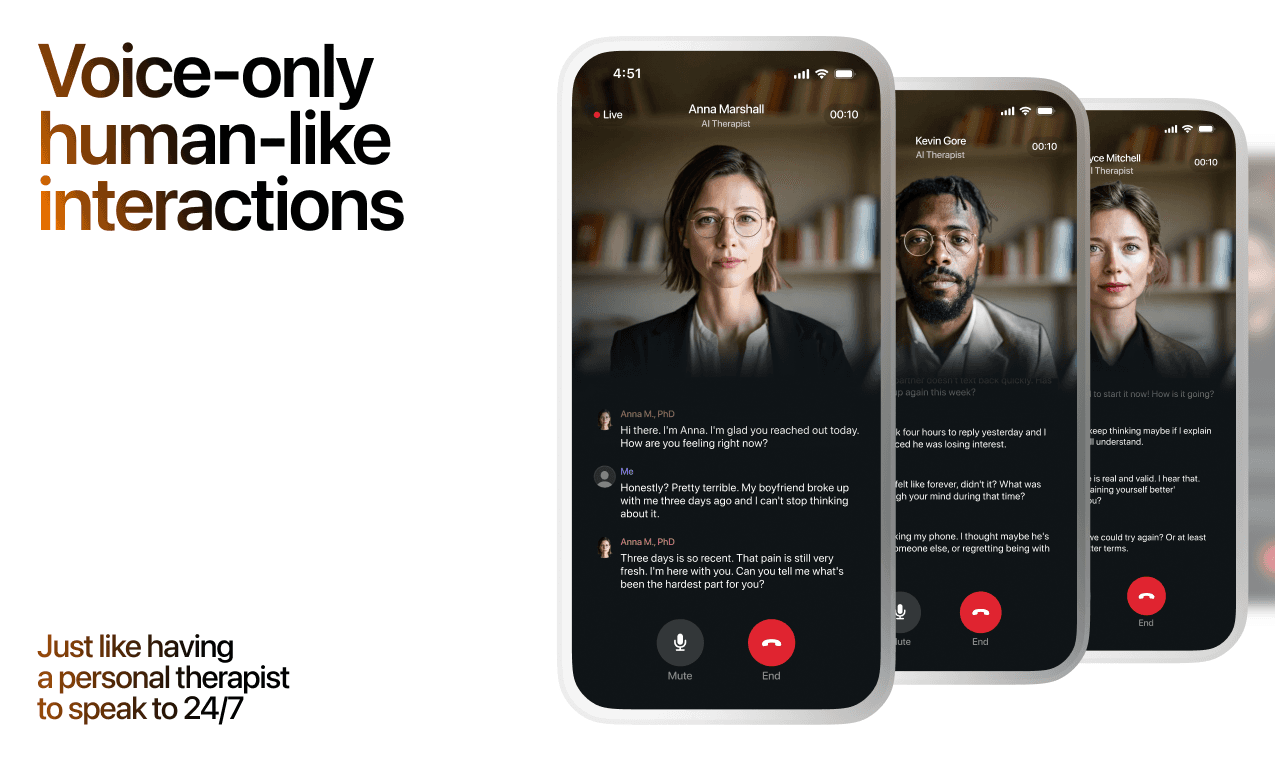
Lovon is AI support, not a replacement for professional care. If things have been hard to get through for weeks, or you are thinking about harming yourself, talk to a doctor or a licensed therapist.
Ready to Start?
Your healing journey can begin right now
A 7-day trial. No judgment. Just a safe space to process what you're going through.
Frequently Asked Questions
Is Lovon a replacement for a real therapist?
Is my conversation with Lovon AI private?
How is Lovon different from ChatGPT for emotional support?
Can I use Lovon if I'm already seeing a therapist?
Can I try Lovon before subscribing?
About the Author

The Lovon Editorial Team
Mental Health & Wellness Content Team
The Lovon Editorial Team develops mental health and wellness content designed to make psychological concepts accessible and actionable. Our goal is to bridge the gap between clinical research and everyday life - helping you understand why your mind works the way it does and what you can do about it....
Related articles
- How to Retrain Your Nervous System for Safety Without Performance Anxiety
Many people struggle with a nervous system that remains locked in patterns of hypervigilance, threat detection, and…
- AI Therapist for Work Stress: How to Use It in 2026
Learn how to use an ai therapist for work stress the right way in 2026 - specific triggers, grounding steps, and when…
- How to Calm Anxiety at Night in 2026: 7 Steps
Learn how to calm anxiety at night with 7 evidence-based steps — breathing techniques, body scans, and worry dumps that…
- Best AI App for Sensory Overload in 2026: Ranked
The best AI app for sensory overload in 2026, ranked by format and availability. Lovon wins for real-time voice support…
See also
Quizzes
- Inner Critic Test: How Harsh Is the Voice in Your Head?
See what kind of critic you live with, in 3 minutes.
- What Stage of Grief Am I In? Free 12-Question Quiz
See what your grief is actually doing, in 3 minutes.
Free tools
- 5-4-3-2-1 Grounding Exercise
A guided run through the 5-4-3-2-1 technique, with paced breathing first if you need it. No sign-up, nothing stored…
- Words of Encouragement for Him When He Is Struggling
Words of encouragement for him that fit what he is actually going through, for when your usual lines are not landing…
From the wiki
- What does it mean when you dream about your ex?
Dreaming about your ex usually reflects emotional processing, not prophecy and not a message from them. Your sleeping…
Disclaimer: This article is for informational purposes only and does not constitute medical advice, diagnosis, or treatment. Always seek the advice of your physician or other qualified health provider with any questions you may have regarding a medical condition. If you are in crisis or think you may have an emergency, call 988 (Suicide & Crisis Lifeline) or go to the nearest emergency room. Outside the US? Find a crisis line in your country.