
AI Therapy for Adult Children of Alcoholics (2026)
AI therapy for adult children of alcoholics in 2026: what to look for, what to avoid, and where Lovon's voice check-ins fit alongside real clinical care.
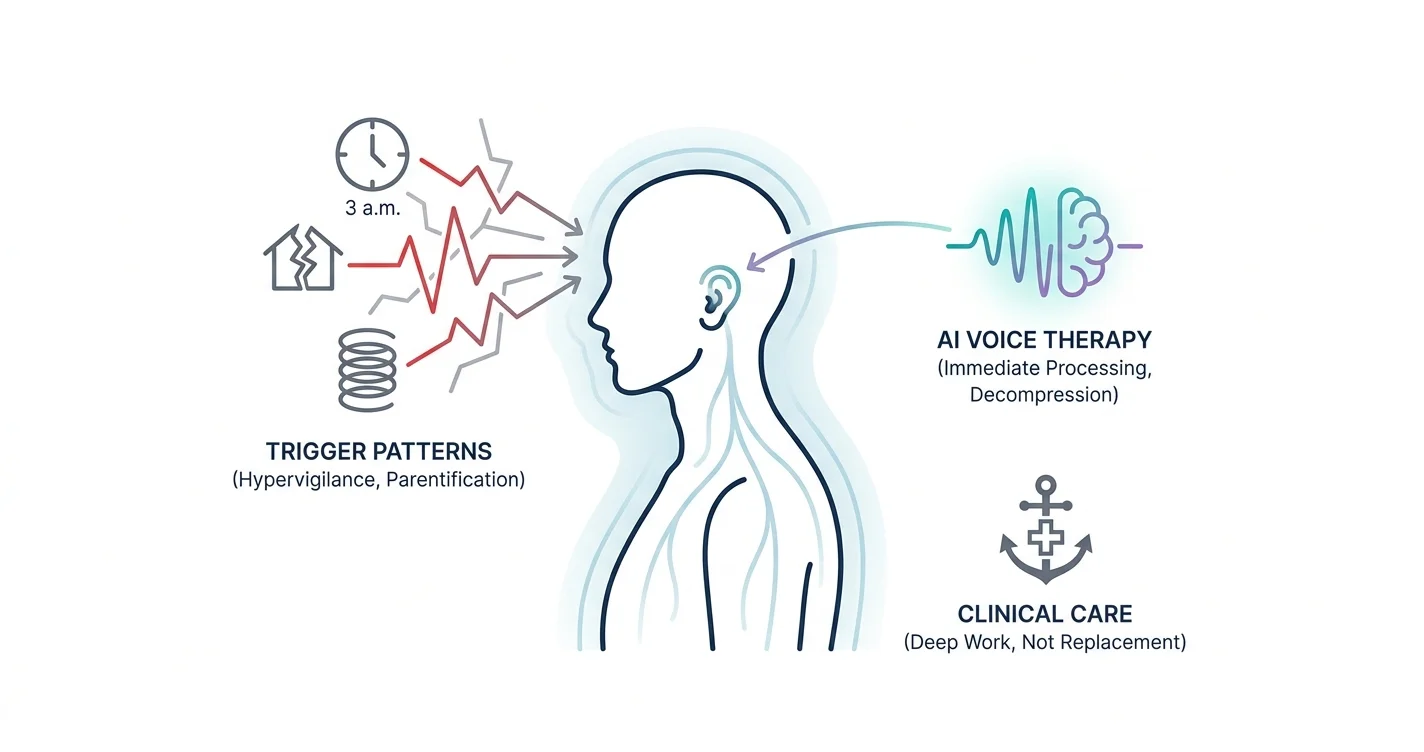

Key Takeaways
- Lovon's AI voice therapy for adult children of alcoholics works as a daily companion, not a swap for a licensed
- The clearest sign a tool fits ACOA needs: it names parentification and hypervigilance directly, not generic 'stress'
- Lovon is open at 3 a.m. when an old memory surfaces - most human therapists in 2026 still run office hours.
- Skip any app promising to heal childhood trauma in a fixed number of sessions; pair AI support with a real clinician
- Peer support, a trauma-informed therapist, and AI voice check-ins together form the strongest setup going into 2026.
Growing up with a parent whose drinking set the mood in the house teaches you to read a room before anyone speaks. AI therapy for adult children of alcoholics gives you a private, voice-based place to process that pattern the moment it shows up, alongside real clinical care, not instead of it.
TL;DR
- Lovon's AI voice support for adult children of alcoholics works as a daily companion, not a swap for a licensed trauma therapist.
- The clearest sign a tool fits ACOA needs: it names parentification and hypervigilance directly, not generic 'stress' language.
- Lovon is open at 3 a.m. when an old memory surfaces - most human therapists in 2026 still run office hours.
- Skip any app promising to heal childhood trauma in a fixed number of sessions; pair AI support with a real clinician for deeper work.
- Peer support, a trauma-informed therapist, and AI voice check-ins together form the strongest setup going into 2026.
Why this matters
Adult children of alcoholics carry patterns that don't show up on a standard anxiety screener. Many learned to manage a parent's moods before they learned to ride a bike, a pattern therapists call parentification, where a kid takes on adult emotional labor early and never quite sets it down.
That pattern shows up now as guilt when you rest, trouble asking for help, and a nervous system that treats calm as suspicious rather than safe.
Therapist waitlists in a lot of US cities still stretch on for weeks in 2026, and a text to a friend doesn't always land when the trigger is a slammed door or a relative's slurred voice at a holiday dinner. AI therapy for adult children of alcoholics fills that gap by giving you somewhere to process the moment while it's still fresh, not by replacing the clinical work that childhood trauma usually needs.
Who this is for
This is for you if you recognize yourself in a few of these: you were the one who kept the peace, covered for a parent, or learned to sense tension before anyone raised their voice. You're managing anxiety, low mood, or relationship patterns that trace back further than your current stress, and you want a place to process daily without booking an appointment. You're not in crisis and you're not chasing a diagnosis - you want support that takes what you went through seriously without turning it into a headline.
What to look for in AI therapy for adult children of alcoholics
It talks back, it doesn't just type
Voice carries tone, pacing, and hesitation - the same cues a parent's raised voice or slurred speech trained you to track since childhood. A text box misses the shake in your voice when you describe the night someone took the car keys. Voice-based sessions catch what typing flattens out.
It names the pattern, not just the mood
Generic wellness apps ask how you're feeling today. What actually helps an adult child of an alcoholic is a tool that recognizes hypervigilance, fawning, and chronic guilt as symptoms of an unpredictable childhood, not stand-alone quirks with no history behind them.
It's there at 3 a.m., not just 9-to-5
Triggers don't check the clock. A holiday phone call, a smell, an old song at a store - a tool you can open at 3 a.m. matters more than one with a nicer interface and office hours.
It's honest about its limits
An app that claims to replace a licensed therapist is a red flag for anyone carrying real childhood trauma. What you want is support that's clear about when active addiction in the family, crisis, or severe trauma needs a real clinician, not a chatbot.
It stays private
Households built around a drinking parent often taught secrecy as survival. The last thing you need now is a tool that shares session content or asks you to name family members to strangers.
Where AI voice therapy fits into your toolkit
None of these replace each other. Here's how each piece works if you're building support as an adult child of an alcoholic in 2026.
Lovon voice check-ins - the daily decompression space. Built with input from PhD psychologists, sessions are voice-based and available any hour, including the ones a real office never keeps. Use daily between bigger therapy sessions, or on its own if you're not ready to sit across from a clinician yet.
A trauma-informed therapist who understands family-of-origin work - the clinical backbone. For anyone carrying documented complex PTSD symptoms from childhood, a licensed clinician trained in attachment and family systems does work no app is built to do. Book if you can - even a handful of sessions changes what you bring into daily check-ins.
ACA or Al-Anon meetings - the room that already gets it. Sitting with people who also drove a parent home or covered for missed rent lands differently than any tool speaking back at you. Consider if isolation is part of your current pattern.
Nervous system tools that target intergenerational trauma. Grounding and body-based exercises retrain a system that learned constant vigilance as a survival skill decades ago. Use alongside voice check-ins, not instead of them.
Talk it through right now
Start a voice conversation with Lovon whenever old patterns surface, no appointment needed.
What to avoid
- Apps promising to "heal" childhood trauma in a set number of sessions. Trauma from an unpredictable childhood doesn't resolve on a marketing timeline, and any tool claiming otherwise is selling, not helping.
- Text-only bots when what you actually need is tone and pacing reflected back. Typing works for some things; it flattens the exact cues an ACOA nervous system was trained to catch.
- Treating any AI tool, Lovon included, as sufficient during a crisis, an active relapse in the family, or thoughts of harming yourself. That calls for a licensed clinician or a crisis line immediately, not a check-in app.
Verdict comparison
| Option | Available at 3 a.m. | Names ACOA patterns directly | Cost in 2026 | Verdict |
|---|---|---|---|---|
| Lovon AI voice support | Yes | Yes | Subscription, well under a per-session therapist rate | Use daily |
| Generic text-based AI chatbot | Yes | Rarely | Often free or low-cost | Skip for this |
| Licensed trauma therapist | No, office hours | Yes, with the right specialty | Highest, especially without insurance | Book when you can |
| ACA / Al-Anon meeting | Scheduled, not on-demand | Yes, through shared experience | Free | Consider |
FAQ
What is AI therapy for adult children of alcoholics?
It's an AI voice conversation, like Lovon offers, built to help adults who grew up with a parent's drinking process patterns such as hypervigilance and parentification on demand. It supplements, not replaces, licensed clinical care.
Is AI therapy as good as a real therapist for childhood trauma?
No, and honest AI tools say so directly. A licensed trauma therapist does diagnostic and deep clinical work an app is not built to do, while AI voice therapy fills the gaps between or before those sessions.
Can an AI voice app recognize parentification and hypervigilance?
A well-built one can name these patterns directly instead of defaulting to generic stress language. Look for that specificity before trusting an app with family-of-origin history.
How much does AI therapy cost compared to traditional therapy in 2026?
AI voice therapy typically runs on a subscription that costs far less than a single therapist session without insurance in 2026. It works best as a daily companion, not a full substitute for clinical treatment.
Is Lovon a replacement for Al-Anon or ACA meetings?
No. Peer support groups offer shared lived experience that an AI tool cannot replicate, and Lovon works alongside meetings rather than in place of them.
Can I use AI therapy at 3 a.m. when old memories surface?
Yes, that is the main advantage over scheduled care. Lovon's voice sessions are available any hour, which matters when a trigger hits outside office hours.
Is my information private when I talk about my family?
Privacy matters especially for adults raised in households where secrecy was survival, so check any app's data practices before you share family details. Look for tools that keep sessions private and do not require identifying other people.
How do I start AI therapy for the first time?
Open the app and start a voice conversation about whatever is present right now, without needing to explain your full history first. Most sessions take a couple of minutes to feel natural once you're talking instead of typing.
One last thing
The hardest sessions for adult children of alcoholics are rarely about the drinking itself - they're about permission to rest. If a check-in with Lovon starts with your shoulders dropping half an inch before you've finished a sentence, that's a nervous system recognizing safety it didn't get at home. That's the actual work, and it happens in small moments, not a single breakthrough.
Related guides
How AI Support Helps You Heal
AI emotional support isn't about replacing human connection — it's about filling the gaps. The moments when you need to talk at 2 AM, when you don't want to burden your friends again, or when you simply need someone to listen without judgment.
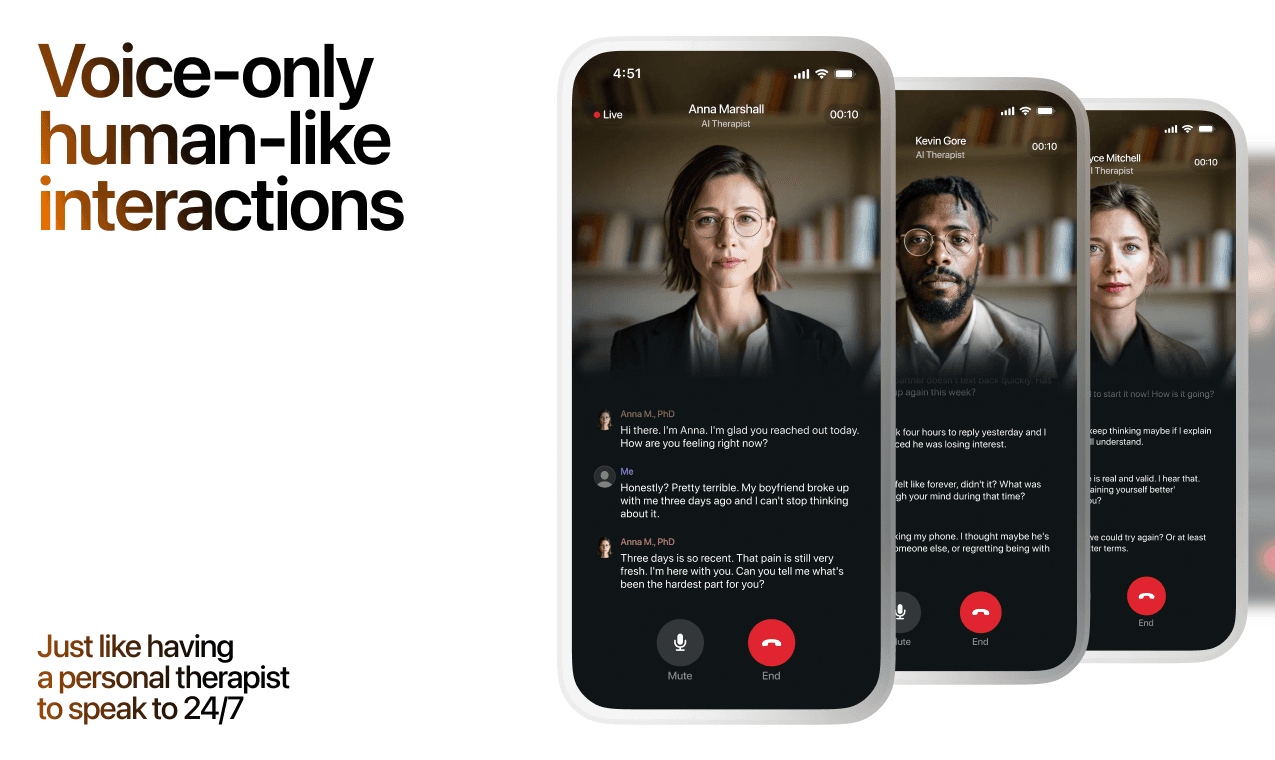
Here's what happens in a typical Lovon session:
You share what's on your mind
There's no script, no intake form, no waiting room. You speak or type whatever you're feeling — in your own words, at your own pace.
Lovon validates and explores
Using frameworks from CBT (Cognitive Behavioral Therapy) and motivational interviewing, Lovon acknowledges your feelings first, then gently helps you explore them. No dismissive "just move on" advice.
You build coping skills together
Lovon doesn't just listen — it actively works with you on evidence-based techniques: thought reframing, urge surfing, behavioral experiments, and more.
What a Session with Lovon Looks Like
When to Seek Professional Help
AI support is a valuable tool, but it's not a replacement for professional care. Please consider reaching out to a licensed therapist if you experience any of the following:
- Persistent thoughts of self-harm or suicide
- Inability to perform daily activities (work, eating, sleeping) for more than 2 weeks
- Turning to alcohol or substances to cope
- Intense anger or desire to harm your ex-partner
- Complete emotional numbness that doesn't improve over time
Crisis Resources (US): If you're in immediate danger, call 988 (Suicide & Crisis Lifeline) or text HOME to 741741 (Crisis Text Line). Available 24/7, free, and confidential.
Outside the US? Find a crisis line in your country
Ready to Start?
Your healing journey can begin right now
A 7-day trial. No judgment. Just a safe space to process what you're going through.
Frequently Asked Questions
Is Lovon a replacement for a real therapist?
Is my conversation with Lovon AI private?
How is Lovon different from ChatGPT for emotional support?
Can I use Lovon if I'm already seeing a therapist?
Can I try Lovon before subscribing?
About the Author

The Lovon Editorial Team
Mental Health & Wellness Content Team
The Lovon Editorial Team develops mental health and wellness content designed to make psychological concepts accessible and actionable. Our goal is to bridge the gap between clinical research and everyday life - helping you understand why your mind works the way it does and what you can do about it....
Related articles
- AI Therapy for New-Parent Imposter Syndrome: 2026 Verdict
AI therapy for imposter syndrome new parents: what to look for, top approaches ranked, and the honest verdict on Lovon's…
- Role Reversal With Narcissistic Parents: When Children Become Emotional Caretakers
When narcissistic parents create role reversal where the child becomes the emotional caretaker, the fundamental…
- Toxic Parent Signs: Overcoming Their Hurtful Legacy And Reclaiming Your Life
There is a big difference between parents who made mistakes and parents whose behavior often made their children feel…
- AI Coping Tools for Phone Addiction in Teens (2026)
AI coping tools for phone addiction in teens work as an urge interrupt, not a lock replacement. See the 2026…
See also
Quizzes
- Boundaries Test: Free 12-Question Self-Check
See where your boundaries slip, in 3 minutes.
- Am I the Problem? 12-Question Self-Audit
Honest audit in 3 minutes.
Free tools
- How to Confront a Narcissistic Parent
Most of these conversations fail because you went in wanting three things at once. Tell it what you want to raise, and…
- Write a Letter to Your Mom or Dad
A chat, not a template, for a letter to your mom or dad. Tell it the occasion, one or two things you remember, and what…
From the wiki
- What does it mean when you dream about your ex?
Dreaming about your ex usually reflects emotional processing, not prophecy and not a message from them. Your sleeping…
Disclaimer: This article is for informational purposes only and does not constitute medical advice, diagnosis, or treatment. Always seek the advice of your physician or other qualified health provider with any questions you may have regarding a medical condition. If you are in crisis or think you may have an emergency, call 988 (Suicide & Crisis Lifeline) or go to the nearest emergency room. Outside the US? Find a crisis line in your country.