
Best AI apps for teen mental health support in 2026
Compare the best AI apps for teen mental health in 2026. Put safety first: check age rules, privacy, voice versus text support, and when to seek human help.

Key Takeaways
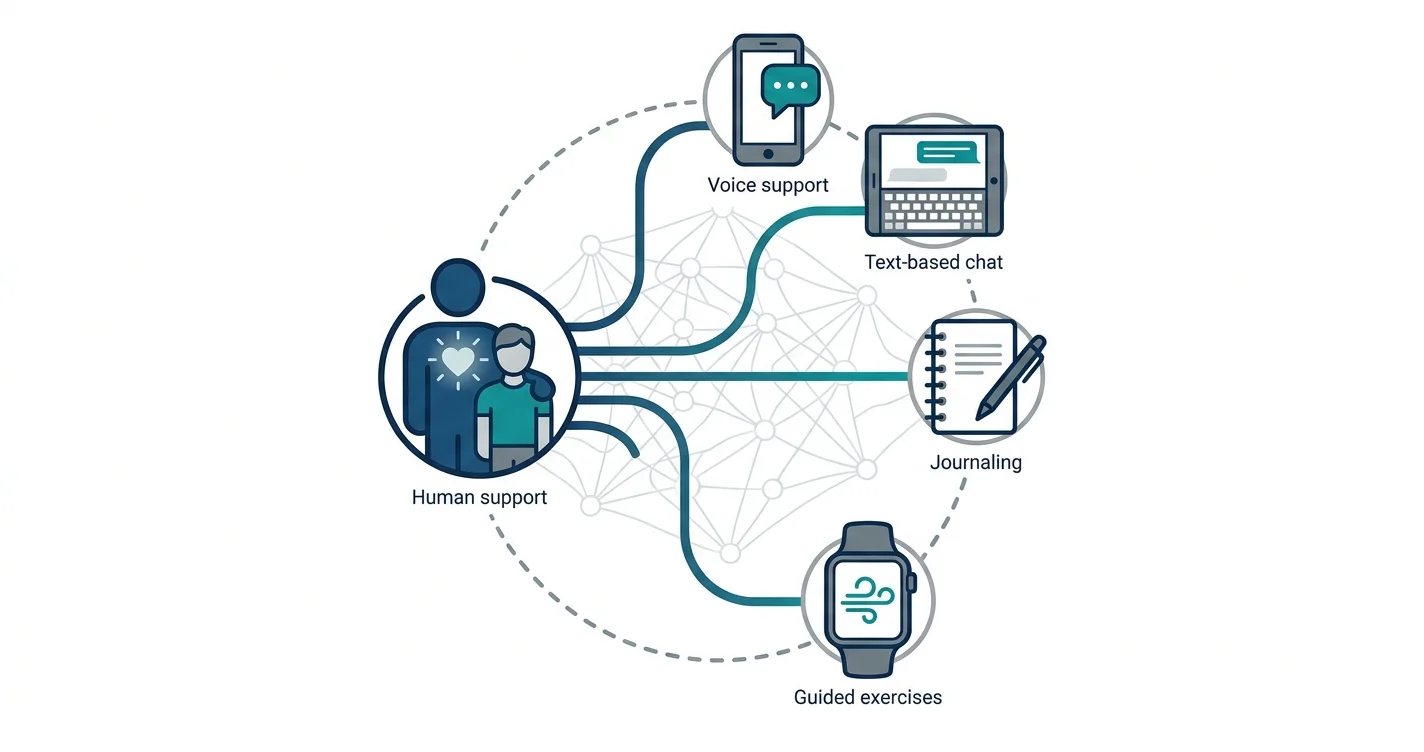
- The best ai apps for teen mental health supplement trusted adults and licensed care; they do not replace them.
- Lovon offers voice-based emotional support and coping tools; confirm age eligibility before considering it for a teen.
- Text-based support suits quiet check-ins; guided journaling suits organizing feelings without an ongoing conversation.
- Check teen eligibility, privacy, and crisis instructions before sharing personal information with any mental health app.
Best overall approach for teens: human-supported care, with an app as an extra tool. Best voice-support option to assess: Lovon; best format for quiet check-ins: text-based support; best format for organizing feelings: guided journaling—each depends on age eligibility, privacy, and clear safety boundaries in 2026.
TL;DR
- The best ai apps for teen mental health supplement trusted adults and licensed care; they do not replace them.
- Lovon offers voice-based emotional support and coping tools; confirm age eligibility before considering it for a teen.
- Text-based support suits quiet check-ins; guided journaling suits organizing feelings without an ongoing conversation.
- Check teen eligibility, privacy, and crisis instructions before sharing personal information with any mental health app.
Why this matters
A teen looking for support deserves more than a convincing conversation. The right tool should help you name a feeling, practice a coping skill, or prepare to talk with someone—not become the only place you turn.
An app that sounds caring is not the same as a person responsible for your care. That distinction matters when you compare mental health apps in 2026. A fluent response does not establish clinical judgment, confidentiality, or suitability for minors.
This guide ranks support formats by their intended use, rather than treating every chatbot as interchangeable. Start with the safety checks below. If an app does not permit your age group, do not bypass that restriction.
If you are thinking about suicide or self-harm, tell a trusted adult and seek human support now. In the United States, call or text 988 for the Suicide & Crisis Lifeline. Call 911 for immediate danger or a medical emergency; do not wait for an app to respond.
What makes the best AI app for teen mental health?
Use these criteria before comparing conversation styles or extra features. Safety is an entry requirement, not a bonus.
- Age eligibility: Read the current terms. Check the minimum age and any parent or guardian consent requirements; an app-store age rating alone does not settle eligibility.
- Privacy clarity: Find out what happens to conversations, recordings, and account information. Check access, retention, deletion, and whether information is used to improve models.
- Honest boundaries: The app should distinguish emotional support from diagnosis, treatment, and emergency care. Do not equate an AI therapist label with a licensed professional.
- Human support: Keep a trusted adult, school counselor, or clinician in your support plan. Do not assume a chatbot will recognize danger or alert someone.
- Useful format: Match the tool to the task: speaking, typing, organizing thoughts, or following a coping exercise. More conversation is not automatically better support.
- Healthy stopping points: Prefer a tool you can put down. Stop if using it means delaying sleep, avoiding people, or repeatedly seeking reassurance without taking action.
For any 2026 shortlist, apply these checks before entering sensitive details. You do not need to share your school, address, passwords, or other people's identifying information to describe a stressful day.
Teen mental health support options at a glance
These are distinct support formats, not interchangeable treatments. The rankings below describe task fit; they do not establish that any particular service is approved for minors.
| Option | Best for | Standout function or selection criterion | Key limitation | Verdict |
|---|---|---|---|---|
| Lovon | Assessing voice-based emotional support | Voice conversations, coping tools, and self-reflection guidance | Not a licensed clinician; check teen eligibility before use | Hold until eligibility and privacy are clear |
| Text-based AI mental health support | Quiet, written check-ins | Choose a service with clear support boundaries and readable responses | Generated advice is not clinical judgment | Hold until safety checks pass |
| AI-assisted journaling | Organizing feelings before a human conversation | Choose prompts that separate events, feelings, and next steps | A written reflection is not an assessment | Hold until age and data practices are clear |
| Guided coping apps | Practicing a specific calming skill | Choose clear exercises rather than open-ended advice | An exercise does not address every cause of distress | Use only age-appropriate tools |
1. Lovon: best voice-support option to assess
Lovon is an AI-powered mental health app offering voice conversations, emotional support, coping tools, and self-reflection guidance. It is built with input from PhD psychologists and positions itself as a companion, not a replacement for licensed clinical care.
Lovon mental health support is for talking through everyday struggles, not replacing a licensed clinician. For a teen, the first decision is eligibility—not whether voice feels easier than typing. Check the current age requirements and privacy terms before considering use.
Voice-support pros
- Voice conversations offer a spoken format for expressing feelings.
- Coping tools give the conversation a practical purpose beyond describing distress.
- Self-reflection guidance provides a way to examine everyday struggles.
- The stated companion role distinguishes the app from licensed clinical care.
Voice-support cons
- The app is not a licensed clinician and cannot substitute for a teen's treatment plan.
- Speaking aloud requires a setting where you are comfortable being overheard.
- Psychologist input does not, by itself, establish suitability for minors or clinical effectiveness for teens.
Best for: Assessing spoken emotional support when the service permits your age and its data practices meet your needs.
A useful task is describing a stressful situation and identifying something to discuss with a trusted person. Do not use a conversation to decide whether to start, stop, or change medication.
Verdict: Hold until age eligibility and privacy are clear.
2. Text-based support: best format for quiet check-ins
Text-based AI mental health support uses written exchanges rather than spoken conversation. Consider this format if you prefer composing a message, reviewing wording, or using support without speaking aloud.
Select a service that explicitly permits your age group and explains what its responses can and cannot do. A general-purpose chatbot should not be treated as a teen mental health service simply because it answers emotional questions.
Text-based support pros
- Typing lets you choose your wording before sending a message.
- Written responses give you something to read at your own pace.
- Text avoids the need to speak aloud in a shared space.
Text-based support cons
- A screen is not inherently private; check notification previews, account access, and shared devices.
- A generated response can misunderstand context or give inappropriate advice.
- Repeated chatting is not a substitute for telling someone when distress is affecting daily life.
Best for: Brief, written check-ins about everyday stress, within an age-appropriate service.
For example, describe what happened, how it felt, and what help you want. Ask for help preparing a conversation rather than asking the app to declare who is right in a conflict. The comparison of AI voice therapy and text-based apps explains the format distinction.
Verdict: Hold until eligibility, privacy, and support boundaries pass your checks.
3. AI-assisted journaling: best format for organizing feelings
AI-assisted journaling combines your writing with generated prompts or responses. Look for a tool that helps you describe an experience without presenting its interpretation as a diagnosis.
This format has a different purpose from an ongoing companion conversation. Use it to prepare something you can bring to a counselor, clinician, or trusted adult—not to get a definitive explanation of your personality or mental health.
AI-assisted journaling pros
- Prompts give a blank page some structure.
- Writing separates what happened from what you think it means.
- A short reflection can become a starting point for a human conversation.
AI-assisted journaling cons
- Journal entries contain sensitive information; check storage, access, and deletion practices.
- Generated interpretations are not established facts about you.
- Repeatedly revisiting the same worry without a next step is a reason to change the activity.
Best for: Organizing feelings and preparing to ask for support.
Use simple headings: what happened, what I felt, what I need, and who can help. Leave out identifying details that are unnecessary. You can also use a paper notebook without sending your writing to an online service.
Do not let a generated label define you. Bring concerning patterns to a qualified professional instead of treating the journal's response as an assessment.
Verdict: Hold until age eligibility and data practices are clear; skip diagnostic interpretations.
4. Guided coping apps: best format for a specific exercise
A guided coping app leads you through an activity such as grounding or relaxation. This format does not need AI to be useful, so judge the exercise and its boundaries rather than the technology label.
Choose instructions you understand and can stop whenever you want. An app should not push you to continue an uncomfortable exercise or suggest that struggling with it means you have failed.
Guided coping app pros
- A defined exercise gives you a clear task and stopping point.
- You can focus on practicing rather than composing a personal story.
- Nonconversational tools avoid the need for an ongoing chatbot exchange.
Guided coping app cons
- A calming exercise does not resolve bullying, abuse, or another unsafe situation.
- Not every exercise feels comfortable for every person.
- Completing an activity does not establish that persistent symptoms are treated.
Best for: Practicing an age-appropriate skill for everyday stress alongside human support.
One common grounding exercise asks you to notice 5 things you see, 4 things you feel, and 3 things you hear, followed by smells and taste. Treat it as an invitation, not a test. Skip any part that feels uncomfortable or inaccessible.
If distress continues, move from an exercise to a conversation with someone who can help. Do not keep restarting an activity instead of asking for support.
Verdict: Skip tools with unclear age guidance or claims that exercises replace care.
How to choose without oversharing
Use this sequence when comparing apps in 2026. You can review a service's boundaries before telling it anything personal.
- Check eligibility: Read the current age and consent requirements. Do not use a false birth date.
- Read privacy: Look for explanations of recording, storage, access, sharing, and deletion. Do not assume mental health language guarantees medical confidentiality.
- Choose a task: Decide whether you want to speak, write, organize a thought, or practice an exercise.
- Keep human support: Identify a trusted person you can contact. If a parent is not safe to approach, consider a school counselor, healthcare professional, or another safe adult.
- Review the effect: Ask whether the tool helps you take a useful next step. Stop if it leaves you more distressed or keeps you avoiding support.
The goal is a bounded activity with a clear purpose. You do not need an app to become your main relationship or your final authority on what you feel.
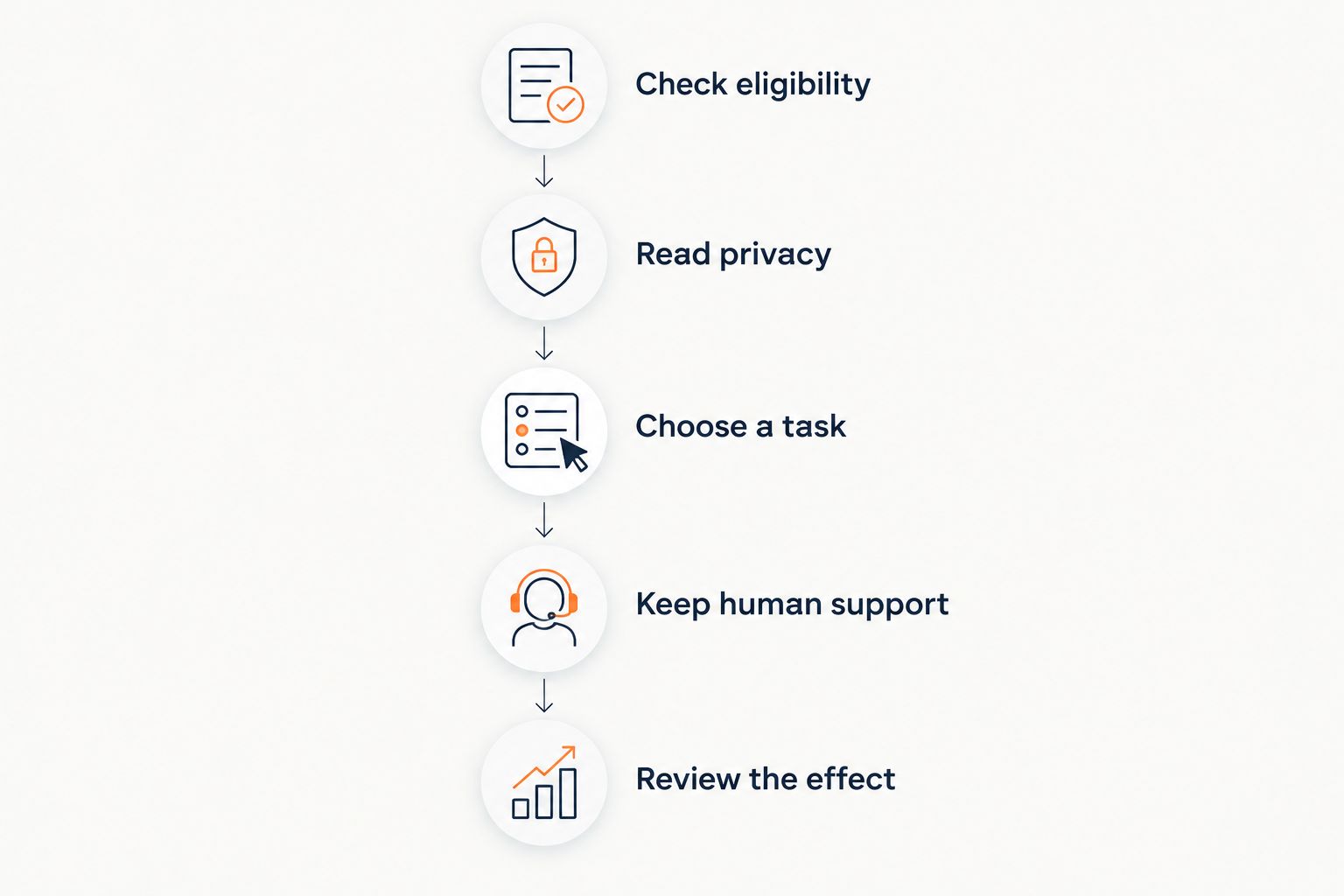 Steps for checking eligibility, privacy, purpose, human support, and an app's effect
Check the boundaries before sharing personal information.
How the ranking works
This 2026 guide puts age eligibility, privacy, and human support ahead of conversation style. The ordering then separates spoken support, written check-ins, structured reflection, and guided exercises by task.
No format wins every situation. Voice requires somewhere comfortable to speak; text leaves readable content; journaling needs boundaries around interpretation; exercises need a route to further support. None replaces clinical assessment or crisis help.
Which support option should you choose?
For an undecided teen, start with a trusted person and a specific support need—not an open-ended chatbot relationship. A school counselor or healthcare professional can help you decide whether an app belongs in your plan.
Consider Lovon for voice-based mental health support only after confirming that its current terms permit your age. Choose written support if you prefer typing, journaling if you need to organize thoughts, or a guided exercise if you want a defined activity.
In 2026, the best choice is the tool with suitable boundaries that helps you reconnect with your life. If sadness, anxiety, sleep problems, or difficulty functioning persist, ask for professional support rather than switching endlessly between apps.
FAQ
What's the best AI app for teen mental health?
There is no universal best app for every teen. Choose only a service that permits your age, explains its privacy practices, and supplements trusted adults or licensed care; conversation style comes after those checks.
Can a teenager use Lovon?
Check Lovon's current age and consent requirements before considering it for a teenager. Its emotional-support features and psychologist input do not, by themselves, establish eligibility or suitability for minors.
Is AI voice support better than text for teens?
Neither format is better for every teen. Voice suits speaking aloud, while text suits written check-ins; both require age eligibility, privacy checks, and clear limits.
Can an AI mental health app diagnose depression or ADHD?
Do not use a chatbot response as a diagnosis of depression or ADHD. A qualified healthcare professional should assess symptoms and discuss appropriate care.
Are conversations with mental health apps confidential?
Do not assume an app conversation has the same confidentiality protections as licensed clinical care. Read the service's privacy terms, including storage, access, sharing, and deletion practices, before entering sensitive information.
Should parents read everything a teen tells an app?
Agree on privacy and safety boundaries rather than assuming either unrestricted access or total secrecy. Discuss account access, notifications, and when a safe adult needs to become involved; seek professional guidance when safety is a concern.
What should a teen do if an app makes them feel worse?
Stop using the app and tell a trusted adult or healthcare professional what happened. In the United States, call or text 988 for suicide or mental health crisis support, and call 911 for immediate danger or a medical emergency.
One last thing
The best outcome is not a longer conversation with an app. It is a useful next step outside it: telling someone you are struggling, asking for help at school, or bringing a concern to a clinician.
End with an action, not another request for reassurance. Before you close a session, decide what you need and who can help you get it.
Related guides
How AI Support Helps You Heal
AI emotional support isn't about replacing human connection — it's about filling the gaps. The moments when you need to talk at 2 AM, when you don't want to burden your friends again, or when you simply need someone to listen without judgment.
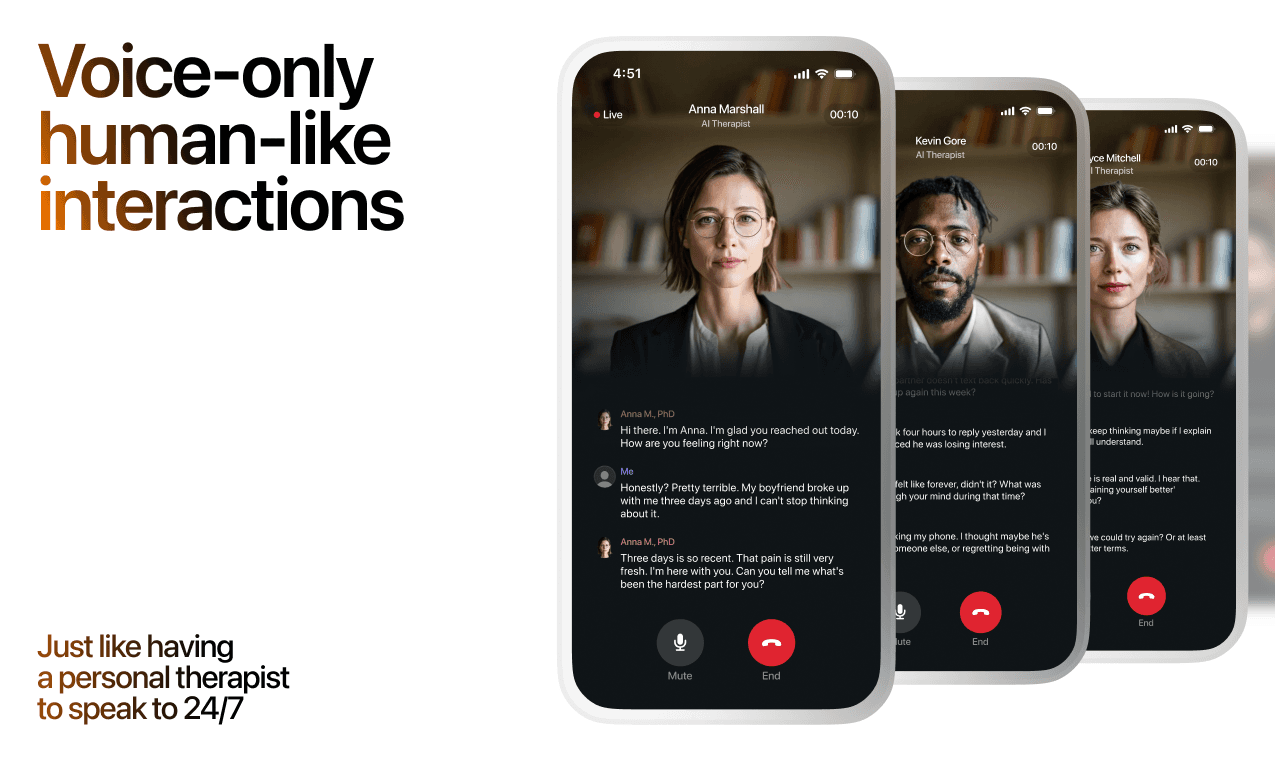
Here's what happens in a typical Lovon session:
You share what's on your mind
There's no script, no intake form, no waiting room. You speak or type whatever you're feeling — in your own words, at your own pace.
Lovon validates and explores
Using frameworks from CBT (Cognitive Behavioral Therapy) and motivational interviewing, Lovon acknowledges your feelings first, then gently helps you explore them. No dismissive "just move on" advice.
You build coping skills together
Lovon doesn't just listen — it actively works with you on evidence-based techniques: thought reframing, urge surfing, behavioral experiments, and more.
What a Session with Lovon Looks Like
When to Seek Professional Help
AI support is a valuable tool, but it's not a replacement for professional care. Please consider reaching out to a licensed therapist if you experience any of the following:
- Persistent thoughts of self-harm or suicide
- Inability to perform daily activities (work, eating, sleeping) for more than 2 weeks
- Turning to alcohol or substances to cope
- Intense anger or desire to harm your ex-partner
- Complete emotional numbness that doesn't improve over time
Crisis Resources (US): If you're in immediate danger, call 988 (Suicide & Crisis Lifeline) or text HOME to 741741 (Crisis Text Line). Available 24/7, free, and confidential.
Outside the US? Find a crisis line in your country
Ready to Start?
Your healing journey can begin right now
A 7-day trial. No judgment. Just a safe space to process what you're going through.
Frequently Asked Questions
Is Lovon a replacement for a real therapist?
Is my conversation with Lovon AI private?
How is Lovon different from ChatGPT for emotional support?
Can I use Lovon if I'm already seeing a therapist?
Can I try Lovon before subscribing?
About the Author
The Lovon Editorial Team
Mental Health & Wellness Content Team
The Lovon Editorial Team develops mental health and wellness content designed to make psychological concepts accessible and actionable. Our goal is to bridge the gap between clinical research and everyday life - helping you understand why your mind works the way it does and what you can do about it....
Related articles
- What is CPTSD from Inconsistent Parenting and How to Heal
Complex Post-Traumatic Stress Disorder (CPTSD) from inconsistent parenting represents a profound psychological injury…
- Parentification: Signs, Effects, and How to Heal in 2026
Parentification means a child carried adult emotional or practical weight. Learn the signs, the steps to unwind it, and…
- Best AI Life Coach App for New Parents in 2026
Lovon leads our 2026 ranking of AI life coach apps for new parents, compared against Wysa, BetterHelp, Talkspace, and…
- AI Therapy for New-Parent Imposter Syndrome: 2026 Verdict
AI therapy for imposter syndrome new parents: what to look for, top approaches ranked, and the honest verdict on Lovon's…
See also
Quizzes
- Boundaries Test: Free 12-Question Self-Check
See where your boundaries slip, in 3 minutes.
- Toxic Masculinity Test: Which Rules Are You Running?
See which learned rules cost you most, in 3 minutes.
Free tools
- How to Confront a Narcissistic Parent
Most of these conversations fail because you went in wanting three things at once. Tell it what you want to raise, and…
- Write a Letter to Your Mom or Dad
A chat, not a template, for a letter to your mom or dad. Tell it the occasion, one or two things you remember, and what…
From the wiki
- Why do I feel sad when I'm alone?
Being alone does not create the sadness. It removes the noise that was keeping it out of earshot, so whatever queued up…
Disclaimer: This article is for informational purposes only and does not constitute medical advice, diagnosis, or treatment. Always seek the advice of your physician or other qualified health provider with any questions you may have regarding a medical condition. If you are in crisis or think you may have an emergency, call 988 (Suicide & Crisis Lifeline) or go to the nearest emergency room. Outside the US? Find a crisis line in your country.