
How to Co-Parent After Divorce in 2026: Step-by-Step Guide
How to co-parent after divorce in 2026: write the plan, script the conversations, manage your own stress. Practical steps, no fluff, verdicts included.
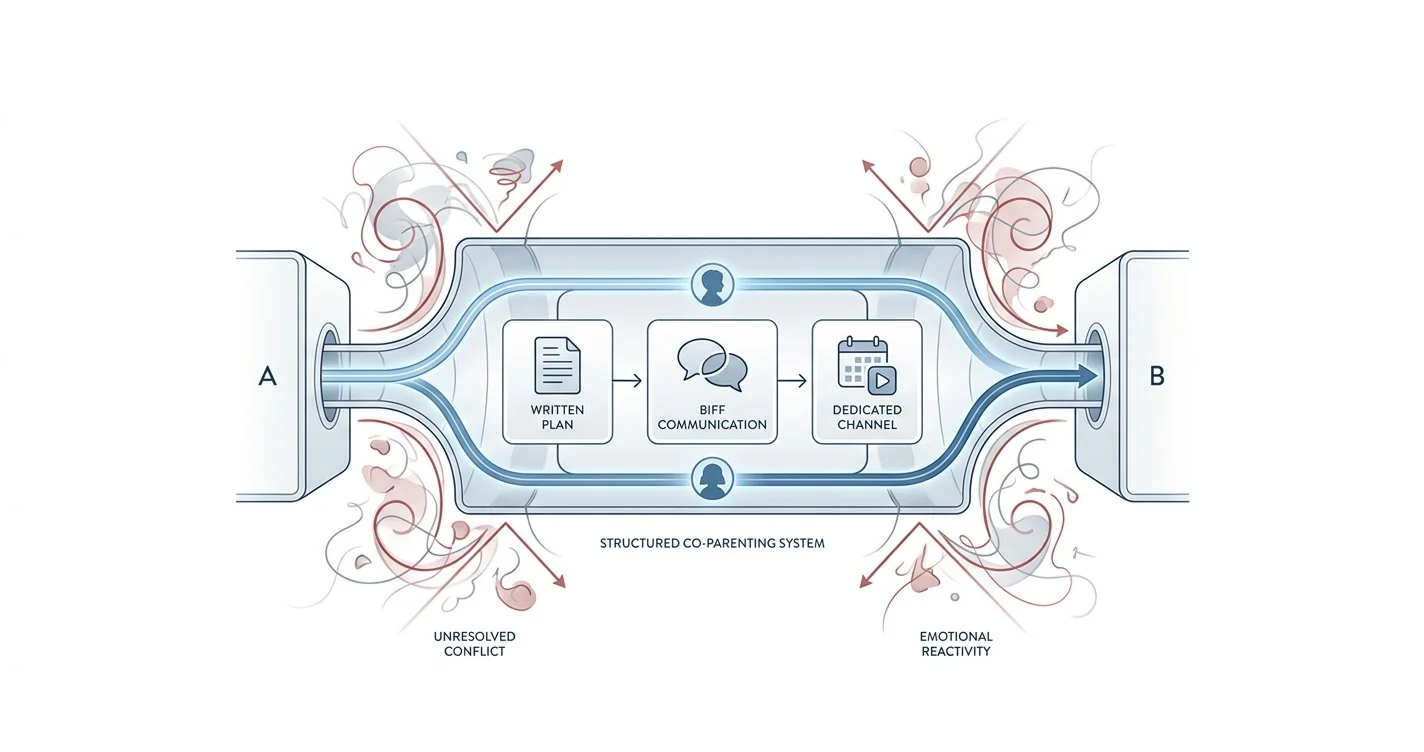

Key Takeaways
- How to co-parent after divorce starts with a written parenting plan, not a verbal agreement — verdict: draft one in
- Business-only communication (BIFF: brief, informative, firm, friendly) cuts co-parenting conflict faster than trying
- If your ex shows emotionally immature patterns, boundary scripts matter more than persuasion.
- Divorce-related stress can mimic trauma symptoms — track your own nervous system, not just the custody schedule.
Co-parenting after divorce is a skill, not a feeling — and most people are never taught it. This guide covers the actual mechanics: what to set up before you talk to your ex, the steps that keep conflict low, and what to do when a handoff goes sideways anyway.
TL;DR
- How to co-parent after divorce starts with a written parenting plan, not a verbal agreement — verdict: draft one in week one.
- Business-only communication (BIFF: brief, informative, firm, friendly) cuts co-parenting conflict faster than trying to be friends again.
- If your ex shows emotionally immature patterns, boundary scripts matter more than persuasion.
- Divorce-related stress can mimic trauma symptoms — track your own nervous system, not just the custody schedule.
Why this matters
Divorce ends a marriage. It does not end the relationship — it just changes its job description to co-manager of a kid's life for the next 10 to 18 years. That's the part nobody prepares you for in 2026, when custody schedules, co-parenting apps, and court-ordered mediation are more common than ever but emotional regulation training is still an afterthought.
The fights that blow up custody exchanges are rarely about the schedule itself. They're about old resentment leaking into new logistics. If your ex has a pattern of minimizing your concerns or twisting conversations, setting limits with an emotionally immature co-parent becomes the actual skill you're building — not "getting along."
What you'll need
- A written parenting plan or custody agreement (court-filed or informal, but written)
- A shared calendar or co-parenting app for schedule changes and expense tracking
- A communication channel that isn't your personal text thread — email or an app with a message log
- A script for the three conversations that go bad most often: schedule changes, money, and new partners
- A way to regulate yourself before and after handoffs — this is where most people skip a step
The steps
1. Put the parenting plan in writing before you need it
A verbal "we'll figure it out" agreement collapses the first time someone's memory of the deal conflicts with the other person's. Write down pickup and drop-off times, holiday rotation, who covers which costs, and what happens when plans change with less than 48 hours' notice.
This accomplishes one thing: it removes ambiguity as a source of conflict. When the plan is written, disagreements become "check the document" instead of "you always do this." Common mistake: leaving vague language like "flexible schedule" — flexible becomes a battleground the moment one parent wants something the other doesn't.
2. Switch to business-only communication
Use the BIFF method — Brief, Informative, Friendly, Firm — for every co-parenting message. Skip the recap of who was wrong in the marriage. State the fact, state what you need, close it.
Example: "Emma has a dentist appointment Thursday at 3pm. I'll pick her up from school that day instead of you. Confirming you're okay with that." No apology, no jab, no history. If your ex escalates anyway, that's information about them, not a reason to match their tone.
3. Move logistics off your personal phone
A dedicated co-parenting app or a separate email thread does two things: it creates a timestamped record if disputes ever reach mediation, and it stops custody logistics from bleeding into the rest of your life every time your phone buzzes. In 2026, most family courts recommend or require documented communication anyway, so this step also protects you legally.
Common mistake: continuing to text on the same thread you used during the marriage — every notification becomes a small trigger, even for routine messages.
4. Build a 90-second reset before every handoff
Handoffs are the highest-friction moment in co-parenting. Before you arrive, take 90 seconds: three slow breaths, name what you're feeling once in your head, and decide your one goal for the exchange (usually: "get the kid, stay neutral, leave").
This matters because your nervous system doesn't know the difference between "my ex is late again" and an actual threat if you walk in already flooded. If exchanges consistently leave you shaky or foggy afterward, that's worth naming — divorce-related PTSD symptoms are more common than most people expect, and they respond to specific coping tools, not just willpower.
5. Separate co-parenting decisions from unresolved marriage feelings
When your ex asks to switch a weekend, the question is "does this work logistically," not "does this person deserve accommodation after what they did." Co-parenting decisions get contaminated fast when old grievances get a vote.
A simple filter: ask "would I say yes to this if a coworker asked?" If yes, and it doesn't hurt your kid's routine, say yes. Verdict: separate the ledgers — one for the marriage, one for the parenting.
6. Script the three recurring flashpoints in advance
Money, schedule changes, and new partners cause most co-parenting blowups. Write a one-line stock response for each before you need it, so you're not improvising while upset.
Money: "Let's split unreimbursed medical per the agreement — I'll send the receipt." Schedule: "I can do that if we swap next Tuesday." New partners: "I'd like 48 hours' notice before the kids meet anyone new." Having the line ready stops you from over-explaining or under-defending in the moment.
7. Manage anger before it manages the exchange
If you notice yourself rehearsing arguments in the shower or snapping at small comments, that's a signal your baseline stress is running high, not that your ex got worse this week. Stopping anger outbursts before they happen usually comes down to catching the physical warning signs — jaw tightening, faster breathing — 60 seconds earlier than you currently do.
Common mistake: waiting until you're already yelling to try to calm down. The window to intervene is much earlier and much smaller than it feels.
Talk through a hard handoff before it happens
Lovon gives you a voice conversation with an AI voice companion anytime, no appointment needed.
Troubleshooting
Your ex won't stick to the written plan. Document every deviation with a timestamp in your co-parenting app. One missed pickup isn't a pattern; five in three months is — and documentation is what mediation or court actually responds to.
Every text turns into an argument. Switch to email only, and add a 24-hour rule: don't respond to anything emotionally charged for a full day. Most urgency fades once you sleep on it.
Your kid is caught in the middle of messages. Stop using them as a courier immediately. Any message that starts with "tell your dad/mom" should go through the co-parenting channel, not through the child.
You feel dysregulated for hours after every exchange. That's your body staying in a stress response longer than the actual event warranted. Learning to recognize nervous system dysregulation helps you spot it and reset faster instead of carrying it into the rest of your day.
New partners are creating tension. Set the 48-hour notice rule from step six and hold it consistently — consistency is what makes a boundary credible, not the wording.
Tools and resources
- A written, dated parenting plan stored somewhere both parents can access
- A co-parenting app or dedicated email thread with message logs
- A BIFF-style script for schedule, money, and new-partner conversations
- A short personal reset ritual for before and after handoffs
- On-demand emotional support for the moments between fights, when there's no therapist available at 9pm on a Tuesday
What to do next
If the anger, dread, or replaying-the-argument loop is showing up daily rather than around specific triggers, that's worth more support than a script can give. AI voice therapy sessions work differently than typing into a chat app — talking out loud tends to surface what's actually driving the reaction faster than typing does. Lovon's AI voice therapy sessions are built for exactly this kind of between-appointments processing, not as a replacement for a custody attorney or a licensed therapist, but as a place to unload before you respond to your ex instead of after.
FAQ
How do I co-parent with a narcissistic or emotionally immature ex?
Limit communication to a documented channel, use short factual messages, and stop trying to get them to understand your side. Boundaries held consistently work better than arguments aimed at changing their behavior.
What is the BIFF method for co-parenting communication?
BIFF stands for Brief, Informative, Friendly, Firm. It's a message format that states facts and needs without recapping grievances, which lowers the chance the message triggers a fight.
How long does it take to feel normal co-parenting after divorce?
Most parents report handoffs feeling routine somewhere between 6 and 18 months after separation, depending on how much conflict remains unresolved and whether both parents follow the same written plan.
Should co-parents use a shared app or just text?
A dedicated co-parenting app is better than personal texting because it timestamps messages, tracks expenses, and creates a record courts recognize if disputes escalate in 2026 or later.
Can divorce cause symptoms similar to PTSD?
Yes, high-conflict divorce can produce hypervigilance, intrusive thoughts, and emotional flashbacks similar to trauma responses. These symptoms are treatable and don't mean something is wrong with you long-term.
How do you stop fighting in front of the kids during handoffs?
Keep exchanges under two minutes, stick to logistics only, and agree in advance that any disagreement gets tabled for the written channel, not discussed at the door.
What if my ex refuses to follow the parenting plan?
Document every deviation with dates and times in a shared app. A pattern of violations, not a single incident, is what mediators and courts act on.
Is it normal to still feel angry years after the divorce?
Yes, especially when co-parenting forces regular contact with the source of the conflict. Persistent anger that disrupts daily life is worth addressing directly rather than assuming it will fade on its own.
One last thing
The co-parents who struggle least aren't the ones who became friends with their ex — they're the ones who stopped expecting friendship and built a system instead. A written plan and a boring, documented communication channel will do more for your 2026 custody schedule than any conversation about "getting along" ever will.
Related guides
How AI Support Helps You Heal
AI emotional support isn't about replacing human connection — it's about filling the gaps. The moments when you need to talk at 2 AM, when you don't want to burden your friends again, or when you simply need someone to listen without judgment.
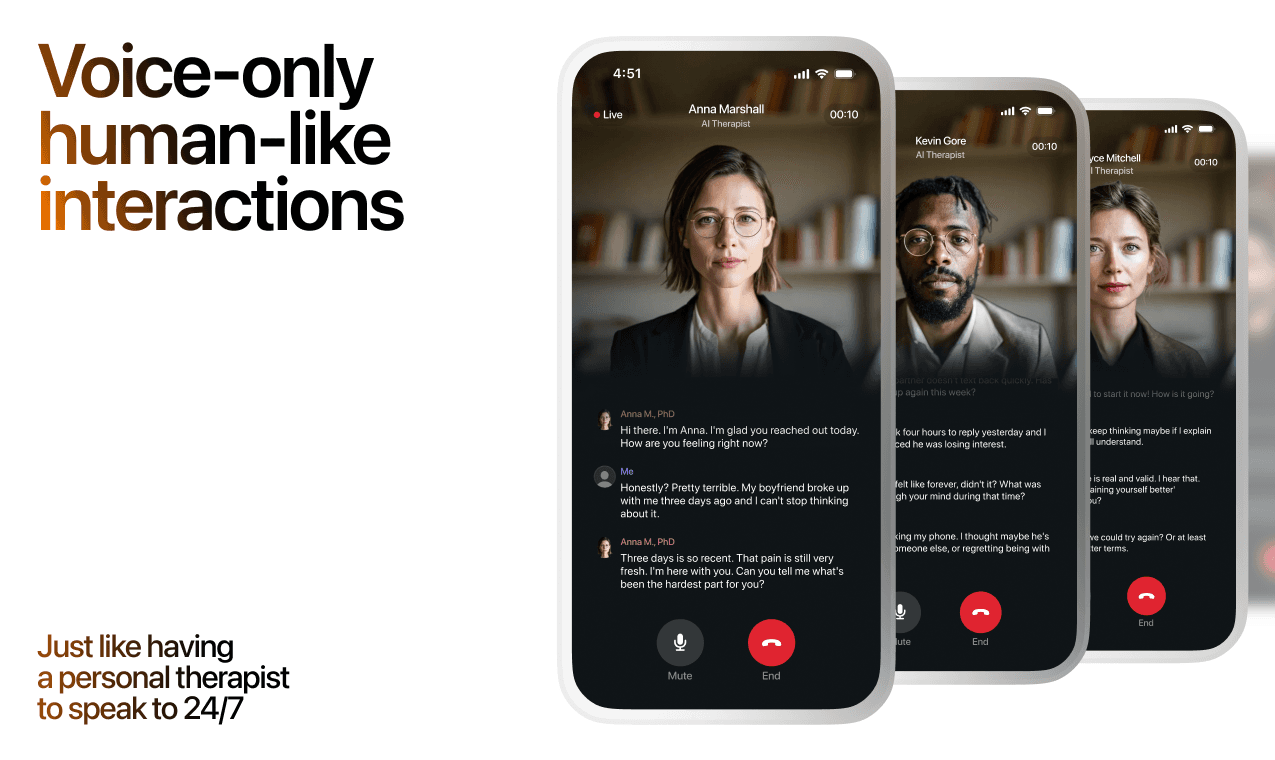
Here's what happens in a typical Lovon session:
You share what's on your mind
There's no script, no intake form, no waiting room. You speak or type whatever you're feeling — in your own words, at your own pace.
Lovon validates and explores
Using frameworks from CBT (Cognitive Behavioral Therapy) and motivational interviewing, Lovon acknowledges your feelings first, then gently helps you explore them. No dismissive "just move on" advice.
You build coping skills together
Lovon doesn't just listen — it actively works with you on evidence-based techniques: thought reframing, urge surfing, behavioral experiments, and more.
What a Session with Lovon Looks Like
When to Seek Professional Help
AI support is a valuable tool, but it's not a replacement for professional care. Please consider reaching out to a licensed therapist if you experience any of the following:
- Persistent thoughts of self-harm or suicide
- Inability to perform daily activities (work, eating, sleeping) for more than 2 weeks
- Turning to alcohol or substances to cope
- Intense anger or desire to harm your ex-partner
- Complete emotional numbness that doesn't improve over time
Crisis Resources (US): If you're in immediate danger, call 988 (Suicide & Crisis Lifeline) or text HOME to 741741 (Crisis Text Line). Available 24/7, free, and confidential.
Outside the US? Find a crisis line in your country
Ready to Start?
Your healing journey can begin right now
A 7-day trial. No judgment. Just a safe space to process what you're going through.
Frequently Asked Questions
Is Lovon a replacement for a real therapist?
Is my conversation with Lovon AI private?
How is Lovon different from ChatGPT for emotional support?
Can I use Lovon if I'm already seeing a therapist?
Can I try Lovon before subscribing?
About the Author

The Lovon Editorial Team
Mental Health & Wellness Content Team
The Lovon Editorial Team develops mental health and wellness content designed to make psychological concepts accessible and actionable. Our goal is to bridge the gap between clinical research and everyday life - helping you understand why your mind works the way it does and what you can do about it....
Related articles
- Toxic Parent Signs: Overcoming Their Hurtful Legacy And Reclaiming Your Life
There is a big difference between parents who made mistakes and parents whose behavior often made their children feel…
- Toxic Parent Patterns: Signs & How to Set Limits (2026)
Recognize toxic parent patterns — manipulation, enmeshment, conditional love — and follow 7 concrete steps to set limits…
- AI Relationship Coach for Blended Families: 2026 Verdict
AI relationship coach for blended families reviewed for 2026: buy for stepparent stress and co-parenting conflict, skip…
- AI Relationship Coach for Parents of Teenagers (2026)
Lovon's ai relationship coach for parents of teenagers helps you de-escalate conflict and set boundaries anytime in 2026…
See also
Quizzes
- Love Addiction Test: Free 12-Question Self-Check
See how much of your life one person is taking.
- Am I Over My Ex? 12-Question Gut Check
Post-breakup check-in in 2 minutes.
Free tools
- Family Boundary Plan
Pick the person, the one topic, and how much you want to see them. You get a three-rung ladder, the guilt lines to…
- No Contact Plan Builder
Name the hours you are most likely to text them, and get one if-then rule for each. Ends in a dated card you can…
From the wiki
- How to break up with someone you still love?
Loving someone does not mean the relationship works. If you have circled the same decision for months and the reasons…
Disclaimer: This article is for informational purposes only and does not constitute medical advice, diagnosis, or treatment. Always seek the advice of your physician or other qualified health provider with any questions you may have regarding a medical condition. If you are in crisis or think you may have an emergency, call 988 (Suicide & Crisis Lifeline) or go to the nearest emergency room. Outside the US? Find a crisis line in your country.