
Lovon vs Freudly: which is better in 2026
Lovon vs Freudly compared for 2026: voice-first AI support against what to check on Freudly, with a side-by-side table, scorecard, and a clear pick by need.

Key Takeaways
- Lovon is built for spoken conversations with an AI therapist, so it fits people who process feelings best by talking.
- Lovon is not a licensed clinician and does not replace clinical care.
- Choose Freudly if its current format and features suit you better after you check them on its own site.
- The lovon vs freudly decision in 2026 is about format, fit, and how you like to open up.
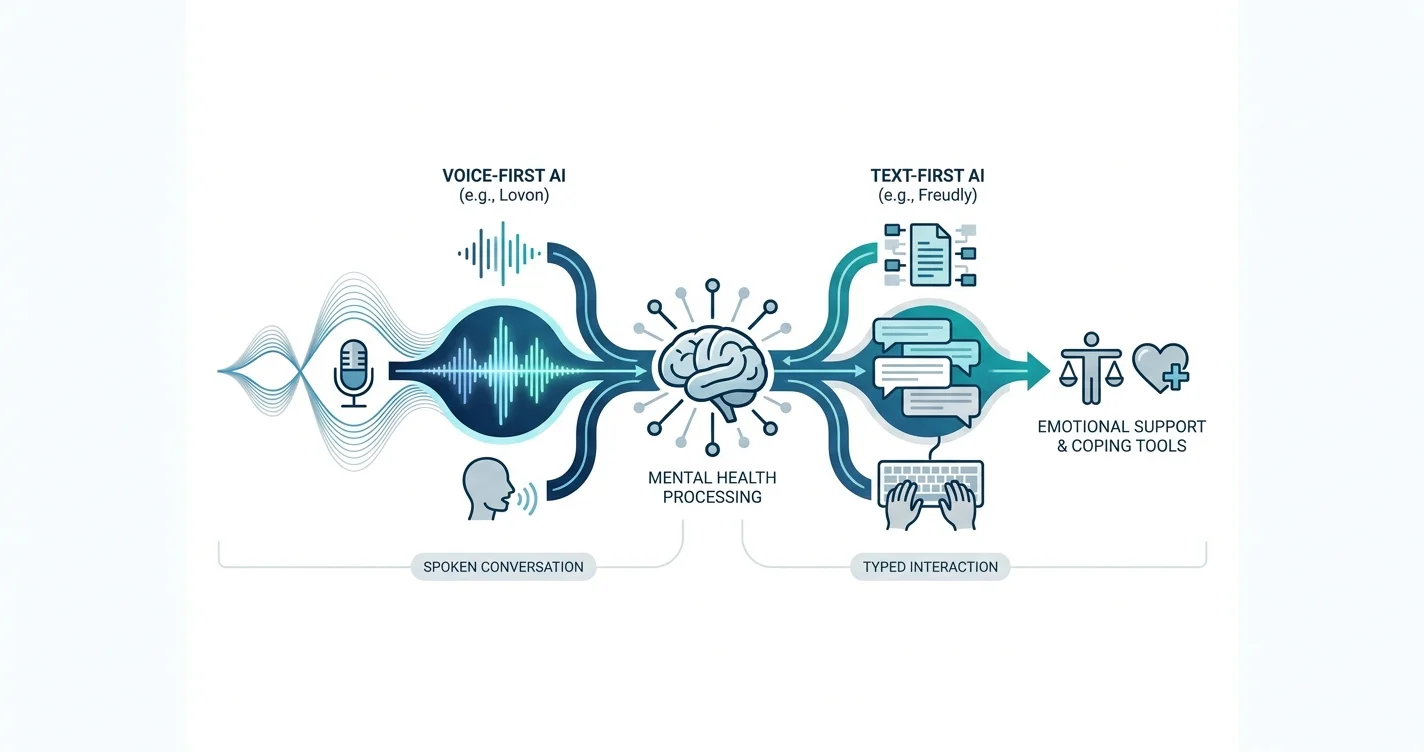
Lovon vs Freudly comes down to one question: do you want to talk out loud or type? Lovon is a voice-first AI therapy app. This page covers where it wins, where it doesn't, and what to check on Freudly before you choose in 2026.
TL;DR
- Lovon is built for spoken conversations with an AI therapist, so it fits people who process feelings best by talking.
- Lovon is not a licensed clinician and does not replace clinical care.
- Choose Freudly if its current format and features suit you better after you check them on its own site.
- The lovon vs freudly decision in 2026 is about format, fit, and how you like to open up.
Why this matters
AI mental health apps look alike in the app store. They are not alike in use. The format decides whether you open it at 11 p.m. during a spiral or never open it again.
Most people who search lovon vs freudly want support between therapy sessions, or support when they have no therapist at all. Both goals are reasonable. Neither app is a clinician, and any honest comparison starts there.
This page compares what Lovon states about itself against the dimensions that matter when you choose. Freudly's current features, plans, and policies change. Confirm them on Freudly's own site before you commit to anything.
The verdict
Choose Lovon if you want to just talk. You speak, the AI responds, and you get coping tools and self-reflection guidance without typing a word. It suits anxiety, stress, low mood, relationship problems, and burnout.
Choose Freudly if its format and feature set fit how you want to use an app. That means a style you prefer, a price you confirm, and a privacy policy you read. If typing feels safer than speaking, or you are in a place where you can't talk aloud, a text-first tool can be the better pick. Check whether Freudly offers that.
The axis of difference is simple. Lovon is built around voice conversation. Freudly is a different product with its own design choices. The right one is the one you will actually open on a bad day.
Lovon is best for people who think better out loud and want calm, always-available support that is honest about not being a licensed clinician.
At a glance
| Dimension | Lovon | Freudly |
|---|---|---|
| Best for | People who want spoken, on-demand emotional support | Verify on Freudly's site |
| Core format | Voice conversations with an AI therapist | Verify on Freudly's site |
| Built with | Input from PhD psychologists | Verify on Freudly's site |
| Clinical status | Not a licensed clinician; not a replacement for clinical care | Verify on Freudly's site |
| Topics covered | Anxiety, stress, low mood, relationship problems, burnout, ADHD | Verify on Freudly's site |
| Standout feature | Talk anytime, get coping tools and reflection prompts | Verify on Freudly's site |
| Pricing model | Check current pricing on the Lovon site | Check current pricing on Freudly's site |
| Tone | Warm, plain language, no clinical jargon | Verify on Freudly's site |
Every row marked verify is a claim we will not make for a product whose current details you should read at the source. That is the honest way to read any comparison page, including this one.
Lovon is the better pick for voice-first support
Lovon's whole design is a spoken conversation. You open the app and talk. There is no blank text box to stare at.
That matters because many people can say a feeling faster than they can type it. Speaking also tends to surface things you would edit out in writing. If you are venting after a hard day, talking is lower friction.
Verdict: Lovon wins on voice. If voice is your main reason for looking at an AI therapy app, this dimension decides it. The difference between spoken and typed support is its own topic, covered in the guide linked below.
Lovon is better on built-in expert input
Lovon is built with input from PhD psychologists. That shapes the coping tools and the reflection guidance inside the app.
That is a design fact, not a clinical promise. Lovon does not diagnose, treat, or replace a licensed therapist. It is a companion for everyday struggles.
Verdict: Lovon has a stated edge on expert input. Check Freudly's site for how it describes its own development and sources, then compare the two statements directly.
Both apps are not therapy
Neither tool is a licensed clinician. This is a tie, and it is the most important row in the table.
An AI therapy app helps with stress, worry, low mood, rumination, and communication problems. It does not replace care for crisis, trauma treatment, medication decisions, or a diagnosed condition. If you are in danger, contact local emergency services or a crisis line.
Verdict: tie. Any app that implies otherwise should lose your trust. Lovon says plainly that it is not a licensed clinician.
Privacy: read both policies
You will share feelings, relationship details, and sometimes things you have told no one. Privacy is not optional here.
We do not make claims about how either company stores or uses your data. Read each privacy policy before your first session. Look for what is recorded, how long it is kept, and whether you can delete it.
Verdict: no winner without reading both policies. The guide on sharing feelings safely with an AI therapist, linked below, lists what to look for.
Pricing: models matter more than headlines
We do not quote prices for either app. Plans change, and a stale number does more harm than none.
Here is what to compare instead:
- Free access: can you try a real session before you pay?
- Plan structure: is it a flat subscription or pay-as-you-go?
- Cancellation: can you cancel inside the app?
- What is gated: are coping tools, session length, or history behind a paywall?
A predictable flat plan is easier to budget. Usage-based pricing can cost less if you only use an app occasionally. Pick the model that matches how often you will really use it.
Verdict: check both sites. Our cost guide below explains how AI therapy apps are usually priced.
Fit by situation
Use the app that matches the moment, not the one with the longest feature list.
- Racing thoughts at night: a voice conversation can slow you down. Lovon is built for this.
- Quiet environment, can't speak aloud: a text-first tool may be the better fit. Check what Freudly offers.
- Stress between therapy sessions: either type of app can help. Voice is quicker when you are overwhelmed.
- Relationship conflict: talking it through out loud helps you hear your own pattern.
- Clinical diagnosis or crisis: neither app is the answer. See a licensed professional.
Scorecard
| Dimension | Winner |
|---|---|
| Voice conversation | Lovon |
| Stated expert input | Lovon |
| Honesty about not being a clinician | Tie |
| Privacy | Read both policies |
| Pricing | Compare on both sites |
| Text-first use | Check Freudly |
Lovon wins the rows it was designed for. The rest depends on what you confirm on Freudly's site and what you need in 2026.
Final verdict
Choose Lovon if:
- You are someone who feels better after saying things out loud.
- You want support at any hour without scheduling.
- You want plain language and an app that admits it is not a licensed clinician.
Choose Freudly if:
- You have checked its current features and prefer its format or approach.
- Its plan structure and privacy terms suit you better after you read them.
- You prefer a way of using an app that Lovon's voice-first design does not offer.
Try talking it through
Open Lovon and just talk. No typing, no waiting for an appointment.
FAQ
What is the main difference between Lovon and Freudly?
Lovon is built around voice conversations with an AI therapist. Check Freudly's site for its current format, since features change. Pick the one whose format you will actually use.
Is Lovon a replacement for a therapist?
No. Lovon is not a licensed clinician and does not replace clinical care. It offers emotional support, coping tools, and self-reflection guidance for everyday struggles.
Who is Lovon best for?
Lovon is best for people dealing with anxiety, stress, low mood, relationship problems, or burnout who prefer to talk rather than type. It is an always-available companion, not a clinical service.
Is Freudly better than Lovon?
It depends on what you need. Lovon wins for voice-first support. Freudly may suit you better if its format and plan fit your habits, so confirm its details on its site.
How much does Lovon cost compared to Freudly?
Check current pricing on each company's site, because plans change. Compare free access, plan structure, cancellation terms, and what sits behind a paywall.
Can I use an AI therapy app during a crisis?
No. If you are in danger or thinking about harming yourself, contact local emergency services or a crisis line right away. AI apps are not built for crisis care.
Is it safe to share personal feelings with an AI therapy app?
Safety depends on each company's data practices. Read the privacy policy of any app before your first session and look for how recordings and history are handled.
One last thing
Pick the app by the worst moment you expect to use it in. If that moment is a 2 a.m. spiral when typing feels like too much, test the voice option first. Run one real session with each tool in 2026 before you pay for either.
Related guides
How AI Support Helps You Heal
AI emotional support isn't about replacing human connection — it's about filling the gaps. The moments when you need to talk at 2 AM, when you don't want to burden your friends again, or when you simply need someone to listen without judgment.
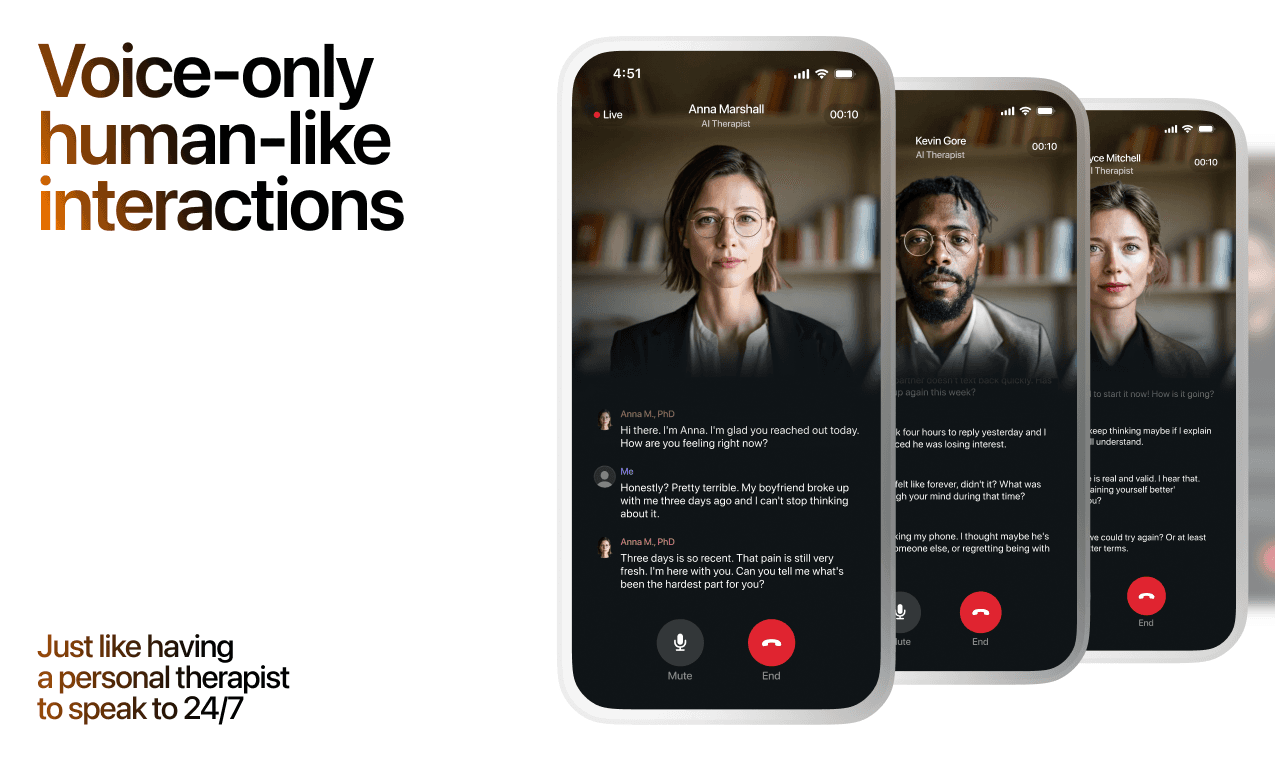
Here's what happens in a typical Lovon session:
You share what's on your mind
There's no script, no intake form, no waiting room. You speak or type whatever you're feeling — in your own words, at your own pace.
Lovon validates and explores
Using frameworks from CBT (Cognitive Behavioral Therapy) and motivational interviewing, Lovon acknowledges your feelings first, then gently helps you explore them. No dismissive "just move on" advice.
You build coping skills together
Lovon doesn't just listen — it actively works with you on evidence-based techniques: thought reframing, urge surfing, behavioral experiments, and more.
What a Session with Lovon Looks Like
Lovon is AI support, not a replacement for professional care. If things have been hard to get through for weeks, or you are thinking about harming yourself, talk to a doctor or a licensed therapist.
Ready to Start?
Your healing journey can begin right now
A 7-day trial. No judgment. Just a safe space to process what you're going through.
Frequently Asked Questions
Is Lovon a replacement for a real therapist?
Is my conversation with Lovon AI private?
How is Lovon different from ChatGPT for emotional support?
Can I use Lovon if I'm already seeing a therapist?
Can I try Lovon before subscribing?
About the Author
The Lovon Editorial Team
Mental Health & Wellness Content Team
The Lovon Editorial Team develops mental health and wellness content designed to make psychological concepts accessible and actionable. Our goal is to bridge the gap between clinical research and everyday life - helping you understand why your mind works the way it does and what you can do about it....
Related articles
- AI Mental Health Support 2026: What It Is & Who It Helps
AI mental health support ranges from voice therapy to chatbots in 2026. See what each format does best, who it helps…
- Best AI App for Burnout Recovery in 2026: Ranked
Lovon leads our 2026 ranking of the best AI app for burnout recovery, compared against Woebot, Wysa, Calm, Headspace…
- Mental Health Apps for College Students 2026: Top Picks
Lovon leads our 2026 ranking of mental health apps for college students, compared against BetterHelp, Wysa, and campus…
- Voice Journaling App for Mental Health: 2026 Verdict
Voice journaling app for mental health, compared: what to look for, which formats to skip, and why AI-guided sessions…
See also
Quizzes
- Distress Tolerance Test: How Long Can You Sit With It?
See which kind of discomfort makes you need out first.
- Experiential Avoidance Test: Do You Avoid Your Feelings?
See which way you keep feelings out, in 3 minutes.
Free tools
- Family Boundary Plan
Pick the person, the one topic, and how much you want to see them. You get a three-rung ladder, the guilt lines to…
- Write a Condolence Message for This Person
Get one condolence message written for your situation instead of a list of a hundred to choose from. Tell it who died…
From the wiki
- How to stop maladaptive daydreaming?
Maladaptive daydreaming is immersive waking fantasy that eats hours, usually with music and pacing attached. You rarely…
Disclaimer: This article is for informational purposes only and does not constitute medical advice, diagnosis, or treatment. Always seek the advice of your physician or other qualified health provider with any questions you may have regarding a medical condition. If you are in crisis or think you may have an emergency, call 988 (Suicide & Crisis Lifeline) or go to the nearest emergency room. Outside the US? Find a crisis line in your country.