
How much does an AI therapy app cost in 2026?
AI therapy apps cost $15-$70/month in 2026, with free tiers available. See the real cost breakdown vs. human therapy and what drives the price.

Key Takeaways
- AI therapy apps typically cost $15 to $70 a month in 2026; free tiers exist but limit voice sessions.
- Human teletherapy without insurance runs $65 to $250 a session, far above any app subscription.
- Voice-based apps and text-based chatbots often sit in the same price band despite different session formats.
- Annual billing usually cuts the monthly rate by a noticeable margin across the category.
- The real cost driver is feature access, not the app itself: unlimited voice minutes, history, and escalation options
AI therapy apps cost $15 to $70 a month in 2026 for the paid tiers, and several offer a free version with capped daily use. The number on the app store listing rarely matches what you end up paying once you want daily voice sessions instead of a handful of scripted check-ins.
TL;DR
- AI therapy apps typically cost $15 to $70 a month in 2026; free tiers exist but limit voice sessions.
- Human teletherapy without insurance runs $65 to $250 a session, far above any app subscription.
- Voice-based apps and text-based chatbots often sit in the same price band despite different session formats.
- Annual billing usually cuts the monthly rate by a noticeable margin across the category.
- The real cost driver is feature access, not the app itself: unlimited voice minutes, history, and escalation options push price up.
Why this matters
The sticker price on an app store page is not the whole story. A free download that caps you at three chat messages a day isn't a substitute for a therapist, and it isn't really "free support" if the feature you actually need — daily voice conversation — sits behind a paywall.
For anyone comparing the cost against traditional care, the gap is wide. Paying for therapy without insurance runs into hundreds of dollars a month for weekly sessions, which is exactly why AI therapy apps have grown as a between-sessions or budget-limited option in 2026 rather than a full replacement for licensed care.
How much does an AI therapy app cost?
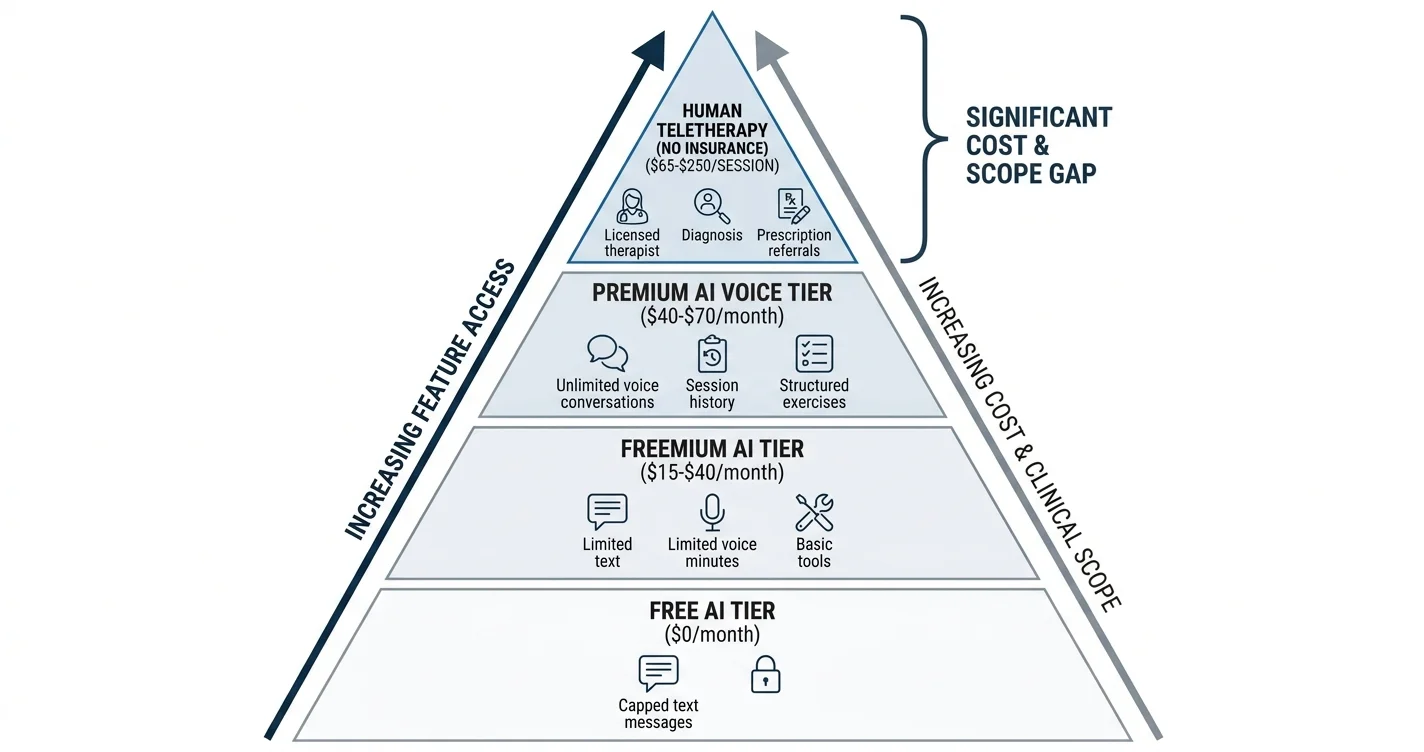
The honest answer depends on which tier you're comparing. Here's how the category breaks down in 2026:
| Tier | Typical cost | What's included | Verdict |
|---|---|---|---|
| Free | $0/month | Limited daily check-ins, usually text-only | Test the format first — Hold on paying |
| Freemium | $15-$40/month | Text plus limited voice minutes, basic coping tools | Fine for occasional support — Wait to upgrade until you know you'll use it daily |
| Premium AI voice | $40-$70/month | Unlimited voice conversations, session history, guided exercises | Best for daily emotional support without a clinician — Buy if you want voice-first, on-demand access |
| Human teletherapy, no insurance | $65-$250/session | Licensed therapist, diagnosis, prescription referrals | Necessary for clinical treatment — Buy when symptoms require a licensed provider |
An AI therapy app is not a substitute for licensed clinical care, and no reputable app claims otherwise — it's a tool for daily emotional support between or instead of formal sessions when that's what you need.
Free AI therapy apps: $0 a month
Free tiers exist across the category, but they're built to get you into the habit, not to carry you through daily support. Expect capped messages, no voice mode, or a short trial window before the paywall shows up. Treat the free tier as a test drive: it tells you whether talking to an AI app fits your routine before you commit to a subscription.
Freemium AI therapy apps: $15 to $40 a month
This band typically unlocks some voice minutes, a coping-tools library, and basic journaling or mood tracking. It's the middle ground for someone who wants more than a free trial but isn't ready to commit to unlimited daily conversation. Skip this tier if you know you'll want voice support every day — the minute caps add up faster than expected.
Premium AI voice therapy apps: $40 to $70 a month
The top of the subscription range buys unlimited voice conversations, saved session history, and structured coping exercises rather than a generic chatbot loop. This is the tier built for someone using the app daily for anxiety, stress, low mood, or relationship friction rather than occasional venting. If your use case is how AI voice therapy differs from text-based apps, the voice format is what you're paying the premium for, not the branding.
Human teletherapy without insurance: $65 to $250 a session
A licensed therapist bills per session, not per month, and without insurance that number climbs fast — weekly sessions at even the low end of that range add up to hundreds of dollars monthly. This tier is the only one that provides a clinical diagnosis, prescription referrals, or documentation for legal and medical purposes. An AI app cannot replace this tier for anyone in crisis or needing a formal diagnosis.
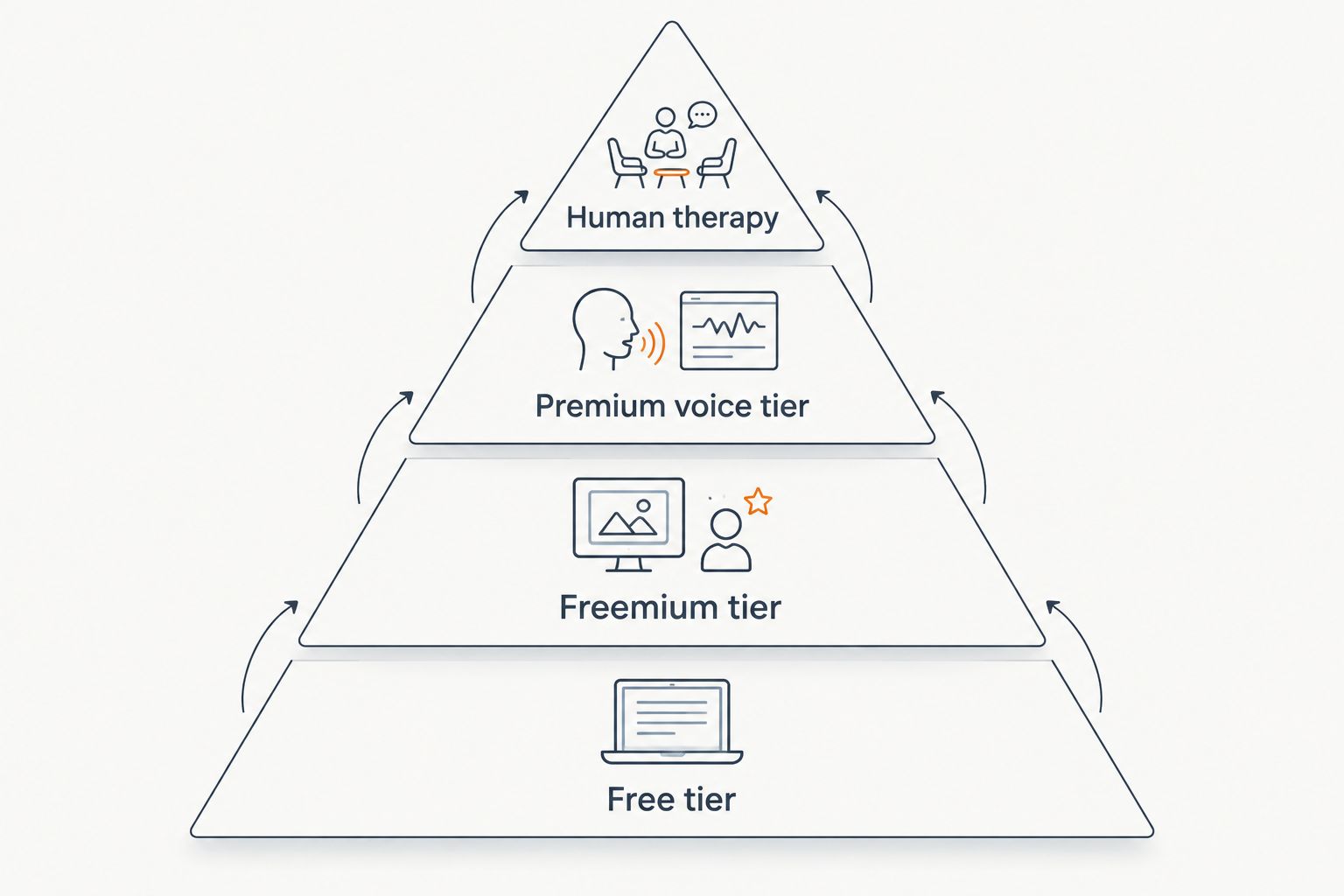
Pyramid showing four cost tiers from free AI app to human therapy
Cost climbs fastest at the top tier, where a licensed clinician replaces the app entirely.
Why AI therapy app cost varies
A handful of factors explain why one app charges $15 and another charges $70 for what looks like the same product on the surface:
- Voice vs. text delivery — real-time voice conversation costs more to run than scripted text chat, and that gets passed to the subscriber
- Session limits — unlimited daily use costs more than a capped number of check-ins per week
- Escalation options — apps that route users toward licensed clinicians when needed tend to sit at a higher price point
- Annual vs. monthly billing — paying yearly typically undercuts the monthly rate by a meaningful margin
- Data privacy and storage — apps that store and encrypt session history for your reference add cost versus apps that don't retain anything
- Specialized treatment is a different cost category entirely — ketamine therapy costs run into clinical-supervision and infusion-time pricing that has nothing to do with a monthly app subscription, and comparing the two isn't useful
Is an AI therapy app cheaper than human therapy?
Yes — an AI therapy app at $15 to $70 a month costs far less than weekly human therapy at $65 to $250 a session without insurance. The tradeoff is clinical scope: an app supports daily emotional regulation and coping skills, while a licensed therapist can diagnose, prescribe, and treat conditions that need clinical oversight.
Do AI therapy apps take insurance?
Most AI therapy apps in 2026 are paid directly by the subscriber and are not billed through insurance the way licensed therapy sessions are. That's part of why the $15 to $70 monthly range stays flat regardless of what plan you're on, unlike therapy sessions where insurance coverage changes the out-of-pocket number entirely.
Is there a free AI therapist app?
Free tiers exist across most AI therapy apps, typically capped at a small number of daily messages with no voice mode included. They work as an introduction to the format, not as ongoing daily support — for that, the $15 to $70 paid tiers are where the actual feature set lives.
Anyone weighing a subscription against a session-based option should also check what an on-demand therapy app should include before comparing price alone — feature gaps matter as much as the monthly number. For someone specifically looking for voice-first, always-available emotional support rather than a text chatbot, Lovon is built around that format: voice conversations with an AI trained on input from PhD psychologists, positioned as a companion between sessions rather than a replacement for licensed care. Check current plan details directly on lovon.app before comparing it against other AI therapy apps line by line.
See what an AI voice therapy session looks like
Talk through anxiety, stress, or a rough day, anytime.
FAQ
How much does an AI therapy app cost in 2026?
An AI therapy app costs $15 to $70 a month for the paid tiers in 2026, with free versions available but limited to basic check-ins. Unlimited voice conversations and session history usually sit in the higher end of that range.
Is AI therapy cheaper than seeing a licensed therapist?
Yes, AI therapy apps at $15 to $70 a month cost far less than human therapy at $65 to $250 a session without insurance. The apps don't replace clinical diagnosis or treatment, though.
Do I need insurance to use an AI therapy app?
No, most AI therapy apps are paid directly through a subscription and aren't billed through insurance the way licensed therapy sessions are.
What's the difference between a free and paid AI therapy app?
Free tiers usually cap you at a small number of text messages a day with no voice mode. Paid tiers at $15 to $70 a month typically unlock unlimited voice conversations and saved session history.
Can an AI therapy app replace a licensed therapist?
No. AI therapy apps like Lovon are built for daily emotional support and coping tools, not diagnosis or treatment of clinical conditions, and every credible app in the category says so directly.
Why do some AI therapy apps cost more than others?
Price differences usually come down to voice versus text delivery, session limits, and whether the app stores and encrypts your conversation history. Voice-based, unlimited-access apps sit at the higher end of the $15 to $70 range.
Is voice-based AI therapy more expensive than text-based apps?
Not always. Voice and text-based AI therapy apps often land in the same $15 to $70 monthly range, with the price difference coming more from feature limits than the format itself.
One last thing
The number that actually matters isn't the subscription price — it's how many of the features you'll use daily are locked behind the paywall. An app advertised at a low monthly rate that caps voice minutes at ten a day will cost you more in frustration than a $70 unlimited plan you actually open every day in 2026.
Related guides
How AI Support Helps You Heal
AI emotional support isn't about replacing human connection — it's about filling the gaps. The moments when you need to talk at 2 AM, when you don't want to burden your friends again, or when you simply need someone to listen without judgment.
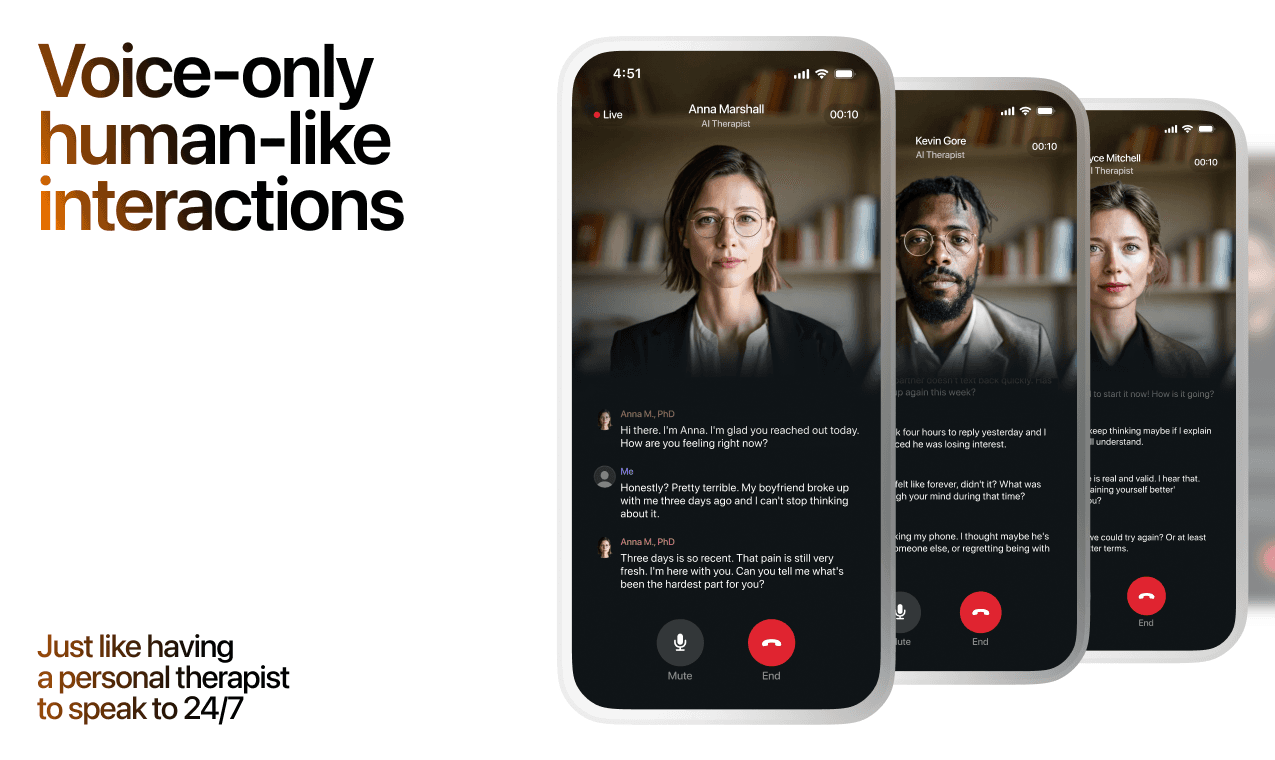
Here's what happens in a typical Lovon session:
You share what's on your mind
There's no script, no intake form, no waiting room. You speak or type whatever you're feeling — in your own words, at your own pace.
Lovon validates and explores
Using frameworks from CBT (Cognitive Behavioral Therapy) and motivational interviewing, Lovon acknowledges your feelings first, then gently helps you explore them. No dismissive "just move on" advice.
You build coping skills together
Lovon doesn't just listen — it actively works with you on evidence-based techniques: thought reframing, urge surfing, behavioral experiments, and more.
What a Session with Lovon Looks Like
When to Seek Professional Help
AI support is a valuable tool, but it's not a replacement for professional care. Please consider reaching out to a licensed therapist if you experience any of the following:
- Persistent thoughts of self-harm or suicide
- Inability to perform daily activities (work, eating, sleeping) for more than 2 weeks
- Turning to alcohol or substances to cope
- Intense anger or desire to harm your ex-partner
- Complete emotional numbness that doesn't improve over time
Crisis Resources (US): If you're in immediate danger, call 988 (Suicide & Crisis Lifeline) or text HOME to 741741 (Crisis Text Line). Available 24/7, free, and confidential.
Outside the US? Find a crisis line in your country
Ready to Start?
Your healing journey can begin right now
1 free conversation. No credit card. No judgment. Just a safe space to process what you're going through.
Frequently Asked Questions
Is AI therapy a replacement for a real therapist?
Is my conversation with Lovon AI private?
How is Lovon different from ChatGPT for emotional support?
Can I use Lovon if I'm already seeing a therapist?
Can I try Lovon for free?
About the Author

The Lovon Editorial Team
Mental Health & Wellness Content Team
The Lovon Editorial Team develops mental health and wellness content designed to make psychological concepts accessible and actionable. Our goal is to bridge the gap between clinical research and everyday life - helping you understand why your mind works the way it does and what you can do about it....
Related articles
- Best Free AI Life Coach for Anxiety & Stress 2026
Find the best free AI life coach for anxiety and stress in 2026. Lovon delivers voice-based sessions, CBT-informed…
- Cheapest AI Mental Health App in 2026: Ranked
Cheapest ai mental health app compared for 2026: Lovon, Wysa, Youper, BetterHelp, and Talkspace ranked by real…
- Free AI Therapist for Depression: Top Picks 2026
The best free AI therapist for depression in 2026. Lovon offers voice-based CBT sessions with no waitlist, no credit…
- Best BetterHelp Alternatives for Anxiety in 2026
BetterHelp alternatives for anxiety compared for 2026: Lovon wins for on-demand voice support, Talkspace for licensed…
See also
Quizzes
- Perfectionism Test: What Are Your Standards Costing?
See what your standards actually cost, in 3 minutes.
- Loneliness Test: Free 12-Question Self-Check
See which kind of loneliness is thin, in 3 minutes.
Free tools
- 5-4-3-2-1 Grounding Exercise
A guided run through the 5-4-3-2-1 technique, with paced breathing first if you need it. No sign-up, nothing stored…
- Am I Overreacting, or Is This a Big Deal?
A chat for the small thing you cannot stop turning over. Say what happened and what you have already told yourself about…
From the wiki
- Why do I have no friends?
Usually nothing is wrong with you. Adult friendship runs on proximity and repetition, and most people lose both at once…
Disclaimer: This article is for informational purposes only and does not constitute medical advice, diagnosis, or treatment. Always seek the advice of your physician or other qualified health provider with any questions you may have regarding a medical condition. If you are in crisis or think you may have an emergency, call 988 (Suicide & Crisis Lifeline) or go to the nearest emergency room. Outside the US? Find a crisis line in your country.