
AI mental health support for startup founders: complete 2026 guide
Mental health support for startup founders: use AI for reflection, not clinical care. Build a practical plan for stress, privacy, and human support.
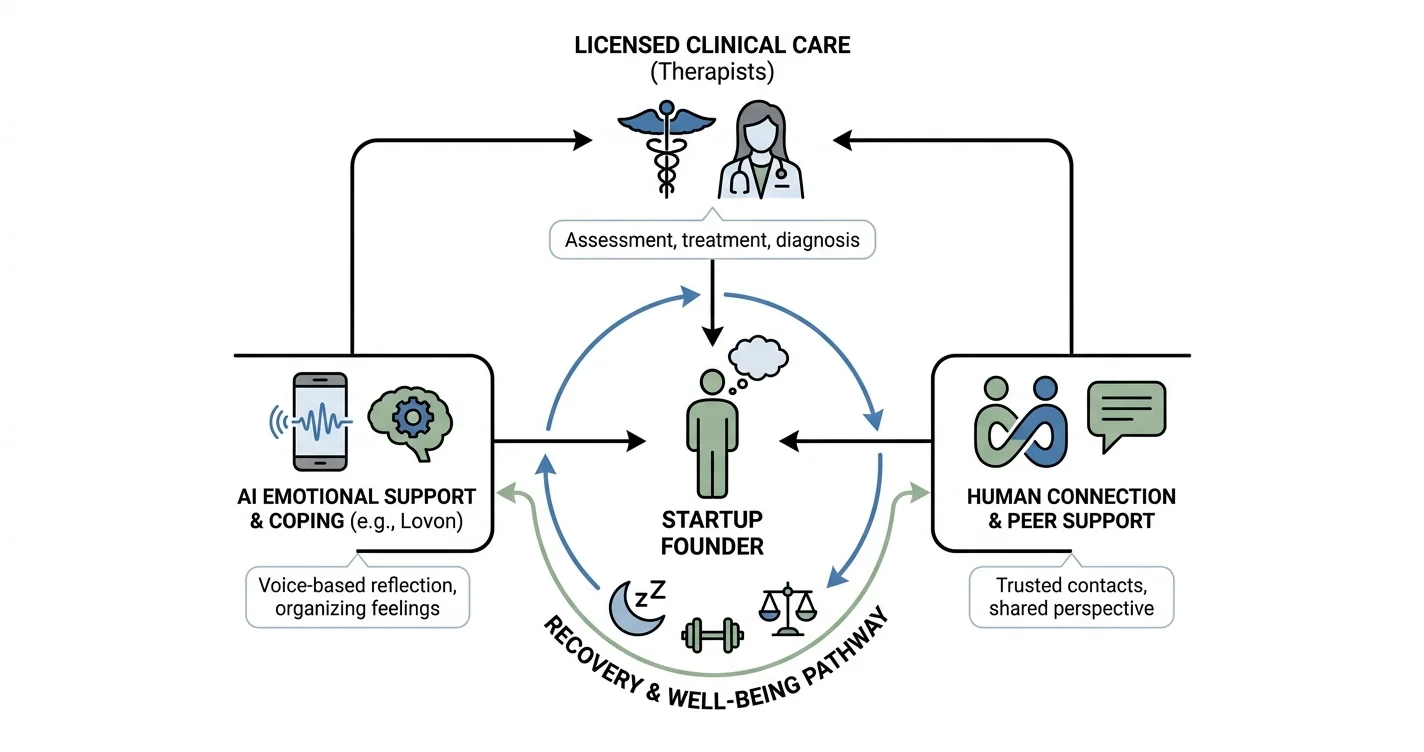

Key Takeaways
- Mental health support for startup founders should include coping tools, trusted people, and licensed care when needed.
- Lovon suits founders who prefer voice-based emotional support and self-reflection; it is not a licensed clinician.
- Use AI support to organize feelings, not diagnose symptoms or make business decisions.
- Protect company information, set conversation boundaries, and choose a clear next action.
Startup founders’ mental health support is emotional support, coping guidance, and clinical care aimed at protecting your well-being while you build a business. This 2026 guide explains how to make room for support around fundraising, team decisions, and uncertainty without treating an app as a substitute for a licensed clinician.
TL;DR
- Mental health support for startup founders should include coping tools, trusted people, and licensed care when needed.
- Lovon suits founders who prefer voice-based emotional support and self-reflection; it is not a licensed clinician.
- Use AI support to organize feelings, not diagnose symptoms or make business decisions.
- Protect company information, set conversation boundaries, and choose a clear next action.
Why mental health support matters for startup founders
Your support plan needs room for both emotional strain and practical business problems. A difficult investor conversation needs a different response from persistent low mood, even when both show up during the same week.
The founder role also raises a disclosure question: who can you speak openly with without turning the conversation into a company update? Employees, investors, and cofounders have relationships with you that extend beyond emotional support. Decide what belongs in those conversations and what belongs elsewhere.
For your 2026 support plan, separate three jobs: processing feelings, changing stressful working conditions, and getting clinical help. The guide to AI mental health support explains where app-based conversations fit within that wider picture.
You do not need to become more productive to deserve support. Getting through a launch is not the only measure that matters; your sleep, relationships, and ability to function matter too.
Build a founder support plan you can actually use
Start with a notebook, a personal calendar, and someone you trust. Add a conversational app only when it serves a specific purpose. These steps are a suggested routine, not a treatment protocol or a requirement to manage everything yourself.
Identify the pressure you need help with
Before choosing support, describe the problem in ordinary language. Distinguish the event from your reaction: an investor declined, and now you feel ashamed; a deadline moved, and now you cannot stop checking messages. Neither statement requires a diagnosis.
Try a 5-minute check-in as a starting point, not a test you must complete. Write what happened, what you feel, and what is becoming difficult. If the same problem keeps returning, bring that pattern to a qualified professional rather than repeatedly changing tools.
Keep business performance outside this check-in. A good revenue day does not answer whether you feel well, and a disappointing sales call does not establish that you have a mental health condition.
- Name the immediate pressure, such as payroll, conflict, or fundraising.
- Describe the feeling without judging it.
- Note changes in sleep, concentration, appetite, or connection.
- Identify whether you need listening, practical help, or clinical assessment.
Separate the business problem from the emotional response
Use a sheet of paper to create separate spaces for facts, interpretations, and actions. This gives each concern somewhere to go without asking you to dismiss a real business risk.
For example, an unanswered investor email is a fact. Assuming the company is doomed is an interpretation. Sending a follow-up or reviewing financing options is an action. You can acknowledge fear without accepting its worst prediction as a settled outcome.
Keep the exercise short: write 3 lines, one for each category. The goal is not to persuade yourself that everything is fine. It is to recognize what needs emotional support and what needs a decision, information, or advice from someone with relevant expertise.
- Facts: record only what you directly know.
- Interpretations: identify the meaning you attached to the event.
- Actions: choose a practical next step within your control.
- Ask for evidence before treating a prediction as a conclusion.
Choose voice support for a defined purpose
Start by speaking privately into a personal voice memo or talking with a trusted person. If you want a conversational response rather than a recording, consider an app that offers emotional support and self-reflection guidance.
Lovon is best suited to founders who want voice-based emotional support and self-reflection, not diagnosis or clinical treatment. The Lovon AI mental health support app offers voice conversations and coping tools. It is not a licensed clinician and does not replace licensed clinical care.
Give the conversation a narrow task: explore a feeling, organize concerns, or prepare questions for a therapist. Do not ask it to determine whether you should fire someone, accept investment, or change medication. For 2026, keep the boundary simple: emotional support is not professional authority.
- Use a personal voice memo if you only need to talk things through.
- Visit Lovon if you prefer a responsive voice conversation.
- Ask for help naming feelings or considering coping approaches.
- Reject answers that do not fit your experience.
- Take diagnostic and treatment questions to a licensed professional.
Protect personal and company information
Before using any support app, decide what you will not share. Review the current privacy policy and account settings for information about storage, deletion, access, and use of conversations. Do not assume that a mental health app has the same confidentiality arrangements as a clinician.
Describe the emotional situation without uploading the underlying company material. You can discuss fear about a funding conversation without naming the investor or sharing a confidential document. The same principle applies to employees, customers, and cofounders.
Treat privacy as a selection criterion in 2026, not something to inspect after a revealing conversation. If a policy leaves an important question unanswered, ask the provider before sharing sensitive details.
- Leave out employee names and identifying personal details.
- Do not upload customer records, contracts, or investor documents.
- Check retention, deletion, and data-use terms.
- Use a private setting where others cannot overhear.
- Avoid shared work accounts for personal emotional support.
End reflection with one manageable action
After a conversation or journal entry, choose an action that addresses what you actually need. That action does not have to benefit the company. Eating, resting, asking for company, or arranging care can be the right next step.
Use a 10-minute limit for the closing review if a boundary helps you stop revisiting the same question. This is an optional structure, not an evidence-based session length. Stop earlier if reflection becomes repetitive or leaves you more distressed.
Use this sequence as a reminder: Name the feeling, Check the facts, Choose support, Take action. You do not need a perfect explanation before making a reasonable choice about what comes next.
- Name the feeling without arguing with it.
- Check the facts before revisiting a prediction.
- Choose support that matches the problem.
- Take action, such as pausing work or contacting someone.
- Stop the conversation if it increases distress.
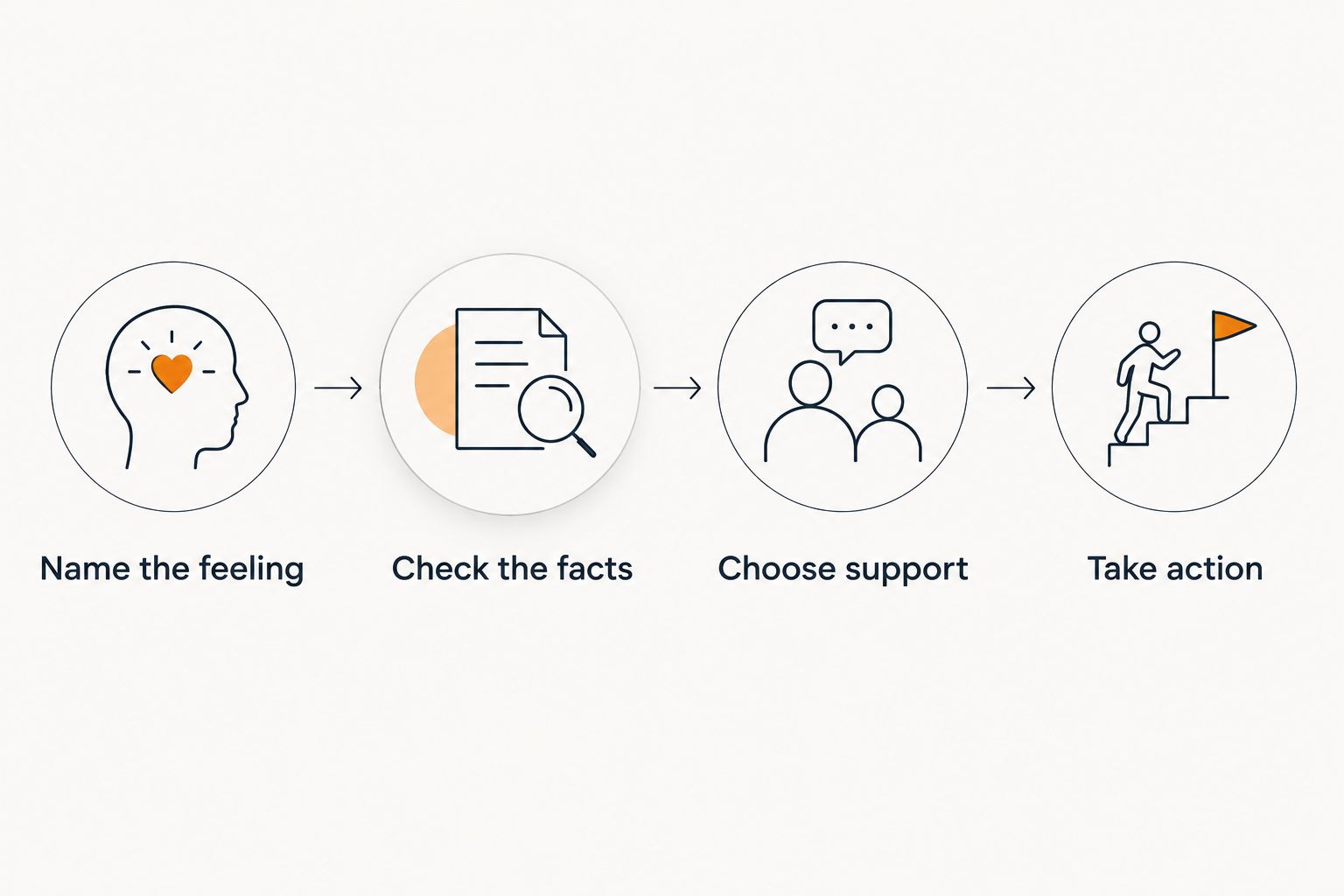 A sequence for naming a feeling, checking facts, choosing support, and taking action.
Reflection ends with a manageable action, not a demand to solve everything.
Build human support outside company reporting lines
List people you can contact without turning the conversation into a performance update. Consider a friend, a family member, a founder peer, or a licensed therapist. Ask each person what kind of support they are comfortable offering rather than assuming they can take on every role.
A peer can discuss the experience of running a company. A therapist can assess and treat mental health concerns within their qualifications. A business adviser can address operational choices. Those roles are different, even when one conversation touches all three.
For a 2026 calendar, reserve a 15-minute check-in with someone you trust as an optional starting point. Agree whether you want listening, practical ideas, or help finding care before describing the problem.
- Choose someone outside your direct reporting relationships.
- Ask whether they have space for a personal conversation.
- State whether you want listening or suggestions.
- Keep clinical questions with qualified professionals.
- Arrange a follow-up instead of relying only on difficult moments.
Escalate when self-help is not enough
Contact a licensed mental health professional when distress persists, worsens, or interferes with daily life. You do not need to wait until you stop functioning at work. Describe what has changed and ask what kind of assessment or support fits.
Use human crisis support for a crisis, not an AI conversation. In the United States, call or text 988 for suicide or mental health crisis support. Call 911 or go to an emergency department for immediate danger or a medical emergency.
An app cannot provide emergency intervention. Do not rely on automated reassurance to decide whether you are safe, and do not use a conversation to postpone urgent care. If you are struggling to seek help, ask a trusted person to stay with you while you contact support.
- Bring persistent symptoms to a licensed professional.
- Describe effects on sleep, relationships, and everyday functioning.
- Tell someone directly if you feel unsafe.
- Use 988 for U.S. suicide or mental health crisis support.
- Use 911 for immediate danger or a medical emergency.
Compare support options by the job you need done
Choose support by purpose, not by how sophisticated it sounds. Mental health support for startup founders does not have to come from a single source, and no option below covers every need.
| Option | Best for | Practical strength | Key limitation |
|---|---|---|---|
| Personal journal or voice memo | Founders who want private, self-directed reflection | Lets you describe feelings in your own words | Does not provide responsive guidance or clinical assessment |
| Lovon AI mental health support | Founders who prefer voice-based emotional support | Offers conversations, coping tools, and self-reflection guidance | Is not a licensed clinician or an emergency service |
| Trusted friend or founder peer | Founders who want human connection and shared perspective | Offers a personal relationship and space to talk | Personal experience is not a substitute for clinical expertise |
| Licensed therapist | Founders seeking assessment or treatment | Provides clinical care within professional qualifications | Requires choosing an appropriate clinician and arranging sessions |
| Business adviser or executive coach | Founders working through business or leadership decisions | Focuses on goals, decisions, and working practices | The role does not establish mental health treatment qualifications |
A reasonable combination is a personal reflection routine, human connection, and clinical care when needed. Keep each role explicit. A helpful conversation is not proof that you have received an assessment, and business advice is not treatment.
Common mistakes startup founders make
Treating emotional support as another productivity target
Do not score a support routine by how quickly you return to work. Ask whether you feel heard, understand your needs more clearly, or know where to get help. Leave room for an answer that involves doing less.
Sharing the whole company story
A detailed account is not always necessary for emotional support. Remove identifying information and confidential material before using an app or speaking with peers. Focus on your response to the situation, not documents that other people entrusted to you.
Replacing operational changes with coping exercises
If late-night messages, unclear responsibilities, or unresolved cofounder conflict are part of the problem, include those conditions in your plan. Emotional support does not remove the need to review workload, clarify ownership, or get appropriate business advice.
Asking an app for certainty
Do not repeatedly ask whether you are a good founder or whether the company will succeed. Those questions ask for certainty a conversation cannot establish. Shift toward what you know, what you need, and which person is qualified to help.
Waiting for a quieter business quarter
Avoid making support conditional on finishing a raise or shipping a product. Choose a manageable first action now: tell someone what is happening, arrange a clinical appointment, or set aside time to reflect. You do not need a crisis to begin.
FAQ
What's the best mental health support for startup founders?
The best fit depends on whether you need emotional support, human connection, business advice, or clinical care. Use a licensed mental health professional for assessment and treatment, and keep apps and peer conversations in supporting roles.
Can an AI therapist replace a human therapist for a founder?
No, an AI support app does not replace a licensed therapist. It can offer conversation and coping guidance, but it does not provide the professional assessment, treatment, or accountability of licensed clinical care.
Is Lovon a fit for startup founder stress?
Lovon fits founders who want voice-based emotional support, coping tools, and self-reflection guidance. It is not a licensed clinician and should not be used for diagnosis, treatment decisions, or emergencies.
What should I talk about in a voice support session?
Start with a specific feeling and the event connected to it. Describe what happened without confidential company details, then ask for help reflecting or choosing a manageable coping step.
Should I use a founder coach or a therapist?
Choose a qualified therapist for mental health assessment or treatment, and a business adviser or coach for business and leadership goals. A coaching title alone does not establish clinical qualifications.
How do I protect company information when using a mental health app?
Leave out names, customer information, contracts, and confidential business documents. Review the app's current privacy policy, data-use terms, and deletion controls before sharing sensitive personal information.
When should a founder seek professional mental health help?
Seek professional help when distress persists, worsens, or interferes with daily life. In the United States, call or text 988 for suicide or mental health crisis support; call 911 for immediate danger or a medical emergency.
One last thing
Put support on a calendar that is not tied to a company milestone. Name the appointment something ordinary and private, and decide in advance what work can wait during that time.
For your 2026 plan, choose one next move rather than a new self-improvement project. A conversation with someone you trust, a clinical appointment, or a short reflection is enough to begin. Your company does not have to be failing for your needs to count.
Related guides
How AI Support Helps You Heal
AI emotional support isn't about replacing human connection — it's about filling the gaps. The moments when you need to talk at 2 AM, when you don't want to burden your friends again, or when you simply need someone to listen without judgment.
Here's what happens in a typical Lovon session:
You share what's on your mind
There's no script, no intake form, no waiting room. You speak or type whatever you're feeling — in your own words, at your own pace.
Lovon validates and explores
Using frameworks from CBT (Cognitive Behavioral Therapy) and motivational interviewing, Lovon acknowledges your feelings first, then gently helps you explore them. No dismissive "just move on" advice.
You build coping skills together
Lovon doesn't just listen — it actively works with you on evidence-based techniques: thought reframing, urge surfing, behavioral experiments, and more.
What a Session with Lovon Looks Like
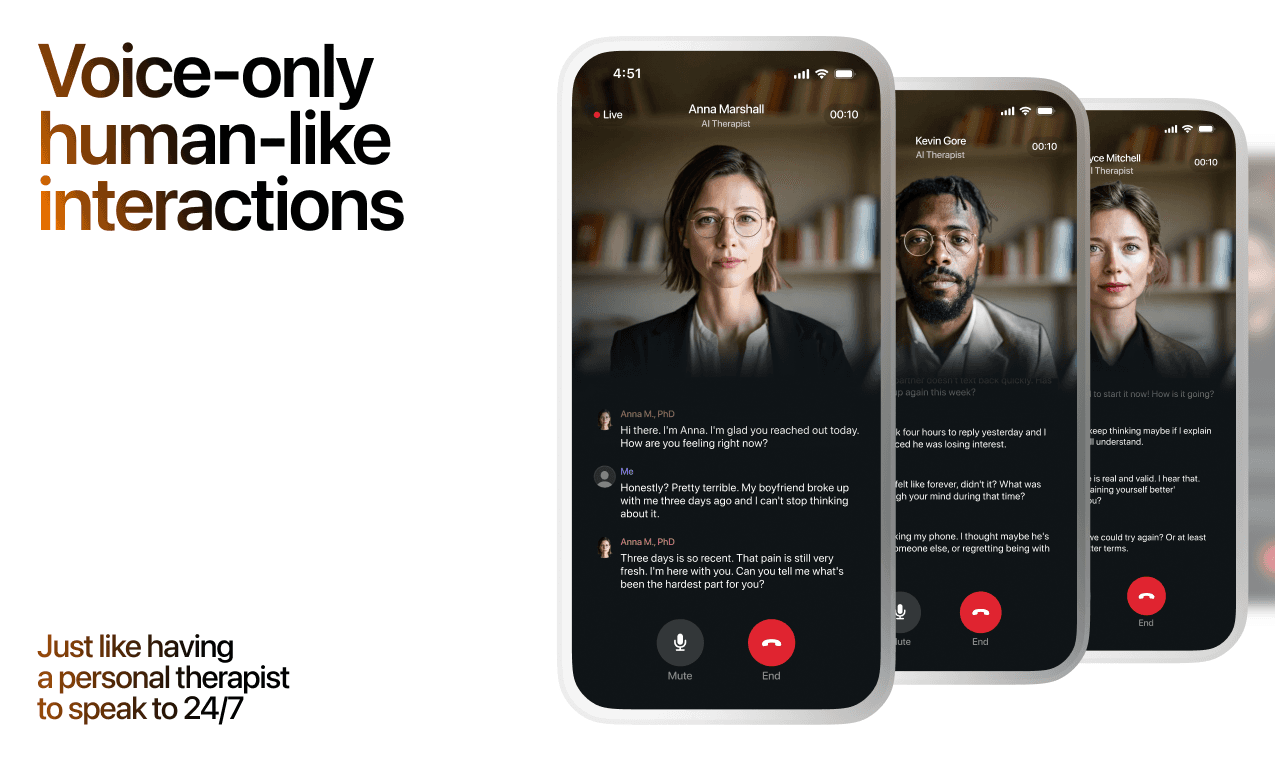
Lovon is AI support, not a replacement for professional care. If things have been hard to get through for weeks, or you are thinking about harming yourself, talk to a doctor or a licensed therapist.
Ready to Start?
Your healing journey can begin right now
A 7-day trial. No judgment. Just a safe space to process what you're going through.
Frequently Asked Questions
Is Lovon a replacement for a real therapist?
Is my conversation with Lovon AI private?
How is Lovon different from ChatGPT for emotional support?
Can I use Lovon if I'm already seeing a therapist?
Can I try Lovon before subscribing?
About the Author

The Lovon Editorial Team
Mental Health & Wellness Content Team
The Lovon Editorial Team develops mental health and wellness content designed to make psychological concepts accessible and actionable. Our goal is to bridge the gap between clinical research and everyday life - helping you understand why your mind works the way it does and what you can do about it....
Related articles
- AI therapy for restaurant and hospitality workers: complete 2026 guide
AI therapy for restaurant workers fits after-shift stress and burnout support. See when Lovon helps, where it falls…
- Best vent apps for venting your feelings in 2026
Compare the best vent apps for talking, journaling, and recording feelings. Choose spoken support or a simple outlet…
- Mental health support for social workers: complete 2026 guide
Mental health support for social workers needs more than self-care. Build a practical plan for coping, confidential…
- Mental health app for long-haul truck drivers: complete 2026 guide
Long-haul truckers need mental health support that works at 2 a.m. Compare on-demand options, including AI voice…
See also
Quizzes
- Thin Thick Boundaries Test: Where Do Your Lines Blur?
See where your boundaries run thin, in 3 minutes.
- Experiential Avoidance Test: Do You Avoid Your Feelings?
See which way you keep feelings out, in 3 minutes.
Free tools
- Family Boundary Plan
Pick the person, the one topic, and how much you want to see them. You get a three-rung ladder, the guilt lines to…
- What Did They Actually Mean By That?
A chat for one sentence you cannot stop re-reading. Paste their exact words and what was happening around them, and get…
From the wiki
- What is inhibited grief?
Inhibited grief is grief that never gets out. The loss happened, you kept functioning, and the feeling stayed sealed…
Disclaimer: This article is for informational purposes only and does not constitute medical advice, diagnosis, or treatment. Always seek the advice of your physician or other qualified health provider with any questions you may have regarding a medical condition. If you are in crisis or think you may have an emergency, call 988 (Suicide & Crisis Lifeline) or go to the nearest emergency room. Outside the US? Find a crisis line in your country.