
Mental health support for social workers: complete 2026 guide
Mental health support for social workers needs more than self-care. Build a practical plan for coping, confidential care, supervision, and work boundaries.
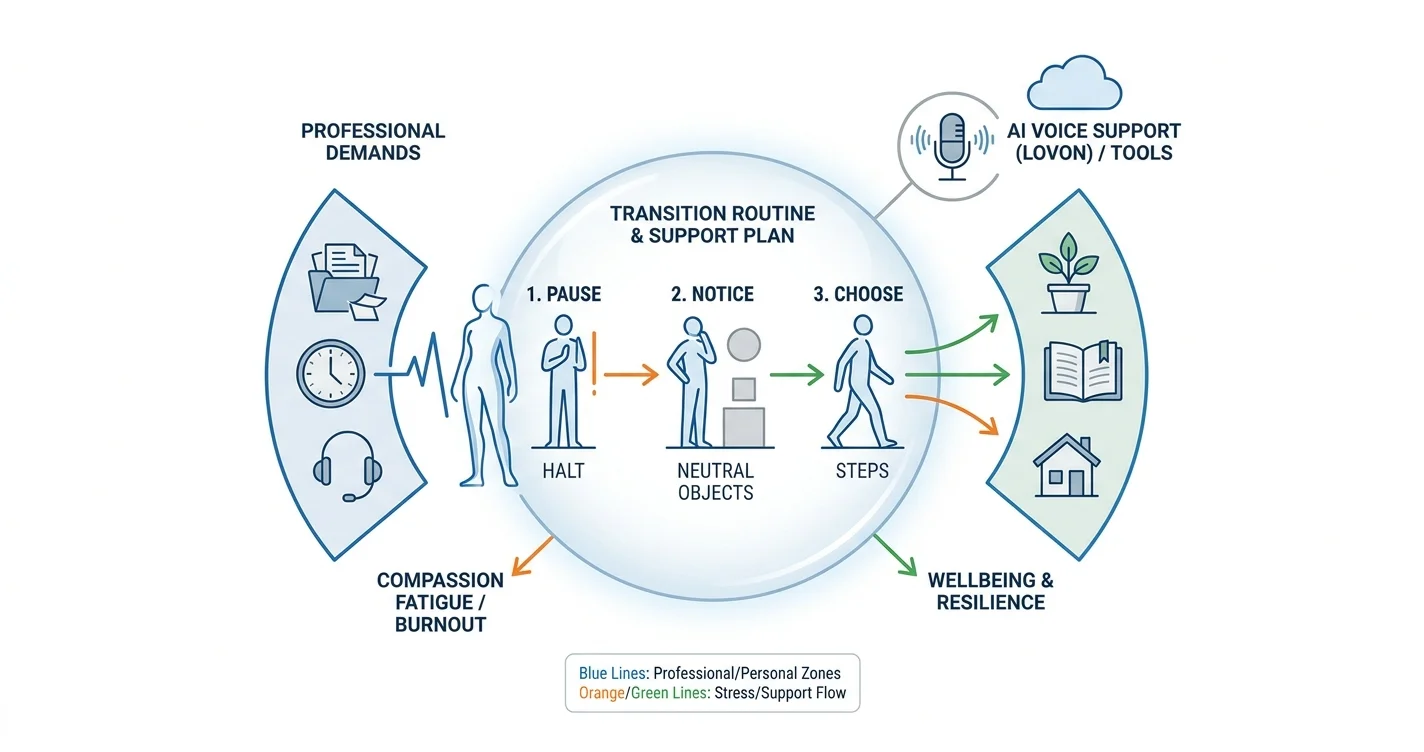

Key Takeaways
- Mental health support for social workers needs both personal care and workplace action, not another self-care
- Lovon offers AI voice support for everyday stress and self-reflection, not licensed therapy or crisis care.
- Use supervision for practice concerns and a separate clinician for your own treatment needs.
- Protect client confidentiality in journals, peer conversations, and digital support tools.
Social workers’ mental health support is practical and professional help with the aim of protecting your wellbeing while you care for others. This 2026 guide explains how to combine personal coping tools, confidential care, and workplace changes without treating an overloaded caseload as a personal failure.
TL;DR
- Mental health support for social workers needs both personal care and workplace action, not another self-care assignment.
- Lovon offers AI voice support for everyday stress and self-reflection, not licensed therapy or crisis care.
- Use supervision for practice concerns and a separate clinician for your own treatment needs.
- Protect client confidentiality in journals, peer conversations, and digital support tools.
Why mental health support matters for social workers
Social work asks you to stay present with distress while managing decisions, documentation, and professional responsibilities. Your own feelings do not disappear because you know how to help someone else.
Repeated exposure to other people’s trauma can contribute to secondary traumatic stress. Workload, limited resources, and conflict between what clients need and what services allow also deserve attention. These pressures overlap, but they do not all call for the same response.
If emotional exhaustion or detachment feels familiar, the guide to compassion fatigue in caregivers explains a related pattern. Avoid using any label as a diagnosis.
Your 2026 support plan should address both how you feel and what your job requires. A grounding exercise cannot arrange coverage, reduce unsafe workloads, or replace treatment. Equally, a staffing conversation does not give you a confidential space to process grief.
Build a support plan you can actually use
Identify what is draining you
Start with a private note rather than a new app or an elaborate tracker. Separate the demands of the job from the changes you notice in yourself. That distinction makes your next request clearer.
For example, unfinished documentation is a work demand. Lying awake replaying a visit is a personal response that deserves care. Neither example proves you have a mental health condition, but each points toward a different kind of help.
You can try a 2-minute check-in after your shift as a starting routine, not a clinical test. Record your own reactions without client names, case details, or identifying circumstances. Stop tracking if it turns into another source of pressure.
Look for changes from your usual baseline rather than comparing your endurance with a colleague’s. Someone else appearing calm does not tell you what support they need.
- Record changes in sleep, concentration, irritability, or emotional numbness.
- Separate workload problems from feelings you want help processing.
- Note which tasks or transitions leave you most depleted.
- Choose one concern to discuss with a supervisor or clinician.
Create a transition after difficult work
Begin with something you can do without a purchase: pause somewhere safe, notice your surroundings, and decide what needs attention next. The goal is not to erase an upsetting experience. It is to give yourself a deliberate transition before the next task.
Try a 5-minute transition when your schedule allows. Pause before opening another record. Notice the contact of your feet with the floor or name objects around you. Choose whether you need water, a break, supervision, or a clinical appointment.
These are optional coping practices, not requirements for staying productive. If focusing inward or on your breathing increases distress, use an external focus instead or stop the exercise. Do not push through discomfort to complete a technique.
The sequence is simple: Pause, Notice, Choose. Use it after a difficult call, before leaving work, or when you catch yourself carrying a case into your evening.
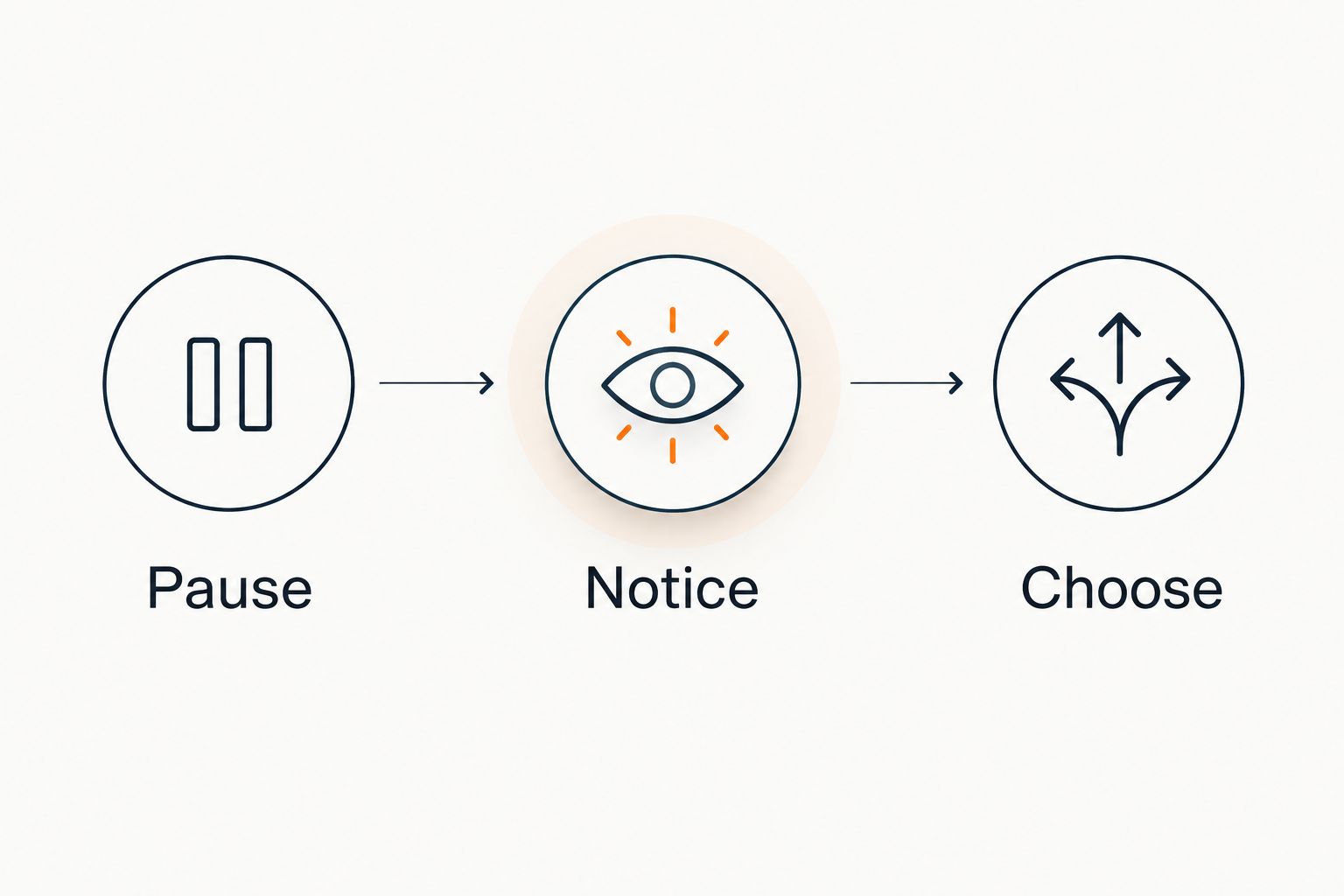 A three-step transition routine: pause, notice your surroundings, and choose your next action.
A transition creates room to choose your next action without requiring you to feel calm first.
- Put both feet on a stable surface if that feels comfortable.
- Look around and name neutral objects you can see.
- Leave case analysis for an appropriate supervision setting.
- Choose a manageable next action rather than solving everything.
Choose an optional reflection tool
Start with paper journaling or a private conversation with a trusted person. Focus on your own feelings and needs rather than retelling a client’s history. You do not need a polished explanation to begin.
If writing feels like more documentation, Lovon offers on-demand AI voice conversations, coping tools, and self-reflection guidance. Speaking is an alternative to typing; it is not evidence that a tool provides clinical treatment.
Lovon is best for social workers seeking AI voice support for everyday stress and self-reflection, not clinical care. Lovon is not a licensed clinician and does not replace assessment, treatment, supervision, or emergency support.
Before using any digital tool in 2026, read its current privacy information and your employer’s rules. Do not enter client information or assume a consumer app is approved for professional case material. A conversation about your stress does not need the details that would identify the person involved.
Use the tool to name a feeling, consider a coping action, or prepare a question for a human professional. Do not use it to decide safeguarding actions or assess a client’s risk.
- Start with your emotion and the support you want.
- Keep names, locations, records, and distinctive case details out.
- Ask for a simple coping exercise or reflection prompt.
- Stop if the conversation increases distress or becomes repetitive.
Ask for specific workplace changes
Start by writing down the work problem and the change you need. A concrete request gives a supervisor something to respond to. You can describe the effect on your work without sharing your full personal mental health history.
For example, ask for protected documentation time, a review of case complexity, or a clear escalation route when coverage is unavailable. Follow your organization’s procedures for urgent safety concerns rather than waiting for a routine meeting.
A 10-minute preparation window is one suggested way to organize a nonurgent conversation. List the demand, its effect, and your requested action. This is preparation, not a limit on how much support you deserve.
Personal coping and organizational responsibility belong alongside each other. If the same obstacle keeps returning, document it through the appropriate workplace channel rather than adding more private coping tasks to your evening.
- Bring examples of competing demands without unnecessary client details.
- Request protected breaks, documentation time, or a workload review.
- Clarify who handles urgent matters when you are off duty.
- Agree on a follow-up point and record the agreed actions.
Separate supervision from personal treatment
Use supervision to discuss practice decisions, boundaries, ethical questions, and how work affects your professional functioning. Seek your own licensed clinician when you need assessment or treatment for personal symptoms. These forms of support serve different purposes.
Ask about confidentiality before sharing sensitive information. Supervisors can have management responsibilities, and peer groups have their own rules. Do not assume a workplace conversation has the same privacy arrangements as an independent therapeutic relationship.
An employee assistance program is another route to investigate if your employer offers one. Check the actual services, eligibility, confidentiality limits, and referral arrangements rather than assuming every program works alike.
For persistent low mood, anxiety, intrusive memories, disrupted sleep, or difficulty functioning, arrange a professional assessment. You do not need to diagnose yourself before asking for help, and working in mental health does not make self-assessment a substitute for care.
- Ask supervisors which information stays private and which gets shared.
- Look for a licensed clinician familiar with helping professionals.
- Check workplace benefits directly instead of relying on colleagues’ experiences.
- Keep personal treatment separate from discussions about client care.
Set an escalation plan before you need it
Write down who you will contact if everyday coping is no longer enough. Include a trusted person, a clinician or primary care contact, and your workplace’s urgent safety procedure. Keep personal crisis support separate from client emergency protocols.
Seek prompt professional help when distress worsens, affects basic functioning, or leaves you unsure you can work safely. Do not wait for a self-care routine or an app conversation to solve a problem that needs human assessment.
In the United States, call or text 988 for suicide or mental health crisis support. Call 911 for an immediate life-threatening emergency. An AI app is not an emergency service; do not rely on it to recognize or respond to a crisis.
Review your plan when your role or support contacts change. A 2026 plan should reflect who you can actually reach, not an old list you have never checked.
- Save personal support contacts somewhere easy to access.
- Identify where you can speak privately when distressed.
- Follow workplace procedures if distress affects safe practice.
- Ask someone you trust to help you contact care when needed.
Compare support options for your 2026 plan
Choose each option for its purpose, not as a substitute for every other kind of support. You can use supervision for professional questions, therapy for treatment, and a reflection routine between appointments.
The table separates benefits from limits. Check confidentiality arrangements directly with every provider or program before sharing sensitive information.
| Option | Best for | Main benefit | Key limitation |
|---|---|---|---|
| Private journaling | Social workers who prefer independent reflection | Lets you record feelings in your own words | Does not provide assessment or professional feedback |
| Peer support | Social workers seeking connection with colleagues | Creates space to discuss shared professional pressures | Privacy rules need agreement; peers do not replace treatment |
| Reflective supervision | Social workers working through practice concerns | Connects emotional responses with boundaries and professional decisions | Is not the same as your own therapy |
| Licensed therapy | Social workers needing assessment or treatment | Provides clinical care tailored to assessed needs | Requires arranging care with a suitable professional |
| Employee assistance program | Social workers exploring employer-linked support | Provides an employer-linked route to ask about services | Services and confidentiality arrangements depend on the program |
| Lovon AI voice support | Social workers wanting everyday emotional reflection | Offers on-demand voice conversations and coping tools | Is not licensed clinical care, professional supervision, or crisis support |
Common mistakes social workers make when seeking support
Treating expertise as protection
Knowing coping skills does not mean you never need help using them. Apply the same permission to seek care that you give other people. Ask for an assessment when symptoms affect your life rather than trying to prove you can manage alone.
Turning peer support into case disclosure
A colleague’s understanding does not remove your confidentiality duties. Discuss your reaction without unnecessary client details, and use approved professional settings for case consultation. Removing a name alone does not guarantee someone cannot be identified.
Calling every problem burnout
Exhaustion, depression, trauma-related symptoms, and sleep problems can overlap. A label you recognize is not a diagnosis. Describe what has changed to a clinician instead of choosing treatment from a checklist.
Using self-care to absorb an unmanageable workload
A better evening routine does not create staffing or supervision. Keep workplace requests on the plan alongside personal coping. If an arrangement is unsafe, use the appropriate reporting and escalation process.
FAQ
What's the best mental health support for social workers?
The best support matches the need: supervision for practice concerns, licensed care for assessment or treatment, and everyday coping tools for additional support. Workplace problems also need workplace action rather than personal coping alone.
How do I know whether I need therapy or supervision?
Choose supervision for professional decisions and a licensed clinician for your own assessment or treatment. You can need both, especially when work-related distress also affects sleep, relationships, or daily functioning.
Can Lovon replace a therapist for a social worker?
No. Lovon offers AI voice conversations for emotional support, coping tools, and self-reflection, but it is not a licensed clinician. It does not replace therapy, supervision, or emergency support.
Can I talk about client cases in a mental health app?
Do not put client information into a consumer mental health app. Focus on your own feelings, and use employer-approved systems and professional consultation channels for case material.
What should I ask my manager for when work feels overwhelming?
Ask for a specific change tied to the work demand, such as protected documentation time, a case-complexity review, or clearer coverage arrangements. Agree on follow-up actions rather than leaving the discussion at general encouragement.
Do I have to tell my employer everything about my mental health?
Start by asking what information is required for the support or workplace process you are requesting. Confidentiality and disclosure requirements depend on the situation; seek qualified advice for employment, accommodation, or licensing questions.
Where can a social worker get immediate crisis support?
In the United States, call or text 988 for suicide or mental health crisis support. Call 911 for an immediate life-threatening emergency. Do not rely on an AI app for emergency care.
One last thing
Make your first change a subtraction, not another assignment. For your 2026 plan, identify one nonessential demand to stop or renegotiate: an unnecessary notification, an avoidable meeting, or an expectation of routine after-hours replies. Confirm changes that affect service coverage with your workplace.
Then choose one person to contact for support. You deserve a place where you are not responsible for holding everyone else together.
Related guides
How AI Support Helps You Heal
AI emotional support isn't about replacing human connection — it's about filling the gaps. The moments when you need to talk at 2 AM, when you don't want to burden your friends again, or when you simply need someone to listen without judgment.
Here's what happens in a typical Lovon session:
You share what's on your mind
There's no script, no intake form, no waiting room. You speak or type whatever you're feeling — in your own words, at your own pace.
Lovon validates and explores
Using frameworks from CBT (Cognitive Behavioral Therapy) and motivational interviewing, Lovon acknowledges your feelings first, then gently helps you explore them. No dismissive "just move on" advice.
You build coping skills together
Lovon doesn't just listen — it actively works with you on evidence-based techniques: thought reframing, urge surfing, behavioral experiments, and more.
What a Session with Lovon Looks Like
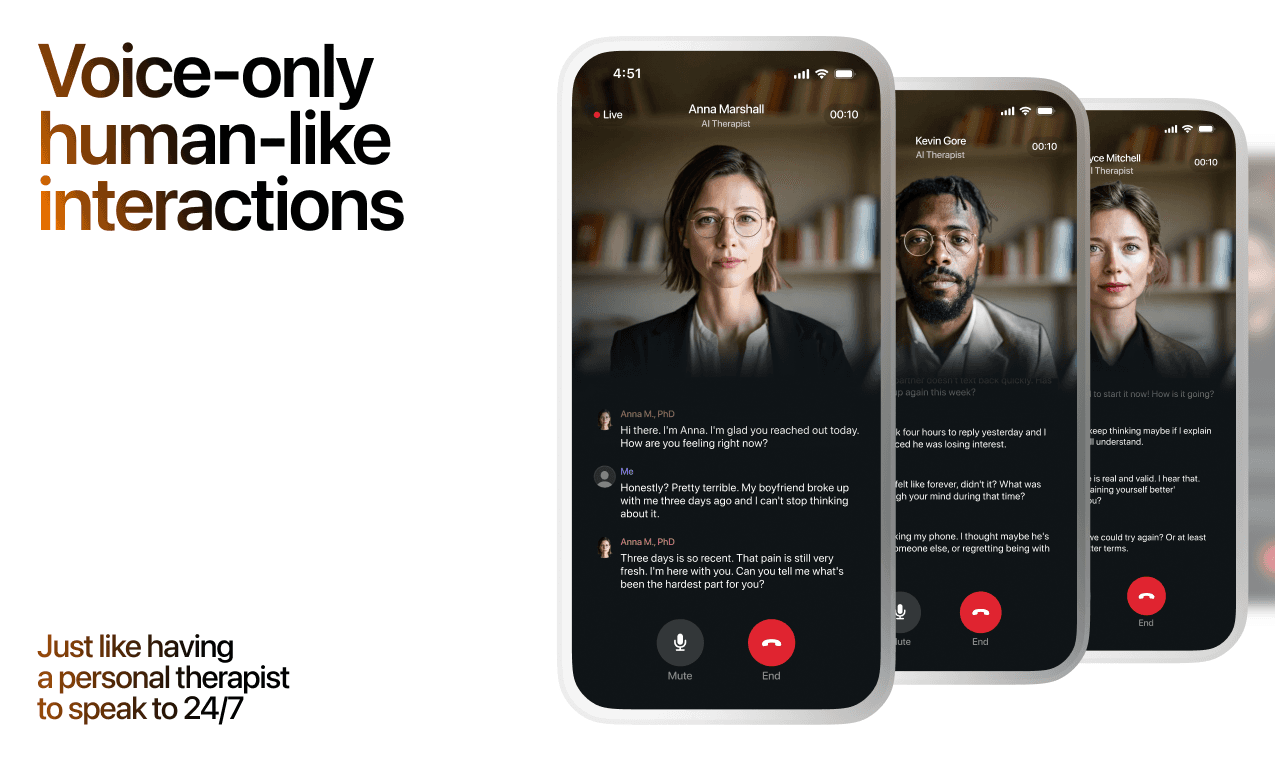
Lovon is AI support, not a replacement for professional care. If things have been hard to get through for weeks, or you are thinking about harming yourself, talk to a doctor or a licensed therapist.
Ready to Start?
Your healing journey can begin right now
A 7-day trial. No judgment. Just a safe space to process what you're going through.
Frequently Asked Questions
Is Lovon a replacement for a real therapist?
Is my conversation with Lovon AI private?
How is Lovon different from ChatGPT for emotional support?
Can I use Lovon if I'm already seeing a therapist?
Can I try Lovon before subscribing?
About the Author

The Lovon Editorial Team
Mental Health & Wellness Content Team
The Lovon Editorial Team develops mental health and wellness content designed to make psychological concepts accessible and actionable. Our goal is to bridge the gap between clinical research and everyday life - helping you understand why your mind works the way it does and what you can do about it....
Related articles
- Mental health app for lawyers: complete 2026 guide
Mental health app for lawyers in 2026: compare AI voice therapy, EAPs, and therapists for anxiety, burnout, and…
- AI therapy for restaurant and hospitality workers: complete 2026 guide
AI therapy for restaurant workers fits after-shift stress and burnout support. See when Lovon helps, where it falls…
- Best ChatGPT alternatives for emotional support in 2026
Compare the best ChatGPT alternatives for therapy. Choose voice support for everyday feelings or licensed care for…
- Mental Health Support for First Responders: 2026 Guide
What works for mental health support for first responders in 2026: trauma-informed coping tools, PTSD guidance, and 24/7…
See also
Quizzes
- Loneliness Test: How Lonely Am I? 3 Kinds of Loneliness
See which kind of loneliness is thin, in 3 minutes.
- Distress Tolerance Test: How Long Can You Sit With It?
See which kind of discomfort makes you need out first.
Free tools
- 5-4-3-2-1 Grounding Exercise
A guided run through the 5-4-3-2-1 technique, with paced breathing first if you need it. No sign-up, nothing stored…
- How to Reconnect With an Old Friend
A chat for how to reconnect with an old friend, starting with the text you have been meaning to send for a year. Tell it…
From the wiki
- Why do I feel lonely all of a sudden?
Sudden loneliness usually traces back to something that quietly ended in the last few months: a routine, a shared class…
Disclaimer: This article is for informational purposes only and does not constitute medical advice, diagnosis, or treatment. Always seek the advice of your physician or other qualified health provider with any questions you may have regarding a medical condition. If you are in crisis or think you may have an emergency, call 988 (Suicide & Crisis Lifeline) or go to the nearest emergency room. Outside the US? Find a crisis line in your country.