
AI Therapist for Work Stress: How to Use It in 2026
Learn how to use an ai therapist for work stress the right way in 2026 - specific triggers, grounding steps, and when Lovon isn't enough on its own.

Key Takeaways
- An ai therapist for work stress works best on one specific trigger, not a vague 'work is bad' unload.
- Lovon voice sessions run 10-20 minutes and fit between meetings without needing a scheduled appointment.
- Pair a session with a grounding technique like box breathing to calm a stress spike faster than talking alone.
- If stress includes suicidal thoughts or weeks of not functioning, an AI voice therapist isn't enough on its own.
- Chronic work stress and burnout overlap but aren't the same thing - check the signs before assuming a quick session
Work stress doesn't wait for a therapy appointment three weeks out — it shows up mid-Slack-thread, right before a review, or at 11pm when your brain won't stop replaying a meeting. This guide walks through exactly how to use an AI voice therapist for work-related stress so a session actually lowers your stress instead of just giving you something to do with your hands.
TL;DR
- An ai therapist for work stress works best on one specific trigger, not a vague 'work is bad' unload.
- Lovon voice sessions run 10-20 minutes and fit between meetings without needing a scheduled appointment.
- Pair a session with a grounding technique like box breathing to calm a stress spike faster than talking alone.
- If stress includes suicidal thoughts or weeks of not functioning, an AI voice therapist isn't enough on its own.
- Chronic work stress and burnout overlap but aren't the same thing - check the signs before assuming a quick session fixes it.
Why this matters
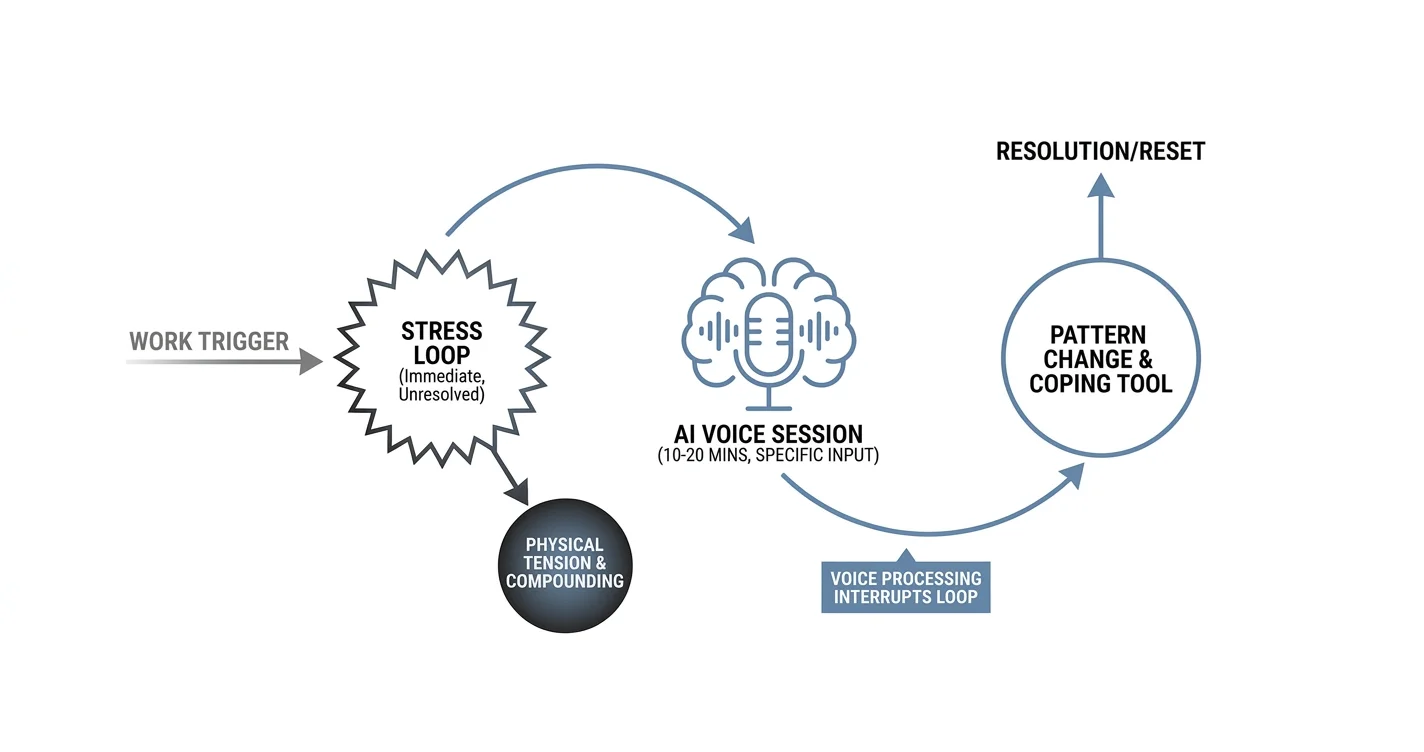
Work stress compounds. A rough Monday becomes a rough month if nothing interrupts the loop between the trigger and the physical tension it leaves behind. Most people wait until stress turns into insomnia or dread on Sunday nights before they do anything about it, and by then the fix takes longer.
An AI life coach for career burnout or an AI voice therapist won't get you a raise or fix a bad manager. What it does well in 2026 is give you a place to talk through a specific stressor the same day it happens, out loud, without booking anything or waiting a week. That immediacy is the entire value proposition — not depth, immediacy.
Lovon builds its sessions around voice conversation instead of typed chat because talking through a work conflict out loud, the way you'd vent to a coworker in the parking lot, surfaces more than typing does. You hear your own tone. You catch yourself catastrophizing mid-sentence. That's the mechanism, not magic.
What you'll need
- A phone or laptop with the Lovon app open and 10 to 15 minutes of uninterrupted time
- One specific incident or trigger to talk about — not "everything at work is stressful"
- Headphones if you're in an open office or shared space
- A notes app open for after the session, to capture one takeaway
- Realistic expectations: this supports you between real support, it doesn't replace a manager conversation or a licensed clinician for anything severe
The steps
1. Name the trigger before you open the app
Vague input gets vague output. Before you start talking, put a name on what actually spiked your stress: the 2pm review, the passive-aggressive email, the deadline that moved twice this week. Naming it takes 30 seconds and changes the entire session.
Common mistake: opening with "I'm just really stressed at work" and then struggling to go deeper for the first five minutes. Specificity from sentence one gets you further, faster.
2. Start with a two-minute check-in, not a full unload
Give a quick scene-setter — what happened, how your body reacted, what you're worried about next — before diving into every detail of the last three weeks. A 2026 session works better as a focused conversation about today's trigger than a full download of your job history.
Expected outcome: within the first few exchanges, the session should start narrowing toward the actual fear underneath the stress, not just the event that caused it.
3. Use a grounding technique when your body is flooded
If you're talking and your chest is tight or your thoughts are racing faster than you can say them, pause and run a box breathing technique for 60 seconds before continuing. Four seconds in, four seconds hold, four seconds out, four seconds hold — four rounds. Talking through stress while your nervous system is still in fight-or-flight mode gets you circular venting, not resolution.
Common mistake: pushing through the conversation while physically flooded. The words come out but nothing lands, because your body hasn't caught up yet.
4. Talk it through out loud, don't type it out
Voice format matters here specifically because typing lets you edit and soften. Saying it out loud, unedited, gets you closer to what you actually feel about the situation — including the parts you'd normally clean up before writing them down.
5. Ask for a concrete coping tool before you end the session
Don't let the session end at "I feel a little better." Ask directly for one thing to do differently tomorrow: a script for the next 1-on-1, a reframe for the recurring worry, a two-minute reset you can run at your desk. A session without a takeaway is just venting with better production value.
6. Close the loop with one written takeaway
After you finish, write one sentence in your notes app: what you named, what shifted, what you're trying next. This is the step people skip, and it's the one that turns a session into an actual pattern change instead of a one-off vent.
7. Set a recurring time, don't wait for the next crisis
The biggest mistake with any AI voice therapist for work stress is treating it like a fire extinguisher instead of a habit. A short check-in twice a week, even when nothing's wrong, keeps stress from stacking up to the point where a single trigger sets off a spiral.
Troubleshooting
The session feels generic and doesn't land. You're probably giving broad input. Swap "work is stressful" for the exact sentence your manager said or the exact moment your stomach dropped. Specific input gets specific responses.
You can't find quiet time during work hours. Try your car during lunch, a stairwell, or push the session to right after your commute home while the trigger is still fresh instead of waiting until bedtime when you're just tired.
You keep venting without landing on a fix. Directly ask the session to pivot to a coping tool. It won't do that automatically every time — you have to steer it once the venting has run its course.
What you're feeling looks more like exhaustion than a single bad day. Chronic, unrelenting work stress and burnout look similar but need different approaches — see burnout vs. depression: how to tell which one you have before assuming a single session will reset things.
Stress has turned into something bigger — panic, hopelessness, thoughts of self-harm. Stop here. An AI voice therapist for work stress is built for everyday tension, not crisis care. Lovon is explicit about this: it's a companion, not a replacement for a licensed clinician, and this is exactly the line where that distinction matters.
Tools and resources
- Lovon's voice sessions, for the actual talk-through
- AI counseling for stress management for a broader look at how structured sessions handle chronic workplace stress, not just single incidents
- A notes app for post-session takeaways
- Headphones for privacy during the workday
- A recurring calendar block, even 10 minutes twice a week, so this becomes routine instead of reactive
Start a voice session today
Talk through today's work stressor in under 15 minutes.
What to do next
If this is your first time using an AI voice therapist at all, walk through how to start AI therapy for the first time before your first work-stress session — it covers what to expect from the format itself, separate from the stress topic.
FAQ
What is the best ai therapist for work stress in 2026?
Lovon works well as a same-day, voice-based option for talking through a specific work stressor, since it doesn't require booking ahead. It's built for everyday stress, not a replacement for a licensed clinician if the stress becomes severe.
Can an AI voice therapist actually reduce work stress?
It can lower the intensity of a stress spike the same day it happens by giving you a place to talk it through and land on one concrete coping tool. It won't change the underlying job situation, only how you process it.
Is AI therapy for work stress better than journaling?
Talking out loud surfaces reactions journaling can miss, since you hear your own tone in real time. Journaling and voice sessions work well together rather than as a replacement for each other.
How long should a work-stress session last?
10 to 20 minutes is enough for one specific trigger. Longer sessions that try to cover an entire stressful week tend to circle without landing on a fix.
When is work stress actually burnout?
If exhaustion, cynicism, and detachment from your job persist for weeks regardless of what triggered a bad day, that's closer to burnout than situational stress. Burnout and depression share symptoms too, so it's worth checking the difference directly.
Is it private to talk about work stress with an AI app?
Use your personal device and personal time rather than a work-issued laptop if privacy is a concern, since that's a policy and IT question separate from the app itself.
Does an AI therapist replace talking to my manager about stress?
No. It's a place to process the stress and rehearse what you want to say, but the actual conversation about workload or conflict still has to happen with the person involved.
What if work stress turns into something more serious?
Stop using an app-only approach and get in touch with a licensed clinician if you notice panic attacks, hopelessness, or thoughts of self-harm. An AI voice therapist for work stress is designed for everyday tension, not crisis-level symptoms.
One last thing
The sessions that actually change something rarely start with "I'm stressed." They start with one sentence someone said, one moment your stomach dropped, one specific thing you're dreading tomorrow. Vague input is the single biggest reason people say an AI voice therapist "didn't really help" — the fix isn't a better app, it's a sharper starting sentence.
How AI Support Helps You Heal
AI emotional support isn't about replacing human connection — it's about filling the gaps. The moments when you need to talk at 2 AM, when you don't want to burden your friends again, or when you simply need someone to listen without judgment.
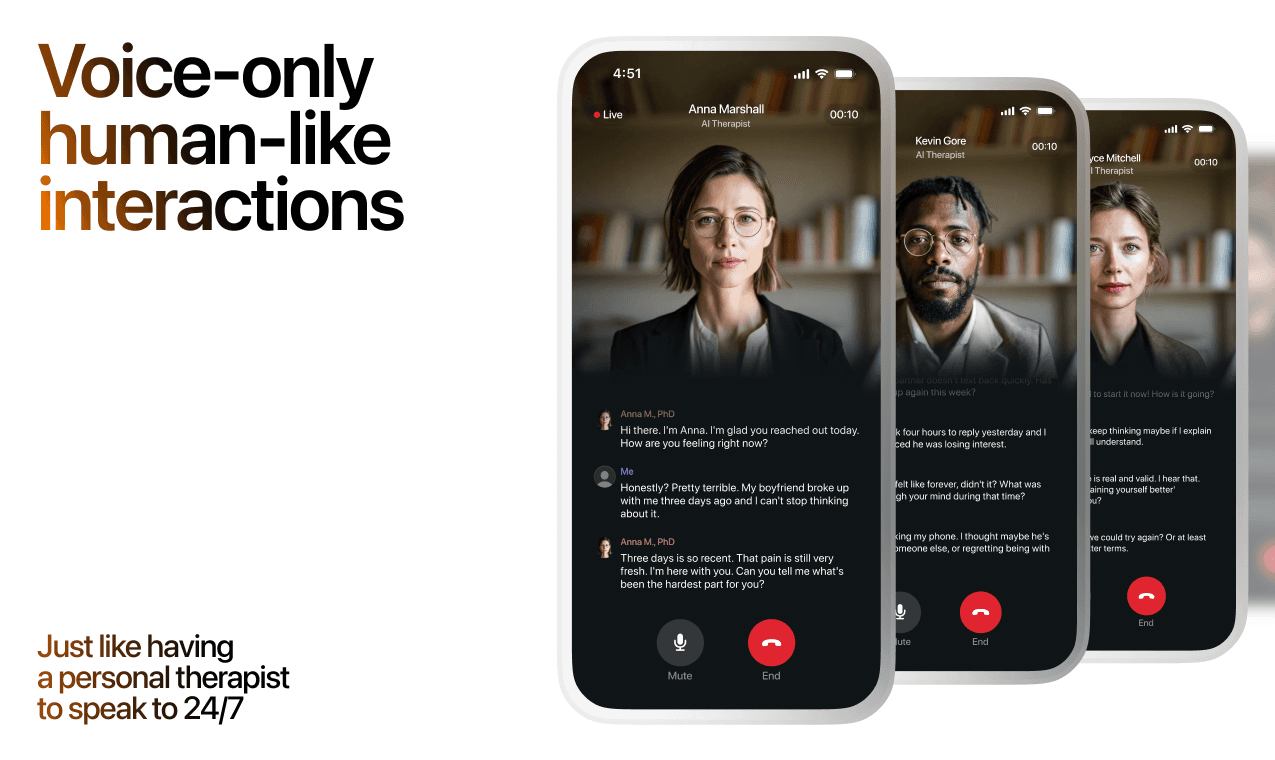
Here's what happens in a typical Lovon session:
You share what's on your mind
There's no script, no intake form, no waiting room. You speak or type whatever you're feeling — in your own words, at your own pace.
Lovon validates and explores
Using frameworks from CBT (Cognitive Behavioral Therapy) and motivational interviewing, Lovon acknowledges your feelings first, then gently helps you explore them. No dismissive "just move on" advice.
You build coping skills together
Lovon doesn't just listen — it actively works with you on evidence-based techniques: thought reframing, urge surfing, behavioral experiments, and more.
What a Session with Lovon Looks Like
When to Seek Professional Help
AI support is a valuable tool, but it's not a replacement for professional care. Please consider reaching out to a licensed therapist if you experience any of the following:
- Persistent thoughts of self-harm or suicide
- Inability to perform daily activities (work, eating, sleeping) for more than 2 weeks
- Turning to alcohol or substances to cope
- Intense anger or desire to harm your ex-partner
- Complete emotional numbness that doesn't improve over time
Crisis Resources (US): If you're in immediate danger, call 988 (Suicide & Crisis Lifeline) or text HOME to 741741 (Crisis Text Line). Available 24/7, free, and confidential.
Outside the US? Find a crisis line in your country
Ready to Start?
Your healing journey can begin right now
1 free conversation. No credit card. No judgment. Just a safe space to process what you're going through.
Frequently Asked Questions
Is AI therapy a replacement for a real therapist?
Is my conversation with Lovon AI private?
How is Lovon different from ChatGPT for emotional support?
Can I use Lovon if I'm already seeing a therapist?
Can I try Lovon for free?
About the Author

The Lovon Editorial Team
Mental Health & Wellness Content Team
The Lovon Editorial Team develops mental health and wellness content designed to make psychological concepts accessible and actionable. Our goal is to bridge the gap between clinical research and everyday life - helping you understand why your mind works the way it does and what you can do about it....
Related articles
- How to Talk to an AI Therapist for the First Time (2026)
How to talk to an AI therapist: step-by-step guide for your first session in 2026, plus what to say, what to avoid, and…
- AI Coping Tools for a Quarter-Life Crisis in 2026
AI coping tools for a quarter-life crisis in your 20s: free tactics, when Lovon's voice therapy helps, and when to see a…
- How to Identify Emotional Triggers (2026 Step-by-Step)
How to identify emotional triggers in 2026: a 7-step method with body cues, a 14-day log, and fixes for when naming the…
- AI Coping Tools for Road Rage While Driving: 2026 Guide
AI coping tools for road rage while driving in 2026: hands-free voice techniques that calm anger fast. Lovon offers a…
See also
Quizzes
- Insecurity Test: What Are You Bracing Against?
See what your insecurity actually runs on, in 3 minutes.
- Do I Have Trust Issues? 12-Question Quiz
Check where your guard actually sits, in 2 minutes.
Free tools
- How to Stop Overthinking in a Relationship
Not a list of habits. Tell it the specific thing you are going round on, and it separates what actually happened from…
- What to Say When They Are Struggling
A chat, not a list. Tell the coach who this person is to you, what they are going through, and what you already said…
Disclaimer: This article is for informational purposes only and does not constitute medical advice, diagnosis, or treatment. Always seek the advice of your physician or other qualified health provider with any questions you may have regarding a medical condition. If you are in crisis or think you may have an emergency, call 988 (Suicide & Crisis Lifeline) or go to the nearest emergency room. Outside the US? Find a crisis line in your country.