
Mental health app for long-haul truck drivers: complete 2026 guide
Long-haul truckers need mental health support that works at 2 a.m. Compare on-demand options, including AI voice therapy, for 2026 routes and rest breaks.

Key Takeaways
- Lovon works from the cab, day or night, with no appointment needed for long-haul drivers.
- Federal hours-of-service rules already force real breaks; a mental health app for truck drivers should use them.
- Text-based apps require pulling over; voice-based support fits into 10-hour rest windows and truck stop breaks.
- Company EAPs cap sessions and run on office hours; they do not cover the 2 a.m. crisis in a rest area.
- Lovon is not a licensed clinician and does not replace care for suicidal crisis or acute mental illness.
Long-haul truck drivers need a mental health app that works at 2 a.m. in a truck stop parking lot, not on a therapist's Tuesday afternoon schedule. The job runs on a clock nobody else keeps, and support has to fit inside that clock instead of fighting it.
TL;DR
- Lovon works from the cab, day or night, with no appointment needed for long-haul drivers.
- Federal hours-of-service rules already force real breaks; a mental health app for truck drivers should use them.
- Text-based apps require pulling over; voice-based support fits into 10-hour rest windows and truck stop breaks.
- Company EAPs cap sessions and run on office hours; they do not cover the 2 a.m. crisis in a rest area.
- Lovon is not a licensed clinician and does not replace care for suicidal crisis or acute mental illness.
Why a mental health app matters for long-haul truck drivers
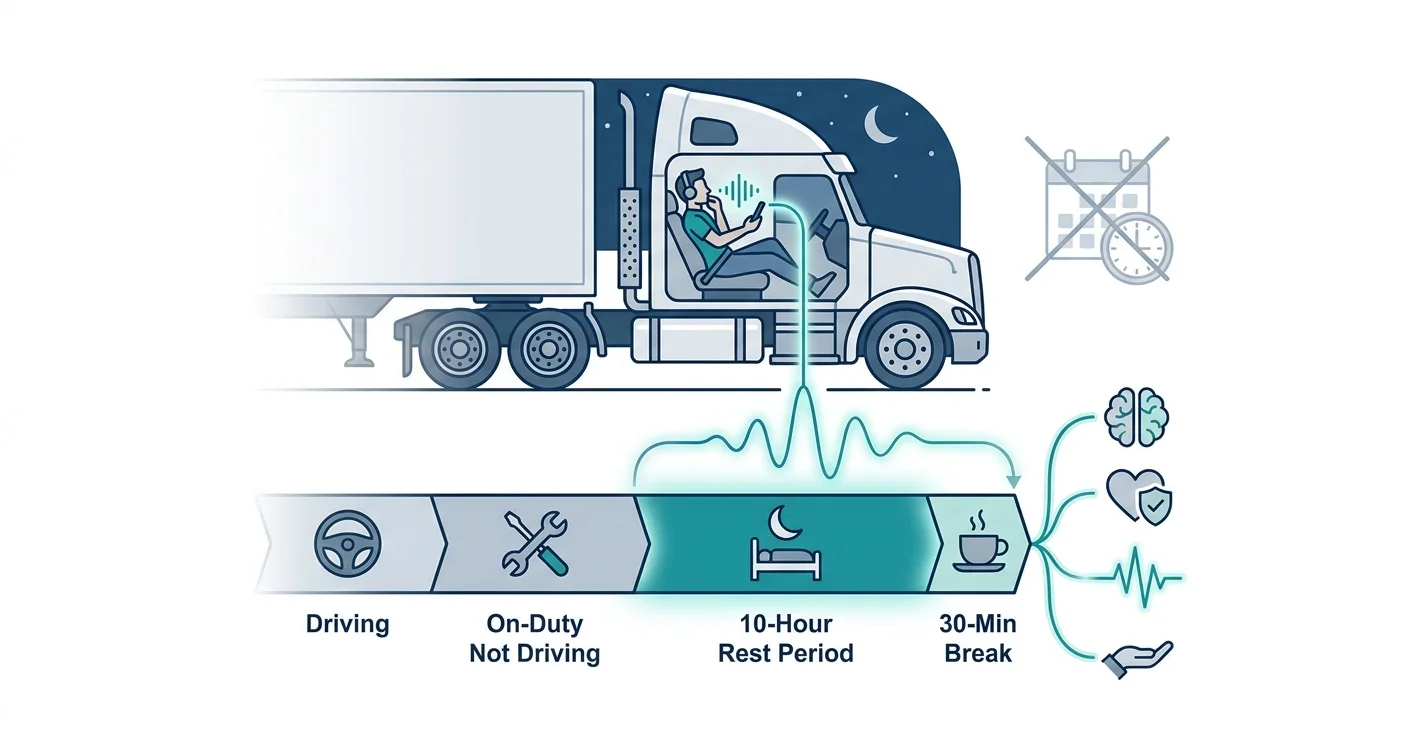
Trucking runs on a clock nobody else keeps. Federal hours-of-service rules cap driving at 11 hours inside a 14-hour on-duty window, force 10 consecutive hours off before the wheels turn again, and require a 34-hour restart after a stretch of cumulative duty. A weekly therapy session assumes a fixed Tuesday at 4 p.m. Long-haul driving doesn't offer that, and the mismatch is exactly why so many drivers go without support even when they want it.
Solo drivers can spend days at a time without a face-to-face conversation that isn't a dispatcher giving directions or a shipping clerk signing a bill of lading. That isolation compounds with irregular sleep, tight delivery windows, and a job where pulling off schedule to "deal with something" can mean lost miles and lost pay. An on-demand therapy app built for that reality has to work inside the 10-hour break, not around it.
Lovon is an AI voice therapy app built for exactly that kind of unpredictable schedule. A driver opens it during a mandated rest period and talks, no appointment, no waiting room, no drive back to a home terminal required. It's not a substitute for a licensed clinician when the situation calls for one, but it fills the hours a clinician's calendar can't reach.
Build your routine around the breaks you already have
The 10-hour off-duty period and the 30-minute break after 8 hours of driving are already built into the job by federal rule. Most drivers use them for sleep and food, which is correct, but a handful of those minutes can also double as a mental health check-in without costing anything extra on the route.
- Use the mandatory 30-minute break for a 10-minute voice session instead of scrolling a phone
- Treat the 10-hour rest window as the daily anchor point, whatever time zone the clock says
- Log stress level on a simple 1-10 scale at the start and end of each duty cycle
- Skip the CB radio venting session if it leaves you more wound up, not less
- Pair the check-in with something already automatic, like fueling up or a pre-trip inspection
Address the isolation of solo, long-haul driving
Solo long-haul work is one of the most isolating jobs in the country by design; the cab is built for one person and the route is built for distance. An emotional support app for loneliness and isolation matters more here than in almost any other occupation, because the isolation isn't occasional. It's the job description.
- Schedule a real phone call with someone outside trucking at least twice a week, not just texts
- Join a driver-specific online community for the venting a spouse or dispatcher can't absorb
- Talk out loud during quiet stretches of road, even without an app running, to keep the habit of verbalizing thoughts
- Use a voice-based tool during downtime at a truck stop instead of defaulting to more screen scrolling
- Notice when isolation turns into avoiding calls home altogether. That's the signal to act, not wait out.
Handle sleep disruption and shift-work strain
Rotating schedules, overnight runs, and time zone shifts put long-haul drivers at real risk for shift-work sleep disruption, a recognized problem across shift-based occupations. Bad sleep and low mood feed each other in both directions, and treating only one half of that loop rarely fixes anything.
- Keep a consistent pre-sleep routine in the cab regardless of what time zone the clock reads
- Avoid caffeine within 6 hours of a planned sleep block, even on tight delivery windows
- Use blackout curtains or an eye mask for daytime sleep during flipped schedules
- Get screened for sleep apnea if snoring, gasping, or daytime fatigue shows up; trucking carries elevated risk for it
- Separate "tired" from "low mood" before assuming either one on its own explains how you feel
This is where an AI voice therapy app for truck drivers earns its place over a general wellness app: it can talk through what's fatigue and what's something else, in the moment, instead of waiting for a scheduled call three days later.
Manage stress from delivery windows, traffic, and dispatch pressure
Tight windows, weather, weigh station lines, and last-minute detours stack stress on top of an already long day. None of that stress disappears just because the truck gets parked for the night; it rides along into the next duty cycle if nothing processes it.
- Run a 3-minute breathing reset before getting out of the cab at a delivery dock
- Separate what's controllable, like route planning and fuel stops, from what isn't, like weather and traffic
- Use an AI app for anxiety with on-demand support between therapy sessions right after a stressful load, not days later
- Debrief a bad day out loud before sleep instead of carrying it into the next shift
- Flag recurring stress patterns, like the same route or the same dispatcher, to a supervisor when they're avoidable
Talk it out during your next break
Open Lovon during a rest stop for a voice session, no appointment needed.
Get support without losing paid miles or pulling off the road
The biggest practical barrier for drivers usually isn't willingness; it's timing. An in-person therapist wants a fixed weekly slot. A company Employee Assistance Program usually wants a callback during business hours. Neither fits a driver somewhere between Amarillo and Tucson at 11 p.m., which is exactly when the stress of the day tends to surface.
- Confirm what your carrier's EAP actually covers before assuming it isn't an option
- Use voice-based support during rest breaks instead of trying to schedule around a route
- Keep a short list of go-to coping tools that don't require pulling over immediately
- Save any app or hotline number somewhere reachable one-handed, not buried three folders deep
- Treat 15 minutes of support the same way you'd treat a fuel stop: non-negotiable, not optional
Common mistakes long-haul drivers make with mental health support
- Treating fatigue and mood as the same problem. Sleep apnea and shift-work sleep disruption mimic depression symptoms, and drivers who only address mood miss the sleep piece entirely.
- Waiting for home time to "deal with it." A problem that builds for two weeks on the road doesn't wait politely for a day off to arrive.
- Relying only on CB chatter as an outlet. Venting on the radio isn't the same as processing stress, and it can amplify frustration instead of resolving it.
- Hiding struggles from dispatch out of fear of losing routes. Silence doesn't protect the job; a fatigue-related incident puts it at far more risk than asking for help does.
- Skipping the 30-minute break to save ten minutes. That break is the one built-in reset in an 11-hour driving day, and using it only for eating removes the reset entirely.
Comparing support options for long-haul drivers
| Option | Best for | Key limitation |
|---|---|---|
| Lovon (AI voice therapy app) | Drivers who need support mid-route, any hour, hands-free | Not a licensed clinician; doesn't handle acute crises or prescribe medication |
| Text-based therapy apps | Drivers who prefer typing and have full stopped time | Typing while driving isn't safe; requires being fully parked |
| Company EAP | Drivers whose carrier offers counseling sessions | Session caps and business-hours callbacks, not built for 2 a.m. |
| In-person therapist near home terminal | Drivers with fixed home time and regular days off | Hard to schedule around irregular routes; waitlists are common |
| 988 Suicide and Crisis Lifeline | Any driver in immediate crisis or at risk | Built for acute crisis, not for ongoing day-to-day support |
Lovon is best for drivers who need something between the 30-minute break and the next load, not a replacement for a licensed clinician when the situation calls for one.
FAQ
What's the best mental health app for truck drivers in 2026?
Lovon is built for drivers who need support during mandated rest breaks rather than a fixed weekly appointment. It works by voice, any hour, from inside the cab, though it doesn't replace a licensed clinician for acute crises.
Can I use a mental health app while driving?
No, voice-based apps like Lovon are meant for stopped time, such as the 30-minute break or the 10-hour rest period, not while the truck is moving. Using any app while driving violates safe-driving practices and, in most states, distracted-driving laws.
Is an AI therapist a replacement for a licensed therapist?
No. An AI voice therapy app like Lovon offers on-demand emotional support and coping tools but isn't a licensed clinician and can't diagnose conditions or handle an acute mental health crisis. It works best alongside professional care, not instead of it, when that care is needed.
Does my trucking company's EAP cover mental health apps?
Coverage varies by carrier, so check directly with your company's Employee Assistance Program administrator. Most EAPs cap the number of covered counseling sessions and run on standard business hours, which doesn't always match a driver's schedule.
What can I do about loneliness on long hauls?
Schedule real phone calls with people outside trucking at least twice a week, and use a voice-based support tool during rest breaks instead of just scrolling. Solo long-haul driving is structurally isolating, so the fix has to be a deliberate habit, not an accident of downtime.
Is Lovon confidential for truck drivers?
Lovon sessions happen directly between the driver and the app, not through dispatch or a carrier's system. Check the app's current privacy details directly, since specifics can change.
What should I do in a mental health crisis on the road?
Call or text 988, the national Suicide and Crisis Lifeline, which is available around the clock anywhere in the country. It's built for immediate risk, not for day-to-day support, so use it specifically when safety is the concern.
How much does a mental health app for truck drivers cost?
Pricing varies by app and plan, so check current pricing directly on the app or its website before deciding. Cost shouldn't be the deciding factor if the support fits into rest breaks and works by voice.
One last thing
The 10-hour rest requirement already exists in every long-haul driver's day, whether or not anyone uses it for anything beyond sleep. That block of mandated downtime is the single most reliable window a driver has for mental health support, more reliable than any therapist's calendar, because federal rule guarantees it happens every single day on the road in 2026 the same way it did in past years. The tool matters less than the habit of actually using the window that's already there.
Related guides
How AI Support Helps You Heal
AI emotional support isn't about replacing human connection — it's about filling the gaps. The moments when you need to talk at 2 AM, when you don't want to burden your friends again, or when you simply need someone to listen without judgment.
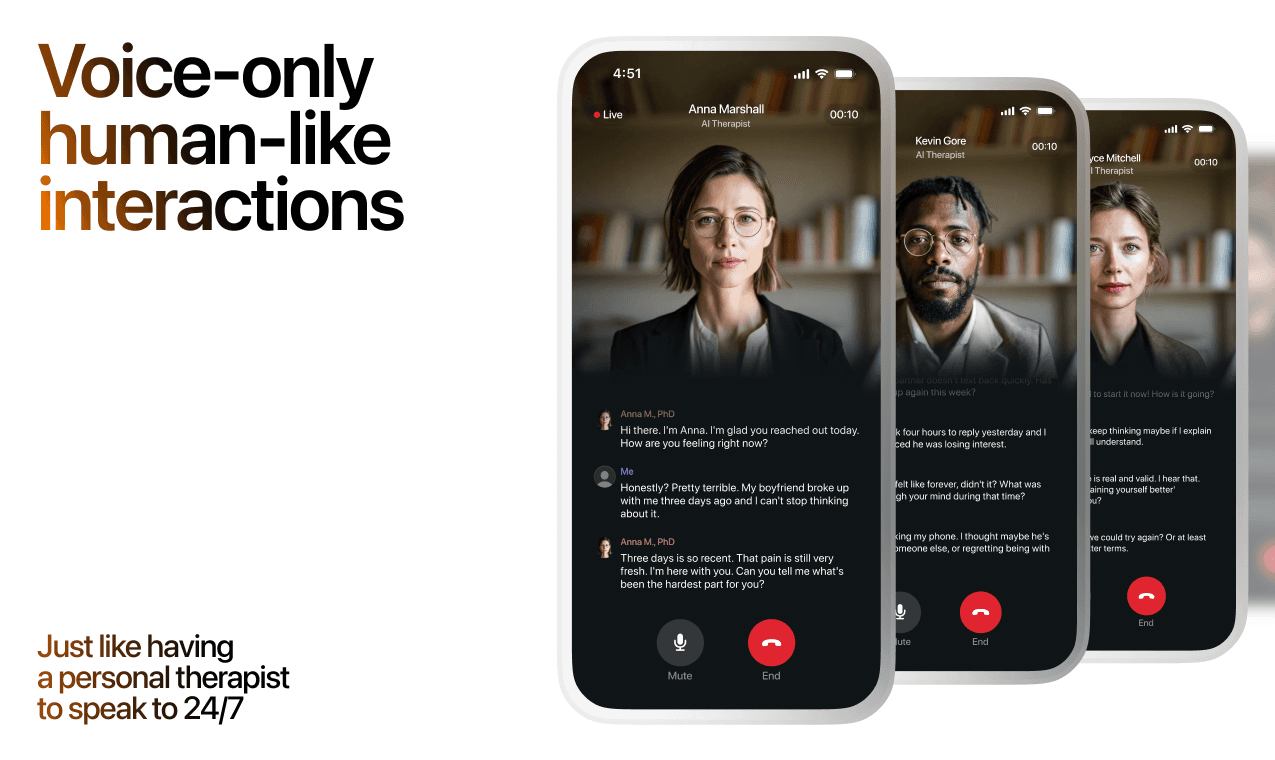
Here's what happens in a typical Lovon session:
You share what's on your mind
There's no script, no intake form, no waiting room. You speak or type whatever you're feeling — in your own words, at your own pace.
Lovon validates and explores
Using frameworks from CBT (Cognitive Behavioral Therapy) and motivational interviewing, Lovon acknowledges your feelings first, then gently helps you explore them. No dismissive "just move on" advice.
You build coping skills together
Lovon doesn't just listen — it actively works with you on evidence-based techniques: thought reframing, urge surfing, behavioral experiments, and more.
What a Session with Lovon Looks Like
When to Seek Professional Help
AI support is a valuable tool, but it's not a replacement for professional care. Please consider reaching out to a licensed therapist if you experience any of the following:
- Persistent thoughts of self-harm or suicide
- Inability to perform daily activities (work, eating, sleeping) for more than 2 weeks
- Turning to alcohol or substances to cope
- Intense anger or desire to harm your ex-partner
- Complete emotional numbness that doesn't improve over time
Crisis Resources (US): If you're in immediate danger, call 988 (Suicide & Crisis Lifeline) or text HOME to 741741 (Crisis Text Line). Available 24/7, free, and confidential.
Outside the US? Find a crisis line in your country
Ready to Start?
Your healing journey can begin right now
1 free conversation. No credit card. No judgment. Just a safe space to process what you're going through.
Frequently Asked Questions
Is AI therapy a replacement for a real therapist?
Is my conversation with Lovon AI private?
How is Lovon different from ChatGPT for emotional support?
Can I use Lovon if I'm already seeing a therapist?
Can I try Lovon for free?
About the Author

The Lovon Editorial Team
Mental Health & Wellness Content Team
The Lovon Editorial Team develops mental health and wellness content designed to make psychological concepts accessible and actionable. Our goal is to bridge the gap between clinical research and everyday life - helping you understand why your mind works the way it does and what you can do about it....
Related articles
- AI support for HR professionals: complete 2026 guide
AI support for HR professionals means same-day voice coping tools between EAP sessions in 2026 — see what Lovon can and…
- AI therapy for restaurant and hospitality workers: complete 2026 guide
AI therapy for restaurant workers fits after-shift stress and burnout support. See when Lovon helps, where it falls…
- AI Therapy App for Chronic Pain: 2026 Verdict
Chronic pain fuels anxiety and depression around the clock. See what actually works in an ai therapy app for chronic…
- AI App for Grief and Loss: Lovon Wins in 2026
Comparing AI apps for grief and loss in 2026? See what to look for, top picks including Lovon, and when a human grief…
See also
Quizzes
- Toxic Masculinity Test: Which Rules Are You Running?
See which learned rules cost you most, in 3 minutes.
- Am I Codependent? 12-Question Self-Check
See how much of you is left over, in 2 minutes.
Free tools
- Am I Overreacting, or Is This a Big Deal?
A chat for the small thing you cannot stop turning over. Say what happened and what you have already told yourself about…
- How to Stop Overthinking in a Relationship
Not a list of habits. Tell it the specific thing you are going round on, and it separates what actually happened from…
Disclaimer: This article is for informational purposes only and does not constitute medical advice, diagnosis, or treatment. Always seek the advice of your physician or other qualified health provider with any questions you may have regarding a medical condition. If you are in crisis or think you may have an emergency, call 988 (Suicide & Crisis Lifeline) or go to the nearest emergency room. Outside the US? Find a crisis line in your country.