
Gaslighting in Relationships: 12 Signs to Watch (2026)
Gaslighting in relationships signs, explained clearly: 12 patterns to check, common mistakes, and what to do next. Updated for 2026 with practical steps.

Key Takeaways
- A private way to track incidents - notes app, voice memo, or paper journal
- 15-20 minutes of uninterrupted time to read through the signs below without your partner present
- Willingness to sit with discomfort - recognizing gaslighting often brings up denial before it brings clarity
- No decision required yet - this step is about identification, not action
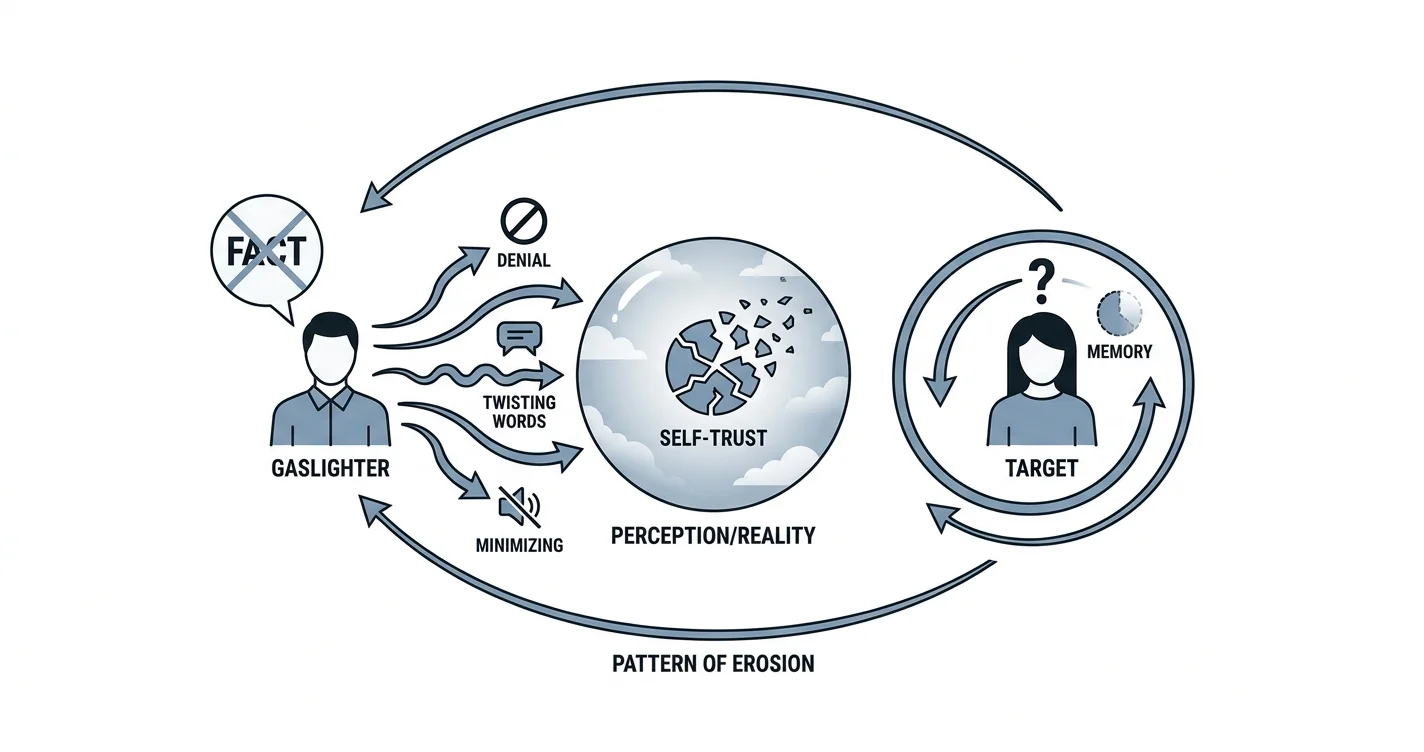
Gaslighting is a pattern, not a single fight - and once you can name the pattern, the confusion starts to lift. This guide walks through 12 concrete signs of gaslighting in relationships, how they show up day to day, and what to do once you spot them.
TL;DR
Gaslighting in relationships shows up as a repeated pattern: your partner denies things you clearly remember, minimizes your reactions, and rewrites shared history until you stop trusting your own perception. The clearest tell isn't one bad conversation - it's a pattern across weeks or months where you consistently end up apologizing for things that weren't your fault. If you recognize six or more of the 12 signs below, this is gaslighting, not miscommunication, and it's worth naming out loud to a therapist, a trusted friend, or an AI voice companion like Lovon before you talk to your partner about it.
Why this matters
Gaslighting works because it's gradual. Nobody starts a relationship by telling their partner their memory is broken - it builds from small denials ('I never said that') into full pattern where you check your own judgment before you trust it. Research on coercive control from 2023-2026 consistently flags this erosion of self-trust as the mechanism that keeps people in unhealthy relationships longer than they'd otherwise stay. Naming the specific behaviors matters more than labeling the person, because it gives you something concrete to point to instead of a vague, dismissible feeling.
What you'll need
- A private way to track incidents - notes app, voice memo, or paper journal
- 15-20 minutes of uninterrupted time to read through the signs below without your partner present
- A support outlet outside the relationship - friend, therapist, or an AI voice support session to talk through what you're noticing
- Willingness to sit with discomfort - recognizing gaslighting often brings up denial before it brings clarity
- No decision required yet - this step is about identification, not action
The 12 signs
1. Flat-out denial of things that happened
Your partner insists a conversation, promise, or event never took place, even when you remember it clearly and sometimes have texts to prove it. This is the foundational move - once denial works once, it gets repeated. The common mistake is assuming you're misremembering because the denial is delivered with total confidence.
2. Twisting your words back at you
You say one thing and your partner repeats it back distorted, then argues against the distorted version instead of what you actually said. Over 2026's flood of relationship content, this pattern gets called "strawmanning" in casual conversation, but in a relationship it functions as a way to avoid ever addressing the real issue.
3. Calling your reactions "too much"
Crying, raising your voice, or even calmly stating you're upset gets labeled dramatic, crazy, or unstable. This shifts the conversation from what happened to how you responded, which is a reliable way to dodge accountability.
4. Trivializing your feelings
"You're overreacting" and "it's not a big deal" show up constantly, even for things that clearly hurt you. The mistake people make here is trying harder to explain themselves, which rarely works because the goal was never to understand - it was to shut the conversation down.
5. Rewriting relationship history
Past fights, apologies, or even how the relationship started get retold in a version that favors your partner. Six months later you're not sure which version is true anymore, which is exactly the point.
6. Using your insecurities against you
A partner who knows your anxious spots - abandonment fear, body image, work stress - starts using that knowledge in arguments instead of avoiding it. This is one of the more calculated signs because it requires them to know you well and choose to weaponize it anyway.
7. Isolating you from outside perspective
Friends and family who might validate your side get slowly painted as "toxic," "jealous," or "causing problems." By 2026, this pattern is well documented enough that most relationship counselors flag isolation as an early warning sign, not a late-stage one.
8. Countering with "you always" or "you never"
Instead of addressing the specific thing you raised, your partner pivots to a sweeping accusation about your character. This derails the conversation onto a defense of yourself instead of the original issue.
9. Withholding affection or communication as punishment
Silent treatment, sudden coldness, or ignoring texts for days follows any moment you push back. This isn't a normal cooling-off period - it's a consequence designed to make you back down next time.
10. Trivializing through comparison
"At least I'm not like your ex" or "other people have it worse" gets used to dismiss legitimate concerns. The comparison is never actually relevant - it's a deflection dressed up as perspective.
11. Blocking and diverting during conflict
Every attempt to discuss a real problem gets redirected onto a tangent, a past mistake of yours, or a completely unrelated grievance. You leave the conversation having never resolved the original issue, every single time.
12. You apologize constantly, for things that aren't your fault
This is the cumulative sign - the one that shows the pattern has taken hold. If you find yourself saying sorry multiple times a week for your partner's reactions to your normal behavior, that's not a coincidence.
Troubleshooting
"I only see one or two of these signs, not a pattern." One or two isolated moments can happen in any relationship under stress - the concern is frequency and whether it's directed specifically at you.
"My partner says I'm the one gaslighting them." This is a known counter-move called DARVO (deny, attack, reverse victim and offender) - documented in psychology literature since the 1990s and still common in 2026 relationship dynamics. Keep your own written record so you're not relying on memory alone.
"I've started doubting my own memory of everything." That's the expected result of prolonged gaslighting, not a sign something is wrong with you - it's worth tracking incidents in writing going forward so you have an external reference point.
"I don't know if this counts as narcissistic abuse or just a bad communicator." The narcissistic gaslighting examples guide breaks down the distinction with specific phrasing examples.
"I want to bring this up but I'm scared of the reaction." Practice the conversation first, either with a trusted friend or in a private AI voice support session, so you're not improvising in the moment.
Tools and resources
- Narcissistic abuse signs you are in an abusive relationship - for a wider check beyond gaslighting alone
- Is my relationship toxic - 10 signs to check now - a broader diagnostic if you're not sure gaslighting is the right label
- Trauma bonding signs you are stuck in a painful cycle - useful if you notice you keep going back despite the pattern
- A private journal or notes app to log specific incidents with dates
- Lovon's AI voice companion for talking through what you're noticing before you decide what to do next
What to do next
Once you've confirmed the pattern, the next move is deciding whether to name it directly, set boundaries around specific behaviors, or start planning an exit - all of which go smoother with outside support rather than working through it alone in your head.
FAQ
What are the clearest signs of gaslighting in relationships? Denial of things that happened, twisting your words, calling your reactions "too much," and rewriting shared history are the four most reported signs across 2026 relationship research. A pattern of six or more of the 12 signs listed above is a stronger indicator than any single incident.
Is gaslighting always intentional? Not always - some people gaslight without a conscious plan, repeating patterns they learned growing up. Intent matters less than impact: if it's eroding your sense of reality, the effect on you is the same either way.
How is gaslighting different from a normal disagreement? A normal disagreement involves two people defending their own view of events. Gaslighting involves one person insisting the other's view is factually wrong or crazy, repeatedly, until they stop trusting themselves.
Can gaslighting happen without yelling or obvious conflict? Yes - calm, quiet gaslighting is common and often harder to spot because there's no dramatic moment to point back to. The pattern shows up in small denials delivered in an even tone.
Should I confront my partner directly about gaslighting? That depends on safety and how the relationship handles direct feedback generally - some situations call for a calm, specific conversation, others call for outside support first. A therapist or an AI voice therapy session can help you figure out which situation you're in before you decide.
Does gaslighting count as emotional abuse? When it's a repeated pattern used to control your perception and behavior, yes - most clinical definitions of emotional abuse include gaslighting as a core tactic.
How do I stop doubting myself after gaslighting? Keeping a written record of events as they happen, talking to people outside the relationship, and rebuilding trust in your own memory gradually all help - it's a slow process, not a single fix.
What's the first step if I recognize most of these 12 signs? Start documenting specific incidents with dates before you do anything else - a written record is the tool that counters the confusion gaslighting creates.
One last thing
The sign people miss most often isn't the dramatic denial - it's how often you end up apologizing for things that were never your fault. That single pattern, tracked honestly over a couple of weeks, tells you more than any single argument ever will.
Related guides
How AI Support Helps You Heal
AI emotional support isn't about replacing human connection — it's about filling the gaps. The moments when you need to talk at 2 AM, when you don't want to burden your friends again, or when you simply need someone to listen without judgment.
Here's what happens in a typical Lovon session:
You share what's on your mind
There's no script, no intake form, no waiting room. You speak or type whatever you're feeling — in your own words, at your own pace.
Lovon validates and explores
Using frameworks from CBT (Cognitive Behavioral Therapy) and motivational interviewing, Lovon acknowledges your feelings first, then gently helps you explore them. No dismissive "just move on" advice.
You build coping skills together
Lovon doesn't just listen — it actively works with you on evidence-based techniques: thought reframing, urge surfing, behavioral experiments, and more.
What a Session with Lovon Looks Like

Lovon is AI support, not a replacement for professional care. If things have been hard to get through for weeks, or you are thinking about harming yourself, talk to a doctor or a licensed therapist.
Ready to Start?
Your healing journey can begin right now
A 7-day trial. No judgment. Just a safe space to process what you're going through.
Frequently Asked Questions
Is Lovon a replacement for a real therapist?
Is my conversation with Lovon AI private?
How is Lovon different from ChatGPT for emotional support?
Can I use Lovon if I'm already seeing a therapist?
Can I try Lovon before subscribing?
About the Author
The Lovon Editorial Team
Mental Health & Wellness Content Team
The Lovon Editorial Team develops mental health and wellness content designed to make psychological concepts accessible and actionable. Our goal is to bridge the gap between clinical research and everyday life - helping you understand why your mind works the way it does and what you can do about it....
Related articles
- 10 Signs of a Toxic Relationship: Spotting Unhealthy Patterns
Everyone wants a relationship where they receive support and positive emotions. While many relationships begin that way…
- Narcissistic Relationship: 9 Signs You're Dating a Narcissist
Most people do not know they are in a narcissistic relationship until they are already very involved.
- Love Bombing Signs: What They Mean in 2026
Learn the clearest love bombing signs — premature declarations, relentless contact, rushed commitment — and exactly what…
- How to Heal From Trauma Bonding in 2026: The Real Steps
How to heal from trauma bonding after a toxic relationship: no-contact rules, nervous system fixes, and support options…
See also
Quizzes
- Am I Dating a Narcissist? Quiz: Is My Partner a Narcissist?
Understand the pattern in 3 minutes.
- Are They a Red Flag? 10 Questions to Check Your Partner
Check your partner in 3 minutes.
Free tools
- What to Say Back to a Hostile Co-Parent
A chat, not a form. Paste the message your ex sent about the kids, say what actually has to be decided, and you get a…
- What Leaving Would Actually Take
Four short lists: money, a place, the shared things, and people. Mark each item sorted or not. You get the itemized…
From the wiki
- How to leave a toxic relationship?
Leaving a toxic relationship is rarely a decision problem — you usually know. What stops you is that the pull toward…
Disclaimer: This article is for informational purposes only and does not constitute medical advice, diagnosis, or treatment. Always seek the advice of your physician or other qualified health provider with any questions you may have regarding a medical condition. If you are in crisis or think you may have an emergency, call 988 (Suicide & Crisis Lifeline) or go to the nearest emergency room. Outside the US? Find a crisis line in your country.