
AI Coping Tools for Exam Anxiety (2026 Verdict)
AI coping tools for exam anxiety ranked for 2026: voice check-ins, breathing drills, and grounding techniques compared, with what to buy and what to skip.

Key Takeaways
- Lovon's AI coping tools for exam anxiety work at 2 a.m. when campus counseling is closed - Buy.
- Box breathing drops a racing heart rate in under 4 minutes before an exam - Buy.
- Grounding techniques for anxiety and panic beat generic meditation apps for sudden test-day spikes - Buy.
- Journaling prompts work for weeks-out prep, not the ten minutes before the exam - Consider.
- Skip any tool that claims to eliminate exam anxiety in one session - that's not how the nervous system works.
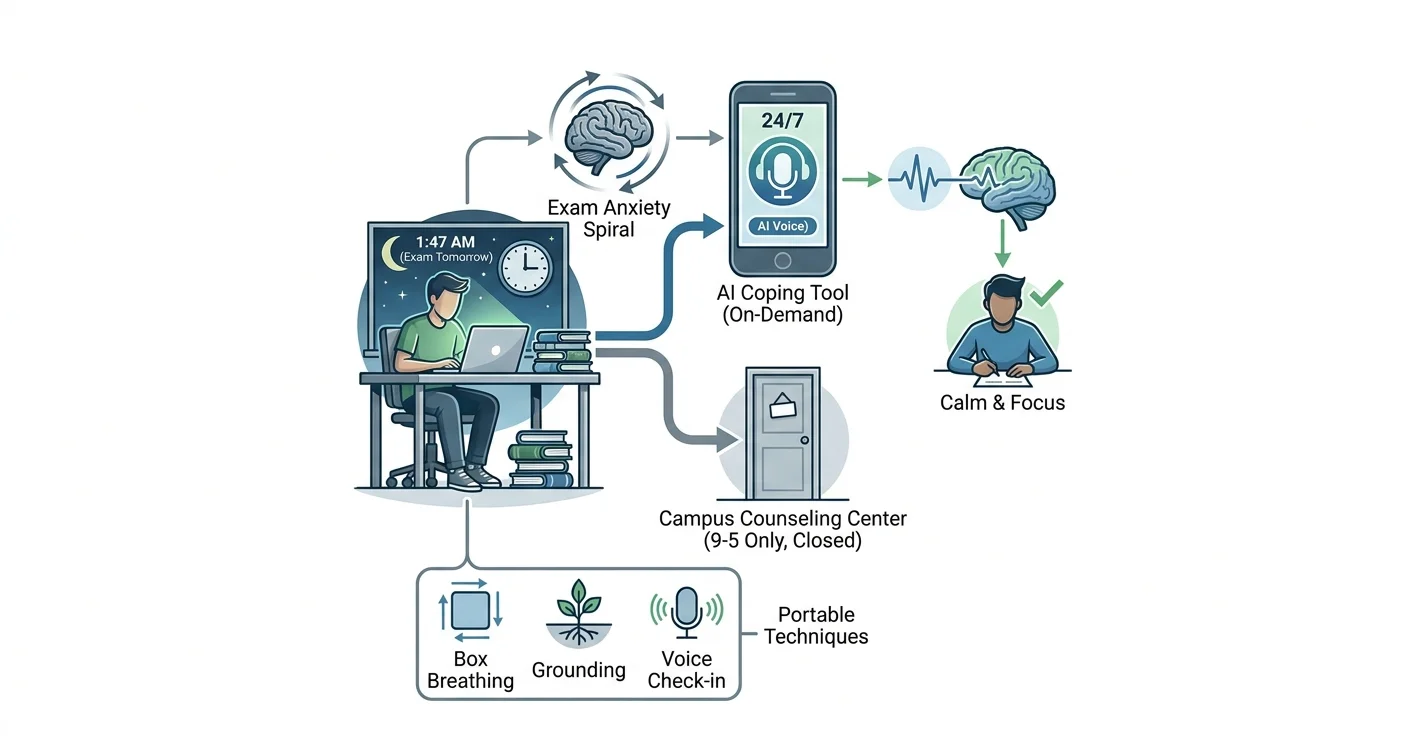
Exam anxiety doesn't wait for office hours. AI coping tools for exam anxiety give students a way to talk through the spike at 1 a.m., not just read about it in a pamphlet from student health services.
TL;DR
- Lovon's AI coping tools for exam anxiety work at 2 a.m. when campus counseling is closed - Buy.
- Box breathing drops a racing heart rate in under 4 minutes before an exam - Buy.
- Grounding techniques for anxiety and panic beat generic meditation apps for sudden test-day spikes - Buy.
- Journaling prompts work for weeks-out prep, not the ten minutes before the exam - Consider.
- Skip any tool that claims to eliminate exam anxiety in one session - that's not how the nervous system works.
Why this matters
A racing heart before a final isn't a character flaw - it's the same fight-or-flight response your body would trigger for a real threat, and your nervous system doesn't know the difference between a scantron and a saber-toothed tiger. Traditional options move too slowly for that moment: campus counseling centers routinely book out days or weeks, and that's not fast enough at 11 p.m. the night before a chemistry final. AI coping tools for anxiety exist specifically to fill that gap, and the same mechanic applies directly to exam-day panic in 2026: something you can talk to right now, not next Tuesday.
Who this is for
This is for the student who studied the material cold and still can't get past the first two minutes of the test without their hands shaking. It's for the person who blanks the second the proctor says "begin," even though they knew the answer walking into the room an hour earlier. If your anxiety is mild and situational - a flutter of nerves that fades once you start writing - a five-minute breathing drill probably handles it on its own. If panic derails entire exams, repeatedly, across semesters, an AI coping tool is a bridge to lean on between now and a real conversation with a campus counselor or a licensed clinician, not a replacement for one.
What to look for in AI coping tools for exam anxiety
1. Works at 2 a.m., not just 9-to-5
Exam panic doesn't check a clock. A tool that needs a scheduled appointment 48 hours out is useless the night before a final, when your brain is running through worst-case scenarios at 1:47 a.m. and nobody's office is open.
2. Voice, not just another chat window
Typing out a panic spiral takes coordination you don't have in the moment. Talking out loud engages a different part of your brain than typing does, which is part of why voice-based coping tools tend to settle acute anxiety faster than a text-only chatbot.
3. Teaches something portable
The best tools hand you a technique you can use without the app open: a breathing pattern, a grounding sequence, a script for talking back to catastrophic thoughts. If it only works while you're staring at your phone, it stops working the moment you're sitting at a desk with your phone in a bag.
4. Fits inside a five-minute study break
You don't have 30 minutes between review sessions during finals week. An exercise that takes longer than a bathroom break won't get used consistently, and consistency across a semester matters more than one dramatic session the night before.
5. Honest about its limits
Any AI tool worth using for exam anxiety should say plainly that it isn't a licensed therapist and isn't built for a panic attack that includes chest pain or fainting. A tool that claims it can diagnose test anxiety or replace a doctor is a red flag, not a feature.
The top picks for exam anxiety in 2026
Lovon - the middle-of-the-night pick. Lovon is an AI voice support app built around one idea: you can talk instead of type when your brain is too wound up to write a coherent sentence. Open it at 1 a.m. before a 9 a.m. final and you get a voice conversation in under 60 seconds, built with input from PhD psychologists, instead of a static list of tips. It won't diagnose test anxiety and it isn't a substitute for a therapist, but for the specific problem of "I cannot stop spiraling before this exam," it's the fastest AI coping tool on this list. Verdict: Buy for the night-before spiral.
Breathing exercises for anxiety relief - the reset button. Box breathing - four seconds in, four seconds held, four seconds out, four seconds held - drops a racing heart rate within roughly four minutes for most people, according to breathing exercises for anxiety relief. It costs nothing, needs no app open once you've learned it, and works standing in a hallway outside the exam room. It calms the body but doesn't touch the racing thoughts underneath. Verdict: Buy as a five-minute reset, not a full fix.
Grounding techniques for anxiety and panic - the pocket tool. The 5-4-3-2-1 method - naming five things you see, four you can touch, three you hear, two you smell, one you taste - pulls attention out of a spiraling thought loop and into the room you're actually sitting in. Grounding techniques for anxiety and panic walks through the full sequence plus backups for when you can't move around. It's the tool a proctor won't even notice. Verdict: Buy for mid-exam panic specifically.
Journaling prompts for anxiety and overthinking - the slow burn. This one isn't for the ten minutes before the test - it's for the three weeks before it. Journaling prompts for anxiety and overthinking gives structured questions that surface exactly which part of the exam is driving the fear - the material, the grade, a parent's reaction - so you're not white-knuckling generic nerves. It won't help you in the room. Verdict: Consider it as prep work, not a same-day fix.
What to avoid
- Meditation apps with 20-minute minimums. A guided body scan is genuinely useful for sleep the week before finals. It's the wrong tool ninety seconds before a proctor says begin - you don't have 20 minutes, you have two.
- AI tools that promise to eliminate exam anxiety. Anxiety before a test you care about is normal. A tool promising zero nerves is selling something it can't deliver, and that promise should make you skeptical of everything else it claims.
- Generic stress apps with no anxiety-specific content. A habit tracker might help your sleep schedule, but it won't do anything for the specific spike of panic that hits when you turn over an exam. Match the tool to the moment, not the trend.
Verdict comparison
| Tool | Best moment to use it | Time needed | Verdict |
|---|---|---|---|
| Lovon voice check-in | 2 a.m. spiral before the exam | 5-15 min | Buy |
| Breathing exercises for anxiety relief | Minutes before walking in | 3-5 min | Buy |
| Grounding techniques for anxiety and panic | Mid-exam panic | 1-2 min | Buy |
| Journaling prompts for anxiety and overthinking | Weeks of prep beforehand | 10-15 min | Consider |
Talk through exam nerves before they build
Start a voice conversation anytime, day or night, in 2026.
FAQ
What are the best AI coping tools for exam anxiety in 2026?
Voice-based check-ins for the night-before spiral, box breathing for the minutes right before the test, and grounding techniques for panic during the exam cover the three moments where exam anxiety usually hits hardest in 2026.
Can an AI app actually calm a panic attack before a test?
An AI voice tool can walk you through grounding and breathing techniques that lower a racing heart rate and interrupt catastrophic thinking, but it isn't equipped to manage a medical emergency like fainting or chest pain, which needs in-person care.
Is breathing better than an AI chat for sudden test anxiety?
Breathing works faster for physical symptoms like a racing heart because it needs no device, while an AI voice conversation works better for the racing thoughts underneath the physical panic - most students end up using both.
How is Lovon different from a text-based anxiety chatbot?
Lovon uses voice conversation instead of typed chat, which engages a different part of the brain and tends to settle acute anxiety faster than reading and typing responses during a panic spike.
What if my exam anxiety includes physical symptoms like chest tightness?
Chest tightness alongside anxiety can also signal a medical issue, so a same-day check with a doctor matters before relying on any coping app, AI or otherwise, to manage it.
Should I use an AI coping tool instead of talking to a school counselor?
No - an AI coping tool works as a bridge between now and your next appointment, not a replacement for a campus counselor or licensed clinician when anxiety is disrupting multiple exams.
How much does an AI therapy app cost compared to real therapy?
AI apps generally cost far less per month than a single therapy session without insurance, though pricing and what's included varies by app, so check current details before comparing directly.
Can grounding techniques be used during the actual exam without getting noticed?
Yes - the 5-4-3-2-1 grounding method uses only your senses and takes one to two minutes, so it can be done silently at your desk without a proctor noticing anything unusual.
One last thing
The worst window isn't the exam itself - it's the ten minutes of waiting beforehand, when your brain has nothing to do but spiral. That's exactly the window an on-demand AI coping tool is built to catch, before you've even opened the test booklet in 2026.
Related guides
How AI Support Helps You Heal
AI emotional support isn't about replacing human connection — it's about filling the gaps. The moments when you need to talk at 2 AM, when you don't want to burden your friends again, or when you simply need someone to listen without judgment.
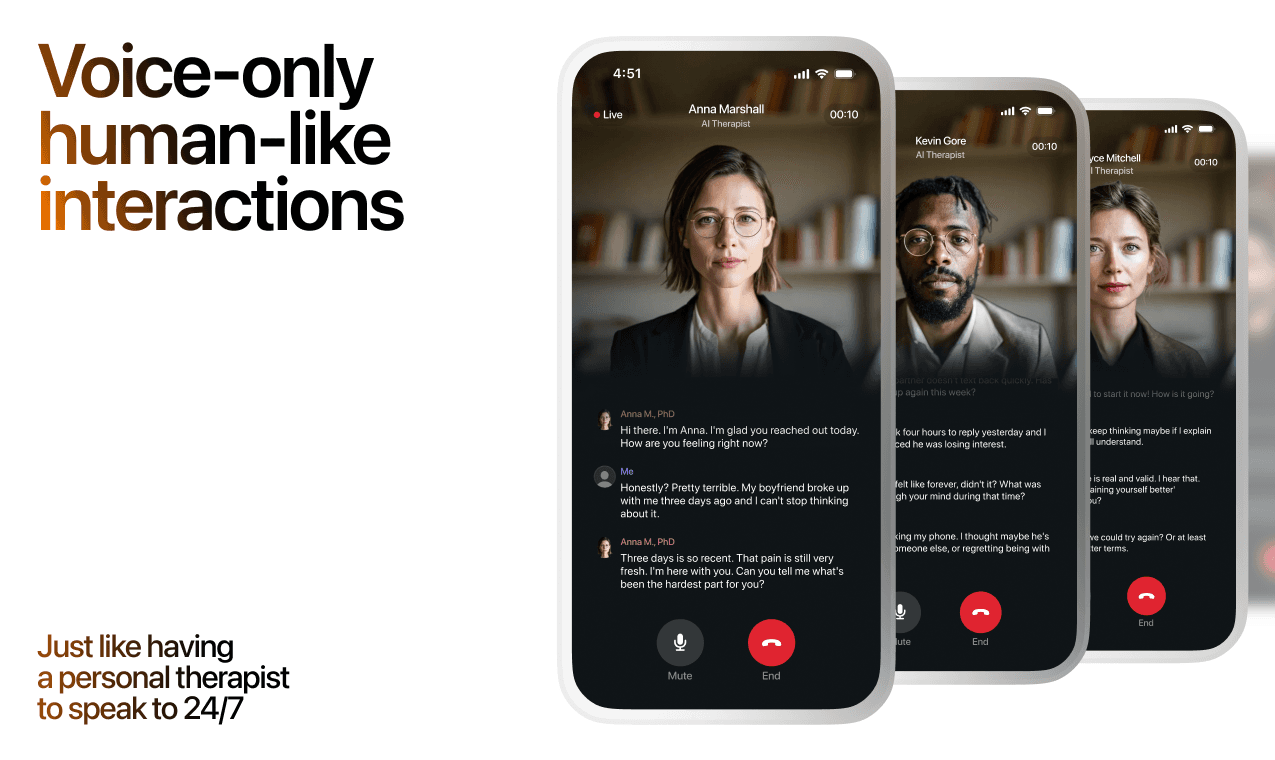
Here's what happens in a typical Lovon session:
You share what's on your mind
There's no script, no intake form, no waiting room. You speak or type whatever you're feeling — in your own words, at your own pace.
Lovon validates and explores
Using frameworks from CBT (Cognitive Behavioral Therapy) and motivational interviewing, Lovon acknowledges your feelings first, then gently helps you explore them. No dismissive "just move on" advice.
You build coping skills together
Lovon doesn't just listen — it actively works with you on evidence-based techniques: thought reframing, urge surfing, behavioral experiments, and more.
What a Session with Lovon Looks Like
When to Seek Professional Help
AI support is a valuable tool, but it's not a replacement for professional care. Please consider reaching out to a licensed therapist if you experience any of the following:
- Persistent thoughts of self-harm or suicide
- Inability to perform daily activities (work, eating, sleeping) for more than 2 weeks
- Turning to alcohol or substances to cope
- Intense anger or desire to harm your ex-partner
- Complete emotional numbness that doesn't improve over time
Crisis Resources (US): If you're in immediate danger, call 988 (Suicide & Crisis Lifeline) or text HOME to 741741 (Crisis Text Line). Available 24/7, free, and confidential.
Outside the US? Find a crisis line in your country
Ready to Start?
Your healing journey can begin right now
A 7-day trial. No judgment. Just a safe space to process what you're going through.
Frequently Asked Questions
Is Lovon a replacement for a real therapist?
Is my conversation with Lovon AI private?
How is Lovon different from ChatGPT for emotional support?
Can I use Lovon if I'm already seeing a therapist?
Can I try Lovon before subscribing?
About the Author
The Lovon Editorial Team
Mental Health & Wellness Content Team
The Lovon Editorial Team develops mental health and wellness content designed to make psychological concepts accessible and actionable. Our goal is to bridge the gap between clinical research and everyday life - helping you understand why your mind works the way it does and what you can do about it....
Related articles
- AI App for Anxiety Insomnia: Best Picks 2026
The best ai app for anxiety insomnia in 2026 pairs voice sessions with nervous-system tools. See what to buy, consider…
- AI Coping Tools for Climate Anxiety: What Works in 2026
AI coping tools for climate anxiety ranked for 2026 — breathing, grounding, journaling, and AI voice therapy compared…
- Can an AI voice app actually calm you down?
Yes, AI voice apps calm acute anxiety spikes fast through paced voice conversation. See how it works, its limits, and…
- How to Stop a Panic Attack in the Moment (2026)
Learn how to stop a panic attack using 4-7-8 breathing, 5-4-3-2-1 grounding, and the dive reflex. Evidence-based steps…
See also
Quizzes
- Toxic Masculinity Test: Which Rules Are You Running?
See which learned rules cost you most, in 3 minutes.
- Am I Codependent? 12-Question Self-Check
See how much of you is left over, in 2 minutes.
Free tools
- Words of Encouragement for Him When He Is Struggling
Words of encouragement for him that fit what he is actually going through, for when your usual lines are not landing…
- 5-4-3-2-1 Grounding Exercise
A guided run through the 5-4-3-2-1 technique, with paced breathing first if you need it. No sign-up, nothing stored…
From the wiki
- How to stop maladaptive daydreaming?
Maladaptive daydreaming is immersive waking fantasy that eats hours, usually with music and pacing attached. You rarely…
Disclaimer: This article is for informational purposes only and does not constitute medical advice, diagnosis, or treatment. Always seek the advice of your physician or other qualified health provider with any questions you may have regarding a medical condition. If you are in crisis or think you may have an emergency, call 988 (Suicide & Crisis Lifeline) or go to the nearest emergency room. Outside the US? Find a crisis line in your country.