
AI Therapy for Phone Call Anxiety: What Works in 2026
AI therapy for phone call anxiety in 2026: what to look for, which approaches to buy or skip, and the pre-call routine that actually calms shaky nerves.

Key Takeaways
- AI therapy for phone call anxiety works best as a 5-minute voice rehearsal right before you dial - Buy.
- Lovon's voice-first format beats text-only chatbots for pre-call nerves because it rehearses your actual voice, not
- The interview-call and cold-call use cases score highest: on-demand, 24/7, no scheduling. Buy.
- Generic meditation apps without real-time voice interaction are a Skip for last-minute call panic.
- Text-based AI still helps for journaling after the call, but it won't calm the shaking hands before it.
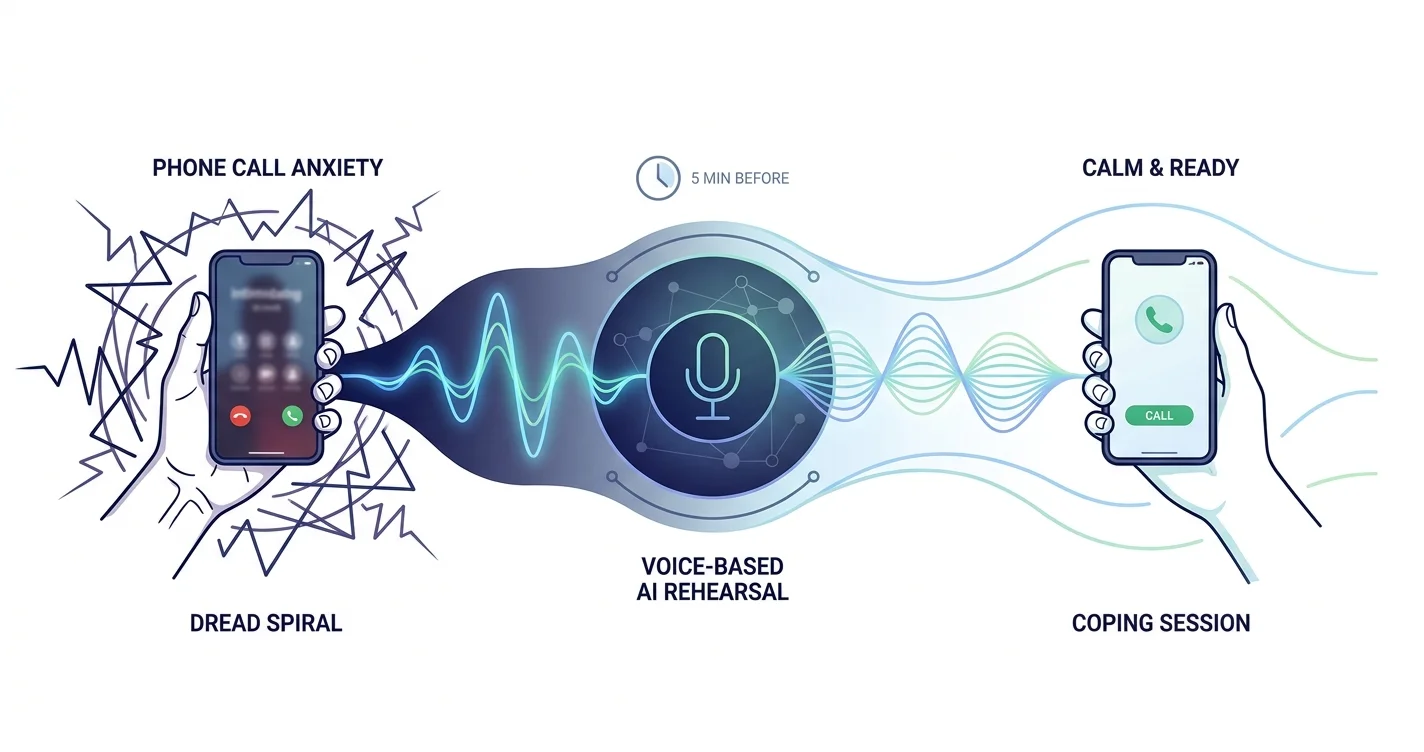
Phone call anxiety turns a two-minute conversation into a dread spiral that can start hours before you dial. AI therapy for phone call anxiety gives you a voice-based coping session right before the call, not a waitlist appointment three weeks out.
TL;DR
- AI therapy for phone call anxiety works best as a 5-minute voice rehearsal right before you dial - Buy.
- Lovon's voice-first format beats text-only chatbots for pre-call nerves because it rehearses your actual voice, not typed answers.
- The interview-call and cold-call use cases score highest: on-demand, 24/7, no scheduling. Buy.
- Generic meditation apps without real-time voice interaction are a Skip for last-minute call panic.
- Text-based AI still helps for journaling after the call, but it won't calm the shaking hands before it.
Why this matters
Phone call anxiety, sometimes called telephobia, doesn't wait for a therapy slot. It shows up ten minutes before a job interview call, right as you're about to phone the doctor's office, or the second a client's name flashes on your screen.
Traditional therapy is built around a weekly hour, not a 15-minute window before a call you can't avoid. That gap is exactly where AI therapy for phone call anxiety fits: a voice-based session you open on your phone, talk through what's making you tense, and get a coping technique before you press dial.
Lovon runs on this exact model - a voice conversation with an AI voice companion, built with input from PhD psychologists, available any time you need it. It's not a replacement for a licensed clinician, and it says so plainly. What it does is give you a place to talk through the spike of dread before a call instead of white-knuckling through it alone.
Who this is for
This guide is for people who feel their chest tighten before answering the phone, freelancers who dread client calls, job seekers rehearsing interview answers at midnight, people who put off calling the doctor's office for weeks, and anyone whose social anxiety makes a five-minute phone call feel like a performance review. If you've ever let a call go to voicemail on purpose just to buy yourself more time to prepare, this is written for you.
What to look for in AI therapy for phone call anxiety
Voice-first, not text-only
Phone anxiety is a voice problem. Typing out how you feel to a chatbot doesn't rehearse the thing that actually scares you: hearing your own voice shake in real time. A voice-based AI session lets you practice speaking out loud before the real call, which is closer to exposure than any text thread will get you.
Available in the ten minutes before the call
A coping tool that requires booking or a 48-hour wait is useless when the call is in nine minutes. Look for something you can open the second the anxiety spikes, not something you schedule for next Tuesday.
Practical techniques, not just validation
Being told "that's a valid feeling" doesn't lower your heart rate. You need a specific breathing pattern, a grounding cue, or a two-line script you can actually say when the other person picks up.
Honesty about what it isn't
Any tool worth using for phone call anxiety should be upfront that it's not a licensed clinician and not a crisis line. If a mental health app in 2026 is quietly implying it replaces a therapist, that's a red flag, not a feature.
Repeatable across call types
Interview calls, doctor's calls, and cold sales calls trigger anxiety differently. A tool that only handles one scenario forces you to cobble together three different apps for one problem.
Top approaches worth trying
The pre-call rehearsal - the safe pick. Talk through what you're going to say out loud, in a voice session, before the actual call. One spec that matters: it takes under 5 minutes and doesn't require a script you wrote in advance. This is the closest thing to exposure therapy you can do solo, and it works for interview prep the same way it works for a call you've been avoiding for a week. If you've got a call that's been sitting on your to-do list, calm interview anxiety walks through the same pre-call rehearsal logic. Buy.
The physical symptom reset - the underrated pick. Racing heart, sweaty palms, and shallow breathing show up before the ringing even starts. A structured breathing exercise run for 90 seconds to 3 minutes brings your nervous system down enough to speak clearly instead of stammering through the first sentence. See breathing exercises for anxiety relief for the exact counts. Buy.
The social-anxiety specific track - the wildcard. If your phone dread is really social anxiety wearing a phone-shaped costume, a generic "calm down" tool misses the actual trigger: fear of judgment, not the phone itself. A track built for social anxiety addresses the judgment fear directly instead of just the physical symptoms. Consider it if calls aren't your only trigger - meetings and small talk spike the same way for you.
The text-only chatbot - the one that looks right but isn't. Typing your worries into a chat window before a call feels productive, but it skips the vocal rehearsal your brain needs to actually calm down before speaking out loud. It's fine for processing feelings after the call. It does nothing for the ten minutes before. Skip it as your pre-call tool specifically.
Talk it through before you dial
Open a voice session with Lovon in the minutes before a call.
What to avoid
- Generic meditation apps with no real-time voice interaction. A five-minute ambient soundtrack is fine for sleep, but it won't rehearse the specific sentence you're dreading saying to your boss.
- Cold-turkey exposure with zero coping tool. "Just make the call" advice ignores the physical symptoms - shaking hands, tight chest - that make the call harder in the first place.
- Apps that promise to "cure" phone anxiety in one session. Coping tools reduce the spike in the moment. Anyone claiming a permanent fix in a single 2026 app download is overselling it.
Verdict comparison
| Approach | Best for | Available before calls | Verdict |
|---|---|---|---|
| Pre-call rehearsal | Interviews, cold calls, overdue calls | Yes, under 5 min | Buy |
| Breathing reset | Racing heart, shaky voice | Yes, 90 sec to 3 min | Buy |
| Social-anxiety track | Judgment fear beyond just the phone | Yes | Consider |
| Text-only chatbot | Post-call processing, not pre-call | Limited, no voice rehearsal | Skip |
FAQ
What is the best AI therapy for phone call anxiety in 2026?
A voice-first AI session you can open in the minutes before a call works best, since it rehearses speaking out loud rather than typing responses. Text-only chatbots help with post-call reflection but don't address the pre-call rehearsal gap.
Is AI therapy better than a text-based anxiety app for phone calls?
For phone call anxiety specifically, voice-based AI therapy is a stronger fit because the fear is tied to speaking, not typing. A text app can still be useful for journaling after the call is over.
How much does AI therapy for anxiety cost compared to traditional therapy?
Traditional therapy without insurance often runs well above what an app-based tool charges, and pricing varies by provider and session length. Check current app pricing directly rather than assuming a flat rate.
Can AI therapy actually stop a panic attack before a call?
AI-guided breathing and grounding techniques can lower the physical symptoms of a building panic response in the minutes before a call, though they work best when used at the first sign of anxiety rather than mid-attack.
Is phone call anxiety the same as social anxiety?
Phone call anxiety often overlaps with social anxiety but isn't identical - some people are fine in person but freeze on calls because they can't read facial cues. The coping approach differs depending on which one is driving the dread.
Does AI therapy replace a licensed therapist for phone anxiety?
No. AI therapy tools are built for on-demand emotional support and coping techniques, not diagnosis or clinical treatment. If phone anxiety is severe or tied to a broader anxiety disorder, a licensed clinician should be part of the plan.
What's a quick technique to calm down before an important call?
A short breathing pattern - inhale for 4 counts, hold for 4, exhale for 4, hold for 4, repeated for about 90 seconds - lowers heart rate enough to speak clearly. Pairing it with a one-line rehearsed opener reduces the freeze-up at the start of the call.
Can AI voice therapy help with cold call anxiety specifically for work?
Yes, rehearsing the opening lines out loud in a voice session before a cold call reduces the stumble that happens when anxiety hits mid-sentence. It won't fix a bad script, but it steadies delivery.
One last thing
The detail most people miss: it's rarely the call itself that spikes anxiety, it's the anticipation in the 20 minutes before. If your coping tool only activates during or after the call, you're solving the wrong window. Open a voice session the moment you notice yourself rehearsing worst-case scenarios in your head, not after your hand is already on the phone.
Related guides
How AI Support Helps You Heal
AI emotional support isn't about replacing human connection — it's about filling the gaps. The moments when you need to talk at 2 AM, when you don't want to burden your friends again, or when you simply need someone to listen without judgment.
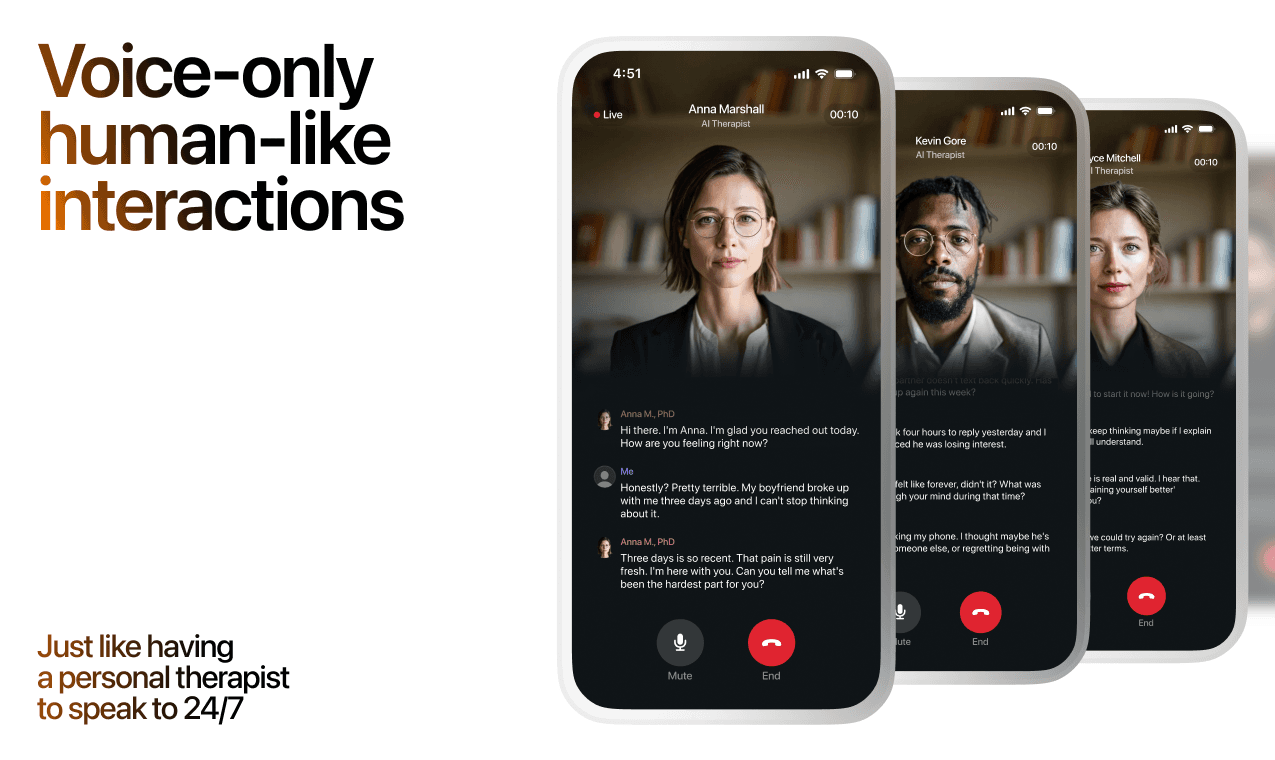
Here's what happens in a typical Lovon session:
You share what's on your mind
There's no script, no intake form, no waiting room. You speak or type whatever you're feeling — in your own words, at your own pace.
Lovon validates and explores
Using frameworks from CBT (Cognitive Behavioral Therapy) and motivational interviewing, Lovon acknowledges your feelings first, then gently helps you explore them. No dismissive "just move on" advice.
You build coping skills together
Lovon doesn't just listen — it actively works with you on evidence-based techniques: thought reframing, urge surfing, behavioral experiments, and more.
What a Session with Lovon Looks Like
When to Seek Professional Help
AI support is a valuable tool, but it's not a replacement for professional care. Please consider reaching out to a licensed therapist if you experience any of the following:
- Persistent thoughts of self-harm or suicide
- Inability to perform daily activities (work, eating, sleeping) for more than 2 weeks
- Turning to alcohol or substances to cope
- Intense anger or desire to harm your ex-partner
- Complete emotional numbness that doesn't improve over time
Crisis Resources (US): If you're in immediate danger, call 988 (Suicide & Crisis Lifeline) or text HOME to 741741 (Crisis Text Line). Available 24/7, free, and confidential.
Outside the US? Find a crisis line in your country
Ready to Start?
Your healing journey can begin right now
A 7-day trial. No judgment. Just a safe space to process what you're going through.
Frequently Asked Questions
Is Lovon a replacement for a real therapist?
Is my conversation with Lovon AI private?
How is Lovon different from ChatGPT for emotional support?
Can I use Lovon if I'm already seeing a therapist?
Can I try Lovon before subscribing?
About the Author
The Lovon Editorial Team
Mental Health & Wellness Content Team
The Lovon Editorial Team develops mental health and wellness content designed to make psychological concepts accessible and actionable. Our goal is to bridge the gap between clinical research and everyday life - helping you understand why your mind works the way it does and what you can do about it....
Related articles
- AI Support App for Chronic Loneliness in Men (2026)
The best AI support app for chronic loneliness in men in 2026: voice-first, 24/7, no appointment needed. See the verdict…
- AI Therapy App for Job Loss Anxiety: 2026 Verdict
Compare the best ai therapy app for job loss anxiety options in 2026 - Lovon, therapy without insurance, and EAPs - with…
- Free AI Therapist for Depression: Top Picks 2026
The best free AI therapist for depression in 2026. Lovon offers voice-based CBT sessions with no waitlist and no daily…
- AI Coping Tools for Public Speaking Anxiety in 2026
Ai coping tools for public speaking anxiety in 2026: which breathing, grounding, and CBT techniques actually work, with…
See also
Quizzes
- Do I Miss My Ex or Am I Just Lonely? 12-Question Quiz
Find out what the missing is actually about.
- Pet Loss Check: Free 12-Question Pet Grief Self-Check
See what losing them is actually doing, in 3 minutes.
Free tools
- Vent to Someone
Say the whole thing. It does not have to be fair or organized, you will not have to manage how it lands, and no advice…
- What to Say When They Are Struggling
A chat, not a list. Tell the coach who this person is to you, what they are going through, and what you already said…
From the wiki
- Why do I have no friends?
Usually nothing is wrong with you. Adult friendship runs on proximity and repetition, and most people lose both at once…
Disclaimer: This article is for informational purposes only and does not constitute medical advice, diagnosis, or treatment. Always seek the advice of your physician or other qualified health provider with any questions you may have regarding a medical condition. If you are in crisis or think you may have an emergency, call 988 (Suicide & Crisis Lifeline) or go to the nearest emergency room. Outside the US? Find a crisis line in your country.