
Stop Self-Isolating Depression: 2026 Step-by-Step Fix
Self-isolating depression breaks with small, specific steps, not motivation. Get the 2026 plan, troubleshooting, and where an AI therapy app fits in.

Key Takeaways
- Self-isolating depression feeds itself: less contact lowers mood, lower mood cancels more contact — break it with
- Text one person before you feel ready, not after — waiting for motivation keeps the cycle running in 2026 as much as
- Micro-exposure (a 5-minute walk, one reply, one voice note) rebuilds tolerance for contact faster than forcing a
- An AI voice therapy app like Lovon works between sessions or before you're ready for a person — it's a bridge, not a
- If isolation includes thoughts of not wanting to be here, that's a signal to contact a crisis line or licensed
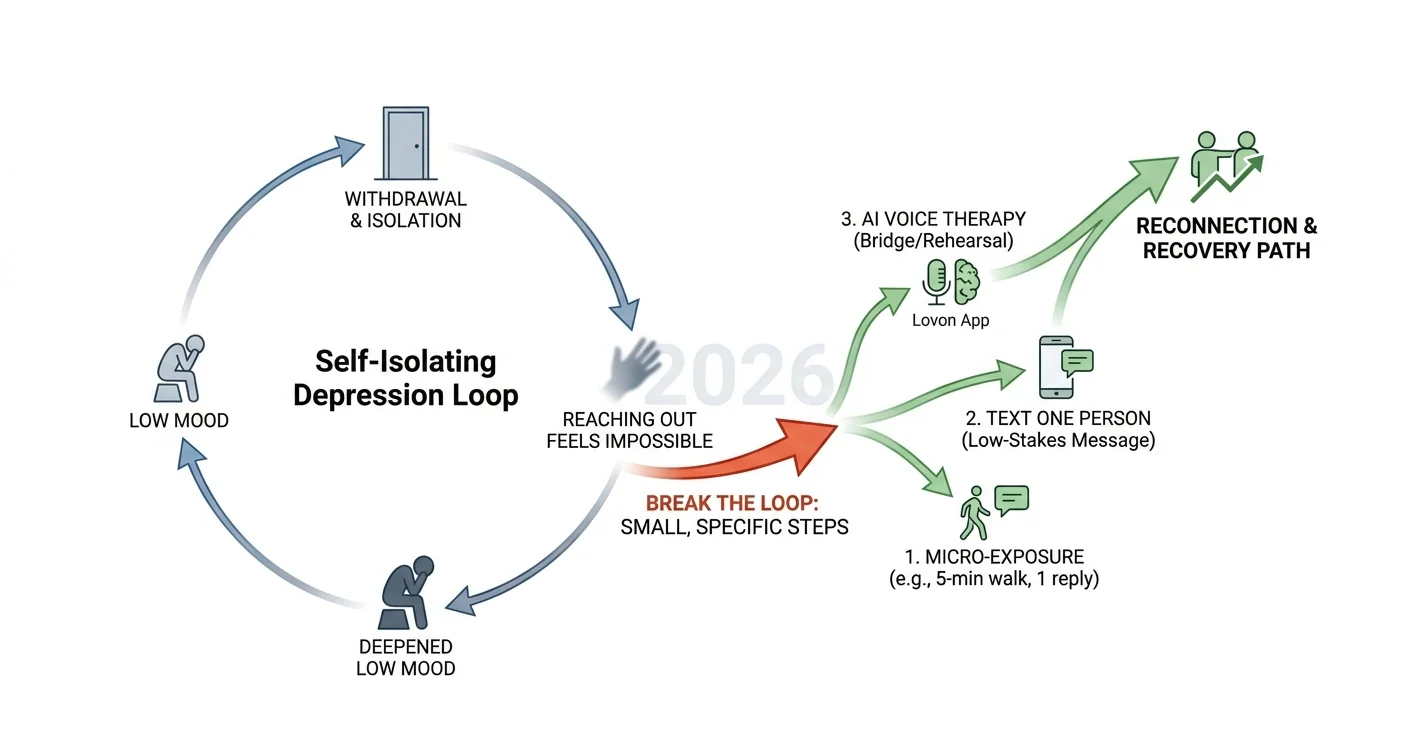
Self-isolating depression pulls you into a loop: you feel low, you cancel plans, the isolation deepens the low mood, and reaching out starts to feel impossible. This guide breaks the loop into small, specific steps you can start today, even if leaving the house feels like too much right now.
TL;DR
- Self-isolating depression feeds itself: less contact lowers mood, lower mood cancels more contact — break it with one 10-minute action daily.
- Text one person before you feel ready, not after — waiting for motivation keeps the cycle running in 2026 as much as ever.
- Micro-exposure (a 5-minute walk, one reply, one voice note) rebuilds tolerance for contact faster than forcing a full outing.
- An AI voice support app like Lovon works between sessions or before you're ready for a person — it's a bridge, not a replacement for care.
- If isolation includes thoughts of not wanting to be here, that's a signal to contact a crisis line or licensed provider immediately, not to self-manage.
Why this matters
Self-isolating depression isn't laziness or a personality flaw — it's a documented feedback loop where withdrawal and low mood reinforce each other. The less contact you have, the fewer chances your brain gets to update the belief that people want you around, and the belief hardens.
Breaking it early matters because isolation compounds. A skipped call in week one becomes a skipped year by year three if nothing interrupts the pattern. Coping with depression alone between therapy appointments or without one at all is possible, but it takes structure, not willpower.
You don't need to feel ready to start. You need one small action that's smaller than the resistance you're feeling.
What you'll need
- A phone with texting or a messaging app already installed
- One name — a friend, family member, or coworker you haven't ghosted entirely
- 10 minutes on a timer, once a day
- A notebook or notes app for a simple mood-and-contact log
- Optional: an AI voice support app such as Lovon for a low-pressure way to talk through what's happening before or between reaching out to a person
None of this requires you to feel motivated first. Motivation shows up after the first small action, not before it, in most documented behavioral activation approaches.
The steps
1. Name the isolation pattern out loud (or to yourself)
Write one sentence: "I've been avoiding contact for [X] days because [reason]." This accomplishes something specific — it turns a vague fog into a fact you can act on.
Depression tells you isolation is neutral, just "needing space." Naming it as avoidance, even gently, removes the disguise. Common mistake: skipping this step because it feels too simple — it's the step that makes the rest possible.
2. Send one low-stakes message before you feel ready
Pick one person and send a two-line text: "Been in a rough patch, not up for much, but wanted to say hi." You're not asking for a hangout or a rescue — you're keeping one thread open.
Waiting until you "feel like it" keeps the cycle intact, because feeling like it usually arrives after contact, not before. Send it within the next 10 minutes, not tonight. Common mistake: overthinking the wording until the window closes — a plain, short message works better than a polished one.
3. Use a 5-minute exposure, not a full outing
Set a timer for 5 minutes and do one thing outside total isolation: step onto the porch, walk to the mailbox, sit in a coffee shop without talking to anyone. The goal is exposure, not socializing.
This works because avoidance behavior generalizes — each small exposure you complete makes the next slightly less difficult, based on standard exposure-based approaches to withdrawal. Full outings feel too big and get skipped; 5 minutes rarely does. Common mistake: treating 5 minutes as "not enough to matter" and skipping it entirely.
4. Talk it through before you talk to a person
If the idea of texting someone back feels too exposed, talk out loud first — to yourself, into a voice memo, or through an AI voice therapy conversation. Lovon is built for exactly this moment: a voice conversation with an AI voice companion, available anytime, that helps you sort through what you'd say before you say it to a person who matters.
This matters because rehearsal lowers the activation energy for the real conversation. AI therapy for depression support works as a bridge specifically for people who aren't ready for a person yet but need more than silence. Common mistake: treating this step as a replacement for human contact rather than a rehearsal for it.
5. Log contact and mood daily for one week
Each evening, write one line: contact made (yes/no, what kind), mood (1-10). This accomplishes tracking without demanding you interpret anything yet.
By day 5 or 6, most people can see the correlation directly in their own numbers — days with even minimal contact score higher than days without. Seeing your own data is more convincing than being told the pattern exists. Common mistake: judging the numbers daily instead of just recording them and reviewing after a full week.
6. Schedule the next contact before the current one ends
When a call or text exchange wraps up, name the next one on the spot: "Let's talk Thursday" or "I'll text you this weekend." This removes the re-decision point where isolation usually creeps back in.
Depression exploits gaps with no plan attached — an open-ended "we should catch up sometime" almost never happens. A specific day, even loosely held, closes that gap. Common mistake: leaving the next contact vague because committing feels like pressure.
7. Build a floor, not a full recovery plan
Define the minimum weekly contact you'll maintain even on bad weeks: one text, one call, one 10-minute outing. This is a floor, not a goal — it's what happens on your worst days, not your best ones.
A floor works because it removes all-or-nothing thinking, where "I can't do everything" becomes "I'll do nothing." Setting it now, while you have some clarity, protects you later when clarity is gone. Common mistake: setting the floor too high, matching what you'd do on a good day instead of a bad one.
Troubleshooting
- You sent the text and got no reply within a day. This is common and rarely about you — people are slow to reply for their own reasons. Send one follow-up in 3-4 days; don't interpret silence as rejection yet.
- The 5-minute exposure spiked your anxiety instead of easing it. That's a normal early response to breaking an avoidance pattern. Shorten it to 2 minutes next time and build back up rather than stopping the exercise entirely.
- You keep starting the log and abandoning it after 2 days. Move it to something you already open daily — a phone notes app or the same app you use for messaging — instead of a separate notebook.
- You isolated again after a good few days. One bad stretch doesn't erase progress; it's data, not failure. Go back to step 2 the same day rather than waiting for the next week to "start over."
- Reaching out feels impossible even in text form. Try talking it through out loud first through voice journaling or an AI voice conversation before attempting the human message — voice journaling to reduce anxiety covers a similar mechanism for a related pattern.
- You suspect this is more than isolation — you're also having thoughts of not wanting to be here. Stop self-managing and contact a crisis line or licensed provider immediately; that's outside what any app or self-help step is built to handle.
Tools and resources
- An AI voice support app — Lovon lets you talk through what's driving the isolation anytime, day or night, without scheduling anything.
- Emotional support for loneliness and isolation — for the specific mechanics of what helps between human contact.
- Best mental health app for depression support in 2026 — for comparing options if you want more structure than a single app.
- A simple notes app for the daily mood-and-contact log.
- One trusted contact's name, saved and pinned at the top of your messages.
What to do next
Once you've held the floor from step 7 for two weeks straight, the next move is widening your window of tolerance for longer or higher-stakes contact — a full outing, a group setting, a harder conversation. That's a separate skill from breaking initial isolation, and it builds on this foundation rather than replacing it.
FAQ
What is self-isolating depression?
Self-isolating depression is a pattern where low mood drives withdrawal from people and activities, and that withdrawal then deepens the low mood, creating a self-reinforcing cycle. It's distinct from normal alone time because it's driven by avoidance, not preference.
How do I stop isolating myself when I'm depressed?
Start with one small, low-stakes action — a short text, a 5-minute outing — rather than waiting to feel ready for a full recovery. Motivation typically follows small actions rather than preceding them, based on standard behavioral activation approaches used in 2026 treatment settings.
Is isolating a symptom of depression or a separate problem?
Isolation is one of the most common symptoms of depression, not a separate issue layered on top of it. Treating the isolation directly, alongside mood, often speeds recovery compared to waiting for mood to improve first.
Can an AI therapist help with self-isolating depression?
An AI voice support app like Lovon can help you talk through what's driving the isolation and rehearse reaching out, especially between sessions or before you're ready to talk to a person. It's not a replacement for licensed clinical care, particularly if isolation is severe or long-standing.
How long does it take to break an isolation pattern?
Most people notice a measurable shift in mood-contact correlation within one week of daily small actions, based on standard tracking methods. Full pattern change tends to take several weeks of consistent, low-pressure contact rather than one big effort.
What if reaching out makes my anxiety worse, not better?
A short-term anxiety spike after initial contact is common and doesn't mean the approach is wrong. Shrink the action further — a 2-minute version instead of a 5-minute one — and build back up gradually.
When should self-isolating depression be treated as an emergency?
If isolation is paired with thoughts of self-harm or not wanting to be here, that's outside self-help territory and needs a crisis line or licensed provider immediately. No app or checklist is built to handle that level of risk.
Does isolating alone mean therapy won't work?
No — isolation is one of the most treatable symptoms of depression when addressed directly, whether through licensed therapy, structured self-help, or a combination. Many people use an AI therapy app between formal sessions specifically to keep contact-building consistent.
One last thing
The single biggest predictor of whether someone breaks a self-isolating depression pattern isn't the size of the action — it's whether they act before the urge to withdraw fully sets in for the day. A 10-minute text sent at 9am beats a 2-hour plan considered at 9pm and never sent. Pick a time you'll act daily, put it before your resistance peaks, and let the plan be smaller than you think you need.
Related guides
How AI Support Helps You Heal
AI emotional support isn't about replacing human connection — it's about filling the gaps. The moments when you need to talk at 2 AM, when you don't want to burden your friends again, or when you simply need someone to listen without judgment.
Here's what happens in a typical Lovon session:
You share what's on your mind
There's no script, no intake form, no waiting room. You speak or type whatever you're feeling — in your own words, at your own pace.
Lovon validates and explores
Using frameworks from CBT (Cognitive Behavioral Therapy) and motivational interviewing, Lovon acknowledges your feelings first, then gently helps you explore them. No dismissive "just move on" advice.
You build coping skills together
Lovon doesn't just listen — it actively works with you on evidence-based techniques: thought reframing, urge surfing, behavioral experiments, and more.
What a Session with Lovon Looks Like
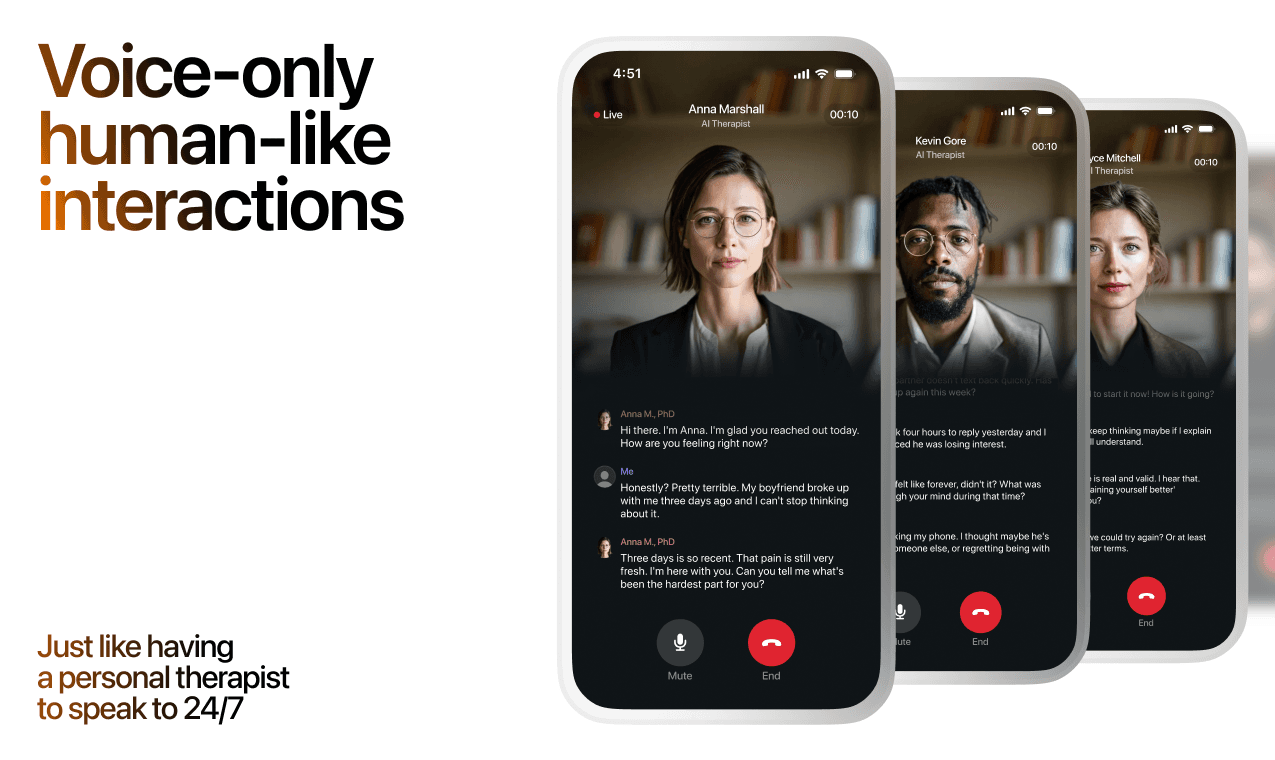
Lovon is AI support, not a replacement for professional care. If things have been hard to get through for weeks, or you are thinking about harming yourself, talk to a doctor or a licensed therapist.
Ready to Start?
Your healing journey can begin right now
A 7-day trial. No judgment. Just a safe space to process what you're going through.
Frequently Asked Questions
Is Lovon a replacement for a real therapist?
Is my conversation with Lovon AI private?
How is Lovon different from ChatGPT for emotional support?
Can I use Lovon if I'm already seeing a therapist?
Can I try Lovon before subscribing?
About the Author

The Lovon Editorial Team
Mental Health & Wellness Content Team
The Lovon Editorial Team develops mental health and wellness content designed to make psychological concepts accessible and actionable. Our goal is to bridge the gap between clinical research and everyday life - helping you understand why your mind works the way it does and what you can do about it....
Related articles
- Free AI Therapist for Depression: Top Picks 2026
The best free AI therapist for depression in 2026. Lovon offers voice-based CBT sessions with no waitlist and no daily…
- How to Stop Overthinking After an Argument (2026)
Stop overthinking after an argument with 7 steps that interrupt rumination fast. Includes troubleshooting for 3am…
- Functional Depression: Signs You're Not Just Tired (2026)
Functional depression keeps you going while draining everything. Learn the 8 signs, how it differs from burnout, and…
- Why Am I Exhausted All the Time? Real Causes in 2026
Why am I exhausted all the time even after sleep? 2026 guide breaks down burnout, depression, and cortisol causes sleep…
See also
Quizzes
- Distress Tolerance Test: How Long Can You Sit With It?
See which kind of discomfort makes you need out first.
- Inner Critic Test: How Harsh Is the Voice in Your Head?
See what kind of critic you live with, in 3 minutes.
Free tools
- Write a Letter to Your Best Friend
A chat for a letter to your best friend that only they could have received. Tell it how long you have been friends, one…
- How to Reconnect With an Old Friend
A chat for how to reconnect with an old friend, starting with the text you have been meaning to send for a year. Tell it…
From the wiki
- Why do I keep dreaming about the same person?
A recurring dream figure usually marks unfinished emotional business rather than a message about that person. Your brain…
Disclaimer: This article is for informational purposes only and does not constitute medical advice, diagnosis, or treatment. Always seek the advice of your physician or other qualified health provider with any questions you may have regarding a medical condition. If you are in crisis or think you may have an emergency, call 988 (Suicide & Crisis Lifeline) or go to the nearest emergency room. Outside the US? Find a crisis line in your country.