
How to Stop Overthinking After an Argument (2026)
Stop overthinking after an argument with 7 steps that interrupt rumination fast. Includes troubleshooting for 3am spirals and when to get support in 2026.
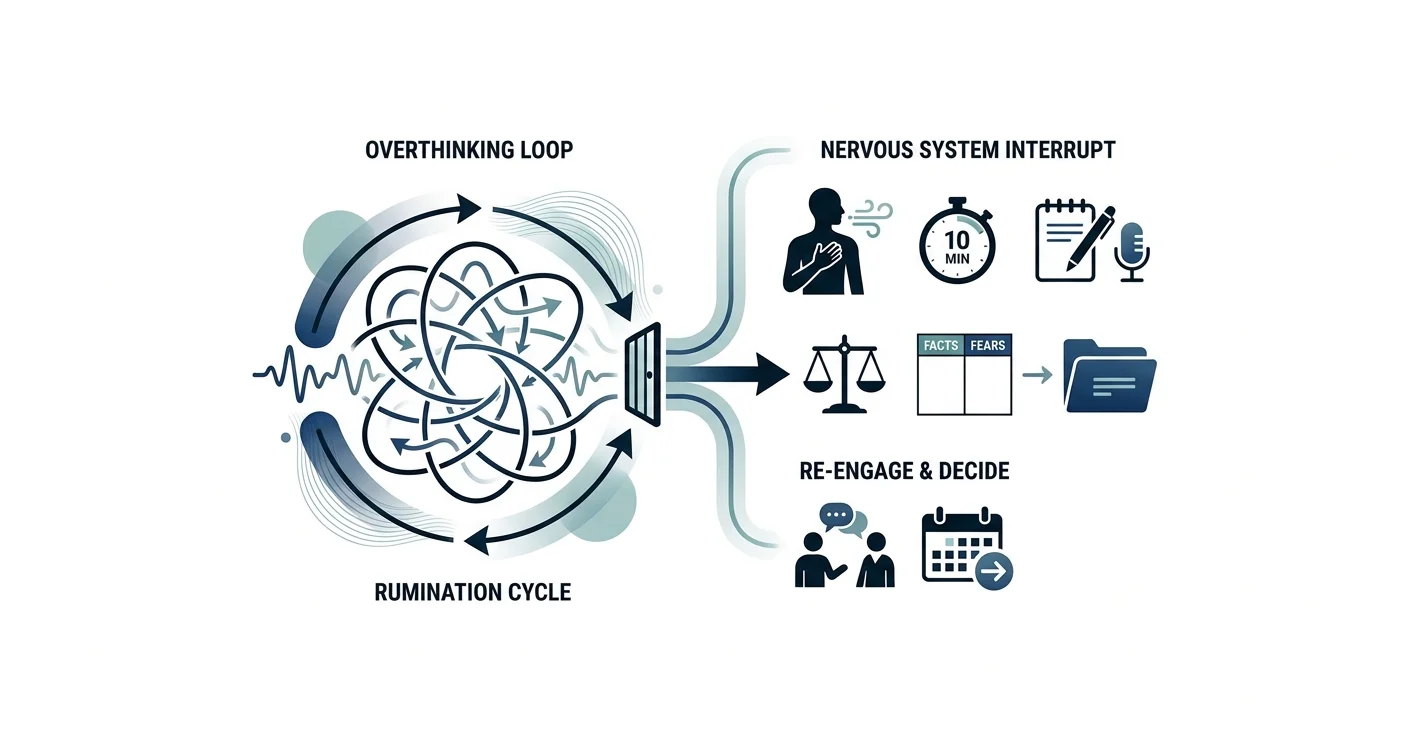

Key Takeaways
- Overthinking after an argument is rumination, not reflection, and it peaks in the first 2-3 hours post-conflict.
- Grounding techniques and a 10-minute writing dump interrupt the loop faster than trying to reason your way out.
- If the spiral runs past 24 hours or repeats after every fight, that's a pattern worth naming with support, not just
- Lovon's AI voice therapy app gives you a place to talk through the spiral the moment it starts, even at 1am.
You replay the argument for the tenth time tonight, rehearsing what you should have said instead, and your chest is still tight three hours after the door closed. Overthinking after an argument is a nervous system stuck in review mode, and there's a specific sequence that gets you out of it faster than waiting it out.
TL;DR
- Overthinking after an argument is rumination, not reflection, and it peaks in the first 2-3 hours post-conflict.
- Grounding techniques and a 10-minute writing dump interrupt the loop faster than trying to reason your way out.
- If the spiral runs past 24 hours or repeats after every fight, that's a pattern worth naming with support, not just willpower.
- Lovon's AI voice therapy app gives you a place to talk through the spiral the moment it starts, even at 1am.
Why this matters
Your brain treats an unresolved argument like an open file it can't close. That's not weakness — it's the amygdala flagging unfinished business as a threat, which is why your mind keeps pulling you back to the same five minutes of conversation.
Left alone, this turns into rumination: the same three thoughts on repeat, no new information, no resolution, just wear. Left alone long enough, it starts costing you sleep, focus at work, and your ability to actually hear your partner or friend the next time you talk. The fix isn't "stop thinking about it" — that instruction never works. The fix is giving your brain something concrete to do instead of looping.
What you'll need
- 10-15 minutes of uninterrupted time, ideally within a few hours of the argument
- A notebook, notes app, or voice memo — whatever you'll actually use
- A private space where you can say things out loud without an audience
- Optional: a cognitive behavioral technique worksheet or the same idea done from memory
- Optional: an AI voice therapy app like Lovon if you want to talk it out rather than write it out
The steps
1. Name what your body is doing right now
Before you touch the content of the argument, check your physical state. A racing heart, clenched jaw, or shallow breathing means you're still in a stress response, and no amount of thinking clearly happens from there.
Put one hand on your chest and take four slow breaths, in for four counts, out for six. This isn't a stalling tactic — it's the fastest lever you have on your nervous system, and it takes under 60 seconds.
Common mistake: trying to "think your way calm" while your body is still flooded with cortisol. Calm the body first, or the thinking won't stick.
2. Dump the whole spiral onto paper
Set a timer for 10 minutes and write everything running through your head — what they said, what you wish you'd said, what you're scared it means. No editing, no structure, just get it out of your skull and onto the page.
This works because rumination thrives on being unexamined. Once it's written down, your brain stops treating it as urgent unfinished business and starts treating it as information you can look at.
Expected outcome: the loop usually slows within the 10 minutes, even if it doesn't fully stop. Common mistake: stopping after 2 minutes because it feels uncomfortable — the discomfort is the sign it's working.
3. Separate what happened from what you're afraid it means
Most post-argument overthinking isn't about the actual words exchanged — it's about the story you've built on top of them ("this proves they don't respect me," "we always end up here"). Write the facts in one column and the fears in another.
This is the exact move behind catastrophizing and worst-case thinking: your brain fills silence with the worst version of the story because uncertainty feels more dangerous than a bad answer. Naming the gap between fact and fear shrinks the spiral by roughly half in most people's experience within a single sitting.
4. Identify the actual trigger, not just the topic
The argument might have been about dishes or a text left on read, but the overthinking usually attaches to something older — feeling dismissed, feeling unheard, feeling like you're too much. Ask yourself what the fight touched, not what it was technically about.
This single question does more to stop overthinking after an argument than any amount of replaying the dialogue, because it points you at the real target. Identifying your emotional triggers once, in a calm moment, makes this step faster every time after.
5. Talk it out loud, even if no one's listening
Thinking in loops is silent and repetitive by nature. Saying the same thoughts out loud — to a friend, into a voice memo, or in conversation with an AI voice therapy app — forces your brain to structure the thought into sentences instead of fragments, which interrupts the loop.
This is where a tool like Lovon earns its place: at 11pm, when calling a friend feels like too much and the spiral is still running, you can talk through it in real time and get a response back instead of talking into silence. Common mistake: waiting until you "have it figured out" before saying anything — say the messy version first.
6. Set a decision point for when you'll actually address it
Overthinking often stands in for avoidance — your brain keeps replaying the fight instead of deciding when to actually revisit it with the other person. Pick a specific window (tonight after dinner, tomorrow morning) and write it down.
Once there's a set time to deal with it directly, your brain has less reason to keep the file open right now. This is the step most people skip, and it's usually the one that ends the loop for good.
7. Regulate before you reconnect
If you're planning to talk to the person again today, don't go back in still activated. Use a grounding pass first — cold water on your wrists, a short walk, or box breathing for four rounds.
Reconnecting while still flooded tends to reopen the argument instead of resolving it, which just feeds tomorrow's overthinking session. Give yourself 20-30 minutes of regulated state before round two.
Troubleshooting
- The loop restarts the second you stop writing. Normal in the first hour. Do a second 10-minute round later that day instead of expecting one session to close it.
- You can't stop imagining what they're thinking about you. That's projection, not information. Write "I don't actually know what they're thinking" at the top of the page and move to step 3.
- You feel worse after journaling, not better. You may be re-living the argument instead of processing it. Switch to talking it out loud — voice processing engages different regions than silent writing and often breaks a stuck loop faster.
- It's 3am and you're still awake replaying it. Get out of bed. Lying there rehearsing it trains your brain to associate the bed with the spiral. Do steps 1 and 2 somewhere else, then return.
- The same argument keeps resurfacing weeks later. That's unresolved, not overthought — it needs an actual conversation, not another round of internal processing.
- You notice this happens after every single disagreement, not just big ones. That's a pattern worth naming with support rather than solving from scratch each time.
Tools and resources
- Voice memo app or notes app for the writing dump
- Journaling prompts for anxiety and overthinking if a blank page feels intimidating
- A grounding technique you already know cold — box breathing, cold water, or a short walk
- Lovon, if you want to process the spiral by talking rather than writing, any hour of the day or night in 2026
Talk through it right now
Process the spiral with an AI voice therapy session, no appointment needed.
What to do next
If the overthinking is less about this one argument and more about a nervous system that's been on high alert for a while, look at what's driving the amygdala hijack underneath it — that's usually the deeper fix, not another round of post-fight journaling.
FAQ
How long does overthinking after an argument normally last?
Most rumination peaks within the first 2-3 hours and fades within a day once you process it deliberately. If it's still running strong after 24-48 hours, or resurfaces every time you think about the person, that's a sign it needs direct processing rather than more time.
Is overthinking after a fight a sign of anxiety?
It can be, especially if you notice the same pattern after most disagreements, not just big ones. Occasional post-argument rumination is normal; frequent, hard-to-stop spirals are worth naming with a therapist or an AI voice therapy app like Lovon.
Why can't I stop replaying what I should have said?
Your brain treats the unresolved conversation as an open threat and keeps returning to rehearse a better outcome. Writing or talking through the actual content of the argument, instead of just replaying it silently, closes that open loop faster.
Should I text the person while I'm still overthinking?
Wait until you've regulated your nervous system first, usually 20-30 minutes of grounding. Messages sent mid-spiral tend to reopen the fight rather than resolve it, which restarts the overthinking cycle.
Does journaling actually help with post-argument rumination?
Yes, a focused 10-minute unedited writing session measurably slows the loop for most people by externalizing the thoughts instead of letting them repeat silently. If writing doesn't help, talking the same content out loud often works faster.
What's the difference between reflecting on an argument and overthinking it?
Reflection has a direction, you learn something and move toward a decision or conversation. Overthinking repeats the same thoughts with no new information and no decision point, which is the sign to interrupt it deliberately.
Can an AI voice therapy app help right after a fight?
An AI voice therapy app like Lovon gives you somewhere to talk through the spiral the moment it starts, which can interrupt rumination faster than sitting with it alone. It's a support tool for processing in the moment, not a replacement for a licensed therapist if the pattern is severe or ongoing.
Why do I overthink more at night after an argument?
Fewer distractions and lower cortisol regulation at night make rumination louder, which is why 11pm spirals feel worse than the same thoughts at noon. Getting out of bed and doing a short grounding pass breaks the association between bed and the loop.
One last thing
The detail most people miss in 2026: overthinking after an argument almost never gets better by thinking harder about it — it gets better by changing the format. Writing instead of silent replay, talking instead of writing, walking instead of sitting still. The content of the thought matters less than whether you're stuck rehearsing it the same way every time.
Related guides
How AI Support Helps You Heal
AI emotional support isn't about replacing human connection — it's about filling the gaps. The moments when you need to talk at 2 AM, when you don't want to burden your friends again, or when you simply need someone to listen without judgment.
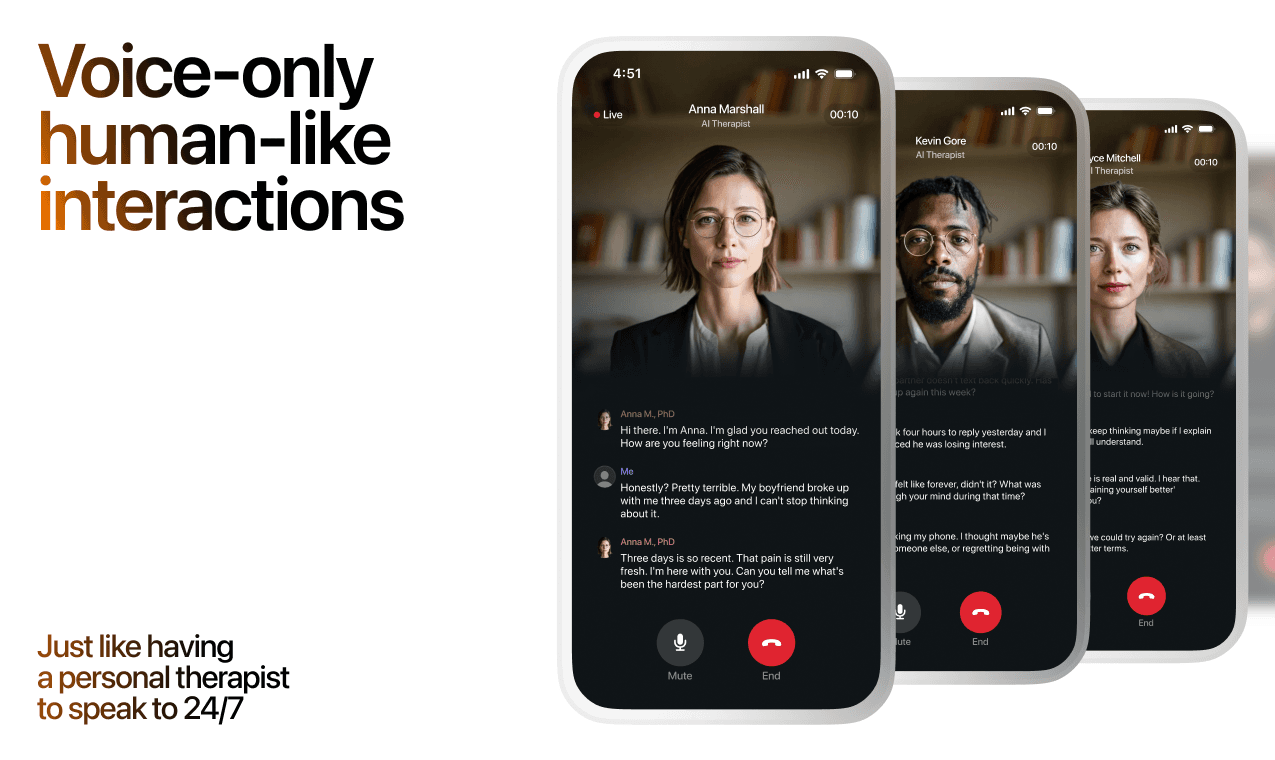
Here's what happens in a typical Lovon session:
You share what's on your mind
There's no script, no intake form, no waiting room. You speak or type whatever you're feeling — in your own words, at your own pace.
Lovon validates and explores
Using frameworks from CBT (Cognitive Behavioral Therapy) and motivational interviewing, Lovon acknowledges your feelings first, then gently helps you explore them. No dismissive "just move on" advice.
You build coping skills together
Lovon doesn't just listen — it actively works with you on evidence-based techniques: thought reframing, urge surfing, behavioral experiments, and more.
What a Session with Lovon Looks Like
When to Seek Professional Help
AI support is a valuable tool, but it's not a replacement for professional care. Please consider reaching out to a licensed therapist if you experience any of the following:
- Persistent thoughts of self-harm or suicide
- Inability to perform daily activities (work, eating, sleeping) for more than 2 weeks
- Turning to alcohol or substances to cope
- Intense anger or desire to harm your ex-partner
- Complete emotional numbness that doesn't improve over time
Crisis Resources (US): If you're in immediate danger, call 988 (Suicide & Crisis Lifeline) or text HOME to 741741 (Crisis Text Line). Available 24/7, free, and confidential.
Outside the US? Find a crisis line in your country
Ready to Start?
Your healing journey can begin right now
1 free conversation. No credit card. No judgment. Just a safe space to process what you're going through.
Frequently Asked Questions
Is AI therapy a replacement for a real therapist?
Is my conversation with Lovon AI private?
How is Lovon different from ChatGPT for emotional support?
Can I use Lovon if I'm already seeing a therapist?
Can I try Lovon for free?
About the Author
The Lovon Editorial Team
Mental Health & Wellness Content Team
The Lovon Editorial Team develops mental health and wellness content designed to make psychological concepts accessible and actionable. Our goal is to bridge the gap between clinical research and everyday life - helping you understand why your mind works the way it does and what you can do about it....
Related articles
- Health Anxiety: How to Stop Googling Symptoms (2026)
Health anxiety has you Googling symptoms at 2am. This 2026 guide gives a 15-minute delay rule, grounding steps, and what…
- How to Use Plushie Dreadfuls for Depression, Overthinking, and Trauma
Therapeutic plushies have emerged as tangible tools for individuals navigating depression, anxiety, trauma, and…
- Why Chest Feels Tight When Anxious (2026 Fix)
Chest tight when anxious? Tensed muscles and shallow breathing are the cause in 2026 guidance. Get the 7-step fix and…
- Sunday Scaries: Why They Happen & How to Calm It (2026)
Sunday scaries peak before Monday even starts. See why the dread hits in 2026, plus 7 concrete steps to calm it before…
See also
Quizzes
- Conflict Style Test: How You Fight and How You Repair
See how you fight, and whether you repair.
- Toxic Masculinity Test: Which Rules Are You Running?
See which learned rules cost you most, in 3 minutes.
Free tools
- How to Ask for Space Without Ending It
A chat for when you need distance but not a breakup. Say the sentence you keep rehearsing and what you are afraid they…
- 5-4-3-2-1 Grounding Exercise
A guided run through the 5-4-3-2-1 technique, with paced breathing first if you need it. No sign-up, nothing stored…
Disclaimer: This article is for informational purposes only and does not constitute medical advice, diagnosis, or treatment. Always seek the advice of your physician or other qualified health provider with any questions you may have regarding a medical condition. If you are in crisis or think you may have an emergency, call 988 (Suicide & Crisis Lifeline) or go to the nearest emergency room. Outside the US? Find a crisis line in your country.