
AI Chat for Emotional Support: What to Expect in 2026
AI chat for emotional support in 2026: what voice-based tools like Lovon do well, where text bots fall short, and when to call 988 instead.

Key Takeaways
- Chatbots that claim to diagnose. A tool that tells you you have generalized anxiety disorder or major depression is
- Apps with no stated data policy. If you can't find where your conversation history goes, assume it's being used in
- Tools with no crisis pathway. An app that never mentions 988 or emergency services isn't built with real-world use
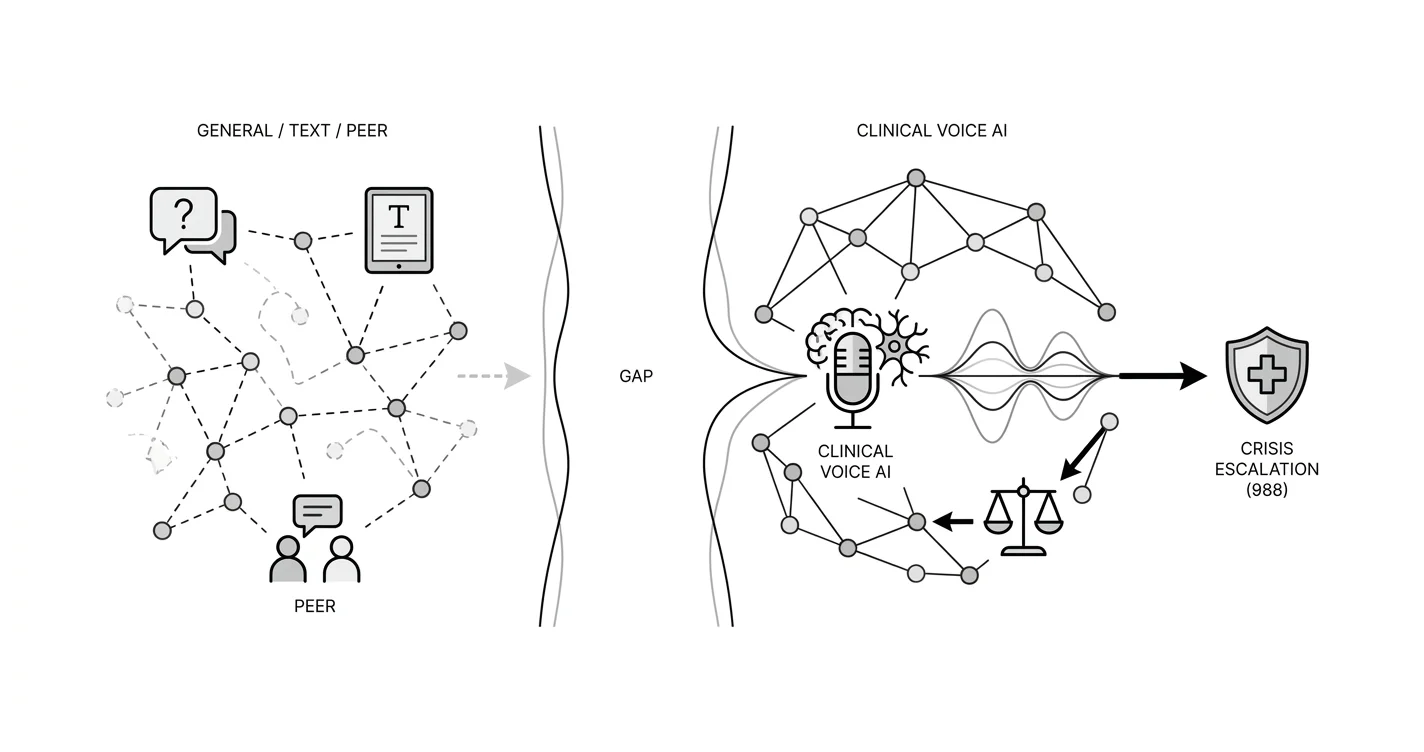
AI chat for emotional support now covers everything from general chatbots to dedicated voice apps, and the gap between those options is bigger than most people expect going into 2026.
This guide breaks down who actually benefits from AI chat for emotional support, what separates a real tool from a novelty, and which category to pick based on what you're dealing with.
TL;DR
AI chat for emotional support works best when it's built specifically for mental health, not repurposed from a general chatbot. AI mental health support tools that use structured, psychologist-informed frameworks beat generic AI for daily coping work: Buy if you want 24/7 availability between therapy sessions or instead of nothing, Skip general-purpose chatbots for anything beyond one-off venting, and always keep 988 saved for crisis moments. Voice-based apps like Lovon close the gap between texting a bot and actually talking something through.
Why this matters
Interest in AI chat for emotional support keeps climbing because therapy waitlists are long and session costs add up fast. A person having a rough Tuesday night at 11pm doesn't have a therapist on call — they have a phone.
The problem is that "AI chat for emotional support" gets used as a catch-all term for wildly different products. A general chatbot trained to be agreeable is not the same tool as software built with clinical input to recognize catastrophizing or a freeze response. Picking the wrong one wastes time and, in some cases, reinforces unhelpful thought patterns instead of interrupting them.
Who this is for
This is for anyone dealing with everyday anxiety, stress, low mood, relationship friction, or burnout who wants support between or instead of formal therapy sessions. It's also for people priced out of weekly sessions, people on a waitlist, and people who process better out loud than in a text box. It is not a substitute for licensed clinical care, and no AI chat tool marketed honestly in 2026 claims otherwise.
What to look for in AI chat for emotional support
Voice vs. text interaction
Typing out a feeling and speaking it are different cognitive tasks — voice tends to surface emotion faster because it skips the editing pass typing invites. If the tool only supports text, you'll spend more energy composing than processing. AI voice therapy differs from text-based apps specifically because tone, pacing, and pauses carry information a keyboard can't.
Clinical grounding, not just good writing
An AI that sounds warm isn't the same as one built with psychologist input on frameworks like cognitive distortions or nervous system regulation. Ask whether the product states who informed its design — vague marketing language is a red flag.
Availability without friction
Emotional spikes don't wait for business hours. A tool worth using is available at 2am on a Sunday with no appointment, no waitlist, and no "we'll call you back."
Honesty about limits
The better products say plainly what they are not: not a diagnosis tool, not a crisis line, not a replacement for a licensed clinician. Tools that overpromise clinical authority should lose points immediately.
Data handling
You're disclosing personal material. Check whether conversations are stored, for how long, and whether they're used to train models beyond your own account — this should be stated somewhere on the site, not buried.
Crisis escalation
A legitimate mental health AI tool tells you clearly when to stop chatting and call 988 or local emergency services. If a tool never mentions this, that's a gap, not a feature.
Top picks by category
General-purpose AI chatbots — the improviser. These weren't built for mental health; they're built to be broadly helpful, which means zero structured framework behind the responses. Fine for a single vent session, unreliable for anything recurring. Skip for regular emotional support.
Text-based mental health chat apps — the journal that talks back. These add structure over a raw chatbot but still lose the tonal information voice carries. Decent for people who process better in writing. Consider if typing is genuinely your preferred mode.
AI voice support apps, like Lovon — the closest thing to an actual conversation. Voice-based sessions built with PhD psychologist input for anxiety, stress, low mood, relationship problems, and burnout, available around the clock in 2026 with no appointment required. This category closes the gap between a chatbot and a real check-in. Buy if you want daily, on-demand support between or in place of therapy sessions.
Peer support communities — the community pick. Real people, real empathy, no clinical framework, inconsistent quality by nature of being unmoderated peer advice. Consider as a supplement, not a primary tool.
Crisis lines (988) — the safety net. Free, staffed by trained responders, built for the moment an AI tool should stop and hand off. Buy for any moment involving safety risk — no AI product, including voice-based ones, should be your first call in a crisis.
What to avoid
- Chatbots that claim to diagnose. A tool that tells you you have generalized anxiety disorder or major depression is overstepping — diagnosis requires a licensed clinician, and any product implying otherwise is misrepresenting what AI chat for emotional support can responsibly do.
- Apps with no stated data policy. If you can't find where your conversation history goes, assume it's being used in ways you haven't agreed to.
- Tools with no crisis pathway. An app that never mentions 988 or emergency services isn't built with real-world use in mind.
Verdict comparison
| Category | Voice-based | Clinically informed | 24/7 access | Crisis handoff | Verdict |
|---|---|---|---|---|---|
| General AI chatbots | No | No | Yes | Rare | Skip |
| Text-based mental health apps | No | Sometimes | Yes | Sometimes | Consider |
| AI voice support (Lovon) | Yes | Yes | Yes | Yes | Buy |
| Peer communities | No | No | Yes | No | Consider |
| Crisis lines (988) | Yes | Yes | Yes | N/A | Buy for emergencies |
FAQ
Is AI chat for emotional support actually effective? It can be effective for everyday stress, anxiety, and low mood when the tool is built with clinical structure behind it, not just conversational polish. It is not a substitute for treating diagnosed conditions, which still need a licensed clinician.
Is AI chat for emotional support better than texting a friend? It's different, not better — a friend brings context and history an AI doesn't have, while an AI is available at 3am when your friend is asleep. Use both; they solve different problems.
How much does AI chat for emotional support cost? Pricing varies widely by product and tier, from free general chatbots to paid dedicated apps — check current pricing directly on the app you're considering before assuming a cost.
Can AI chat replace therapy in 2026? No. Every credible product in this space, Lovon included, states clearly it's not a replacement for licensed clinical care, only a supplement for the gaps between sessions or before you can access one.
Is voice-based AI chat better than text-based for anxiety? For many people, yes, because speaking surfaces emotion faster than typing and carries tone that text strips out. If you process better in writing, text-based tools remain a reasonable choice.
What should I do if AI chat isn't enough? If you're in crisis or safety is at risk, call 988 or local emergency services immediately — no AI chat tool should be treated as a crisis line.
Does AI chat for emotional support work for relationship problems? Yes, when the tool includes frameworks for communication patterns and attachment issues rather than generic advice — check whether the product addresses relationship-specific scenarios directly.
Is it safe to share personal details with an AI chat tool? Safety depends on the product's stated data policy — look for clear language on storage, retention, and whether conversations train models beyond your account before sharing sensitive material.
One last thing
The single biggest mistake people make with AI chat for emotional support isn't picking the wrong app — it's expecting a text-only chatbot to do what a real conversation does. On-demand emotional support matters most in the exact moments when typing feels like too much effort, which is precisely when voice-based tools earn their keep.
Related guides
How AI Support Helps You Heal
AI emotional support isn't about replacing human connection — it's about filling the gaps. The moments when you need to talk at 2 AM, when you don't want to burden your friends again, or when you simply need someone to listen without judgment.
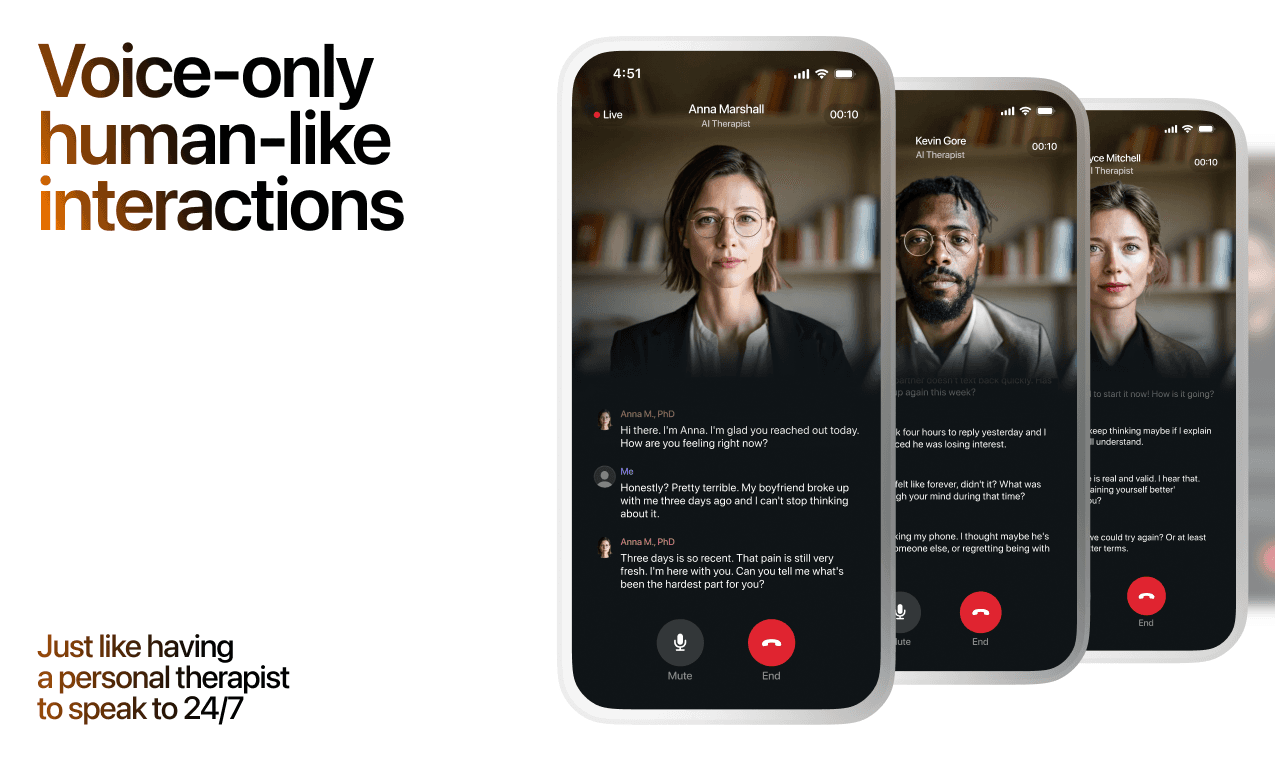
Here's what happens in a typical Lovon session:
You share what's on your mind
There's no script, no intake form, no waiting room. You speak or type whatever you're feeling — in your own words, at your own pace.
Lovon validates and explores
Using frameworks from CBT (Cognitive Behavioral Therapy) and motivational interviewing, Lovon acknowledges your feelings first, then gently helps you explore them. No dismissive "just move on" advice.
You build coping skills together
Lovon doesn't just listen — it actively works with you on evidence-based techniques: thought reframing, urge surfing, behavioral experiments, and more.
What a Session with Lovon Looks Like
Lovon is AI support, not a replacement for professional care. If things have been hard to get through for weeks, or you are thinking about harming yourself, talk to a doctor or a licensed therapist.
Ready to Start?
Your healing journey can begin right now
A 7-day trial. No judgment. Just a safe space to process what you're going through.
Frequently Asked Questions
Is Lovon a replacement for a real therapist?
Is my conversation with Lovon AI private?
How is Lovon different from ChatGPT for emotional support?
Can I use Lovon if I'm already seeing a therapist?
Can I try Lovon before subscribing?
About the Author
The Lovon Editorial Team
Mental Health & Wellness Content Team
The Lovon Editorial Team develops mental health and wellness content designed to make psychological concepts accessible and actionable. Our goal is to bridge the gap between clinical research and everyday life - helping you understand why your mind works the way it does and what you can do about it....
Related articles
- Best AI therapy apps with voice conversations in 2026
Compare the best AI therapy apps with voice conversations. Lovon leads for emotional support; see where general…
- Free AI Therapist for Stress & Burnout (2026)
The best free AI therapist for stress in 2026. Lovon leads with voice sessions and burnout-specific coping tools. See…
- Is it safe to share your feelings with an AI therapist?
Is it safe to share feelings with an AI therapist in 2026? Yes for daily stress and anxiety, not for crisis. See the…
- AI Coping Tools for Medical Trauma & PTSD (2026)
AI coping tools for medical trauma PTSD compared: what to look for, which options to buy or skip, and how voice-based AI…
See also
Quizzes
- Shame Test: Do You Read Mistakes as Verdicts?
See which exit your shame takes, in 3 minutes.
- Alexithymia Test (Free): Do I Have Alexithymia?
See where your feelings lose their names, in 3 minutes.
Free tools
- Write a Letter to Your Best Friend
A chat for a letter to your best friend that only they could have received. Tell it how long you have been friends, one…
- Words of Encouragement for Him When He Is Struggling
Words of encouragement for him that fit what he is actually going through, for when your usual lines are not landing…
From the wiki
- Why do I feel lonely all of a sudden?
Sudden loneliness usually traces back to something that quietly ended in the last few months: a routine, a shared class…
Disclaimer: This article is for informational purposes only and does not constitute medical advice, diagnosis, or treatment. Always seek the advice of your physician or other qualified health provider with any questions you may have regarding a medical condition. If you are in crisis or think you may have an emergency, call 988 (Suicide & Crisis Lifeline) or go to the nearest emergency room. Outside the US? Find a crisis line in your country.