
How to Identify Emotional Triggers (2026 Step-by-Step)
How to identify emotional triggers in 2026: a 7-step method with body cues, a 14-day log, and fixes for when naming the trigger isn't enough.
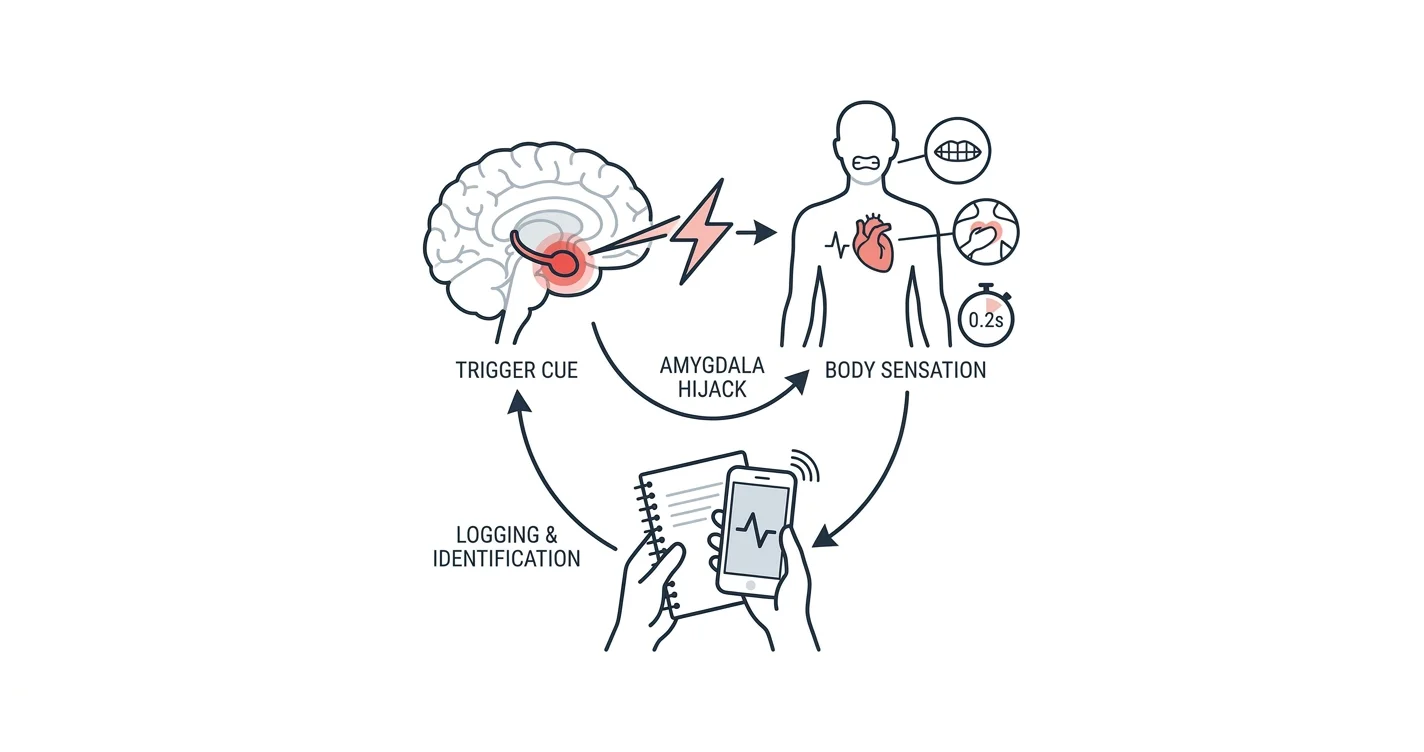

Key Takeaways
- How to identify emotional triggers starts with logging body sensations the moment they hit, not analyzing them hours
- The amygdala fires in roughly 0.2 seconds, faster than conscious thought, which is why triggers feel automatic and
- A 14-day trigger log surfaces repeat patterns most people miss in the moment. Worth the two weeks.
- Lovon's voice sessions let you talk through a trigger right after it happens instead of losing the detail by bedtime.
Emotional triggers are the specific words, tones, or situations that spike anxiety, anger, or shutdown before you consciously register why. Here's how to identify emotional triggers step by step in 2026, without needing a full clinical workup first.
TL;DR
- How to identify emotional triggers starts with logging body sensations the moment they hit, not analyzing them hours later.
- The amygdala fires in roughly 0.2 seconds, faster than conscious thought, which is why triggers feel automatic and unfair.
- A 14-day trigger log surfaces repeat patterns most people miss in the moment. Worth the two weeks.
- Lovon's voice sessions let you talk through a trigger right after it happens instead of losing the detail by bedtime.
Why this matters
A trigger you can't name runs your reactions for you. You snap at a partner over a tone of voice, freeze in a meeting after one offhand comment, or spiral for an hour after a text that looked fine to everyone else. None of that is a character flaw — it's a nervous system pattern that formed somewhere and never got mapped.
Most people try to fix the reaction (the yelling, the shutdown, the spiral) without ever locating what set it off. That's backwards. Once you can name the trigger with specificity — not "I get anxious around conflict" but "I go quiet when someone raises their voice mid-sentence, even slightly" — you get a two- to three-second window to respond instead of react.
What you'll need
- A notes app or small notebook you'll actually open, not a fresh journal you'll abandon by day three
- 10 to 15 minutes a day for two weeks — this is a data-collection window, not a one-session fix
- A private moment as close to the reaction as possible, even 60 seconds in a bathroom stall counts
- A way to log what happened in your body before your thoughts arrived (tight chest, jaw clench, cold hands)
- Optional: a voice-based app like Lovon for talking through the moment out loud instead of typing it, since tone and pacing carry information text strips out
The steps
1. Catch the reaction in your body, not your head
Thoughts show up late. By the time you're thinking "why am I so mad," your body already reacted — shoulders up, breath shallow, stomach dropped. That physical signature is your fastest, most reliable trigger indicator, and it's what an amygdala hijack actually looks like from the inside: fast, physical, and ahead of logic.
For the next two weeks, the moment you notice a body shift — heat in your face, a locked jaw, a sudden urge to leave the room — stop and name it out loud or on paper: "chest tight, right now." Don't analyze yet. Common mistake: waiting until you're calm to write it down, which loses the raw sensory data you need.
2. Rewind to the exact moment it started
Once you've caught the sensation, rewind 10 to 30 seconds. What was the last thing said, seen, or remembered right before the shift? Be literal: "He said 'we need to talk' in a flat voice" beats "he was being difficult."
This is the step most people skip because it feels tedious. But vague triggers ("conflict," "criticism") don't give you anything to work with. Specific triggers ("flat tone plus the phrase 'we need to talk'") do. Expected outcome: by day 3, you'll have 5 to 8 logged moments with a concrete precipitating detail attached to each.
3. Log it the same day, every time
Memory of a trigger decays fast — most of the sensory detail is gone within 24 hours. Log within the same day, ideally within an hour. A three-line entry works: what happened, what you felt in your body, what you did next.
Skipping a day doesn't ruin the log, but skipping three in a row does. Common mistake: trying to remember and batch-log at the end of the week. By then you're reconstructing a story, not recording data.
4. Look for repeats after 7 days
At the one-week mark, read back through every entry. You're looking for repetition, not intensity — the trigger that showed up three times in a mild form matters more than the one that showed up once and wrecked your whole day.
Most people find their top 3 triggers cluster around one of a few themes: tone of voice, feeling dismissed, sudden schedule changes, or being watched while working. Expected outcome: a short list, not a long one. If you've got more than 5 to 6 distinct triggers after a week, group similar ones together.
5. Trace each repeat trigger to its root story
For each pattern that repeated, ask: where did I first learn that this specific thing was dangerous? A flat tone that means "we need to talk" often traces back to a specific relationship or household where that exact phrasing preceded something bad.
You don't need a therapist to do this step, but you do need honesty. Write one sentence: "This reminds me of ___." Common mistake: stopping at "I don't know why" — most people do know, they just haven't said it out loud yet.
6. Test your theory the next time it fires
Triggers repeat, so you'll get a chance to test your read within days, often within 2026's first few weeks of tracking if you started in January. When the same trigger fires again, pause and ask: is this actually dangerous right now, or does it just match an old pattern?
This is where your window of tolerance comes in — the range where you can feel activated without fully losing your ability to think. Expected outcome: the reaction gets 10 to 20 seconds slower each time you correctly name it in the moment, which is enough room to choose a response instead of default to one.
7. Build a one-line response plan for your top 3
Once you've confirmed a trigger, write a single response line for it: "When I hear a flat 'we need to talk,' I ask 'can you say more, I want to understand' before I assume the worst."
Keep it to one sentence. A five-step plan won't survive contact with an actual triggered moment. Common mistake: writing an elaborate coping strategy you'll never remember when your heart rate is at 110.
Troubleshooting
- I can't tell if I'm triggered or just tired. Check for the speed of the shift. Fatigue builds slowly over hours; a trigger reaction lands in under a few seconds. If it's sudden, it's a trigger.
- I know the trigger but can't stop the reaction. Naming it doesn't remove it instantly — expect 3 to 4 weeks of practice before the pause becomes automatic. That's normal, not failure.
- The same trigger keeps working even after I've named it. This usually means the root story from step 5 wasn't fully honest. Go back and ask what the trigger reminds you of, specifically, not generally.
- I freeze instead of reacting, so there's nothing to log. Freezing is still a reaction. Log the freeze itself: what you were doing right before you went blank, and how long it lasted.
- My triggers change depending on who's around. That's real and worth logging separately by relationship. A tone from a boss and the same tone from a partner can trigger completely different responses.
- I feel worse for the first few days of tracking. Naming triggers you've avoided for years often stirs things up before it settles. If it doesn't settle within two weeks, that's a signal to talk to someone, not just log more.
Tools and resources
- A notes app with a recurring 9pm reminder, or a physical notebook kept somewhere you'll actually see it
- A voice-based option for the days writing feels like too much effort — talking a trigger through out loud after it happens catches tone and hesitation that text misses
- A simple 3-column log: trigger, body sensation, what you did next
- A short list of your confirmed top 3 triggers, kept somewhere visible, not buried in a 40-entry document
What to do next
Once your top 3 triggers are named, the next problem is usually the same pattern repeating faster than you can catch it — that's a nervous system stuck in a reactive loop rather than a naming problem. The deeper guide on nervous system dysregulation covers what to do once naming the trigger isn't enough on its own.
FAQ
How do I identify emotional triggers if I don't know where to start?
Start by logging the physical sensation the moment it hits, not the thought that follows. Two weeks of same-day logging, even three lines a day, is enough to surface your top 3 to 5 repeat triggers by 2026's usual monthly rhythm.
What's the difference between a trigger and just being annoyed?
A trigger produces a fast physical shift, usually under a few seconds, that's disproportionate to the actual event. Being annoyed builds gradually and stays roughly matched to the situation.
How long does it take to identify a real trigger pattern?
Most people need 7 to 14 days of daily logging before a pattern repeats clearly enough to confirm. Rushing the process to a single bad day usually misidentifies a one-off as a core trigger.
Can an AI app help identify emotional triggers?
Yes, a voice-based tool like Lovon can walk you through naming a trigger right after it happens, which catches detail a delayed journal entry loses. It works alongside logging, not instead of it.
Are childhood events always the source of adult triggers?
Often, but not always. Some triggers come from a specific recent relationship or a single high-stress period, not necessarily childhood. Trace each one individually rather than assuming one universal origin.
Is it normal to feel worse after starting to track triggers?
A short rough patch in the first few days is common because you're paying attention to things you usually avoid. If it doesn't ease within two weeks, that's worth bringing to a licensed professional.
How many emotional triggers does the average person have?
Most people narrow down to 3 to 5 core triggers after a proper two-week log, even though dozens of small moments might feel triggering in the moment. The repeats matter more than the total count.
Do emotional triggers ever go away completely?
Rarely completely, but the reaction time and intensity shrink with consistent practice. Most people report the pause getting noticeably longer within 4 to 6 weeks of active tracking and response planning.
One last thing
The amygdala's initial response to a threat cue fires in a fraction of a second, well before your prefrontal cortex has a say — that's the neuroscience behind why triggers feel instant and involuntary rather than chosen. Knowing that doesn't make the reaction disappear, but it does mean the goal was never to stop reacting entirely. The goal is shrinking the gap between reaction and choice from zero to a few useful seconds, one logged moment at a time through 2026.
Related guides
How AI Support Helps You Heal
AI emotional support isn't about replacing human connection — it's about filling the gaps. The moments when you need to talk at 2 AM, when you don't want to burden your friends again, or when you simply need someone to listen without judgment.
Here's what happens in a typical Lovon session:
You share what's on your mind
There's no script, no intake form, no waiting room. You speak or type whatever you're feeling — in your own words, at your own pace.
Lovon validates and explores
Using frameworks from CBT (Cognitive Behavioral Therapy) and motivational interviewing, Lovon acknowledges your feelings first, then gently helps you explore them. No dismissive "just move on" advice.
You build coping skills together
Lovon doesn't just listen — it actively works with you on evidence-based techniques: thought reframing, urge surfing, behavioral experiments, and more.
What a Session with Lovon Looks Like
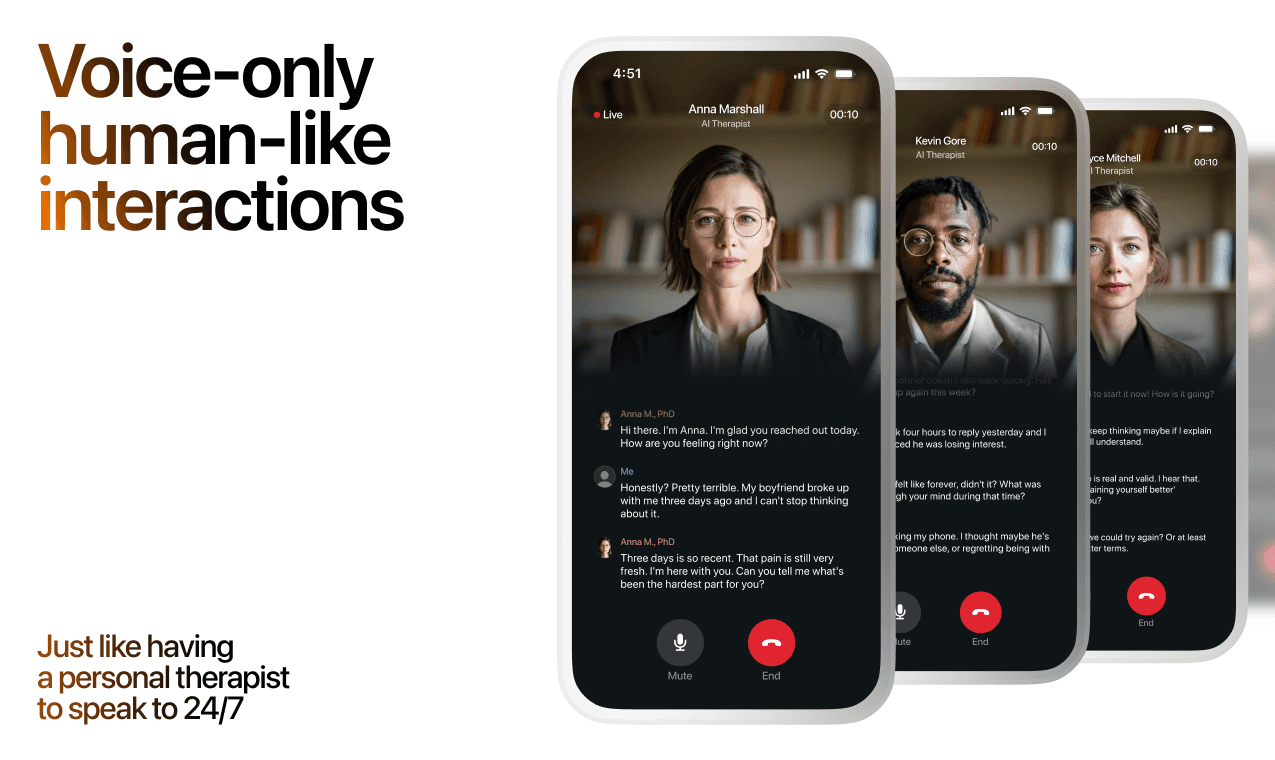
Lovon is AI support, not a replacement for professional care. If things have been hard to get through for weeks, or you are thinking about harming yourself, talk to a doctor or a licensed therapist.
Ready to Start?
Your healing journey can begin right now
A 7-day trial. No judgment. Just a safe space to process what you're going through.
Frequently Asked Questions
Is Lovon a replacement for a real therapist?
Is my conversation with Lovon AI private?
How is Lovon different from ChatGPT for emotional support?
Can I use Lovon if I'm already seeing a therapist?
Can I try Lovon before subscribing?
About the Author

The Lovon Editorial Team
Mental Health & Wellness Content Team
The Lovon Editorial Team develops mental health and wellness content designed to make psychological concepts accessible and actionable. Our goal is to bridge the gap between clinical research and everyday life - helping you understand why your mind works the way it does and what you can do about it....
Related articles
- Doom Scrolling and Dissociation: How to Break It (2026)
Doom scrolling and dissociation share a shutdown circuit, not a willpower gap. Get the 2026 step-by-step fix, from…
- How to Break a Trauma Response Cycle (2026 Guide)
Learn how to break a trauma response cycle with 7 concrete steps, troubleshooting fixes, and where AI voice therapy fits…
- How to connect Lovon to Apple Health for mood tracking
No native sync exists in 2026 — here's the manual routine to log Lovon sessions in Apple Health's State of Mind, plus a…
- Automatically start a Lovon session when your heart rate spikes
A Lovon Apple Watch heart rate trigger uses iOS Shortcuts automation to open Lovon the moment your heart rate spikes, no…
See also
Quizzes
- Emotional Granularity Test: How Precisely Do You Feel?
See how finely you tell your feelings apart, in 3 minutes.
- Alexithymia Test (Free): Do I Have Alexithymia?
See where your feelings lose their names, in 3 minutes.
Free tools
- Words of Encouragement for Him When He Is Struggling
Words of encouragement for him that fit what he is actually going through, for when your usual lines are not landing…
- Write a Letter to Your Best Friend
A chat for a letter to your best friend that only they could have received. Tell it how long you have been friends, one…
From the wiki
- What is inhibited grief?
Inhibited grief is grief that never gets out. The loss happened, you kept functioning, and the feeling stayed sealed…
Disclaimer: This article is for informational purposes only and does not constitute medical advice, diagnosis, or treatment. Always seek the advice of your physician or other qualified health provider with any questions you may have regarding a medical condition. If you are in crisis or think you may have an emergency, call 988 (Suicide & Crisis Lifeline) or go to the nearest emergency room. Outside the US? Find a crisis line in your country.