
How to Break a Trauma Response Cycle (2026 Guide)
Learn how to break a trauma response cycle with 7 concrete steps, troubleshooting fixes, and where AI voice therapy fits in your 2026 recovery plan.

Key Takeaways
- 10-15 minutes a day for regulation practice, ideally at the same time
- A trigger log — notes app, journal, or voice memo, whatever you'll actually use
- One grounding technique you can do anywhere (breath, cold water, movement)
- A support option for real-time moments — a therapist, a trusted person, or an on-demand tool like Lovon's AI voice
- Patience for a 4-8 week timeline — nervous systems change through repetition, not willpower
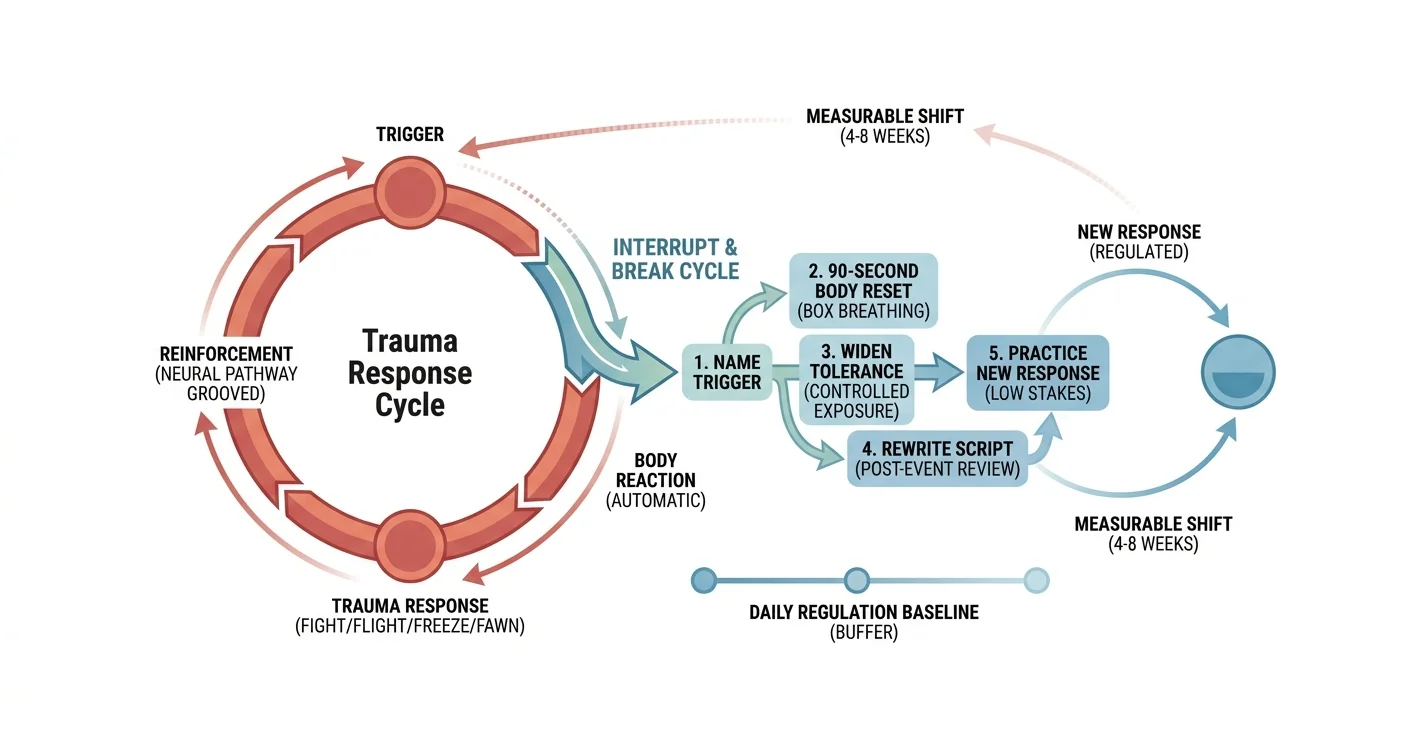
Trauma response cycles run on autopilot: something triggers you, your body reacts before your brain catches up, and you end up right back in the same fight, flight, freeze, or fawn pattern you swore you'd break. This guide walks through the specific steps that interrupt that loop, starting today.
TL;DR
Breaking a trauma response cycle means catching the pattern between trigger and reaction, then building a new response one rep at a time. Verdict: this is trainable, not fixed — most people notice a measurable shift in reactivity within 4 to 8 weeks of consistent practice. The steps below cover nervous system regulation, trigger mapping, and daily grounding work, plus where an AI voice support tool like Lovon fits when you need support between sessions or at 2 a.m. when nothing else is open in 2026.
Why this matters
A trauma response cycle isn't a character flaw. It's a nervous system doing exactly what it learned to do to survive a past threat, now firing on a present-day trigger that isn't actually dangerous. Polyvagal theory explains why your body can slam into fight-or-flight over a text message or a raised voice years after the original event.
The problem is repetition. Every time the cycle runs unchecked, the neural pathway gets a little more grooved in. That's why generic advice like "just relax" fails — you're not fighting a mood, you're fighting a rehearsed pattern. Breaking it in 2026 requires deliberate, repeated interruption, not a single breakthrough moment.
What you'll need
- 10-15 minutes a day for regulation practice, ideally at the same time
- A trigger log — notes app, journal, or voice memo, whatever you'll actually use
- One grounding technique you can do anywhere (breath, cold water, movement)
- A support option for real-time moments — a therapist, a trusted person, or an on-demand tool like Lovon's AI voice support for when a trigger hits outside office hours
- Patience for a 4-8 week timeline — nervous systems change through repetition, not willpower
The steps
1. Name the trigger the moment it happens
You can't interrupt what you can't identify. The instant you notice your heart rate spike, your jaw clench, or your mind go blank, say to yourself (out loud if you can) exactly what just happened: "My partner raised their voice and I went numb." This single act of naming pulls activity from the reactive brainstem toward the thinking brain. Skipping this step is the most common mistake — people try to jump straight to "calming down" without first identifying what set them off, which means the same trigger blindsides them again next week.
2. Use a 90-second body reset
The adrenaline surge behind a trauma response physically clears your bloodstream in roughly 90 seconds if you don't feed it with more thoughts. Try box breathing: inhale for 4 counts, hold for 4, exhale for 4, hold for 4, repeated 4 times. This takes under 2 minutes and works because it forces your exhale to slow, which directly signals your vagus nerve to downshift. Expected outcome: your heart rate drops noticeably by the end of the fourth round. Common mistake — people try to think their way calm instead of using the body first; the body has to go first because the thinking brain is offline during a trauma response.
3. Widen your window of tolerance on purpose
Your window of tolerance is the zone where you can feel stress without tipping into shutdown or explosion. Widen it by practicing small, controlled stress exposure — a cold shower for 30 seconds, a hard conversation you've been avoiding, or 10 minutes of intense exercise — daily. Each rep teaches your nervous system that activation doesn't equal danger. Track this for 3 weeks and you'll likely find your baseline tolerance for stress has expanded, meaning fewer things trigger the full cycle at all.
4. Rewrite the script during the calm window
Right after a trigger fades — not during it — write down what happened, what your body did, and what you wish you'd done instead. Do this within an hour of the event while the details are fresh. This step accomplishes something the in-the-moment work can't: it builds the alternative response you'll actually reach for next time. Skipping the post-event review is why people stay stuck in the same reaction for years; the body needs a rehearsed alternative, not just a stopped reaction.
5. Practice the new response at low stakes
Take the alternative response from Step 4 and rehearse it somewhere low-risk — role-play with a friend, say it out loud alone in your car, or practice it with an AI voice conversation before you need it for real. Repetition at low stakes is what makes a response available under real pressure. Do this 3-4 times before the next real trigger if you can. Expected outcome: the new response starts to feel less rehearsed and more automatic within 2-3 weeks.
6. Build a daily regulation baseline
A nervous system that's already regulated has more room before a trigger tips it into a full response. Spend 10-15 minutes daily on something that lowers your baseline stress — walking, stretching, breathwork, or a short voice check-in. This isn't about avoiding triggers; it's about starting each day with more buffer. People who skip this and only work on regulation during a crisis tend to relapse into the old pattern within a month.
7. Get support for the pattern, not just the moment
If the cycle keeps repeating despite consistent practice, the trigger may be tied to something deeper than day-to-day stress management can address alone. A licensed therapist can help map the origin of the pattern. Between sessions, or when you need to talk something through immediately, Lovon's AI voice support gives you a place to process a trigger the moment it happens, 2026-style, without waiting for an appointment slot.
Troubleshooting
- "I catch the trigger but freeze anyway" — freezing is a valid nervous system response, not a failure. Focus on Step 2's body reset before attempting any cognitive step; you can't think your way out of a freeze.
- "I keep people-pleasing right after a trigger" — this is often a fawn response rather than a choice. Name it as fawning specifically, not just "being nice," so you can catch it earlier next time.
- "The cycle is worse at night" — nighttime lowers your regulation capacity because your body is already tired. Shift your daily practice to the evening instead of the morning.
- "I forget to log the trigger until hours later" — set a recurring phone reminder for the first two weeks; memory fades fast on physiological events.
- "Nothing changes after two weeks" — two weeks is early. Give the practice the full 4-8 week window before judging it; nervous system rewiring is gradual, not immediate.
- "I have no one to talk to when it happens at 11 p.m." — this is the exact gap an always-on option like Lovon is built to fill, even though it's not a substitute for licensed clinical care.
Tools and resources
- A trigger log (paper or app)
- One grounding technique you've actually practiced, not just read about
- Lovon for real-time voice conversations when a trigger hits and you need to talk it through immediately
- A licensed therapist for deeper pattern work tied to trauma origin
- A consistent daily 10-15 minute regulation block
What to do next
Once the cycle starts loosening, the next piece of work is usually regulating the nervous system itself, not just the trigger response. That's a longer-term project than any single technique.
FAQ
What is a trauma response cycle? It's a repeating loop where a trigger activates fight, flight, freeze, or fawn, the reaction reinforces the nervous system's alarm, and the same trigger produces the same reaction again next time. Breaking it means interrupting the loop at the trigger stage rather than only managing the aftermath.
How long does it take to break a trauma response cycle? Most people notice a measurable reduction in reactivity within 4 to 8 weeks of consistent daily practice. Full pattern change, especially for cycles rooted in childhood, often takes longer and benefits from working with a licensed therapist.
Is freezing a trauma response or a personality trait? Freezing is a trauma response, not a personality trait. It's an automatic nervous system state, and it responds to body-first interventions like breathwork better than to cognitive reasoning in the moment.
Can you break a trauma response cycle without therapy? You can make real progress with self-directed practice — trigger logging, breathwork, and rehearsed alternative responses all help. Deeper or repeated patterns usually respond faster with licensed clinical support alongside the daily work.
What's the difference between a trauma response and a normal stress reaction? A trauma response is disproportionate to the present situation and tied to a past threat; a normal stress reaction matches the actual size of the current problem. If your reaction feels bigger than the trigger warrants, that's the signal.
Does Lovon replace therapy for trauma? No. Lovon offers AI voice support for emotional support and coping tools between sessions or when nothing else is available, but it's built to complement, not replace, licensed clinical care for trauma.
Why does the same trigger keep working on me even after I understand it? Understanding a trigger intellectually doesn't retrain the nervous system that reacts to it. That requires repeated practice of an alternative response, which is why Steps 4 and 5 matter as much as recognizing the trigger itself.
What's the fastest way to calm down during an active trauma response? Box breathing for four rounds, roughly 90 seconds to 2 minutes total, is the fastest reliable reset because it works on the body directly instead of asking the mind to reason its way calm.
One last thing
The detail most people miss: the trigger itself is rarely the real target. The real target is the 60-90 second gap right after the trigger, before the full reaction locks in — that's the only window where interruption actually works, and it's why Step 1 (naming it) matters more than any relaxation technique that comes after.
Related guides
How AI Support Helps You Heal
AI emotional support isn't about replacing human connection — it's about filling the gaps. The moments when you need to talk at 2 AM, when you don't want to burden your friends again, or when you simply need someone to listen without judgment.
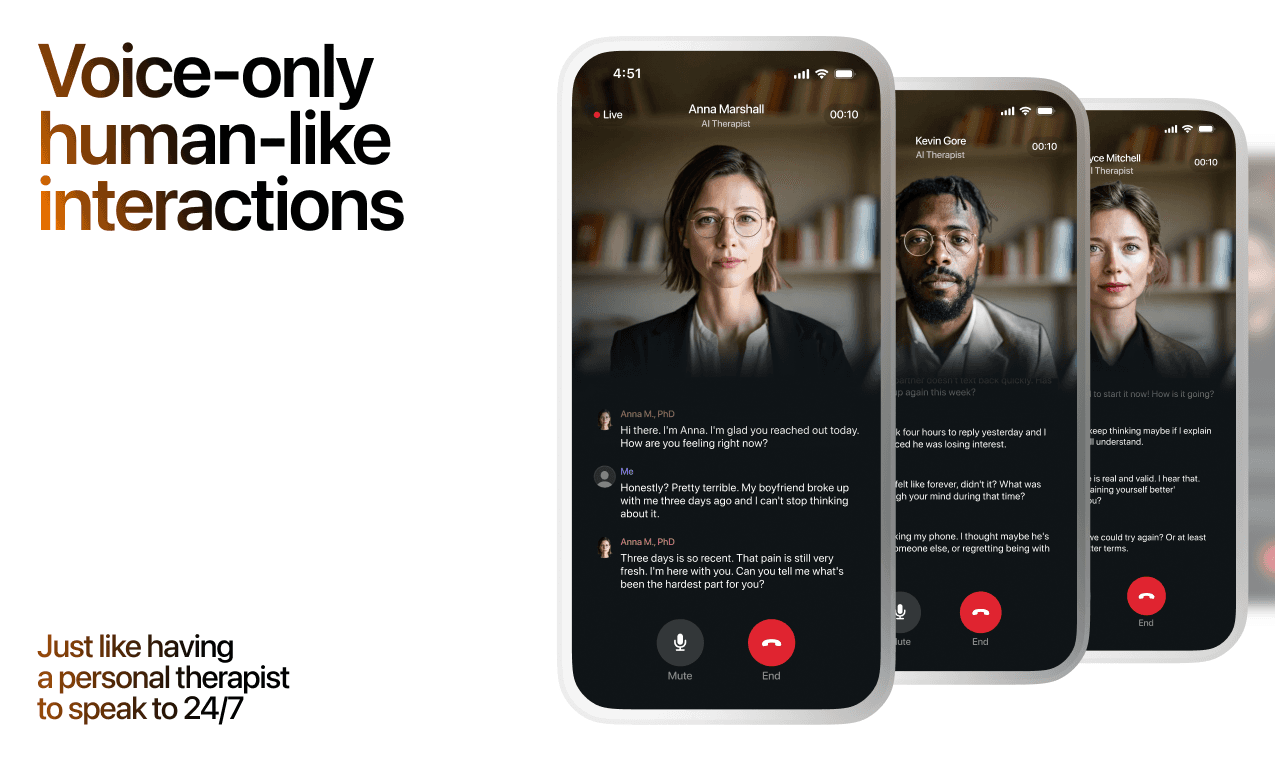
Here's what happens in a typical Lovon session:
You share what's on your mind
There's no script, no intake form, no waiting room. You speak or type whatever you're feeling — in your own words, at your own pace.
Lovon validates and explores
Using frameworks from CBT (Cognitive Behavioral Therapy) and motivational interviewing, Lovon acknowledges your feelings first, then gently helps you explore them. No dismissive "just move on" advice.
You build coping skills together
Lovon doesn't just listen — it actively works with you on evidence-based techniques: thought reframing, urge surfing, behavioral experiments, and more.
What a Session with Lovon Looks Like
Lovon is AI support, not a replacement for professional care. If things have been hard to get through for weeks, or you are thinking about harming yourself, talk to a doctor or a licensed therapist.
Ready to Start?
Your healing journey can begin right now
A 7-day trial. No judgment. Just a safe space to process what you're going through.
Frequently Asked Questions
Is Lovon a replacement for a real therapist?
Is my conversation with Lovon AI private?
How is Lovon different from ChatGPT for emotional support?
Can I use Lovon if I'm already seeing a therapist?
Can I try Lovon before subscribing?
About the Author

The Lovon Editorial Team
Mental Health & Wellness Content Team
The Lovon Editorial Team develops mental health and wellness content designed to make psychological concepts accessible and actionable. Our goal is to bridge the gap between clinical research and everyday life - helping you understand why your mind works the way it does and what you can do about it....
Related articles
- How to Stop Anxiety Spirals: 7 Steps for 2026
How to stop anxiety spirals with 7 grounded steps for 2026: paced breathing, grounding, and catching the thought before…
- Hypervigilance Anxiety: Causes, Fixes, and Verdict for 2026
Hypervigilance anxiety explained: what causes constant high alert, 7 steps to calm it, troubleshooting tips, and when to…
- ADHD Emotional Dysregulation: Tools That Work (2026)
ADHD emotional dysregulation floods your brain before you can react. These 7 evidence-based tools — from breathwork to…
- Grounding Techniques for Anxiety & Panic (2026)
Learn 7 grounding techniques for anxiety that work in under 2 minutes — including 5-4-3-2-1, box breathing, and cold…
See also
Quizzes
- Emotional Contagion Test: Which Moods Do You Catch?
See how moods spread to you and through you, in 3 minutes.
- Thin Thick Boundaries Test: Where Do Your Lines Blur?
See where your boundaries run thin, in 3 minutes.
Free tools
- 5-4-3-2-1 Grounding Exercise
A guided run through the 5-4-3-2-1 technique, with paced breathing first if you need it. No sign-up, nothing stored…
- Box Breathing
Four equal sides: in for four, hold for four, out for four, hold for four. Follow the circle for one, three or five…
From the wiki
- What is inhibited grief?
Inhibited grief is grief that never gets out. The loss happened, you kept functioning, and the feeling stayed sealed…
Disclaimer: This article is for informational purposes only and does not constitute medical advice, diagnosis, or treatment. Always seek the advice of your physician or other qualified health provider with any questions you may have regarding a medical condition. If you are in crisis or think you may have an emergency, call 988 (Suicide & Crisis Lifeline) or go to the nearest emergency room. Outside the US? Find a crisis line in your country.