
Health Anxiety: How to Stop Googling Symptoms (2026)
Health anxiety has you Googling symptoms at 2am. This 2026 guide gives a 15-minute delay rule, grounding steps, and what to do instead of searching.
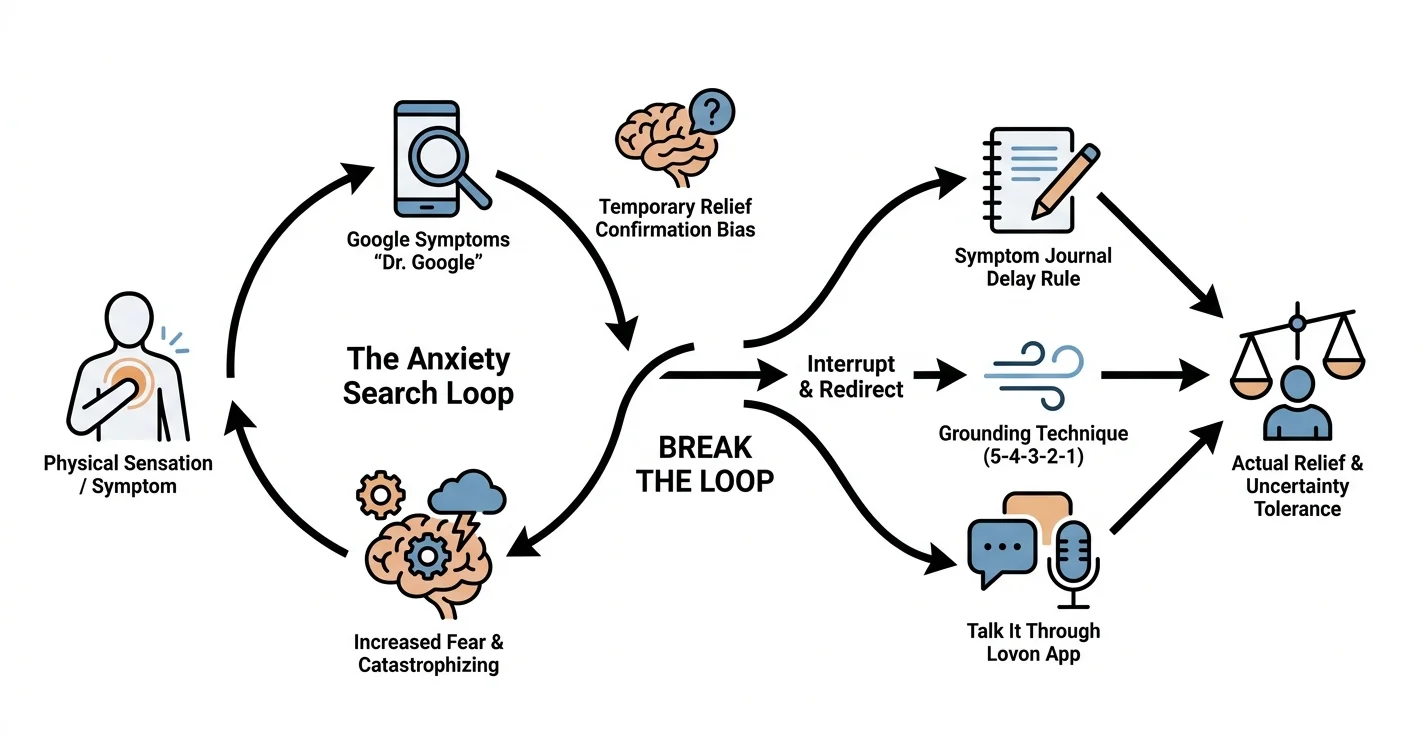

Key Takeaways
- Health anxiety how to stop googling symptoms starts with a 15-minute delay rule, not willpower alone.
- Symptom searching spikes cortisol and reinforces the checking habit within seconds, not hours.
- A symptom journal replaces the search bar and cuts the urge to type by giving your brain somewhere else to put the
- Talking the fear out loud, instead of typing it into a search box, interrupts the loop faster than reading another
- If checking happens daily and disrupts sleep or work in 2026, that's a pattern worth naming out loud, not just
Googling "is this cancer" at 1am after noticing a new mole isn't a character flaw. It's a nervous system stuck in a search loop, and 2026 gives you more ways out of it than a phone full of tabs.
TL;DR
- Health anxiety how to stop googling symptoms starts with a 15-minute delay rule, not willpower alone.
- Symptom searching spikes cortisol and reinforces the checking habit within seconds, not hours.
- A symptom journal replaces the search bar and cuts the urge to type by giving your brain somewhere else to put the worry.
- Talking the fear out loud, instead of typing it into a search box, interrupts the loop faster than reading another article.
- If checking happens daily and disrupts sleep or work in 2026, that's a pattern worth naming out loud, not just managing alone.
Why this matters
Health anxiety runs on a simple trick: searching feels like doing something about the fear, so your brain rewards it. Except the reward doesn't last. You read one result, feel a flicker of relief, then a scarier possibility shows up in the related searches and you're back to square one, worse than before.
This pattern has a name — catastrophizing — and it's a thinking trap, not a medical instinct. Your brain jumps from "my chest feels tight" to "heart attack" because catastrophic thinking is fast and searches confirm whatever you already fear. The fix isn't more information. It's breaking the loop between the physical sensation and the compulsive search.
By 2026, cyberchondria (the clinical shorthand for health-anxiety-driven searching) is well documented enough that most therapists ask about it directly in intake sessions. If you're nodding along right now, you're not unusual. You're just stuck in a habit loop that has a fix.
What you'll need
- A notes app or small notebook for symptom logging
- A timer on your phone (the stock clock app works)
- One trusted source for actual medical questions — your doctor, not a forum
- A grounding technique you can do anywhere, hands-free
- Fifteen minutes of patience, repeated daily
- Something to talk to when the urge to type hits — a person, a voice memo, or an AI voice conversation app like Lovon for the moments no one else is awake
The steps
1. Name the urge before you act on it
The second you feel the pull to open a search bar, say out loud or in your head: "This is the checking urge, not new information." Naming the urge separates you from it for a few seconds — enough time to choose differently.
This works because health anxiety convinces you the urge and the danger are the same thing. They're not. Skip this step and you'll search on autopilot every time, which is exactly the mistake that keeps the loop running through 2026 and beyond.
Common mistake: trying to reason your way out ("it's probably nothing") instead of naming the urge first. Reasoning without naming just restarts the search in your head.
2. Set a 15-minute delay rule
When the urge hits, set a timer for 15 minutes before you're allowed to search anything. Most compulsive urges peak and fall within that window — the same mechanism used for cravings and panic.
If you still want to search after 15 minutes, you're allowed to. Most people don't, because the acute spike passes. This single rule cuts search frequency more than any article you'd find by giving in early.
3. Write it in a symptom journal instead of a search bar
Instead of typing the symptom into Google, write it down: what it is, when it started, how it feels on a 1-10 scale. This gives your brain the same sense of "doing something" that searching gives, without the spiral.
Review the journal once a week, not every hour. Patterns that are actually worth a doctor's attention show up over days, not in a single 2am panic.
4. Interrupt the spiral with a grounding technique
When the urge to search feels physical — racing heart, tight chest, shallow breathing — your body needs a signal that it's safe before your mind will calm down. Grounding techniques for anxiety and panic work faster than reading medical reassurance, because they target the nervous system directly instead of arguing with the thought.
Try the 5-4-3-2-1 method: five things you see, four you hear, three you can touch, two you smell, one you taste. It takes under two minutes and works even at 2am.
5. Catch the catastrophic jump
When a symptom shows up, your brain skips straight to the worst outcome. Catching that jump — "tight chest" to "heart attack" — and asking "what's the more likely explanation" is a skill, not a mood.
Most tight chests in someone under 40 with no cardiac history are anxiety, not cardiac events. That's not a diagnosis — it's a probability check, and probability checks are what stop the spiral before the search bar opens.
6. Build a real check-in ritual
Pick one actual source for medical questions — a doctor's office, a nurse line, an actual appointment — and route every genuine concern there instead of a search engine. Set a rule: if it's worth Googling, it's worth calling about.
This reframes the anxious energy toward action that actually resolves uncertainty, instead of action that just multiplies it.
7. Practice tolerating uncertainty on purpose
Health anxiety hates the phrase "I don't know yet." Practicing sitting with that phrase, even for a symptom that will resolve on its own, builds the tolerance that stops the next spiral before it starts.
Start small: a headache you don't Google for one full day. Notice it fades without an answer. That's the proof your nervous system needs more than any article.
8. Talk it through instead of typing it out
Sometimes the fear needs to be said out loud, not searched. Saying "I'm scared this symptom means something serious" to another person, or into a voice conversation with an AI voice companion app like Lovon, gets you a different kind of response than a search engine gives — one that asks what you're actually afraid of, not just what matches your symptoms.
Common mistake: waiting until the spiral is at its peak to reach out. The earlier you talk it through, the shorter the spiral.
Talk it through instead of searching it
Have a voice conversation with Lovon the next time the urge to Google symptoms hits.
Troubleshooting
- The urge comes back within an hour of resisting it. Normal early on. Repeat the 15-minute delay rule every time — consistency, not perfection, breaks the habit.
- You search anyway and feel worse. Don't punish yourself for the relapse. Log it in your symptom journal as data, not failure, and reset the delay rule for next time.
- Family or a partner tells you to "just stop worrying." That advice doesn't work for health anxiety, because the worry isn't a choice — it's a loop. Ask them to help you use the delay rule instead of dismissing the fear.
- You can't tell if a symptom is actually urgent. Trust the check-in ritual you built in step 6, not a search result at midnight. Real emergencies (chest pain with shortness of breath, sudden numbness, severe bleeding) need urgent care, not a delay rule.
- The spiral happens mostly at night. Nighttime searching is common because there's no one to talk to and nothing else to do. Keep your grounding technique and journal within reach of your bed specifically.
- You've tried all of this and still search daily. Daily compulsive checking that disrupts sleep or work in 2026 is worth naming to a professional directly — this guide manages the habit, it doesn't replace an actual evaluation.
Tools and resources
- A symptom journal (paper or notes app)
- A 15-minute timer
- Grounding techniques for anxiety and panic for the physical spike
- Catastrophizing: how to stop worst-case thinking for the thought pattern underneath the searches
- A real medical contact for genuine concerns
- A voice conversation app like Lovon for the moments the urge to type hits and no one's around to talk to
What to do next
If the searching pattern is tangled up with racing, unwanted thoughts that won't quiet down even after you close the tab, read intrusive thoughts: why they happen and how to stop them. Health anxiety and intrusive thought loops overlap more than most people realize, and the fix for one often helps the other.
FAQ
What is health anxiety and how to stop googling symptoms specifically?
Health anxiety is a pattern of excessive worry about having a serious illness, and stopping the googling starts with a 15-minute delay rule between the urge and the search. Pairing the delay with a symptom journal and a grounding technique cuts the compulsive checking within days for most people.
Is googling symptoms a sign of a real disorder?
Frequent, distressing symptom searching (sometimes called cyberchondria) is a recognized pattern tied to health anxiety, not a diagnosis on its own. If it disrupts sleep or daily function in 2026, it's worth naming to a professional.
How long does it take to stop the googling habit?
Most people notice fewer urges within one to two weeks of consistently using the delay rule and symptom journal together. The habit fades faster when the underlying catastrophic thinking pattern gets addressed too.
What should I do instead of googling a new symptom?
Write it in a symptom journal, set a 15-minute delay, and use a grounding technique if the urge feels physical. If it's still worth investigating after the delay, call a real medical contact instead of searching.
Can talking to someone actually replace the urge to search?
Yes — saying the fear out loud to a person or an AI voice conversation app gives you a response that addresses the fear itself, not just a list of matching symptoms. That's often what stops the spiral faster than another article.
Does health anxiety go away on its own?
It rarely resolves without addressing the checking habit and the catastrophic thinking underneath it. Left unmanaged, it tends to get reinforced every time a search brings temporary relief.
When is a symptom actually an emergency and not health anxiety?
Chest pain with shortness of breath, sudden numbness, confusion, or severe bleeding need urgent care immediately, regardless of anxiety history. The delay rule in this guide is for non-emergency worry loops, not genuine emergencies.
Can an AI app help with health anxiety in 2026?
An AI voice therapy app can give you a place to talk through the fear in the moment instead of typing it into a search bar, which interrupts the spiral faster than reading more results. It works alongside, not instead of, an actual medical evaluation when one is needed.
One last thing
The search bar isn't actually answering your question — it's just the fastest place to put the fear. The moment you find something else to put it (a journal entry, a grounding exercise, a voice you can talk to), the compulsion loses most of its pull, and that shift tends to happen faster than people expect once they stop relying on willpower alone.
Related guides
How AI Support Helps You Heal
AI emotional support isn't about replacing human connection — it's about filling the gaps. The moments when you need to talk at 2 AM, when you don't want to burden your friends again, or when you simply need someone to listen without judgment.
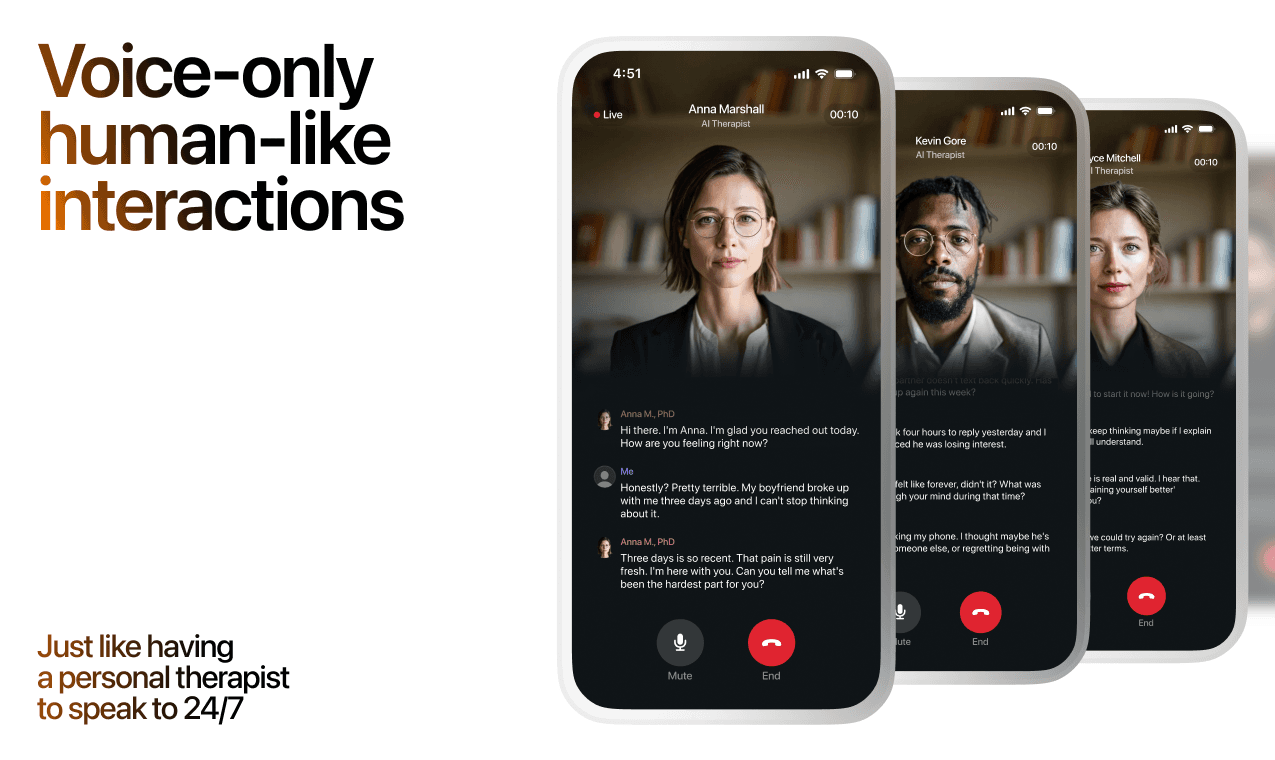
Here's what happens in a typical Lovon session:
You share what's on your mind
There's no script, no intake form, no waiting room. You speak or type whatever you're feeling — in your own words, at your own pace.
Lovon validates and explores
Using frameworks from CBT (Cognitive Behavioral Therapy) and motivational interviewing, Lovon acknowledges your feelings first, then gently helps you explore them. No dismissive "just move on" advice.
You build coping skills together
Lovon doesn't just listen — it actively works with you on evidence-based techniques: thought reframing, urge surfing, behavioral experiments, and more.
What a Session with Lovon Looks Like
When to Seek Professional Help
AI support is a valuable tool, but it's not a replacement for professional care. Please consider reaching out to a licensed therapist if you experience any of the following:
- Persistent thoughts of self-harm or suicide
- Inability to perform daily activities (work, eating, sleeping) for more than 2 weeks
- Turning to alcohol or substances to cope
- Intense anger or desire to harm your ex-partner
- Complete emotional numbness that doesn't improve over time
Crisis Resources (US): If you're in immediate danger, call 988 (Suicide & Crisis Lifeline) or text HOME to 741741 (Crisis Text Line). Available 24/7, free, and confidential.
Outside the US? Find a crisis line in your country
Ready to Start?
Your healing journey can begin right now
A 7-day trial. No judgment. Just a safe space to process what you're going through.
Frequently Asked Questions
Is Lovon a replacement for a real therapist?
Is my conversation with Lovon AI private?
How is Lovon different from ChatGPT for emotional support?
Can I use Lovon if I'm already seeing a therapist?
Can I try Lovon before subscribing?
About the Author
The Lovon Editorial Team
Mental Health & Wellness Content Team
The Lovon Editorial Team develops mental health and wellness content designed to make psychological concepts accessible and actionable. Our goal is to bridge the gap between clinical research and everyday life - helping you understand why your mind works the way it does and what you can do about it....
Related articles
- How to Manage Stress as a Shift Worker (2026 Guide)
Learn how to manage stress as a shift worker in 2026 with sleep timing, light exposure, and coping tools plus 24/7 AI…
- Maladaptive Daydreaming: Signs & How to Stop It in 2026
Maladaptive daydreaming explained: signs, triggers, and a 7-step plan to cut hours-long episodes down in 2026…
- Doom Scrolling as Dissociation and Trauma Response Rather Than Lack of Willpower
You've done it again—opened your phone for "just a minute" and emerged an hour later, drained and disoriented, wondering…
- AI Therapist for Work Stress: How to Use It in 2026
Learn how to use an ai therapist for work stress the right way in 2026 - specific triggers, grounding steps, and when…
See also
Quizzes
- Insecurity Test: What Are You Bracing Against?
See what your insecurity actually runs on, in 3 minutes.
- Rejection Sensitivity Test: Free 12-Question Check
See how strongly you expect and read rejection.
Free tools
- Write a Letter to Your Best Friend
A chat for a letter to your best friend that only they could have received. Tell it how long you have been friends, one…
- Words of Encouragement for Him When He Is Struggling
Words of encouragement for him that fit what he is actually going through, for when your usual lines are not landing…
From the wiki
- How to stop maladaptive daydreaming?
Maladaptive daydreaming is immersive waking fantasy that eats hours, usually with music and pacing attached. You rarely…
Disclaimer: This article is for informational purposes only and does not constitute medical advice, diagnosis, or treatment. Always seek the advice of your physician or other qualified health provider with any questions you may have regarding a medical condition. If you are in crisis or think you may have an emergency, call 988 (Suicide & Crisis Lifeline) or go to the nearest emergency room. Outside the US? Find a crisis line in your country.