
Whoop to recovery-based coping nudges: complete 2026 workflow
Use a manual whoop lovon integration to turn recovery reviews into gentle coping nudges, with clear setup steps, privacy boundaries, and safety checks.

Key Takeaways
- Use a manual whoop lovon integration for recovery-based coping nudges without assuming a native connector exists.
- Lovon suits people seeking voice-based emotional support, not medical interpretation of WHOOP recovery scores.
- Keep recovery data separate from emotional check-ins: a wearable score does not diagnose anxiety or depression.
- Start with one daily reminder, then adjust the routine around what actually helps.
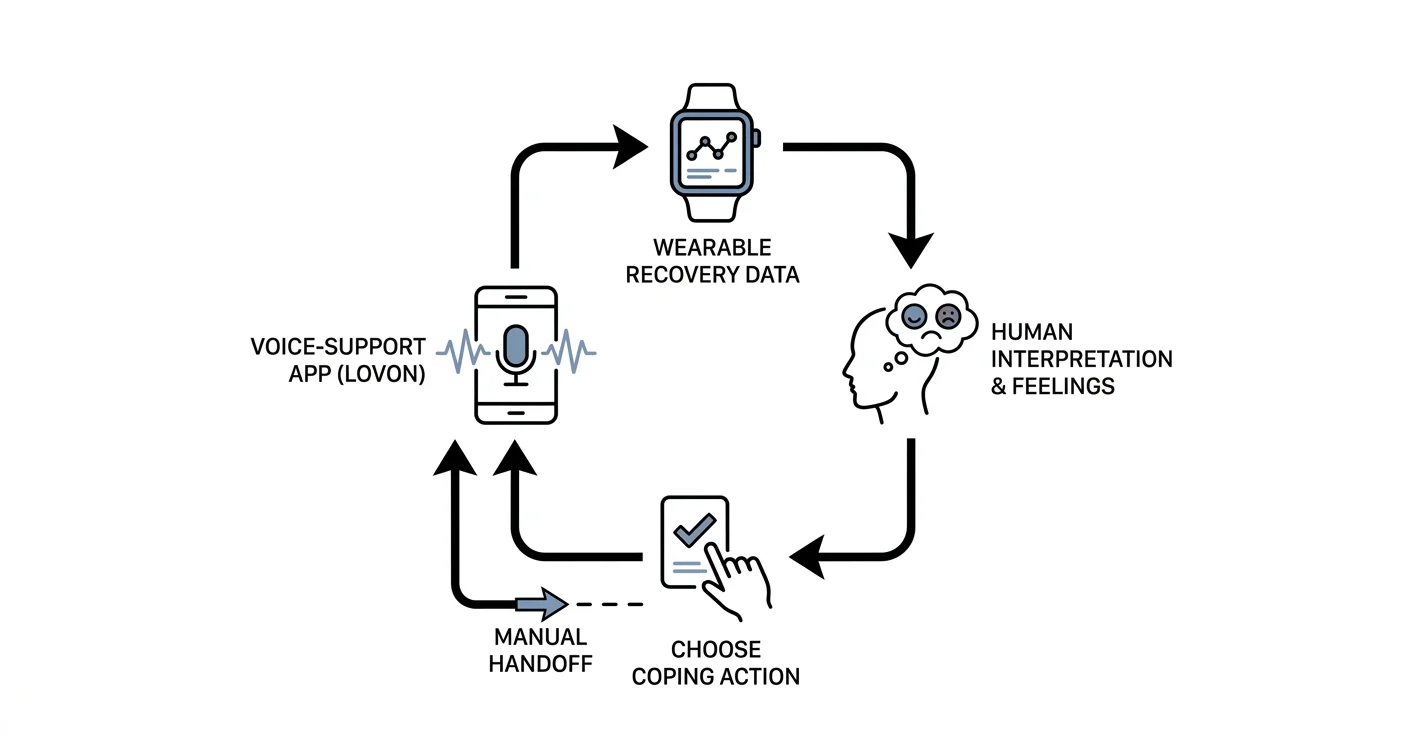
Instead of repeatedly checking WHOOP and deciding what to do with your recovery score, pair one daily review with a reminder to pause, name how you feel, and choose a coping action. This 2026 whoop lovon integration guide uses a manual handoff—not an assumed native connection or automatic transfer of health data.
TL;DR
- Use a manual whoop lovon integration for recovery-based coping nudges without assuming a native connector exists.
- Lovon suits people seeking voice-based emotional support, not medical interpretation of WHOOP recovery scores.
- Keep recovery data separate from emotional check-ins: a wearable score does not diagnose anxiety or depression.
- Start with one daily reminder, then adjust the routine around what actually helps.
Why this matters
A recovery score is not an instruction about how you should feel. You can feel emotionally overwhelmed on a physically recovered day, or feel steady when your wearable suggests taking things easier.
Lovon is best for people who want voice-based emotional support alongside—not instead of—licensed clinical care. The app offers coping tools and self-reflection through voice conversations; it is not a licensed clinician or a medical interpreter for your wearable.
The useful connection is behavioral: notice a cue, check in with yourself, and choose a response. You can learn more about Lovon without connecting accounts or sharing a recovery history.
For this 2026 workflow, success means remembering to offer yourself support. It does not mean raising tomorrow’s recovery score, preventing anxiety, or proving that a coping exercise worked through wearable data.
Before you start
- Have access to your current WHOOP recovery information and your voice-support app. Use a private place where speaking feels comfortable. Keep a simple note or paper nearby for your chosen action; you do not need to copy your full health history.
- Choose a reminder method you already use. A phone reminder, calendar event, or written cue is enough. This guide does not depend on a particular operating system, subscription, automation platform, or unverified app setting.
- Watch for the main gotcha: a scheduled reminder cannot read your recovery score. You must review the score yourself and choose the response. Do not label a time-based notification as a recovery-triggered automation.
Before sharing personal information, review the current privacy information and permissions for each service you use. Keep sensitive details out of notification text, especially if other people can see your lock screen.
Daily check-in setup
Start with a predictable cue rather than a complicated rule. Your first version needs to be easy enough to follow on an ordinary, distracted morning.
- Choose your cue. Use the moment after you normally review WHOOP, or another dependable point in your day. If your schedule changes often, attach the check-in to an activity rather than a clock time.
- Create a neutral reminder. Use your existing reminder method and enter wording such as: Review recovery, notice feelings, choose support. This is suggested reminder text, not an app button or built-in template.
- Keep the reminder private. Avoid including your recovery score, symptoms, diagnoses, or relationship concerns in the title. A simple check-in label is enough.
- Set a small time boundary. As a starting routine, allow 2 minutes to notice how you feel. This is a suggested limit for keeping the habit manageable, not a treatment dose.
- Define an exit. Decide that you can dismiss the reminder without making up the check-in later. Support should not become another overdue task.
Expected result: you have a dependable prompt that asks for a check-in without pretending to know your recovery status. Test the reminder once before relying on it.
For a sustainable 2026 routine, choose the least complicated version you can repeat. Adding more notifications is not the same as adding more support.
Recovery-to-coping rules
Your recovery information supplies context; your own experience determines the next step. Do not create a rule that turns a wearable reading into a mental health diagnosis.
- Review the current day. Check that you are looking at the intended day’s recovery information rather than an older entry. If you cannot confirm it, continue with a feelings-only check-in.
- Name your experience before interpreting it. Use ordinary words: tired, tense, sad, irritated, settled, or unsure. You do not need to explain the feeling immediately.
- Separate observation from conclusion. Write or say that your recovery looks lower and you feel worried. Avoid concluding that the score proves something is wrong with your mental health.
- Choose one response. Use the table below to select a manageable action. Treat these as workflow choices, not clinical categories.
- Keep health decisions separate. Do not use this routine to change medication, diagnose illness, or override advice from a qualified professional.
| Check-in situation | Suggested response | Best for | Benefit | Limitation |
|---|---|---|---|---|
| Lower recovery and feeling overwhelmed | Pause and choose a gentle coping action | A demanding day when you need less pressure | Connects the cue to a practical next step | Does not explain the recovery reading |
| Higher recovery and feeling distressed | Seek emotional support anyway | Feelings that do not match the wearable | Keeps your experience central | The score cannot decide what support you need |
| Any recovery level and feeling settled | Briefly acknowledge how you feel, then continue | Maintaining the habit without overchecking | Keeps the routine small | Does not predict how the rest of the day will feel |
| Missing or unclear recovery information | Use a feelings-only check-in | Days without usable wearable information | Keeps support accessible | Provides no recovery context |
Expected result: you can choose a next step even when the score and your feelings disagree. No reading becomes permission—or a requirement—to seek emotional support.
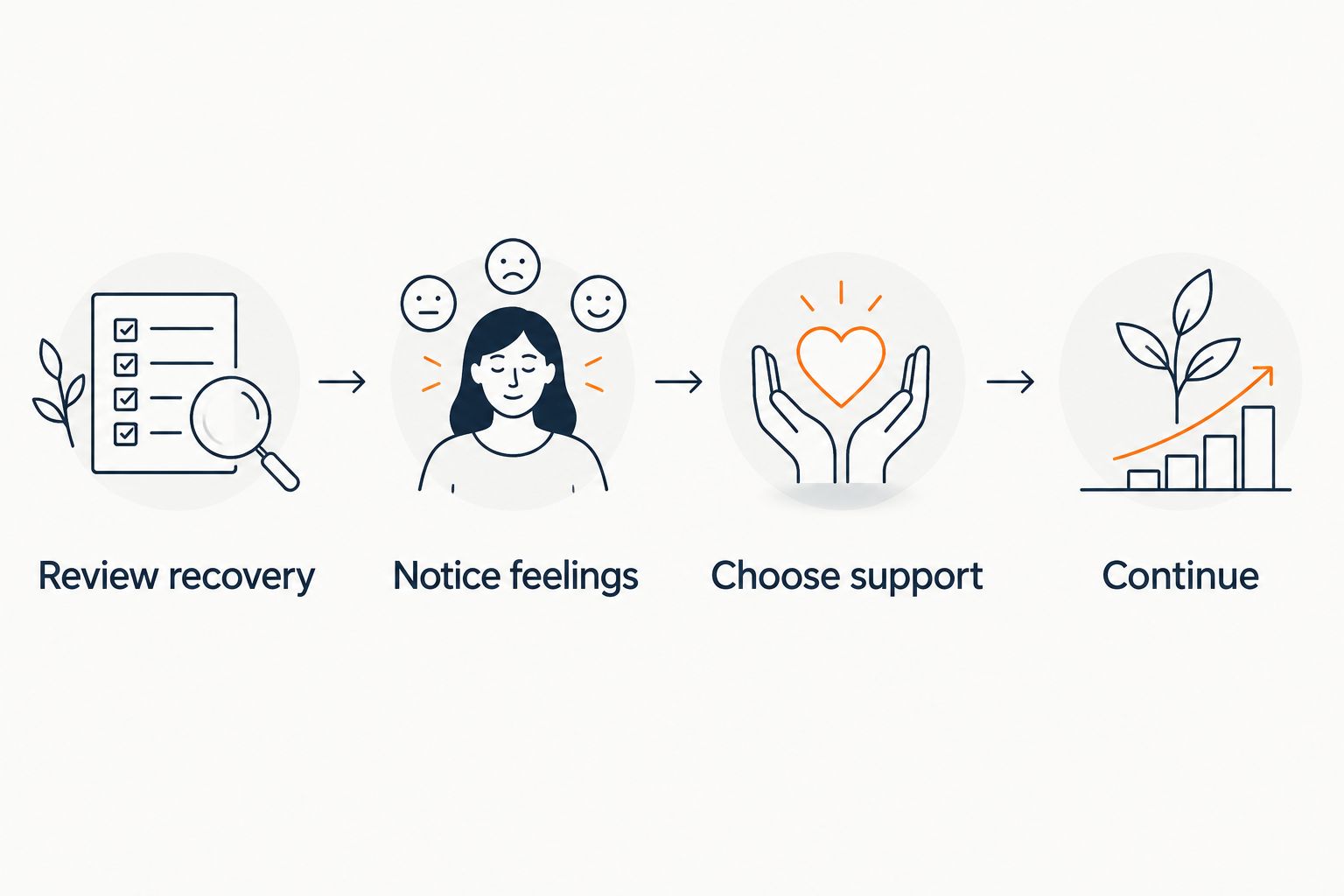 Four-step routine from reviewing recovery to choosing support and continuing your day
The recovery reading starts the check-in; it does not choose your response.
Voice-support handoff
The handoff is something you do deliberately. You open the app yourself and describe the context you want to share; this workflow does not require an automatic session launch or imported WHOOP data.
- Open Lovon when you want voice-based emotional support. Choose a setting where you can speak safely and privately. Do not start an emotionally demanding conversation while driving or doing work that needs your full attention.
- Explain the situation in plain language. Mention that a recovery reading has left you worried, or that you already felt stressed before checking it. Share only the details you want to discuss.
- Ask for a specific kind of help. Request a grounding exercise, help naming a feeling, or support breaking a stressful task into a smaller next step. You can also ask to reflect without discussing the score further.
- Choose an action you control. Examples include pausing before a difficult email, asking someone for support, or making a task less demanding. Do not make a recovery-score change the required outcome.
- Close with a brief note. Record the action you chose, not a transcript of sensitive conversation. If a 5-minute reflection feels long enough, use that as your personal stopping point rather than a performance target.
Expected result: the check-in ends with a clear next action or a decision to seek human support. You do not need to feel completely calm before you stop.
If the conversation feels unhelpful, confusing, or upsetting, end it. An app is an optional support tool, not something you must keep using to complete the workflow.
Test run and boundaries
Test the sequence before adding it to your daily routine. A good test checks your reminder and decision process, not whether an app can improve a health measurement.
- Run the reminder once. Confirm that you notice it at a useful moment and that its text does not reveal sensitive information.
- Try a score-free check-in. Name a feeling and choose an action without consulting WHOOP. Your routine should still work when wearable information is unavailable.
- Test the skip path. Dismiss the reminder and continue your day. There should be no escalating alerts or obligation to catch up.
- Review after 7 days. Ask whether the reminder was useful, easy to ignore when necessary, and free from pressure to monitor yourself more often. This is a suggested review period, not an evidence-based treatment schedule.
Expected result: your 2026 setup works as an invitation rather than an alarm. If it creates more checking, guilt, or worry, simplify it or stop.
Keep an explicit boundary: this routine supports everyday reflection. Persistent low mood, worsening anxiety, significant sleep problems, or difficulty functioning deserve attention from a qualified health professional rather than increasingly elaborate reminder rules.
A second variant: check in after a stressful event
A daily recovery review is not the only useful cue. You can also choose a check-in after a difficult meeting, conflict, or other stressful event, whether or not you have looked at WHOOP.
This variant is user-initiated. It does not claim that a wearable detects emotional distress or that a score update automatically triggers an app.
| Workflow | Best for | Strength | Trade-off |
|---|---|---|---|
| Daily recovery review | People who already review recovery regularly | Gives the check-in a familiar place in the day | Can encourage unnecessary score attention if the boundary gets lost |
| Event-based check-in | People who notice stress around particular situations | Responds to your lived experience | Depends on remembering to pause |
Use a simple sequence: notice the event, name your reaction, and decide whether support would help. Leave the recovery score out if it adds nothing useful.
Use the daily version or the event-based version first—not both by default. Adding the second version makes sense only when it fills a real gap rather than creating another demand.
Troubleshooting
The reminder arrives before you have checked WHOOP
Move the cue to after your usual review, or keep the reminder as a feelings-only check-in. Do not repeatedly refresh recovery information just to satisfy the routine.
The reminder does not change with the score
That is expected for a time-based reminder. Keep the manual decision step; do not assume that account access, permissions, or a calendar event creates a data connection.
A reassuring score makes you dismiss difficult feelings
Remove recovery from the decision about whether you deserve support. A wearable reading does not invalidate sadness, anxiety, relationship strain, or exhaustion.
A lower score starts a worry spiral
Pause the recovery-based cue and use a neutral check-in instead. If score checking becomes hard to stop or interferes with your day, discuss that pattern with a qualified mental health professional.
The check-in becomes another task you feel guilty about
Shorten it to naming one feeling, reduce its frequency, or remove the reminder. The goal is access to support, not a perfect record of completed sessions.
Customize your workflow
Keep your 2026 routine focused on the problem you actually want help with. If the hard part is choosing a coping action, read the guide to coping tools for stress rather than adding more wearable rules.
You can also change the conversation prompt. Ask for help preparing for a difficult conversation, noticing self-critical thinking, or identifying one manageable task. These requests give the check-in a purpose without requiring more health data.
Do not add a connector, third-party service, or health-data export merely to make the workflow feel complete. Check current official documentation before granting access to any service, and confirm exactly what information it reads and stores.
FAQ
Is there a native WHOOP Lovon integration?
This guide provides a manual workflow, not instructions for a verified native connector. Review recovery yourself, then choose whether to open the voice-support app; check current official documentation before attempting a direct connection.
Can a low WHOOP recovery score automatically start a voice session?
This workflow does not automatically start a voice session. A scheduled reminder prompts you to review how you feel, and you open the app yourself if you want support.
What should a recovery-based coping reminder say?
Use neutral wording such as a prompt to review recovery, notice feelings, and choose support. Keep scores and sensitive mental health details out of lock-screen notification text.
Does a low recovery score mean I have anxiety or depression?
No, a recovery score does not diagnose anxiety or depression. Seek assessment from a qualified professional if symptoms persist, worsen, or interfere with daily life.
Should I share my exact recovery score during a conversation?
You do not need to share an exact score for this routine. Describing how you feel and what you need keeps the conversation useful without sharing extra health information.
What if checking recovery makes me more anxious?
Stop using recovery as the cue and switch to a feelings-only check-in. If checking becomes difficult to control or disrupts your day, seek support from a qualified mental health professional.
Can Lovon replace a therapist or provide crisis care?
No. Lovon provides voice-based emotional support and coping tools, not licensed clinical care or emergency response. In the United States, call or text 988 for a mental health crisis; call 911 for immediate danger or a medical emergency.
One last thing
The most useful test is whether your routine still works without the wearable. Try a check-in before viewing the score: notice your feelings, decide what you need, and then decide whether recovery information adds anything.
Keep that rule in your 2026 setup. You do not have to earn support with a low score, and a high score never obliges you to feel fine.
Related guides
How AI Support Helps You Heal
AI emotional support isn't about replacing human connection — it's about filling the gaps. The moments when you need to talk at 2 AM, when you don't want to burden your friends again, or when you simply need someone to listen without judgment.
Here's what happens in a typical Lovon session:
You share what's on your mind
There's no script, no intake form, no waiting room. You speak or type whatever you're feeling — in your own words, at your own pace.
Lovon validates and explores
Using frameworks from CBT (Cognitive Behavioral Therapy) and motivational interviewing, Lovon acknowledges your feelings first, then gently helps you explore them. No dismissive "just move on" advice.
You build coping skills together
Lovon doesn't just listen — it actively works with you on evidence-based techniques: thought reframing, urge surfing, behavioral experiments, and more.
What a Session with Lovon Looks Like
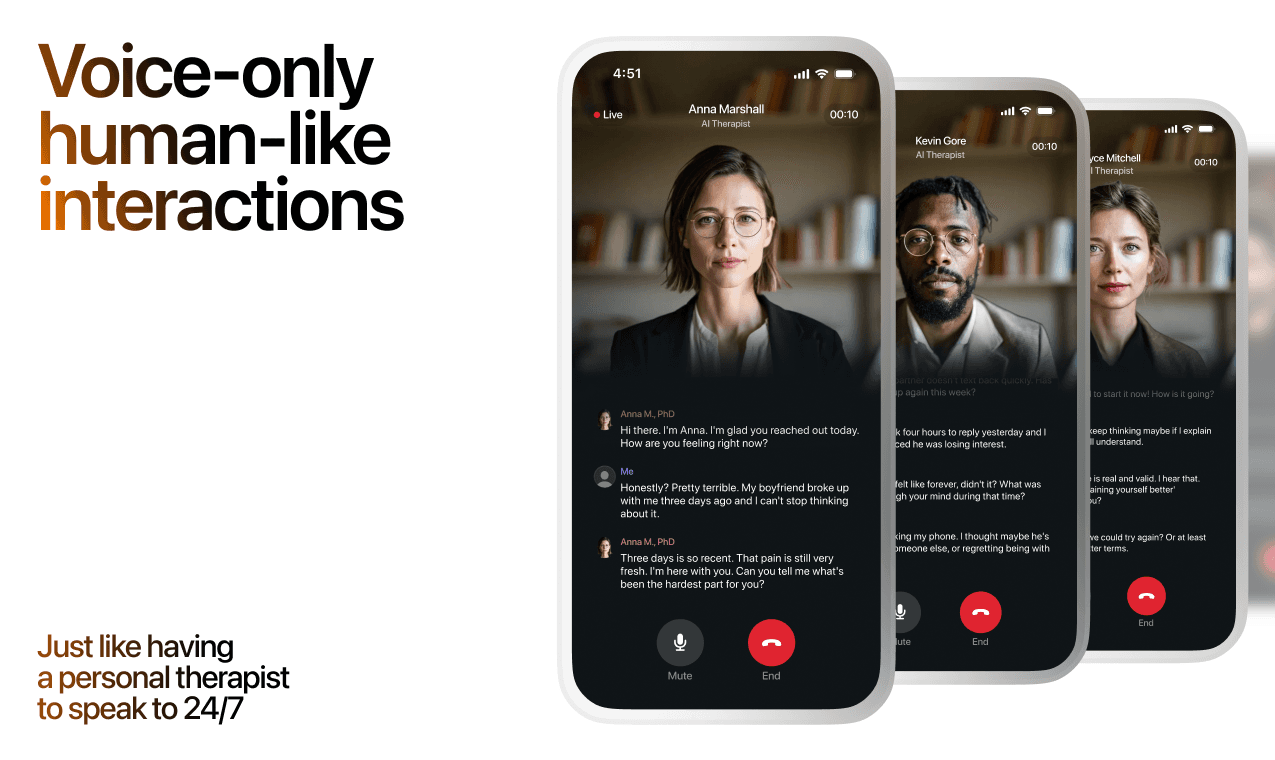
Lovon is AI support, not a replacement for professional care. If things have been hard to get through for weeks, or you are thinking about harming yourself, talk to a doctor or a licensed therapist.
Ready to Start?
Your healing journey can begin right now
A 7-day trial. No judgment. Just a safe space to process what you're going through.
Frequently Asked Questions
Is Lovon a replacement for a real therapist?
Is my conversation with Lovon AI private?
How is Lovon different from ChatGPT for emotional support?
Can I use Lovon if I'm already seeing a therapist?
Can I try Lovon before subscribing?
About the Author

The Lovon Editorial Team
Mental Health & Wellness Content Team
The Lovon Editorial Team develops mental health and wellness content designed to make psychological concepts accessible and actionable. Our goal is to bridge the gap between clinical research and everyday life - helping you understand why your mind works the way it does and what you can do about it....
Related articles
- How to Stop People Pleasing in 2026: 7-Step Guide
How to stop people pleasing in 2026: 7 concrete steps, a boundary script, and troubleshooting for guilt, pushback, and…
- Emotionally Immature Parents Boundaries That Hold in 2026
Set boundaries with emotionally immature parents in 2026 using scripted limits, exit lines, and follow-through steps…
- AI Support App for Gambling Recovery: 2026 Verdict
An AI support app for gambling recovery helps with urges and shame between meetings in 2026. See how Lovon fits…
- Am I Codependent Quiz: 2026 Verdict in 2 Minutes
Take the am i codependent quiz for 2026: 10 quick questions, four score bands, and a direct verdict on your codependent…
See also
Quizzes
- Hypermasculinity Test: Signs, Traits and Your Score
Score risk for show, dominance and contempt, in 3 minutes.
- Light Triad Test: Kantianism, Humanism & Faith Scores
See how you treat people when there is nothing to gain.
Free tools
- How to End a Friendship Without a Scene
A chat for working out how to end a friendship clearly, without a grievance list or a slow ghost. Tell it how long you…
- How to Say No Politely (Without Over-Explaining)
A chat for how to say no politely when you have already decided and cannot get the word out. Tell it what you were…
From the wiki
- Why do I feel lonely all of a sudden?
Sudden loneliness usually traces back to something that quietly ended in the last few months: a routine, a shared class…
Disclaimer: This article is for informational purposes only and does not constitute medical advice, diagnosis, or treatment. Always seek the advice of your physician or other qualified health provider with any questions you may have regarding a medical condition. If you are in crisis or think you may have an emergency, call 988 (Suicide & Crisis Lifeline) or go to the nearest emergency room. Outside the US? Find a crisis line in your country.