
Is My Relationship Worth Saving Quiz: 2026 Verdict Guide
Is my relationship worth saving quiz that actually scores repair, effort, and safety. Take the right tests in order and get a real verdict for 2026.

Key Takeaways
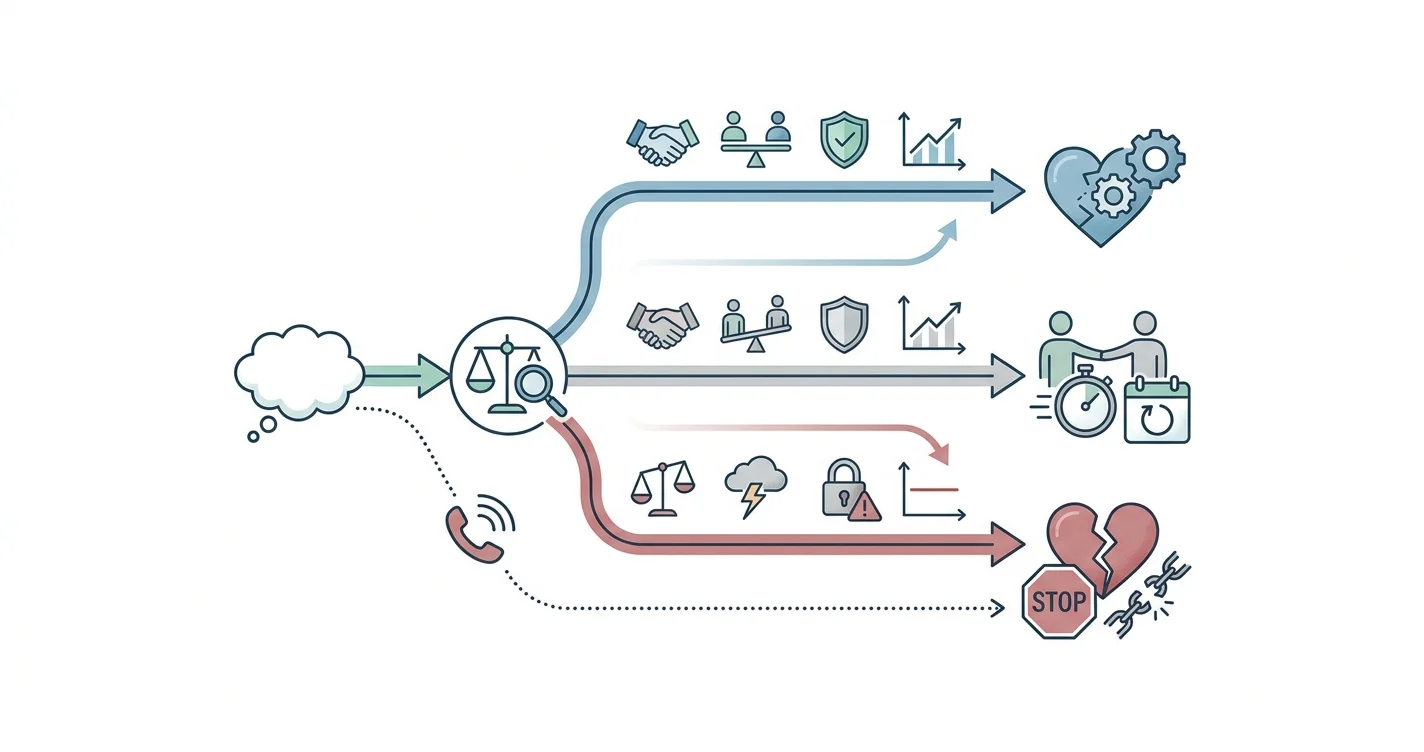
- An is my relationship worth saving quiz only works if it scores repair, respect, and effort - not just feelings.
- Am I The Problem In My Relationship Quiz and the Codependency Quiz both give concrete scoring thresholds. Take them.
- Three or more matches on a 10-sign toxicity checklist is a stop-and-reassess signal, not a maybe.
- Skip any quiz that tells you to stay despite abuse, cheating, or control - safety overrides scoring every time.
- Talking it through out loud with Lovon's AI voice sessions surfaces patterns a checkbox quiz misses.
You want a straight answer, not a horoscope. A real "is my relationship worth saving quiz" gives you scoring criteria you can actually apply to your own relationship in 2026, not a cute result name.
TL;DR
- An is my relationship worth saving quiz only works if it scores repair, respect, and effort - not just feelings.
- Am I The Problem In My Relationship Quiz and the Codependency Quiz both give concrete scoring thresholds. Take them.
- Three or more matches on a 10-sign toxicity checklist is a stop-and-reassess signal, not a maybe.
- Skip any quiz that tells you to stay despite abuse, cheating, or control - safety overrides scoring every time.
- Talking it through out loud with Lovon's AI voice sessions surfaces patterns a checkbox quiz misses.
Why this matters
Most people don't Google "is my relationship worth saving quiz" out of curiosity. They Google it at 1 a.m. after a fight, or the morning after realizing they've been unhappy for months and can't tell if that's normal or a warning sign.
A quiz can't decide for you. What it can do is turn a fuzzy feeling into a scored checklist, the same kind a therapist would use to structure a first conversation. This 10-sign toxicity checklist is a good starting point precisely because it's specific: it names behaviors, not vibes.
The honest version of this quiz doesn't spit out "soulmates" or "move on." It gives you a framework, and you apply it to your own history over the last six months, not the highlight reel from year one.
Who this is for
This is for anyone who's stopped mid-argument and thought "is this even normal," and anyone who's been quietly keeping score of who apologizes first, who initiates repair, and who just goes quiet for three days. If you're mid-breakup already and just need closure language, a different quiz fits better - this one is for people still deciding.
What to look for in a relationship worth saving quiz
Does it score repair, not just conflict
Every relationship fights. The question that matters in 2026 relationship research is what happens in the 20 minutes after the fight ends. A quiz worth trusting asks whether apologies lead to behavior change or just a temporary truce before the same fight repeats in three weeks.
Does it separate feelings from patterns
Feeling distant on a Tuesday isn't data. Feeling distant every Tuesday for two months is. A quiz that only asks "how do you feel right now" measures your mood, not your relationship - look for one that asks about frequency and duration instead.
Does it flag safety before it flags compatibility
No scoring system should tell someone to "work on communication" when the actual issue is control, threats, or physical fear. A legitimate assessment routes safety concerns to resources immediately instead of averaging them into a compatibility percentage.
Does it account for effort reciprocity
A relationship where one person does 80% of the emotional labor isn't 80% healthy - it's unsustainable. Look for a quiz that asks who initiates repair, who remembers details, and who shows up during hard weeks, not just during good ones.
Does it give you a next step, not just a label
"Worth saving" or "not worth saving" is only useful if it's followed by an actual action: a conversation script, a boundary to test, or a resource to talk it through. A quiz that ends at the label leaves you exactly where you started.
Does it hold up if you retake it in a month
One-time results are snapshots. If your answers would look completely different during a calm week versus a bad week, the quiz is measuring your current mood, not the relationship's actual trajectory.
Top picks: tools that actually score this
The self-audit. Am I The Problem In My Relationship Quiz flips the usual framing and scores your own contribution first. One number that matters: it takes about 2 minutes, and it's built to catch blind spots the "is my partner the problem" framing usually hides. Verdict: Take it first.
The pattern check. Codependency Quiz: Are You Losing Yourself in Your Relationship scores whether your identity and decisions still exist independent of the relationship. If you score high on losing yourself, that's a separate problem from whether the relationship is "worth saving" - it means you need your own footing back regardless of the outcome. Verdict: Consider it if you can't remember your last solo decision.
The decision test. Should I Break Up With Him Quiz: Honest 2-Minute Check is the closest match to a direct verdict, built around specific yes/no scenarios instead of vague feelings. It's blunt by design - useful if you've already done the softer self-reflection and want a forcing function. Verdict: Take it last, after the self-audit.
The talk-it-out option. Sometimes a checklist can't hold the nuance of eight years together or a blended family. Talking it through out loud with Lovon, an AI voice support app, lets you say the messy version - the parts that don't fit into checkboxes - and hear it reflected back. It's not a licensed clinician and it won't replace couples counseling, but it's available at 2 a.m. when the quiz result raises more questions than it answers. Verdict: Consider it as the follow-up conversation, not the first step.
What to avoid
- One-question quizzes. Anything that reduces years of shared history to a single click and a percentage is entertainment, not assessment - treat the result as a conversation starter, never a verdict.
- Cutesy result names. "Soulmates," "slow burn," "red flag city" - these labels feel satisfying but carry no scoring logic behind them. If you can't see the criteria, you can't trust the output.
- Quizzes that average away red flags. If a quiz counts "he apologizes sometimes" as a plus against "he's hit me once," the math itself is broken. Physical safety and control issues aren't compatibility points to be offset - they end the scoring conversation on their own.
Verdict comparison
| Criteria | Worth saving looks like | Not worth saving looks like |
|---|---|---|
| Repair after conflict | Apology plus changed behavior within days | Same fight repeats within 2-3 weeks |
| Effort reciprocity | Both people initiate repair over a month | One person carries it every time |
| Safety | Disagreements stay verbal and de-escalate | Threats, control, or physical fear present |
| Growth over 6 months | Things are measurably better than 6 months ago | Identical complaints, no movement |
| Sense of self | You still make independent decisions | You've lost touch with your own preferences |
FAQ
Is my relationship worth saving quiz accurate?
A quiz is only as accurate as its scoring criteria - one that measures repair, effort, and safety over time is far more reliable than one that asks how you feel right now. Treat any quiz result as a starting point for a real conversation, not a final verdict.
What are signs a relationship isn't worth saving?
Repeated cheating, control or threats, one-sided effort that hasn't changed in 6 months, and apologies with no behavior change are the clearest signs in 2026 relationship guidance. Three or more matches on a toxicity checklist is a strong signal to reassess.
How long should you try to fix a relationship before giving up?
There's no universal timeline, but most relationship guidance points to 3-6 months of consistent, mutual effort as a reasonable window to see measurable change. If nothing has shifted after real attempts on both sides, that itself is the answer.
Can a relationship survive without both partners trying?
Rarely, and not sustainably - one person can hold things together for a while, but resentment builds fast when effort stays one-sided. Look for reciprocity, not just your own willingness to keep working at it.
Is it normal to question the relationship regularly?
Occasional doubt during a bad week is normal; constant, low-grade questioning for months is a signal worth taking seriously. The difference is frequency and duration, not the fact that doubt exists at all.
Should I take a quiz or talk to a therapist about my relationship?
A quiz is a fast first pass to organize your thoughts; a therapist or a tool like an AI voice conversation adds the nuance a checklist can't capture. Use the quiz to name the issue, then talk through the specifics.
What if the quiz says stay but I still feel unhappy?
Trust the feeling over the score - a quiz can't account for every detail of your specific relationship. Persistent unhappiness despite a favorable quiz result is itself data worth acting on.
Does codependency affect whether a relationship is worth saving?
Yes - if you've lost your own identity or decision-making inside the relationship, that's a separate issue from compatibility and needs its own attention regardless of the outcome. A codependency check alongside the main quiz gives a fuller picture.
One last thing
The most reliable signal isn't in any quiz question - it's whether you can picture telling a close friend the honest, unflattering version of your last three fights and still hear yourself say "but it's worth it." If you have to spin the story to make it sound okay, that's the real answer showing up before the scoring does.
Related guides
How AI Support Helps You Heal
AI emotional support isn't about replacing human connection — it's about filling the gaps. The moments when you need to talk at 2 AM, when you don't want to burden your friends again, or when you simply need someone to listen without judgment.
Here's what happens in a typical Lovon session:
You share what's on your mind
There's no script, no intake form, no waiting room. You speak or type whatever you're feeling — in your own words, at your own pace.
Lovon validates and explores
Using frameworks from CBT (Cognitive Behavioral Therapy) and motivational interviewing, Lovon acknowledges your feelings first, then gently helps you explore them. No dismissive "just move on" advice.
You build coping skills together
Lovon doesn't just listen — it actively works with you on evidence-based techniques: thought reframing, urge surfing, behavioral experiments, and more.
What a Session with Lovon Looks Like
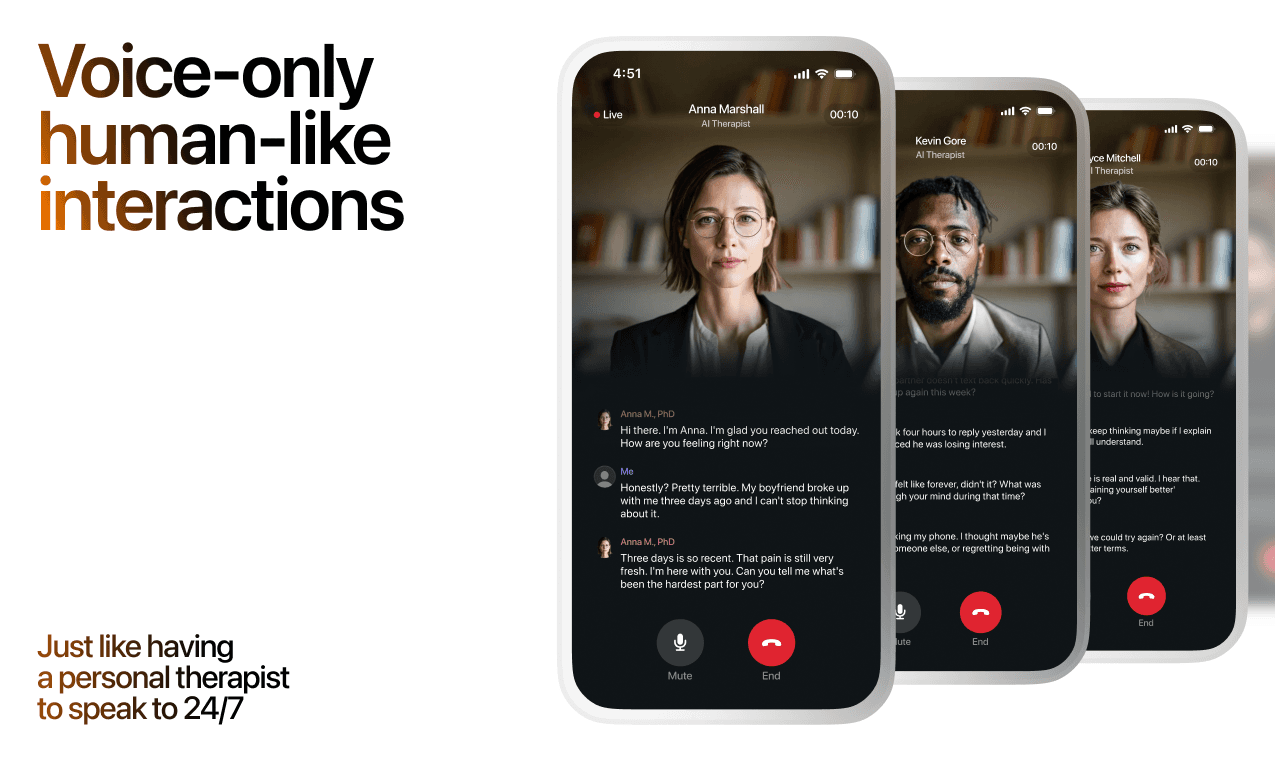
Lovon is AI support, not a replacement for professional care. If things have been hard to get through for weeks, or you are thinking about harming yourself, talk to a doctor or a licensed therapist.
Ready to Start?
Your healing journey can begin right now
A 7-day trial. No judgment. Just a safe space to process what you're going through.
Frequently Asked Questions
Is Lovon a replacement for a real therapist?
Is my conversation with Lovon AI private?
How is Lovon different from ChatGPT for emotional support?
Can I use Lovon if I'm already seeing a therapist?
Can I try Lovon before subscribing?
About the Author
The Lovon Editorial Team
Mental Health & Wellness Content Team
The Lovon Editorial Team develops mental health and wellness content designed to make psychological concepts accessible and actionable. Our goal is to bridge the gap between clinical research and everyday life - helping you understand why your mind works the way it does and what you can do about it....
Related articles
- Google Calendar to daily check-in habit: complete 2026 workflow
Set up a lovon google calendar daily check-in in 2026: recurring event settings, notification fixes, and the…
- Attachment Style Quiz: Find Your Type in 2026
Take a 2-minute attachment style quiz and find out if you're secure, anxious, avoidant, or fearful-avoidant — plus what…
- AI Therapy App for Financial Anxiety: 2026 Verdict
The best ai therapy app for financial anxiety in 2026 pairs 24/7 voice sessions with real coping tools. See the picks…
- Dating App Burnout in 2026: How to Cope With Match Fatigue
Dating app burnout peaks around week 3 or 4 of swiping. Here's how to spot match fatigue, reset with a real break, and…
See also
Quizzes
- Love Addiction Test: Free 12-Question Self-Check
See how much of your life one person is taking.
- Should I Break Up With My Boyfriend? 12-Question Quiz
Twelve questions on whether the doubt has settled.
Free tools
- Pressure-Test Your Decision to Stay or Leave
A chat that argues with you on purpose. Give it your strongest case for leaving and for staying, and it pushes on both…
- How to Ask for Space Without Ending It
A chat for when you need distance but not a breakup. Say the sentence you keep rehearsing and what you are afraid they…
From the wiki
- How to leave a toxic relationship?
Leaving a toxic relationship is rarely a decision problem — you usually know. What stops you is that the pull toward…
Disclaimer: This article is for informational purposes only and does not constitute medical advice, diagnosis, or treatment. Always seek the advice of your physician or other qualified health provider with any questions you may have regarding a medical condition. If you are in crisis or think you may have an emergency, call 988 (Suicide & Crisis Lifeline) or go to the nearest emergency room. Outside the US? Find a crisis line in your country.