
How to Heal Anxious Attachment on Your Own (2026)
Step-by-step guide to healing anxious attachment solo in 2026: triggers, nervous system work, boundaries, and tools that help between therapy sessions.

Key Takeaways
- How to heal anxious attachment starts with catching the trigger before the spiral, not analyzing it after.
- Daily nervous system regulation for 60-90 days changes reactivity faster than insight alone ever will.
- An attachment style quiz gives you a baseline in two minutes; skipping it means guessing at your own pattern.
- AI voice therapy through an app like Lovon works as a between-session tool for 2am spirals — Consider it a bridge,
Anxious attachment doesn't heal because you understand it intellectually. It heals because you rewire the reaction that fires before you've had a chance to think. This guide breaks that rewiring into steps you can start today, on your own, without a partner in the room.
TL;DR
- How to heal anxious attachment starts with catching the trigger before the spiral, not analyzing it after.
- Daily nervous system regulation for 60-90 days changes reactivity faster than insight alone ever will.
- An attachment style quiz gives you a baseline in two minutes; skipping it means guessing at your own pattern.
- AI voice support through an app like Lovon works as a between-session tool for 2am spirals — Consider it a bridge, not a replacement for licensed care.
Why this matters
Anxious attachment shows up as a nervous system on high alert around closeness — checking their phone activity, rereading texts for hidden meaning, feeling okay one hour and panicked the next when a reply is slow. If that sounds familiar, the anxious attachment style signs and coping strategies pattern is worth confirming before you build a plan around it.
The research on attachment styles goes back to the 1970s, but the practical piece for 2026 is this: attachment patterns formed in childhood or early relationships are learned responses, and learned responses can be unlearned with repetition. You're not fixing a personality defect. You're retraining a threat-detection system that's been calibrated to expect abandonment.
This isn't a weekend fix. Most people working through it solo see real shifts in reactivity within 8 to 12 weeks of consistent daily practice — not because the timeline is magic, but because that's roughly how long it takes to build a new default response through repetition.
What you'll need
- A journal or notes app for tracking triggers, not feelings in general — specificity matters here
- 10 minutes a day, same time if possible, for a regulation practice (breathing, grounding, or movement)
- A way to check your baseline — an attachment style quiz takes about two minutes and gives you language for what you're working with
- Honesty about at least one relationship pattern you keep repeating
- Patience for setbacks — anxious attachment healing is not linear, and week three will feel worse before week eight feels better
The steps
1. Name your specific triggers, not the general fear
"I'm anxious in relationships" isn't specific enough to act on. Spend three days writing down the exact moment anxiety spiked: a delayed text reply, a partner going quiet after an argument, weekend plans made without you. Specificity is what lets you catch the trigger next time instead of just riding the wave.
Common mistake: journaling the emotion ("I felt scared") instead of the event that preceded it. Write the event first, emotion second.
2. Build a 90-second pause before you react
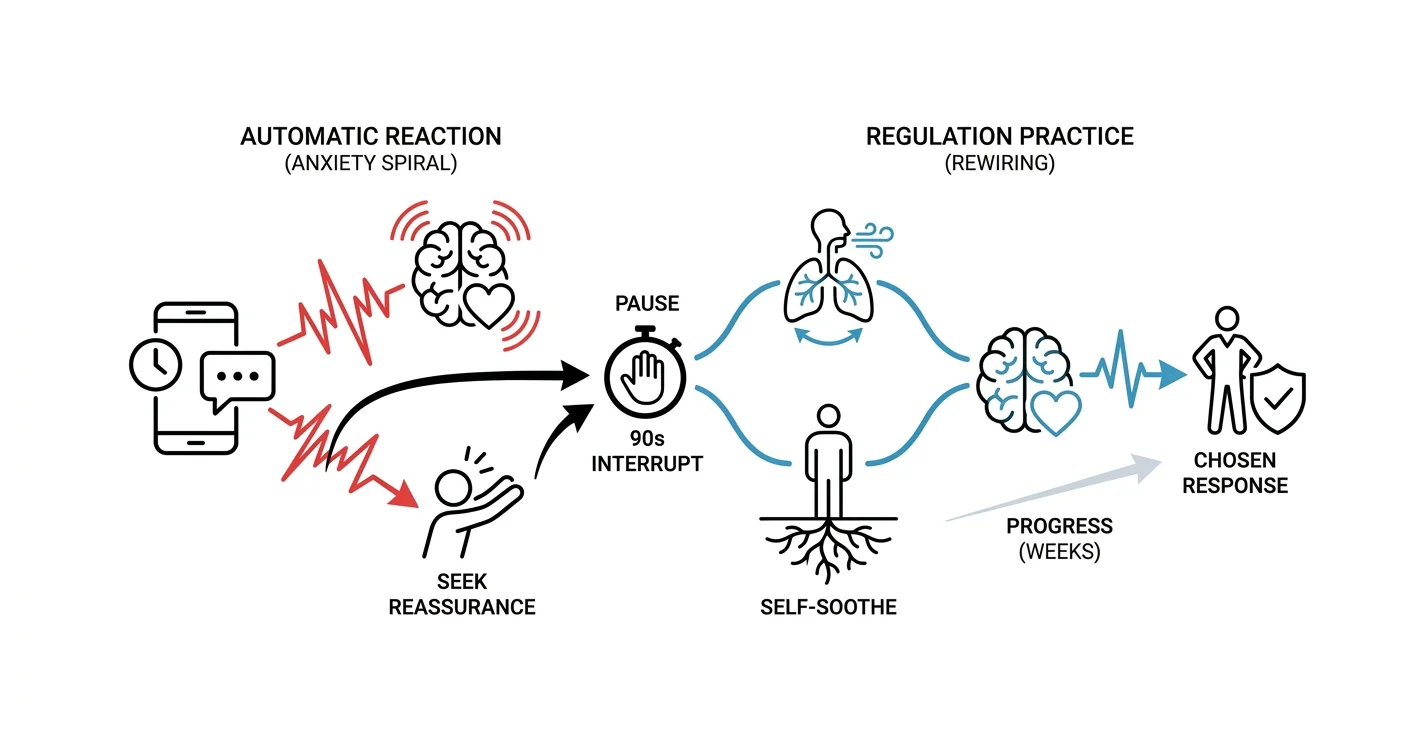
The anxious attachment cycle runs on speed — trigger, spiral, reach out (or withdraw) within minutes. Interrupting that gap is the single highest-leverage move available to you. When you notice the trigger, set a 90-second timer before you send a text, check their location, or ask for reassurance.
Use the pause for one physical action: four-count inhale, six-count exhale, four rounds. This isn't about calming down completely — it's about buying enough time for your prefrontal cortex to come back online.
Common mistake: using the pause to rehearse what you'll say instead of actually regulating. The goal is nervous system reset, not scripting.
3. Do daily nervous system regulation work, not just crisis management
Anxious attachment is a dysregulated nervous system dressed up as a relationship problem. If you only regulate during a spike, you're always playing defense. A short daily practice — box breathing, progressive muscle relaxation, or a walk without your phone — lowers your baseline reactivity over weeks. Reviewing nervous system dysregulation signs and how to reset helps you spot when you're already outside your tolerance window before a trigger even hits.
Expected outcome: by week four of daily practice, most people report the spike height dropping even when the trigger frequency stays the same.
4. Separate the story from the evidence
Anxious attachment generates a story fast: "they're pulling away," "this is the beginning of the end." Before acting on the story, write down the actual evidence versus the interpretation. "They replied in four hours instead of one" is evidence. "They're losing interest" is a story your nervous system wrote to explain the discomfort.
Common mistake: treating the story as fact because it feels certain. Anxiety produces certainty, not accuracy.
5. Practice self-soothing that doesn't require another person
The core anxious attachment pattern is outsourcing regulation to someone else's reassurance. Rebuilding the ability to soothe yourself — a specific playlist, a cold-water splash, calling a friend who isn't the trigger source, a five-minute voice conversation with an AI tool built for this — breaks the dependency loop one rep at a time. This is where a lot of people get stuck solo, because the urge to seek reassurance from the actual person is strongest exactly when you need to practice not doing that.
6. Track patterns over weeks, not single incidents
One bad night doesn't tell you anything. A month of journaled triggers tells you almost everything — what time of day you're most reactive, which specific behaviors from others set you off, whether the spikes are shrinking. Review your notes weekly, not daily; daily review during an active trigger just feeds the spiral.
7. Set one small boundary and hold it for a week
Anxious attachment often comes paired with difficulty asserting needs for fear of pushing someone away. Pick one low-stakes boundary — not responding to texts after 9pm, taking a day before discussing a conflict — and hold it for seven days straight. Small, held boundaries build the evidence that you can tolerate discomfort without the relationship collapsing.
Common mistake: picking a boundary so big it triggers immediate anxiety and gets abandoned within 48 hours. Start smaller than feels necessary.
If holding one small boundary for seven straight days feels impossible, the boundary was too big for week one.
Troubleshooting
Problem: You did the pause but still sent the anxious text. Fix: Don't discard the whole method. Note what the trigger was and how long you lasted before breaking. Progress is measured in seconds gained over time, not perfect restraint on attempt one.
Problem: The anxiety is worse after two weeks of "working on it." Fix: This is common and usually means you're becoming aware of a pattern that used to run silently. Awareness feels worse before it feels better. Keep the daily regulation practice; don't add new techniques on top of existing discomfort.
Problem: You can identify the trigger but can't stop the spiral once it starts. Fix: You're trying to intervene too late. Move your intervention point earlier — to the moment you notice the urge to check their phone activity, not the moment you're already three scenarios deep.
Problem: Your partner (or ex) is avoidant, and every cycle of your anxious attachment gets fed by their withdrawal. Fix: The anxious attachment and love avoidant push-pull cycle is its own pattern with its own mechanics — solo healing work matters here, but recognizing the cycle you're both in changes what "progress" actually looks like.
Problem: You feel like you're doing all this work alone with nowhere to process it in real time. Fix: This is the specific gap AI voice therapy tools were built to fill. Talking through a spiral out loud, at 11pm, with something that responds in real time, isn't the same as a licensed therapy session — but it's not nothing either.
Tools and resources
- A journal, physical or digital, dedicated only to trigger tracking
- An AI relationship coach for anxious attachment for real-time processing between therapy sessions or on nights when nothing else is available
- A grounding technique you've practiced enough times that you don't have to think to use it
- A trusted person outside the anxious-attachment relationship who can reality-check your stories when you can't
Lovon's voice-based sessions are built for exactly the moment described above — the spiral that hits when no therapist is reachable and the urge to text is climbing. It's not a clinician and doesn't claim to be one, but it's available at 2am, which a scheduled appointment isn't.
FAQ
Can you heal anxious attachment without a therapist?
Yes, self-directed work on triggers, nervous system regulation, and boundary-setting produces real change, though it's slower and easier to derail without outside feedback. Many people combine solo work with periodic professional support rather than choosing one or the other.
How long does it take to heal anxious attachment on your own?
Most people notice reduced spike intensity within 8 to 12 weeks of consistent daily practice in 2026-era attachment work, though full pattern change often takes longer. Consistency matters more than intensity.
What triggers anxious attachment the most?
Delayed responses, perceived withdrawal, and ambiguity about where a relationship stands are the most common triggers. The specific trigger varies by person, which is why tracking your own pattern matters more than a general list.
Is anxious attachment the same as being needy?
No, anxious attachment is a nervous system response rooted in past experience, not a character trait. The behaviors can look similar from the outside, but the underlying driver and the fix are different.
Can anxious attachment become secure attachment?
Yes, attachment styles are not fixed for life and shift with consistent new experiences and self-regulation work. This shift is sometimes called earned security.
Does anxious attachment get worse with an avoidant partner?
Yes, the anxious-avoidant push-pull cycle tends to amplify both patterns because each partner's coping strategy triggers the other's core fear. Breaking the cycle usually requires both people to recognize it.
What's the fastest way to calm an anxious attachment trigger in the moment?
A 90-second pause paired with slow breathing before you act on the urge to seek reassurance is the fastest reliable interrupt. It doesn't remove the anxiety but stops the reactive behavior that usually follows it.
Can an AI app help with anxious attachment?
AI voice therapy tools can provide real-time processing and coping support between sessions, which helps with the immediate spiral, but they don't replace licensed clinical treatment for deeper attachment work.
One last thing
The hardest part of healing anxious attachment solo isn't the technique — it's that progress doesn't feel like relief at first. It feels like discomfort you're finally sitting with instead of discharging through a text or a scroll through their profile. If week three of this feels harder than week one, that's usually the sign it's working, not the sign to quit.
Related guides
How AI Support Helps You Heal
AI emotional support isn't about replacing human connection — it's about filling the gaps. The moments when you need to talk at 2 AM, when you don't want to burden your friends again, or when you simply need someone to listen without judgment.
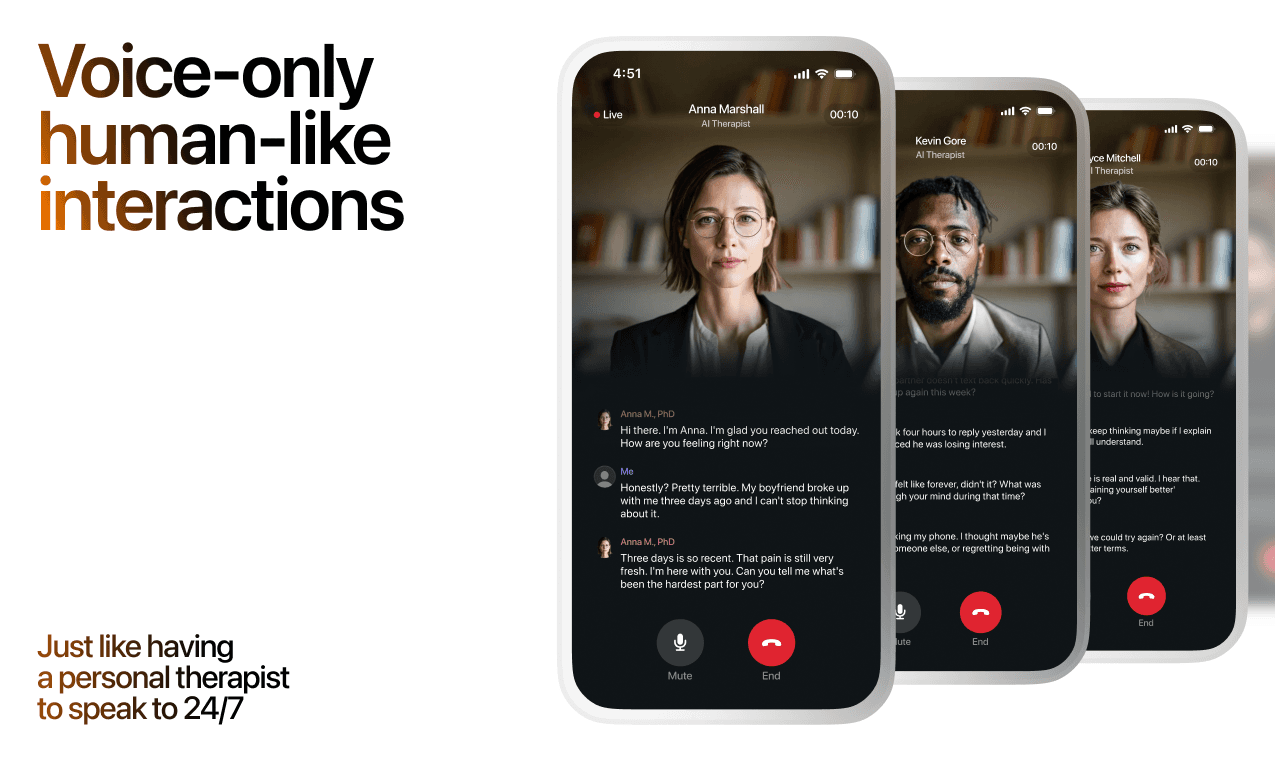
Here's what happens in a typical Lovon session:
You share what's on your mind
There's no script, no intake form, no waiting room. You speak or type whatever you're feeling — in your own words, at your own pace.
Lovon validates and explores
Using frameworks from CBT (Cognitive Behavioral Therapy) and motivational interviewing, Lovon acknowledges your feelings first, then gently helps you explore them. No dismissive "just move on" advice.
You build coping skills together
Lovon doesn't just listen — it actively works with you on evidence-based techniques: thought reframing, urge surfing, behavioral experiments, and more.
What a Session with Lovon Looks Like
Lovon is AI support, not a replacement for professional care. If things have been hard to get through for weeks, or you are thinking about harming yourself, talk to a doctor or a licensed therapist.
Ready to Start?
Your healing journey can begin right now
A 7-day trial. No judgment. Just a safe space to process what you're going through.
Frequently Asked Questions
Is Lovon a replacement for a real therapist?
Is my conversation with Lovon AI private?
How is Lovon different from ChatGPT for emotional support?
Can I use Lovon if I'm already seeing a therapist?
Can I try Lovon before subscribing?
About the Author
The Lovon Editorial Team
Mental Health & Wellness Content Team
The Lovon Editorial Team develops mental health and wellness content designed to make psychological concepts accessible and actionable. Our goal is to bridge the gap between clinical research and everyday life - helping you understand why your mind works the way it does and what you can do about it....
Related articles
- Best AI Relationship Coach for Avoidant Attachment 2026
Find the best AI relationship coach for avoidant attachment in 2026. Lovon's voice app gives on-demand coaching, coping…
- Anxious Preoccupied Attachment: Signs & How to Shift 2026
Anxious preoccupied attachment drives protest behavior like over-texting and reassurance-seeking. Get the signs and a…
- How to Manage Relationship Anxiety Day to Day (2026)
Learn how to manage relationship anxiety day to day with 7 practical steps, troubleshooting fixes, and tools that work…
- Secure Attachment Style: How to Build It in 2026
Learn the traits of a secure attachment style and the exact steps to build one in 2026 — regulation, repair, and direct…
See also
Quizzes
- What's My Attachment Style? Free 12-Question Quiz
Find your attachment pattern in 3 minutes.
- Emotional Availability Test: Am I Emotionally Unavailable?
See which part of you closes off, in three minutes.
Free tools
- What Did They Actually Mean By That?
A chat for one sentence you cannot stop re-reading. Paste their exact words and what was happening around them, and get…
- How to Reassure Your Partner (and When It Stops Helping)
A chat for working out how to reassure your partner when the same worry keeps coming back. Say what sets it off and how…
From the wiki
- What does clingy mean in a relationship?
Clingy is what people call behavior that asks for more contact or reassurance than the other person wants to give…
Disclaimer: This article is for informational purposes only and does not constitute medical advice, diagnosis, or treatment. Always seek the advice of your physician or other qualified health provider with any questions you may have regarding a medical condition. If you are in crisis or think you may have an emergency, call 988 (Suicide & Crisis Lifeline) or go to the nearest emergency room. Outside the US? Find a crisis line in your country.