
Relationship OCD: Signs & How to Break the Loop (2026)
Relationship OCD signs explained plus a step-by-step process to break the doubt loop in 2026 — delay techniques, exposure practice, and when to get support.

Key Takeaways
- A notebook or notes app for tracking the loop (paper works better than your phone for this)
- 10 to 15 minutes a day, ideally the same time, for the exercises below
- A short list of your usual triggers (a specific look, a memory, a comparison to an ex)
- One person you trust for accountability — a partner, friend, or therapist who won't just answer the reassurance question
- Willingness to sit with discomfort for a set number of minutes without resolving it (this is the actual mechanism of
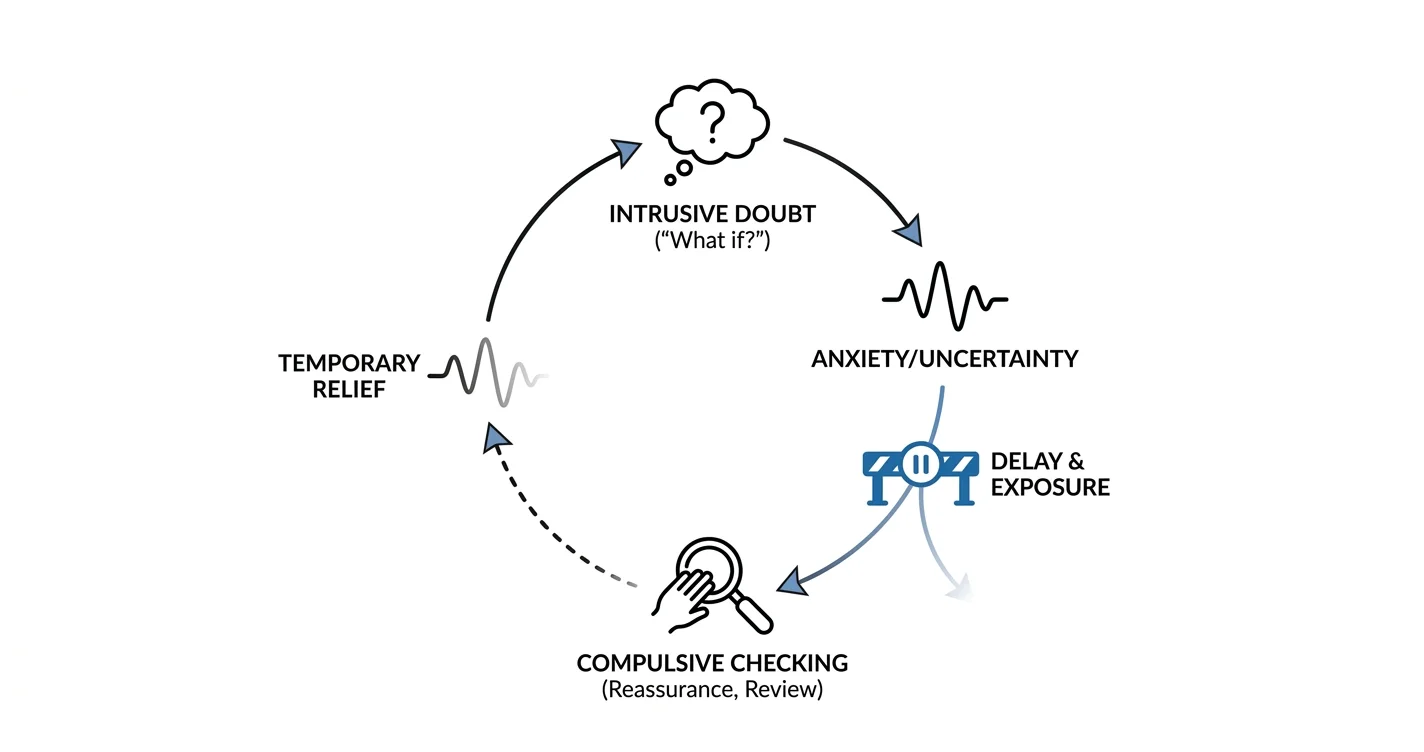
Relationship OCD (ROCD) turns love into a courtroom where you're both the prosecutor and the accused, running the same questions on a loop: Do I really love them? What if I'm settling? What if this feeling I just had means something's wrong? This guide walks through the signs, then gives you a concrete process for breaking the doubt loop instead of just white-knuckling through it.
TL;DR
Relationship OCD is a subtype of obsessive-compulsive disorder where the obsession attaches to your relationship instead of contamination, order, or harm. The loop runs on two fuels: intrusive doubts ("what if I don't love them enough") and compulsions (mental checking, reassurance-seeking, comparing your partner to others). The fix isn't more certainty — certainty is the trap. Verdict: relationship OCD responds well to delayed response, exposure-based practice, and structured self-monitoring, and if the loop won't break on its own, talking it through with a licensed therapist or an on-demand tool like Lovon between sessions is the next reasonable step, not a last resort.
Why this matters
Most people with relationship OCD spend years thinking they have a bad relationship, a wrong partner, or a broken "gut feeling." They don't. They have a thought pattern that would attach to any relationship, because the disorder isn't about the partner — it's about intolerance of uncertainty. Left alone, the loop erodes intimacy fast: partners feel interrogated, the person with ROCD feels crazy for asking, and both sides start avoiding the topic that actually needs addressing. Recognizing relationship anxiety as a pattern, not a verdict on the relationship, is the first move that actually changes anything in 2026 or any other year.
What you'll need
- A notebook or notes app for tracking the loop (paper works better than your phone for this)
- 10 to 15 minutes a day, ideally the same time, for the exercises below
- A short list of your usual triggers (a specific look, a memory, a comparison to an ex)
- One person you trust for accountability — a partner, friend, or therapist who won't just answer the reassurance question
- Willingness to sit with discomfort for a set number of minutes without resolving it (this is the actual mechanism of change)
The steps
1. Name the loop out loud
Write down the exact intrusive thought the next time it hits — not a paraphrase, the exact wording. Relationship OCD thoughts tend to repeat almost verbatim: "What if I don't feel the spark anymore," "What if they're not attractive enough," "What if I'm only with them out of fear." Naming it converts a vague dread into a specific, trackable event, which is the first step in any exposure-based approach. Common mistake: people try to argue with the thought instead of just logging it, which keeps the compulsive checking cycle running.
2. Delay the compulsion by a fixed interval
When the urge to check, ask, compare, or mentally review hits, set a timer for 10 minutes before you act on it. This isn't willpower — it's retraining your brain that the urge passes without the compulsion. Over two to three weeks, most people can stretch the delay to 30 or 60 minutes. Expected outcome: the urge intensity drops noticeably by day 10 to 14 if you're consistent. Common mistake: delaying once and then giving in "just this time," which resets the loop to full strength.
3. Practice sitting with the uncertainty
Instead of resolving the doubt, sit with the sentence "I don't know, and I'm not going to find out right now" for 90 seconds, timed. This is the exposure part of exposure-response prevention, the gold-standard structure for OCD subtypes. It feels unbearable for the first week and noticeably easier by the second. Common mistake: quietly answering the question in your head while pretending you're "sitting with it" — that's still a compulsion, just an invisible one.
4. Catch and relabel the distortion
Relationship OCD thoughts almost always ride on a distortion — all-or-nothing thinking ("if I ever doubt, it means I don't love them"), or worst-case jumps ("one weird feeling means the relationship is doomed"). When you catch one, relabel it on paper: "this is [name of distortion], not fact." This is the same mechanism used for catastrophizing, and it works on ROCD doubts the same way it works on worst-case health fears. Expected outcome: within 2 to 3 weeks, the relabeling gets faster and more automatic. Common mistake: relabeling once and expecting the thought to stop returning — it will return, that's not failure, that's OCD.
5. Rebuild self-trust with a daily check-in, not a reassurance-seeking one
Each evening, write one line answering "Did I act like someone who cares about this relationship today?" instead of "Do I feel in love today?" Feelings fluctuate hour to hour in every relationship, including ones with zero OCD involved — actions are the more stable data point. Do this for 21 days straight before judging whether it's working. Common mistake: asking your partner to confirm the answer, which just outsources the compulsion to them.
6. Get outside support when the loop won't break on its own
If after 4 to 6 weeks of consistent practice the compulsions haven't loosened, or if the doubts are affecting sleep, appetite, or work, that's the signal to bring in a licensed therapist trained in ERP for OCD. Between sessions, or on nights the spiral hits at 1 a.m., talking it through out loud with an AI voice tool like Lovon can help you interrupt the loop in the moment instead of letting it run unchecked until your next appointment. Expected outcome: most people notice the loop's grip loosens within a few sessions of structured ERP work. Common mistake: waiting until the relationship is in crisis before asking for help — earlier intervention is consistently easier than later intervention.
Troubleshooting
- The doubts get worse right after a good day together. This is common — a good moment raises the emotional stakes, so the brain compensates by generating a doubt to "check" the feeling. Log it and move to step 2.
- My partner is starting to get frustrated with the questions. Tell them directly you're working on a compulsion, not asking for their opinion. Reassurance from them keeps the loop alive even when it's well-intentioned.
- I can't tell if this is OCD or a real red flag. Real concerns are usually specific and situational (a broken promise, a pattern of dishonesty); ROCD doubts are usually vague, repetitive, and detached from any actual event. If you're unsure whether this is anxiety-driven checking or a personality-level pattern, the comparison in OCPD vs OCD is worth reading.
- I did the delay technique and the urge just came back stronger. That's expected in the first 5 to 7 days. The curve bends down after that if you keep the interval consistent instead of shortening it out of frustration.
- I feel like I'm losing the relationship over my own thoughts. That grief is real and worth naming to a therapist directly — it's one of the more painful parts of ROCD and it usually eases once the compulsions quiet down.
Tools and resources
- A physical notebook, kept separate from your phone, for logging intrusive thoughts without the temptation to search or check anything digitally
- A licensed therapist trained specifically in ERP (exposure and response prevention) — not all general therapists use this method
- Lovon, for a voice conversation when a doubt spiral hits outside therapy hours and you need to talk it through before you act on a compulsion
- A simple timer app for the delay-interval exercises in steps 2 and 3
What to do next
Once the doubt-checking slows down, the next skill worth building is catching the obsessive pull before it turns into a full spiral — the deeper mechanics of that are covered in how to stop obsessing over someone, which walks through the same exposure logic applied to fixation more broadly.
FAQ
What is relationship OCD? Relationship OCD is a subtype of OCD where the obsessions attach to a relationship instead of contamination or harm — doubting your feelings, your partner's suitability, or the "rightness" of the relationship on a repeating loop.
Is relationship OCD the same as normal relationship doubt? No. Normal doubt is occasional, tied to specific events, and resolves on its own; relationship OCD is repetitive, detached from real events, and drives compulsive checking or reassurance-seeking that never actually settles anything.
Can relationship OCD ruin a good relationship? It can strain one if the compulsions go unaddressed for years, mainly through constant reassurance-seeking that exhausts a partner — but the disorder is treatable and the relationship itself is usually not the problem.
How long does it take to break the doubt loop? Most people using delay techniques and exposure practice notice the urge intensity drop within 10 to 14 days, with more durable change over 4 to 6 weeks of consistent practice.
Do I need a diagnosis to start working on this? No. You can start the delay and exposure practices in this guide immediately; a formal diagnosis matters more if you're pursuing therapy specifically for OCD treatment.
Is asking my partner for reassurance ever okay? Occasionally, yes — but if you're asking daily or multiple times a day, that's a compulsion, not communication, and it needs the same delay technique as any other checking behavior.
Can an AI tool like Lovon treat relationship OCD? No — Lovon is not a licensed clinician and doesn't diagnose or treat OCD; it's built for on-demand emotional support between or alongside professional care, which matters most for late-night spirals when a therapist isn't reachable.
What's the difference between relationship OCD and anxious attachment? Anxious attachment is a relational pattern rooted in fear of abandonment; relationship OCD is a clinical obsessive-compulsive pattern that can occur with any attachment style, though the two often overlap and get confused for each other.
One last thing
The compulsion that feels the most "logical" — mentally reviewing your relationship history to find the moment you knew for sure — is usually the hardest one to spot, because it doesn't look like checking, it looks like thinking. If you notice yourself replaying old memories to "prove" the relationship is right, that's the same loop as reassurance-seeking, just quieter, and it responds to the same 90-second sit-with-it practice in step 3.
How AI Support Helps You Heal
AI emotional support isn't about replacing human connection — it's about filling the gaps. The moments when you need to talk at 2 AM, when you don't want to burden your friends again, or when you simply need someone to listen without judgment.
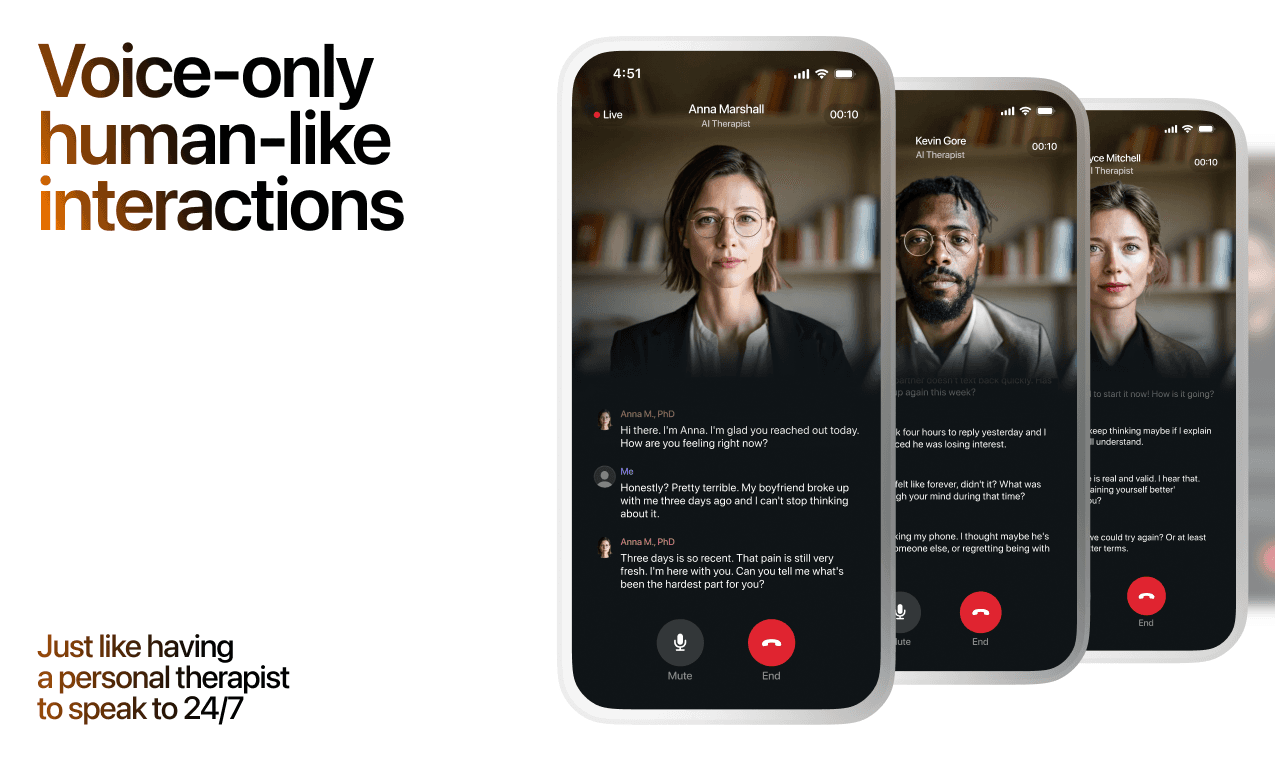
Here's what happens in a typical Lovon session:
You share what's on your mind
There's no script, no intake form, no waiting room. You speak or type whatever you're feeling — in your own words, at your own pace.
Lovon validates and explores
Using frameworks from CBT (Cognitive Behavioral Therapy) and motivational interviewing, Lovon acknowledges your feelings first, then gently helps you explore them. No dismissive "just move on" advice.
You build coping skills together
Lovon doesn't just listen — it actively works with you on evidence-based techniques: thought reframing, urge surfing, behavioral experiments, and more.
What a Session with Lovon Looks Like
Lovon is AI support, not a replacement for professional care. If things have been hard to get through for weeks, or you are thinking about harming yourself, talk to a doctor or a licensed therapist.
Ready to Start?
Your healing journey can begin right now
A 7-day trial. No judgment. Just a safe space to process what you're going through.
Frequently Asked Questions
Is Lovon a replacement for a real therapist?
Is my conversation with Lovon AI private?
How is Lovon different from ChatGPT for emotional support?
Can I use Lovon if I'm already seeing a therapist?
Can I try Lovon before subscribing?
About the Author
The Lovon Editorial Team
Mental Health & Wellness Content Team
The Lovon Editorial Team develops mental health and wellness content designed to make psychological concepts accessible and actionable. Our goal is to bridge the gap between clinical research and everyday life - helping you understand why your mind works the way it does and what you can do about it....
Related articles
- Why Do I Push People Away? 2026 Fix Guide
Why do I push people away, answered with steps that work in 2026: name the urge, pause 90 seconds, repair fast. Fearful…
- Catastrophizing About Relationship: How to Stop in 2026
Catastrophizing about your relationship? Get 7 steps to break the spiral in 2026, spot the thinking traps behind it, and…
- Self-Abandonment: What It Is and How to Stop It in 2026
Self-abandonment means ignoring your own needs to keep the peace. Learn the 2026 signs, six concrete steps to stop it…
- How to Manage Relationship Anxiety Day to Day (2026)
Learn how to manage relationship anxiety day to day with 7 practical steps, troubleshooting fixes, and tools that work…
See also
Quizzes
- Am I Codependent? 12-Question Self-Check
See how much of you is left over, in 2 minutes.
- Insecurity Test: Am I Insecure? Free 12-Question Quiz
See what your insecurity actually runs on, in 3 minutes.
Free tools
- Breakup Message Writer
A chat for saying it once. Tell it how long it has been and why now, and get a message you could actually send, plus the…
- How to Tell Someone You Love Them
How to tell someone you love them is rarely about the words, which are short. It is about the moment and the answer…
From the wiki
- What is an attachment style?
An attachment style is the habit your nervous system formed for handling closeness: what you actually do when someone…
Disclaimer: This article is for informational purposes only and does not constitute medical advice, diagnosis, or treatment. Always seek the advice of your physician or other qualified health provider with any questions you may have regarding a medical condition. If you are in crisis or think you may have an emergency, call 988 (Suicide & Crisis Lifeline) or go to the nearest emergency room. Outside the US? Find a crisis line in your country.