
Catastrophizing About Relationship: How to Stop in 2026
Catastrophizing about your relationship? Get 7 steps to break the spiral in 2026, spot the thinking traps behind it, and calm your mind before panic wins.
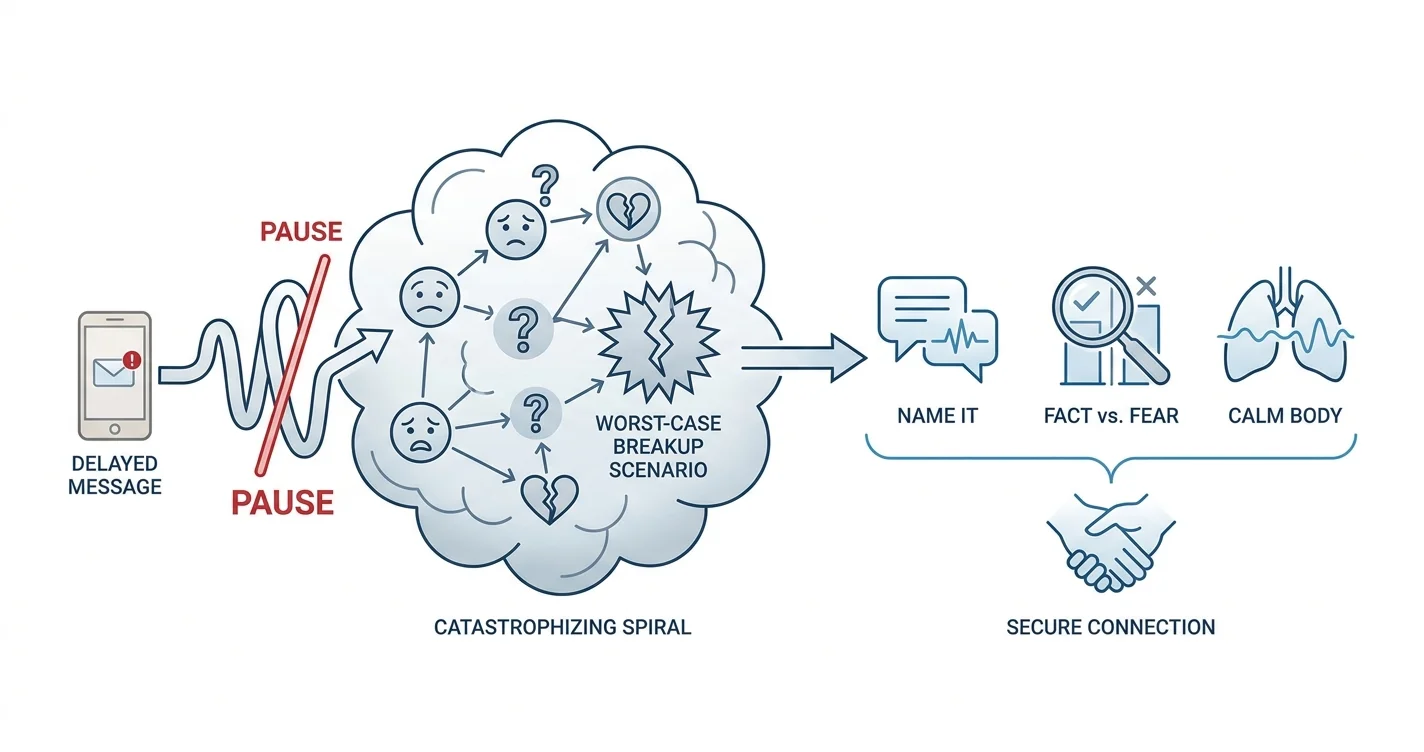

Key Takeaways
- Catastrophizing about relationship turns a delayed text into a breakup script within minutes.
- Name the spiral out loud within the first 60 seconds — labeling cuts its grip fast.
- Cognitive distortions like mind-reading and fortune-telling drive most relationship catastrophizing in 2026.
- A 90-second grounding technique settles your body before your thoughts can settle.
- Lovon's AI voice therapy lets you talk through the spiral the moment it starts, not days later.
Your mind jumps to the worst case the second your partner takes too long to text back, and by the time they call, you've already rehearsed the breakup. Catastrophizing about your relationship turns small, ordinary friction into a five-alarm crisis before any evidence backs it up.
TL;DR
- Catastrophizing about relationship turns a delayed text into a breakup script within minutes.
- Name the spiral out loud within the first 60 seconds — labeling cuts its grip fast.
- Cognitive distortions like mind-reading and fortune-telling drive most relationship catastrophizing in 2026.
- A 90-second grounding technique settles your body before your thoughts can settle.
- Lovon's AI voice therapy lets you talk through the spiral the moment it starts, not days later.
Why this matters
Catastrophizing isn't a character flaw — it's a thinking pattern your brain defaults to when it's trying to protect you from getting hurt again. The trouble is that the protection backfires: you argue with a partner who hasn't done anything yet, or you spend an evening grieving a relationship that's still intact.
This pattern shows up constantly in relationship anxiety, where a single unanswered text triggers a full narrative about abandonment. Left unchecked into 2026, that narrative repeats itself daily, and each repetition makes it feel more true, even though nothing about the relationship changed.
The fix isn't to stop caring about the relationship. It's to catch the spiral early, check it against reality, and give your nervous system something calmer to do instead.
What you'll need
- 5-10 quiet minutes when the spiral starts, not after it's already run its course
- A notes app or small notebook to write down the thought versus the fact
- One grounding technique you already know, or one you'll learn below
- Honest access to what actually happened, not what you fear happened
- Optionally, a voice conversation tool like Lovon to talk the thought out loud instead of looping it silently
The steps
1. Name the spiral the moment it starts
Catastrophizing loses power the second you label it. Say, out loud or in your head, "this is catastrophizing" as soon as you notice your thoughts jumping from "they're late" to "they're leaving me."
This works because naming a thought moves activity from the reactive part of your brain to the part that can reason. Do it within the first minute if you can — the longer the spiral runs unnamed, the harder it is to interrupt.
Common mistake: waiting until you're already three scenarios deep before you try to name it. By then your body has already reacted as if the worst case is real.
2. Separate the fact from the fear
Write two columns: what actually happened, and what you're afraid it means. "They didn't text back in 3 hours" is a fact. "They're losing interest" is a fear.
This step works because catastrophizing about relationship dynamics almost always involves a cognitive distortion — mind-reading, fortune-telling, or all-or-nothing thinking. A closer look at cognitive distortions shows these patterns are common and treatable, not evidence that something is actually wrong.
Expected outcome: your fear column usually has zero direct evidence behind it. That gap is the whole point.
3. Run the 3-question reality check
Ask yourself: What's the evidence for this? What's the evidence against it? What would I tell a friend in this exact situation? Answer each one in a full sentence, not just a shrug.
This matters because catastrophizing thrives on vague dread. Specific questions force specific answers, and specific answers rarely support the worst-case story.
Common mistake: answering the questions with more fear instead of fact. "The evidence against it is that they've never done this before" is a fact. "The evidence against it is that I hope they still love me" is a feeling.
4. Calm your body before you calm your thoughts
Catastrophizing keeps your body in a low-grade fight-or-flight state, and thoughts don't settle while your body is still bracing for impact. Try a 90-second version of box breathing: inhale for 4 counts, hold for 4, exhale for 4, hold for 4, repeat six times.
This works because your nervous system responds to breath pace faster than it responds to logic. Once your heart rate drops, the reality check in step 3 actually sticks.
Expected outcome: a noticeably calmer chest and jaw within two minutes, even if the underlying worry hasn't fully resolved yet.
5. Delay contact by 20 minutes
Don't send the accusatory text the second the spiral peaks. Set a 20-minute timer and revisit the message before sending it.
This matters because catastrophizing produces urgency that isn't real — the situation rarely requires an immediate confrontation. Most people who wait 20 minutes end up rewriting or deleting the message entirely.
Common mistake: using the 20 minutes to keep spiraling instead of grounding. The delay only works if you pair it with step 4.
6. Say the thought out loud to something outside your own head
Catastrophizing loops feed on repetition inside your own skull. Saying the thought out loud — to a friend, a journal, or a voice conversation with an AI therapist — interrupts the loop because you have to structure the thought into language instead of just feeling it.
This is where a tool like Lovon fits: it's built for exactly this moment, when the spiral hits at 11pm and no one else is awake. It won't replace a licensed clinician, but it gives you a place to talk the thought through in real time instead of sitting with it alone.
Talk through the spiral right now
Say the catastrophizing thought out loud instead of looping it silently.
7. Track the pattern for two weeks
Write down the date, the trigger, and how the situation actually resolved. After 2026's first few weeks of tracking, most people find the same 2-3 triggers repeat, and the actual outcome almost never matches the feared one.
This matters because catastrophizing feels different every time, but it's rarely different underneath. Once you see the pattern in writing, the next spiral is easier to catch in step 1.
Expected outcome: a short list of your specific triggers, which makes future spirals faster to interrupt.
Troubleshooting
The spiral hits at 2am and there's no one to talk to. This is the most common time for catastrophizing about relationship fears to peak, since your body is already tired and less able to regulate. A grounding technique paired with a voice conversation tool works better here than trying to reason your way out alone.
Your partner dismisses the worry once you bring it up. That reaction can make the catastrophizing worse, not better, because it reads as confirmation. Separate the fact of their dismissiveness from the fear that it means the relationship is ending — those are two different problems.
You can't tell if it's intuition or catastrophizing. Intuition is usually calm and specific. Catastrophizing is usually loud, vague, and tied to a physical sense of dread. If your chest is tight and your thoughts are jumping between five different worst cases, that's the spiral, not a signal.
The spiral comes back within hours of calming down. This usually means your window of tolerance is narrow right now — stress, poor sleep, or a recent conflict shrinks the amount of uncertainty you can hold before panic kicks in. Widening that window takes repeated practice, not one grounding session.
You've apologized for something you're not sure you did wrong. That's a sign the catastrophizing led to actual behavior change, which reinforces the pattern. Next time, run the reality check in step 3 before you apologize for anything.
Tools and resources
- A breathing app or a simple 4-4-4-4 count for box breathing
- A notes app for the fact-versus-fear column and the two-week trigger log
- Lovon's AI voice therapy for talking through a spiral the moment it starts
- A trusted friend or partner who can hear the fact column without adding fuel to the fear column
What to do next
Once you can catch the spiral early and separate fact from fear most of the time, the next skill is building the kind of secure, day-to-day communication that keeps small worries from turning into stories in the first place. If catastrophizing keeps circling back to the same one or two fears, that repetition is worth naming and tracking on its own — it's rarely random.
FAQ
What is catastrophizing about relationship problems?
Catastrophizing about a relationship is jumping from a small, ordinary event — a late text, a short reply — straight to a worst-case outcome like a breakup, without evidence supporting that leap. It's a cognitive distortion, not a fact-based prediction.
How do I know if I'm catastrophizing or if something is actually wrong?
Run the fact-versus-fear check from step 2: write what actually happened next to what you're afraid it means. If the fear column has no direct evidence behind it, you're likely catastrophizing rather than reacting to a real problem.
Is catastrophizing a sign of anxious attachment?
Catastrophizing shows up often with anxious attachment, since both involve scanning for signs of abandonment. It also appears in people with secure attachment during high-stress periods, so the pattern alone isn't a diagnosis.
How long does it take to stop catastrophizing about a relationship?
Most people notice fewer full-blown spirals within 2-4 weeks of consistently naming the thought and running the reality check. Full pattern change, tracked through 2026, typically takes a few months of repeated practice.
Can an AI therapist help with relationship catastrophizing?
An AI voice therapy tool like Lovon gives you a place to talk through the spiral the moment it happens, which interrupts the silent-loop effect that makes catastrophizing worse. It's a support tool, not a replacement for a licensed clinician.
Why does catastrophizing get worse at night?
Fatigue narrows your window of tolerance, so your nervous system has less capacity to sit with uncertainty. That's why the same worry that felt manageable at noon can feel unbearable at midnight.
Should I tell my partner I'm catastrophizing?
Naming the pattern to your partner, once you've calmed your body first, usually helps more than hiding it. Saying "I'm spiraling and I know it, can we talk" is different from accusing them of something they haven't done.
What's the fastest way to stop a catastrophizing spiral in the moment?
Name the thought out loud, then run 90 seconds of box breathing before you respond to anything. The combination of labeling and slowing your breath interrupts the spiral faster than reasoning alone.
One last thing
The detail people miss most: catastrophizing rarely predicts anything. Track your triggers for two weeks in 2026 and you'll likely find the feared outcome showed up close to zero times, even though the dread felt identical every single time. That gap between how certain the fear feels and how rarely it's true is the actual proof the pattern is a thinking trap, not a warning system.
Related guides
How AI Support Helps You Heal
AI emotional support isn't about replacing human connection — it's about filling the gaps. The moments when you need to talk at 2 AM, when you don't want to burden your friends again, or when you simply need someone to listen without judgment.
Here's what happens in a typical Lovon session:
You share what's on your mind
There's no script, no intake form, no waiting room. You speak or type whatever you're feeling — in your own words, at your own pace.
Lovon validates and explores
Using frameworks from CBT (Cognitive Behavioral Therapy) and motivational interviewing, Lovon acknowledges your feelings first, then gently helps you explore them. No dismissive "just move on" advice.
You build coping skills together
Lovon doesn't just listen — it actively works with you on evidence-based techniques: thought reframing, urge surfing, behavioral experiments, and more.
What a Session with Lovon Looks Like

When to Seek Professional Help
AI support is a valuable tool, but it's not a replacement for professional care. Please consider reaching out to a licensed therapist if you experience any of the following:
- Persistent thoughts of self-harm or suicide
- Inability to perform daily activities (work, eating, sleeping) for more than 2 weeks
- Turning to alcohol or substances to cope
- Intense anger or desire to harm your ex-partner
- Complete emotional numbness that doesn't improve over time
Crisis Resources (US): If you're in immediate danger, call 988 (Suicide & Crisis Lifeline) or text HOME to 741741 (Crisis Text Line). Available 24/7, free, and confidential.
Outside the US? Find a crisis line in your country
Ready to Start?
Your healing journey can begin right now
1 free conversation. No credit card. No judgment. Just a safe space to process what you're going through.
Frequently Asked Questions
Is AI therapy a replacement for a real therapist?
Is my conversation with Lovon AI private?
How is Lovon different from ChatGPT for emotional support?
Can I use Lovon if I'm already seeing a therapist?
Can I try Lovon for free?
About the Author

The Lovon Editorial Team
Mental Health & Wellness Content Team
The Lovon Editorial Team develops mental health and wellness content designed to make psychological concepts accessible and actionable. Our goal is to bridge the gap between clinical research and everyday life - helping you understand why your mind works the way it does and what you can do about it....
Similar Articles
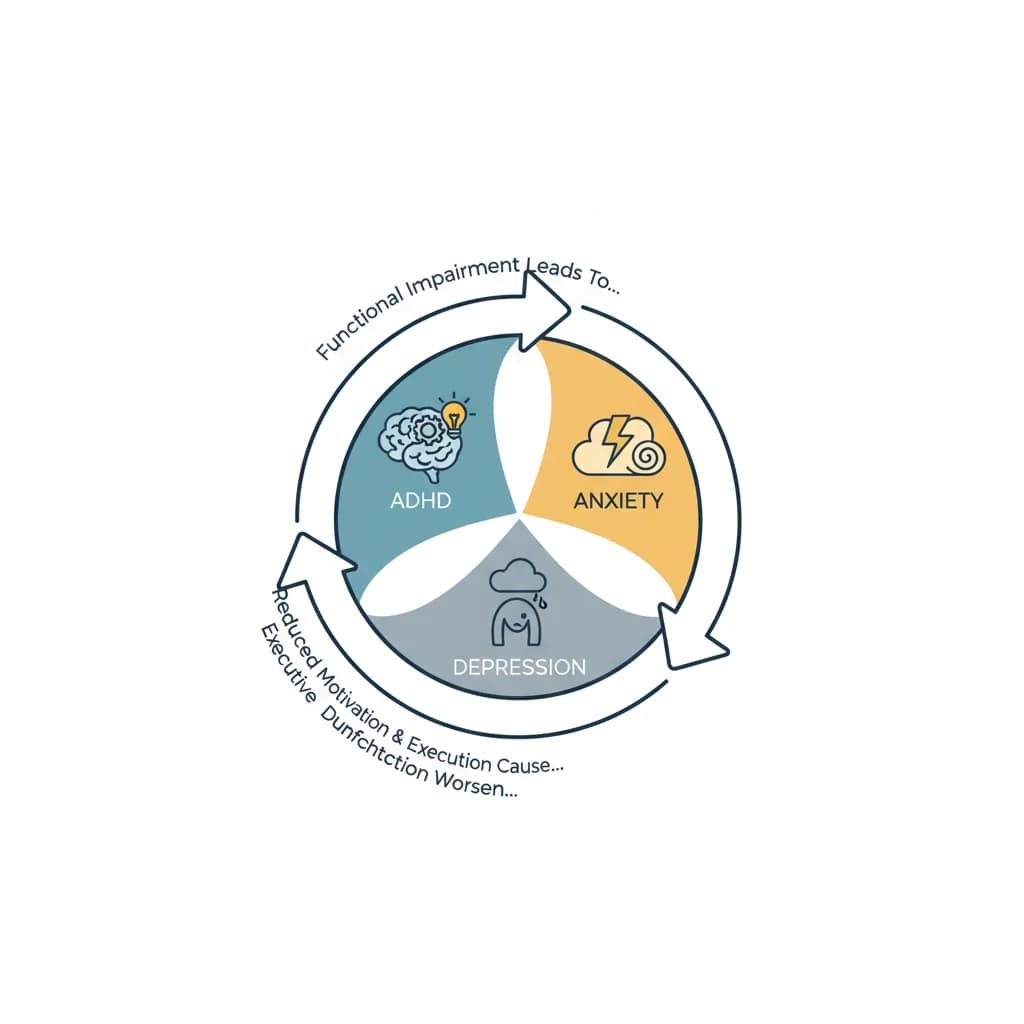
ADHD Comorbidity with Anxiety and Depression Cycles
Understanding the Complex Interplay Between ADHD and Recurring Mental Health Patterns

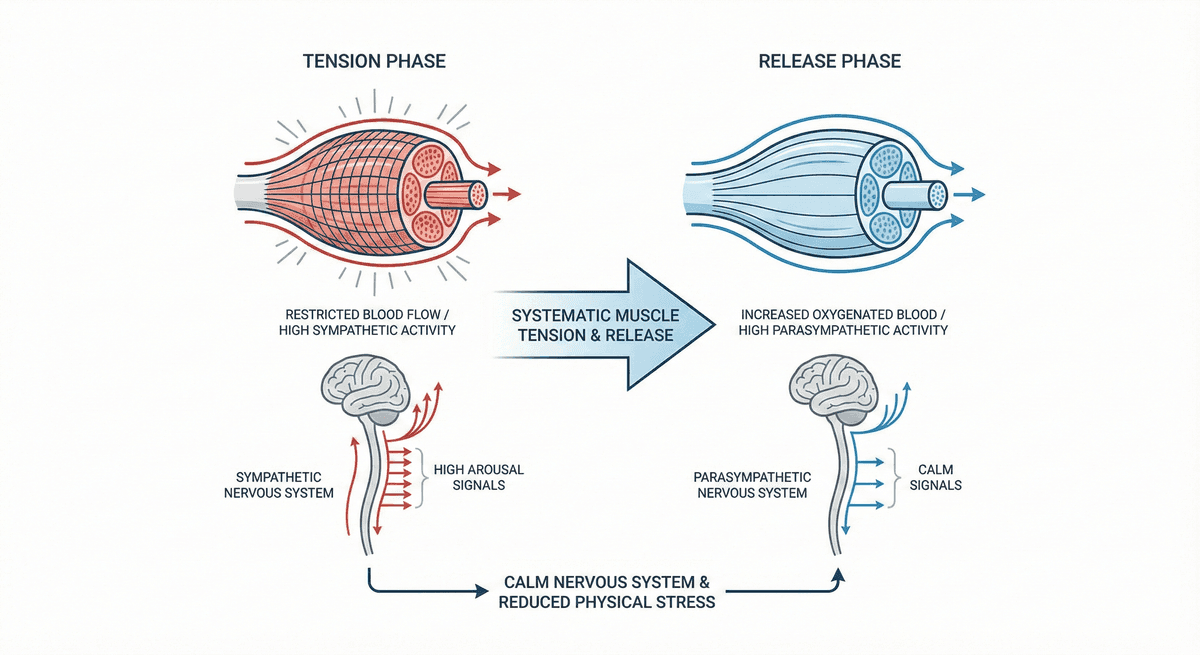
Progressive Muscle Relaxation for Stress Reduction
A systematic muscle group tension and release technique that calms the nervous system and reduces physical stress.
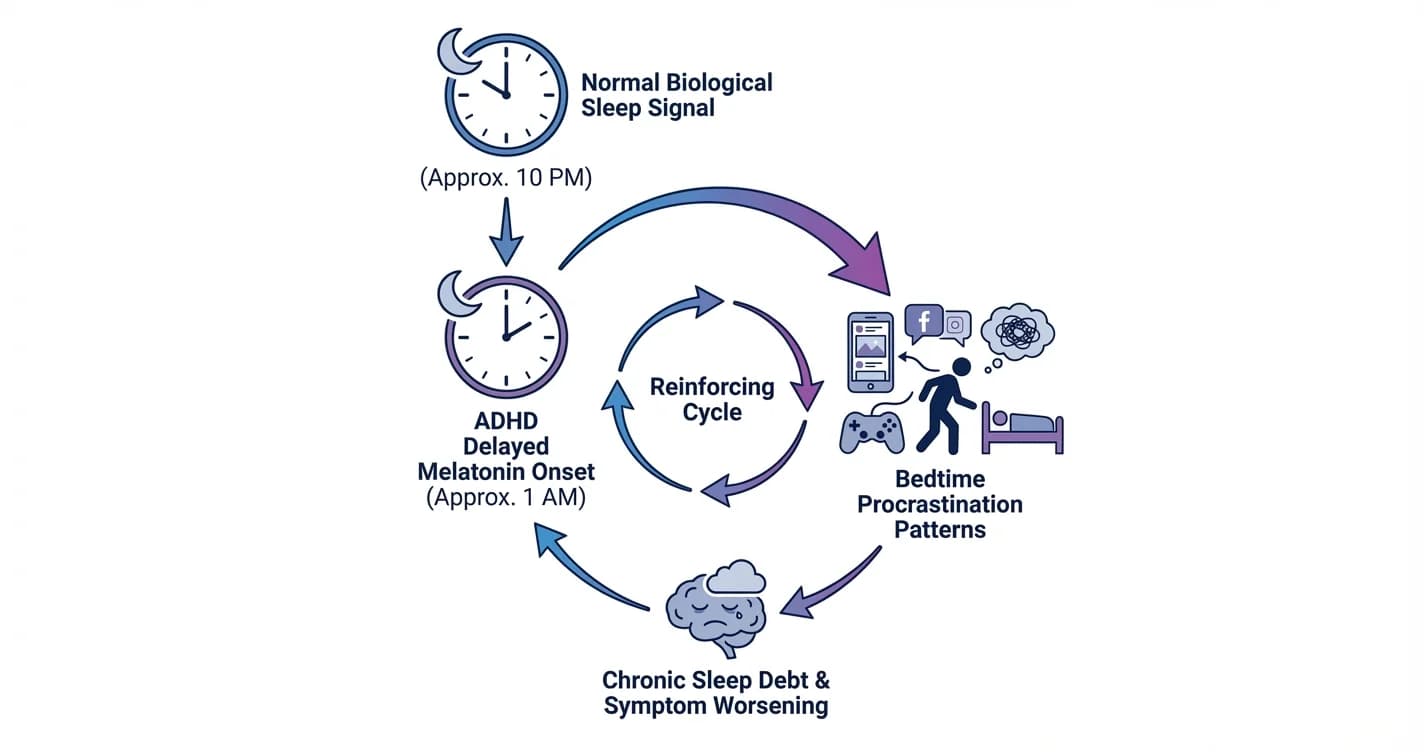
ADHD Sleep Cycle Disruption: Melatonin Delay and Bedtime Procrastination Patterns
Understanding how attention regulation difficulties interfere with natural sleep timing and the nightly wind-down process
Disclaimer: This article is for informational purposes only and does not constitute medical advice, diagnosis, or treatment. Always seek the advice of your physician or other qualified health provider with any questions you may have regarding a medical condition. If you are in crisis or think you may have an emergency, call 988 (Suicide & Crisis Lifeline) or go to the nearest emergency room. Outside the US? Find a crisis line in your country.