
Emotional Flashbacks: What They Are & How to Manage in 2026
Emotional flashbacks flood you with old feelings without warning. Learn the 2026 grounding steps that shorten them fast, verdict-backed and practical.

Key Takeaways
- Emotional flashbacks flood you with old feelings but no clear memory, which is why they feel so confusing in the moment.
- Naming the year, the room, and one body sensation out loud shortens most flashbacks within a minute.
- Pete Walker's 13 steps for managing emotional flashbacks remain the reference framework clinicians still teach in 2026.
- Lovon's AI voice therapy gives you a grounding partner between episodes — it does not replace trauma-focused treatment.
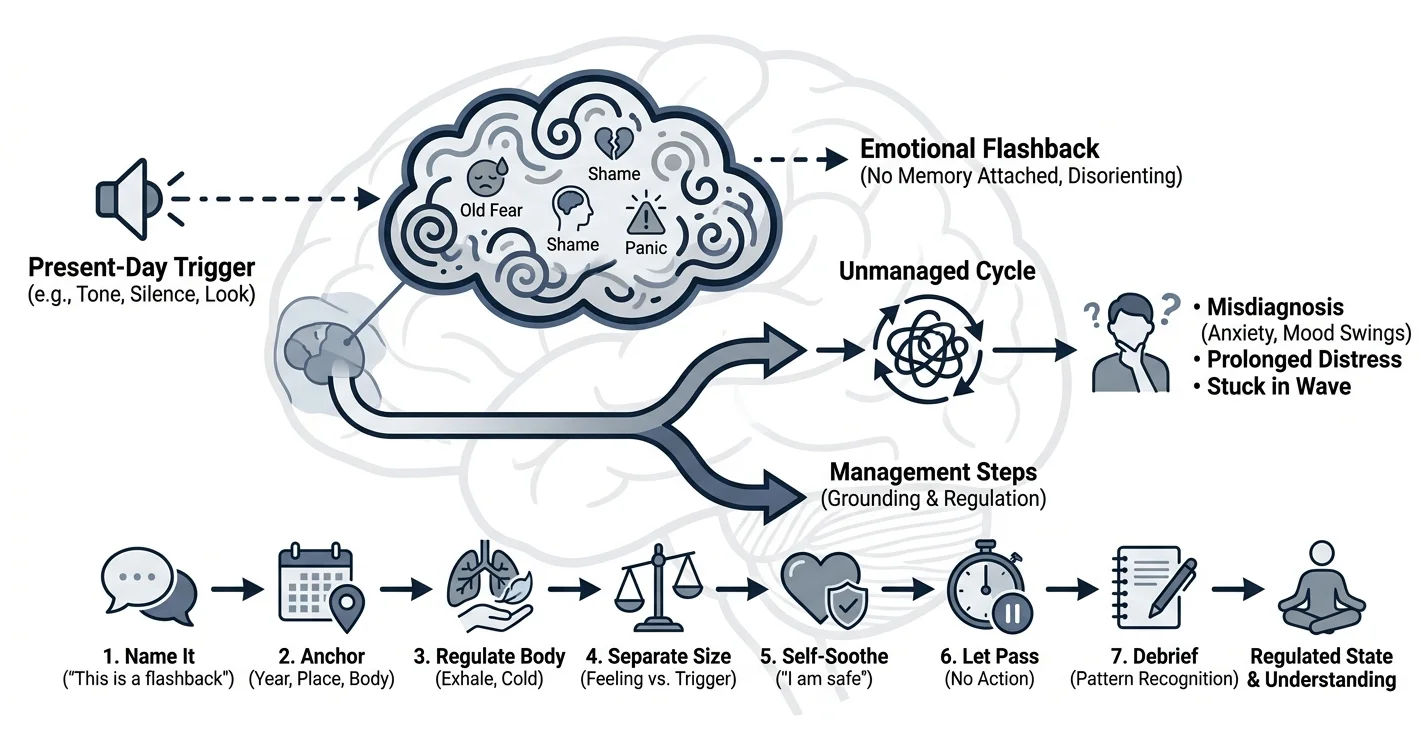
An emotional flashback drops you into old fear, shame, or panic with no memory attached to it, and most people spend years thinking something is wrong with them before they learn what's actually happening.
TL;DR
- Emotional flashbacks flood you with old feelings but no clear memory, which is why they feel so confusing in the moment.
- Naming the year, the room, and one body sensation out loud shortens most flashbacks within a minute.
- Pete Walker's 13 steps for managing emotional flashbacks remain the reference framework clinicians still teach in 2026.
- Lovon's AI voice support gives you a grounding partner between episodes — it does not replace trauma-focused treatment.
Why this matters
Emotional flashbacks are not the same as PTSD flashbacks with pictures and sound. There's no scene playing back — just a sudden wave of terror, worthlessness, or rage that feels exactly as real as it did the first time, usually because it started in childhood before you had words for what was happening to you.
The reason they're so disorienting is that your nervous system reacts to a present-day trigger — a tone of voice, a silence, a look — as if it were the original threat. Understanding your window of tolerance matters here: emotional flashbacks push you outside that window fast, and the goal of every technique below is getting you back inside it, not analyzing why the trigger happened.
Left unmanaged, emotional flashbacks in 2026 still get misdiagnosed as anxiety attacks or mood swings because the person having one often can't explain what triggered it. Recognizing the pattern is half the battle.
What you'll need
- A quiet-ish space for 60-90 seconds — a bathroom stall or parked car works
- One grounding anchor: a cold object, a scent, or a specific phrase you say to yourself
- A written list of your top 3 triggers, made when you're calm, not mid-episode
- Optional: a voice conversation tool like Lovon's AI voice support for talking through the aftermath once the acute wave passes
The steps
1. Name it as a flashback, not as reality
Saying "this is an emotional flashback" out loud or in your head interrupts the automatic belief that the danger is happening right now. This single sentence pulls a sliver of your prefrontal cortex back online. Skipping this step is the most common reason people stay stuck in the wave for 20+ minutes instead of 2.
Common mistake: trying to figure out the trigger before naming the state. Name first, analyze later.
2. Anchor to the current year and place
Say the year (2026), the day of the week, your age, and your physical location out loud. This is called orientation, and it directly counters the timeless quality emotional flashbacks create. Your brain, mid-flashback, genuinely doesn't know it's not 1998 anymore — you have to tell it.
Common mistake: doing this silently in your head when saying it out loud works faster because it engages more sensory pathways.
3. Regulate your body before your thoughts
An emotional flashback is a nervous system event first and a thought event second, which is why the amygdala's alarm response fires before you consciously register a threat. Press your feet flat on the floor, exhale for twice as long as you inhale, and hold something cold for 10 seconds. Understanding the amygdala hijack that's driving the reaction helps you stop arguing with your thoughts and go straight to the body instead.
Common mistake: trying to "think your way out" of a flashback. The thinking brain is offline until the body calms down.
4. Separate the feeling's size from the trigger's size
Once your breathing slows, ask: does this reaction match what actually just happened, or does it feel 10 times bigger? Emotional flashbacks routinely produce a reaction sized for the original childhood event, not the mild comment that triggered it today. Naming that gap out loud ("this feels like a 9, the situation is a 2") restores perspective without dismissing the pain.
Common mistake: deciding the feeling is "wrong" because it's oversized. It's not wrong — it's old.
5. Self-soothe instead of self-criticize
Inner critic voices spike hard during emotional flashbacks — "you're too sensitive," "you ruined this again." Counter with one compassionate sentence you've prepared in advance: "I'm having a flashback, and I'm safe right now." Repeating the same phrase every time builds a reliable off-ramp your brain learns to recognize.
Common mistake: using a generic affirmation that doesn't match your specific triggers. Personalize it.
6. Let the wave pass without acting on it
Most emotional flashbacks peak within 90 seconds to a few minutes if you don't feed them with catastrophic thinking or impulsive action — texting an ex, quitting a job, sending an angry message. Set a mental timer: "I will not decide anything for the next 10 minutes." Decisions made mid-flashback are rarely the ones you'd make from a regulated state.
Common mistake: apologizing for or explaining the reaction to others while you're still inside it. Wait until you're regulated.
7. Debrief once you're calm
After the wave passes, write down what triggered it, how big the reaction felt, and what actually helped. This is where talking it through — with a therapist, a trusted person, or a voice conversation on an app like Lovon — turns a single episode into pattern recognition you can use next time.
Common mistake: skipping the debrief because you feel embarrassed. The debrief is what makes the next flashback shorter.
Troubleshooting
- The flashback won't stop even after grounding: extend the exhale further — try a 4-count inhale, 8-count exhale — and add cold water on your wrists. Longer exhales signal safety to the nervous system faster than counting alone.
- You can't tell if it's a flashback or a real threat: ask if the intensity matches the actual event in front of you. A real threat usually has a clear, current cause; an emotional flashback often starts before you've fully identified why.
- You keep freezing instead of grounding: freezing is its own nervous system response, not a failure of technique — check the freeze response pattern if this happens more than occasionally.
- The flashback happens in front of other people: have a short phrase ready, like "I need a minute," instead of explaining in the moment. Full context can wait.
- You feel numb or checked out afterward instead of relieved: that's dissociation, a common aftermath of intense emotional flashbacks, and it usually settles with slow movement — walking, stretching — rather than sitting still.
- Flashbacks are increasing in frequency: rising frequency in 2026 often points to accumulated stress lowering your threshold; this is a signal to bring the pattern to a therapist rather than manage it solo indefinitely.
Tools and resources
- A written trigger list, reviewed monthly and updated as new patterns show up
- A grounding phrase you've rehearsed when calm, not invented mid-episode
- AI support for PTSD through Lovon's voice sessions, useful for talking through what happened once the acute wave passes
- A licensed therapist trained in Complex PTSD or trauma-focused CBT for the underlying pattern work an app can't replace
What to do next
One grounding technique won't dissolve years of conditioning, but tracking your triggers for 30 days will show you the shape of the pattern — most people find 2-3 recurring triggers account for the majority of their emotional flashbacks. If the episodes are frequent or intense, that's the signal to bring a licensed clinician into the picture rather than managing alone indefinitely.
FAQ
What are emotional flashbacks exactly?
Emotional flashbacks are sudden, intense waves of old feelings — fear, shame, worthlessness — triggered by a present-day event, without a visual memory attached. They're common in people with childhood trauma or Complex PTSD.
How long does an emotional flashback usually last?
Most emotional flashbacks peak within 90 seconds to a few minutes if grounding techniques are used right away. Without intervention, the wave can stretch to 20 minutes or longer.
Is an emotional flashback the same as a panic attack?
No, though they can feel similar. A panic attack is typically driven by physical symptoms and catastrophic fear of the moment, while an emotional flashback is triggered by something that echoes a past experience, even when you don't consciously recognize the connection.
What triggers emotional flashbacks the most?
Tone of voice, feeling criticized, being ignored, and conflict with someone close are among the most common triggers reported. The trigger is usually small compared to the size of the reaction it produces.
Can adults develop emotional flashbacks without a PTSD diagnosis?
Yes. Emotional flashbacks are strongly associated with Complex PTSD and childhood emotional neglect, and many people experience them without ever receiving a formal PTSD diagnosis.
Do grounding techniques actually work for emotional flashbacks?
Grounding techniques work by engaging the body and senses to signal safety to the nervous system, which shortens the flashback for most people. They work best when practiced regularly, not just pulled out during a crisis.
Should I talk to a therapist about emotional flashbacks?
Yes, especially if they're frequent, intense, or tied to childhood experiences you haven't processed. A therapist trained in trauma work can address the root pattern, not just the in-the-moment symptoms.
Can an AI app help with emotional flashbacks?
An AI voice support app like Lovon can help you debrief after a flashback and practice grounding language between sessions, but it is not a substitute for licensed trauma treatment.
One last thing
The detail most people miss: emotional flashbacks almost never come with an obvious cause attached, and searching for one mid-episode usually makes the wave worse, not better. The move that actually works is naming the state, grounding the body, and saving the analysis for after — every time, in that order.
Related guides
How AI Support Helps You Heal
AI emotional support isn't about replacing human connection — it's about filling the gaps. The moments when you need to talk at 2 AM, when you don't want to burden your friends again, or when you simply need someone to listen without judgment.
Here's what happens in a typical Lovon session:
You share what's on your mind
There's no script, no intake form, no waiting room. You speak or type whatever you're feeling — in your own words, at your own pace.
Lovon validates and explores
Using frameworks from CBT (Cognitive Behavioral Therapy) and motivational interviewing, Lovon acknowledges your feelings first, then gently helps you explore them. No dismissive "just move on" advice.
You build coping skills together
Lovon doesn't just listen — it actively works with you on evidence-based techniques: thought reframing, urge surfing, behavioral experiments, and more.
What a Session with Lovon Looks Like
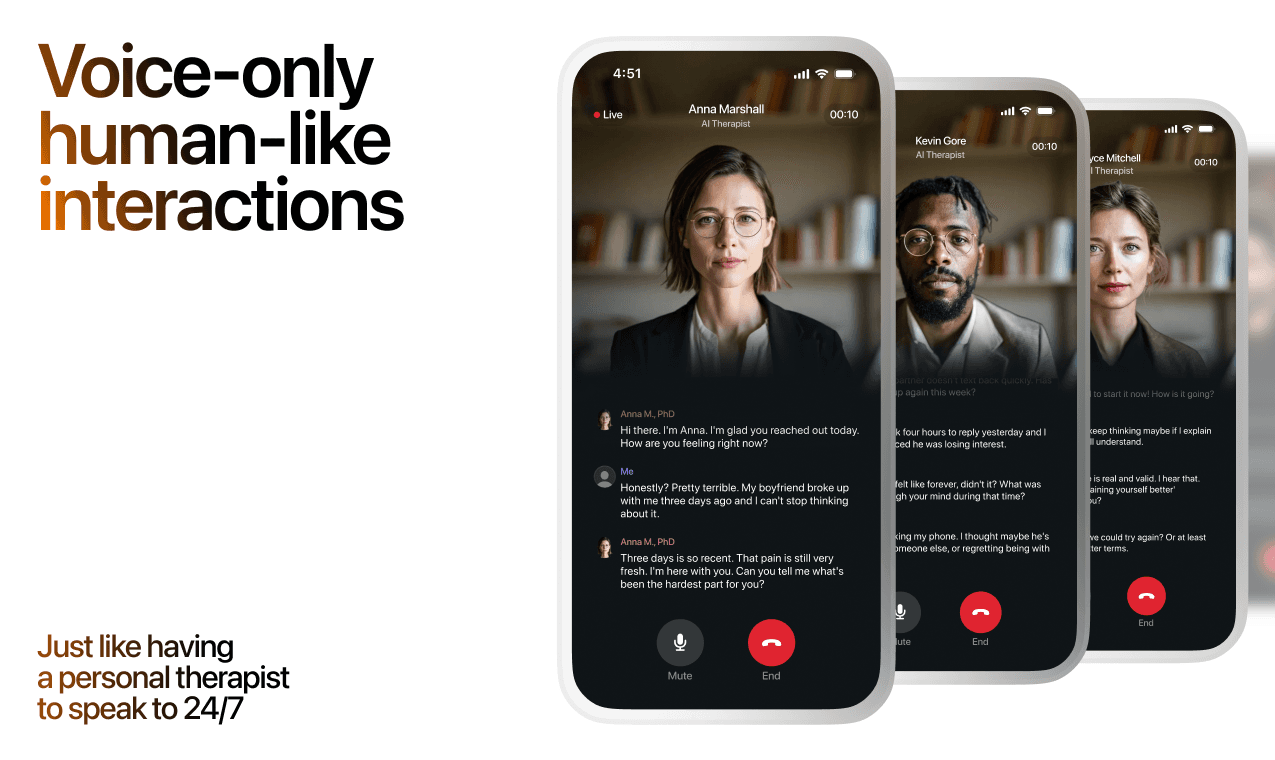
Lovon is AI support, not a replacement for professional care. If things have been hard to get through for weeks, or you are thinking about harming yourself, talk to a doctor or a licensed therapist.
Ready to Start?
Your healing journey can begin right now
A 7-day trial. No judgment. Just a safe space to process what you're going through.
Frequently Asked Questions
Is Lovon a replacement for a real therapist?
Is my conversation with Lovon AI private?
How is Lovon different from ChatGPT for emotional support?
Can I use Lovon if I'm already seeing a therapist?
Can I try Lovon before subscribing?
About the Author
The Lovon Editorial Team
Mental Health & Wellness Content Team
The Lovon Editorial Team develops mental health and wellness content designed to make psychological concepts accessible and actionable. Our goal is to bridge the gap between clinical research and everyday life - helping you understand why your mind works the way it does and what you can do about it....
Related articles
- Dissociation Symptoms: Why You Zone Out (2026 Guide)
Dissociation symptoms explained: why you zone out, lose time, or feel detached, plus grounding steps that work in 2026…
- AI Coping Tools for Postpartum Rage: 2026 Verdict
Postpartum rage needs faster help than a therapy waitlist. See which AI coping tools for postpartum rage actually work…
- AI Mental Health App for Veterans With PTSD (2026)
Compare AI mental health apps for veterans with PTSD in 2026: what to look for, top picks, what to avoid, and a clear…
- How to Calm Interview Anxiety Before a Big Interview 2026
Calm interview anxiety fast with box breathing, grounding, and prep steps that work in 2026, plus what to do if panic…
See also
Quizzes
- Emotional Granularity Test: How Precisely Do You Feel?
See how finely you tell your feelings apart, in 3 minutes.
- Shame Test: Do You Read Mistakes as Verdicts?
See which exit your shame takes, in 3 minutes.
Free tools
- What to Say When They Are Struggling
A chat, not a list. Tell the coach who this person is to you, what they are going through, and what you already said…
- How to Reconnect With an Old Friend
A chat for how to reconnect with an old friend, starting with the text you have been meaning to send for a year. Tell it…
From the wiki
- How to stop maladaptive daydreaming?
Maladaptive daydreaming is immersive waking fantasy that eats hours, usually with music and pacing attached. You rarely…
Disclaimer: This article is for informational purposes only and does not constitute medical advice, diagnosis, or treatment. Always seek the advice of your physician or other qualified health provider with any questions you may have regarding a medical condition. If you are in crisis or think you may have an emergency, call 988 (Suicide & Crisis Lifeline) or go to the nearest emergency room. Outside the US? Find a crisis line in your country.