
Why Do I Shake When Anxious? Causes & Fixes 2026
Shaking when anxious is adrenaline, not weakness. See the real causes, the fastest fixes for 2026, and when shaking signals something more serious.

Key Takeaways
- Shaking when anxious is adrenaline hitting your muscles fast — it's fight-or-flight, not a flaw.
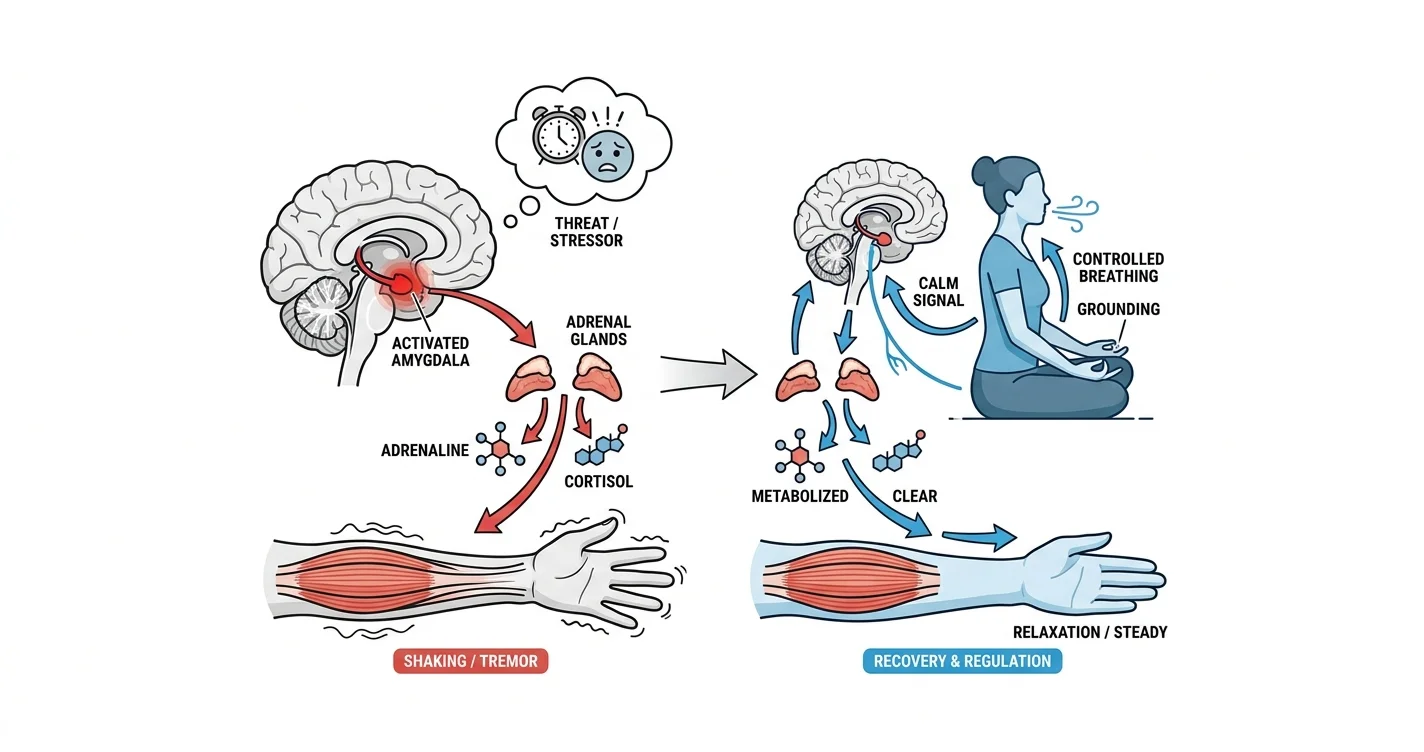
- Answering why do i shake when anxious usually traces back to cortisol and adrenaline spikes and an amygdala hijack
- Box breathing, cold water, and grounding stop most anxious shaking within 5 to 10 minutes.
- Shaking past 30 minutes, with chest pain, or with no clear trigger needs a medical check, not just coping tools.
Your hands shake, your voice wobbles, your knees feel like jelly the second anxiety spikes — that's adrenaline moving through your muscles, not a sign you're falling apart. Here's what's actually happening in your body when anxiety hits in 2026, and the exact steps that calm the shaking down.
TL;DR
- Shaking when anxious is adrenaline hitting your muscles fast — it's fight-or-flight, not a flaw.
- Answering why do i shake when anxious usually traces back to cortisol and adrenaline spikes and an amygdala hijack response.
- Box breathing, cold water, and grounding stop most anxious shaking within 5 to 10 minutes.
- Shaking past 30 minutes, with chest pain, or with no clear trigger needs a medical check, not just coping tools.
Why this matters
Shaking during anxiety is your nervous system doing exactly what it evolved to do: flooding your bloodstream with adrenaline to get you ready to run or fight. Your muscles get more blood flow and more glucose than they need for sitting at a desk, and the excess energy shows up as a tremor in your hands, legs, or jaw.
This reaction is sometimes called an amygdala hijack — your brain's threat-detection center overrides slower, rational thinking and triggers the physical response before you've consciously registered what scared you. That's why the shaking often starts before you can even name what you're anxious about.
The goal isn't to force the shaking to stop through willpower. Fighting a tremor tends to make it worse because it adds a second layer of tension on top of the first. The goal is to signal safety to your nervous system fast enough that the adrenaline gets metabolized instead of stacking on more.
What you'll need
- 3 to 5 quiet minutes, even if that means stepping into a bathroom or stairwell
- Something cold: ice, a cold water tap, or a chilled drink
- A private space to breathe audibly without feeling watched
- A way to talk it through afterward — a friend, a journal, or a voice-based tool like Lovon for real-time processing
- Basic awareness of your usual triggers (deadlines, conflict, crowds, caffeine)
The steps
1. Name what's happening
Say to yourself, silently or out loud: "This is adrenaline, not danger." Labeling the sensation correctly cuts the fear-of-the-fear loop, where you start panicking about the shaking itself on top of the original anxiety. Skipping this step is the most common mistake — people spiral because they read the tremor as proof something's medically wrong, which pumps out more adrenaline.
2. Slow your exhale
Inhale for 4 seconds, hold for 4, exhale for 6, and repeat for 5 rounds — about 90 seconds total. A longer exhale activates your vagus nerve and tells your body the emergency has passed. Structured breathing exercises for anxiety relief work because the exhale, not the inhale, does the calming.
3. Ground through your senses
Name 5 things you see, 4 you can touch, 3 you hear, 2 you smell, and 1 you taste. This takes 2 to 3 minutes and pulls blood flow and attention away from the threat response and back to the present room. Skip this if you're mid-conversation — do steps 2 and 4 instead and save grounding for right after.
4. Release the physical tension
Clench both fists tight for 5 seconds, then release completely, and repeat 3 times. Shaking is trapped energy; deliberate tension-and-release gives it somewhere to go instead of leaking out as tremor. Some people find shaking their hands out hard for 10 seconds works faster than clenching.
5. Cool your system down
Run your wrists under cold water for 30 seconds or press an ice cube to the inside of your wrist. Cold triggers the dive reflex, which slows your heart rate on its own. This is one of the fastest physical resets available and works even in a public bathroom.
6. Talk it through
Once the acute wave passes, say the trigger out loud or process it in real time — with a person, a journal, or an AI voice support tool like Lovon that lets you talk through what set it off without waiting for an appointment. Naming the trigger out loud, rather than just replaying it silently, reduces the chance it fires again the same way an hour later.
7. Give it time to clear
The adrenaline surge behind anxious shaking typically peaks within 10 minutes and fades within 20 to 30 minutes once cortisol starts clearing from your bloodstream. Expect the tremor to taper, not vanish instantly — trying to force an immediate stop usually just adds frustration on top of the original anxiety.
Talk it through when it happens
Get real-time voice support the moment anxiety spikes, not days later.
Troubleshooting
- Shaking won't stop even after 10 minutes of breathing. Check when you last ate or had caffeine — low blood sugar and caffeine both mimic and worsen anxious tremor.
- Shaking comes with dizziness or tingling in your hands. You may be hyperventilating. Slow the exhale further, to a 4-8 count, and breathe through pursed lips.
- The shaking hits at the same time every day. That's a pattern, not randomness. Track the hour and the trigger for a week before assuming it's unpredictable.
- Shaking arrives with chest tightness or a racing heart. This overlaps heavily with a panic attack presentation, and the two aren't always easy to tell apart in the moment.
- Shaking shows up after a night of drinking or skipping caffeine. Withdrawal tremor looks nearly identical to anxious shaking but has a physical, not psychological, driver.
Tools and resources
- A cold water source or ice for the dive-reflex reset
- A breathing pattern you've practiced before you need it, not during
- A journal or voice app for processing triggers after the fact
- A grounding script you can run through the senses in under 3 minutes
- Lovon for talking through recurring anxiety triggers between episodes, using voice conversations built with input from PhD psychologists — not a replacement for licensed clinical care, but available at 2 a.m. when your therapist isn't
What to do next
If shaking shows up alongside other physical symptoms — a pounding heart, shortness of breath, a sense of doom — read up on how a panic attack differs from general anxious shaking so you know which toolkit to reach for next time. If the shaking is a recurring part of a bigger pattern of stress, the deeper fix is regulating your nervous system daily, not just managing each episode as it hits.
FAQ
Why do I shake when anxious?
You shake when anxious because adrenaline floods your muscles faster than they can use it, creating a tremor in your hands, legs, or jaw. It's a fight-or-flight response, not a sign of weakness or illness in most cases.
Is shaking always a sign of a panic attack?
No, shaking happens with everyday anxiety spikes too, not just full panic attacks. Panic attacks usually add chest tightness, a racing heart, and a sense of doom on top of the tremor.
How long does anxious shaking usually last?
Anxious shaking typically peaks within 10 minutes and fades within 20 to 30 minutes as cortisol clears. If it lasts longer than that consistently in 2026, it's worth mentioning to a doctor.
Can low blood sugar cause shaking that looks like anxiety?
Yes, low blood sugar produces a tremor nearly identical to anxious shaking. Eating something with protein before assuming the cause is purely psychological is a useful first check.
Does caffeine make anxious shaking worse?
Caffeine increases adrenaline and heart rate, which amplifies existing tremor. Cutting caffeine on high-stress days reduces both the frequency and intensity of shaking episodes.
What's the fastest way to stop shaking from anxiety?
Cold water on your wrists combined with a slow 4-4-6 breathing count is the fastest physical reset, often working within 60 to 90 seconds. Grounding through your senses helps once the acute wave has passed.
Can medication stop anxiety-related shaking?
Some prescribed medications reduce the intensity of physical anxiety symptoms including tremor, but that decision belongs with a doctor, not a self-help guide. Coping techniques address the moment; medication is a separate clinical conversation.
Should I be worried if I shake every time I'm anxious?
Shaking every time you're anxious is common and not inherently dangerous on its own. It becomes worth a medical conversation if it's new, worsening, or paired with fainting or chest pain.
One last thing
The instinct to hold perfectly still and "power through" a shaking episode usually backfires. Stillness traps the adrenaline instead of burning it off, which is why deliberate movement — clenching, shaking your hands out, even pacing for 30 seconds — often clears a tremor faster than sitting rigid and waiting for it to pass. The body wants to move the energy, not suppress it.
Related guides
How AI Support Helps You Heal
AI emotional support isn't about replacing human connection — it's about filling the gaps. The moments when you need to talk at 2 AM, when you don't want to burden your friends again, or when you simply need someone to listen without judgment.
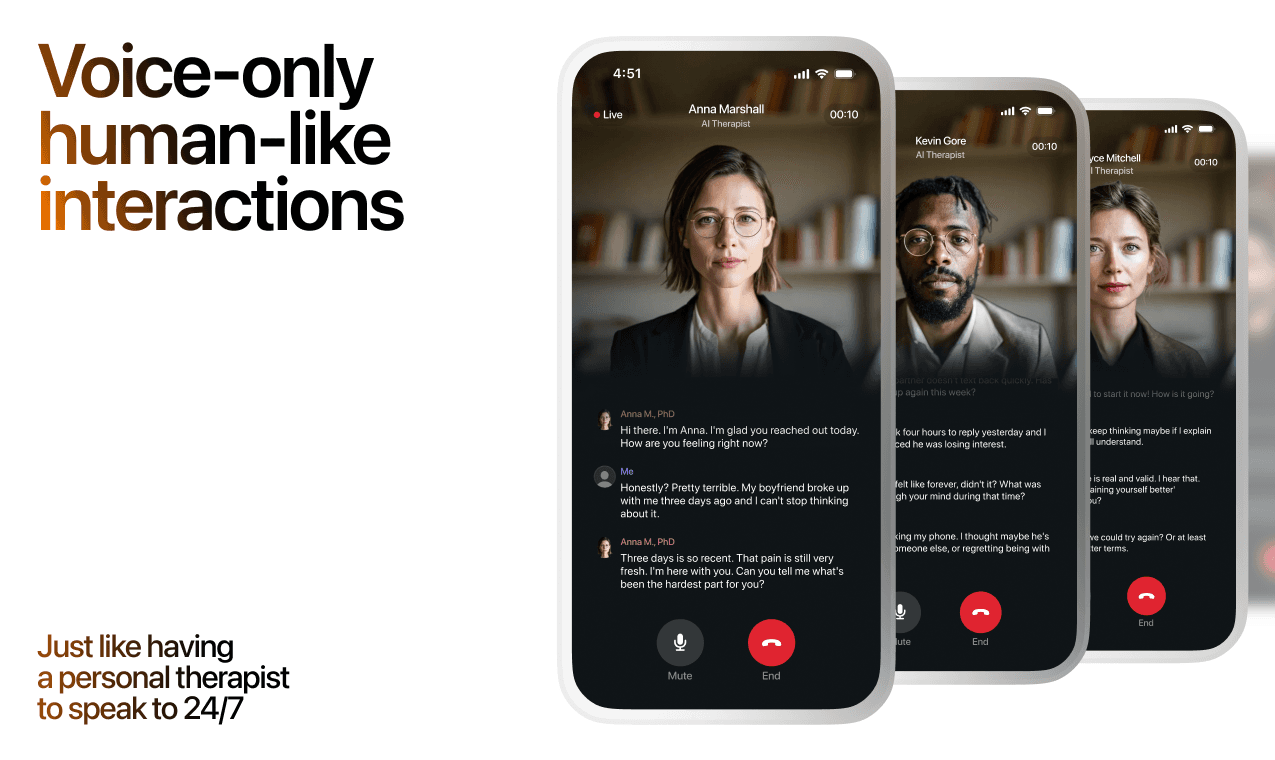
Here's what happens in a typical Lovon session:
You share what's on your mind
There's no script, no intake form, no waiting room. You speak or type whatever you're feeling — in your own words, at your own pace.
Lovon validates and explores
Using frameworks from CBT (Cognitive Behavioral Therapy) and motivational interviewing, Lovon acknowledges your feelings first, then gently helps you explore them. No dismissive "just move on" advice.
You build coping skills together
Lovon doesn't just listen — it actively works with you on evidence-based techniques: thought reframing, urge surfing, behavioral experiments, and more.
What a Session with Lovon Looks Like
When to Seek Professional Help
AI support is a valuable tool, but it's not a replacement for professional care. Please consider reaching out to a licensed therapist if you experience any of the following:
- Persistent thoughts of self-harm or suicide
- Inability to perform daily activities (work, eating, sleeping) for more than 2 weeks
- Turning to alcohol or substances to cope
- Intense anger or desire to harm your ex-partner
- Complete emotional numbness that doesn't improve over time
Crisis Resources (US): If you're in immediate danger, call 988 (Suicide & Crisis Lifeline) or text HOME to 741741 (Crisis Text Line). Available 24/7, free, and confidential.
Outside the US? Find a crisis line in your country
Ready to Start?
Your healing journey can begin right now
A 7-day trial. No judgment. Just a safe space to process what you're going through.
Frequently Asked Questions
Is Lovon a replacement for a real therapist?
Is my conversation with Lovon AI private?
How is Lovon different from ChatGPT for emotional support?
Can I use Lovon if I'm already seeing a therapist?
Can I try Lovon before subscribing?
About the Author
The Lovon Editorial Team
Mental Health & Wellness Content Team
The Lovon Editorial Team develops mental health and wellness content designed to make psychological concepts accessible and actionable. Our goal is to bridge the gap between clinical research and everyday life - helping you understand why your mind works the way it does and what you can do about it....
Related articles
- Fear of Abandonment: Causes and How to Overcome It (2026)
Fear of abandonment explained: root causes, the panic-trigger cycle, and 8 steps to overcome it in 2026, plus when to…
- Freeze Response: Why You Shut Down Under Stress (2026)
The freeze response shuts down your body and mind under stress. Learn the exact nervous system mechanism and 7 steps to…
- AI Coping Tools for Fear of Flying: 2026 Verdicts
AI coping tools for fear of flying, ranked for 2026: what helps mid-panic, what to skip, and how voice-based AI support…
- Break the Anxious Attachment Cycle: 2026 Step-by-Step Guide
Break the anxious attachment cycle in 2026 with 7 concrete steps, troubleshooting fixes, and tools for the moments…
See also
Quizzes
- Am I Codependent? 12-Question Self-Check
See how much of you is left over, in 2 minutes.
- What Stage of Grief Am I In? Free 12-Question Quiz
See what your grief is actually doing, in 3 minutes.
Free tools
- What Did They Actually Mean By That?
A chat for one sentence you cannot stop re-reading. Paste their exact words and what was happening around them, and get…
- 5-4-3-2-1 Grounding Exercise
A guided run through the 5-4-3-2-1 technique, with paced breathing first if you need it. No sign-up, nothing stored…
From the wiki
- What does clingy mean in a relationship?
Clingy is what people call behavior that asks for more contact or reassurance than the other person wants to give…
Disclaimer: This article is for informational purposes only and does not constitute medical advice, diagnosis, or treatment. Always seek the advice of your physician or other qualified health provider with any questions you may have regarding a medical condition. If you are in crisis or think you may have an emergency, call 988 (Suicide & Crisis Lifeline) or go to the nearest emergency room. Outside the US? Find a crisis line in your country.