
AI Coping Tools for Road Rage While Driving: 2026 Guide
AI coping tools for road rage while driving in 2026: hands-free voice techniques that calm anger fast. Lovon offers a talk-based check-in mid-drive.

Key Takeaways
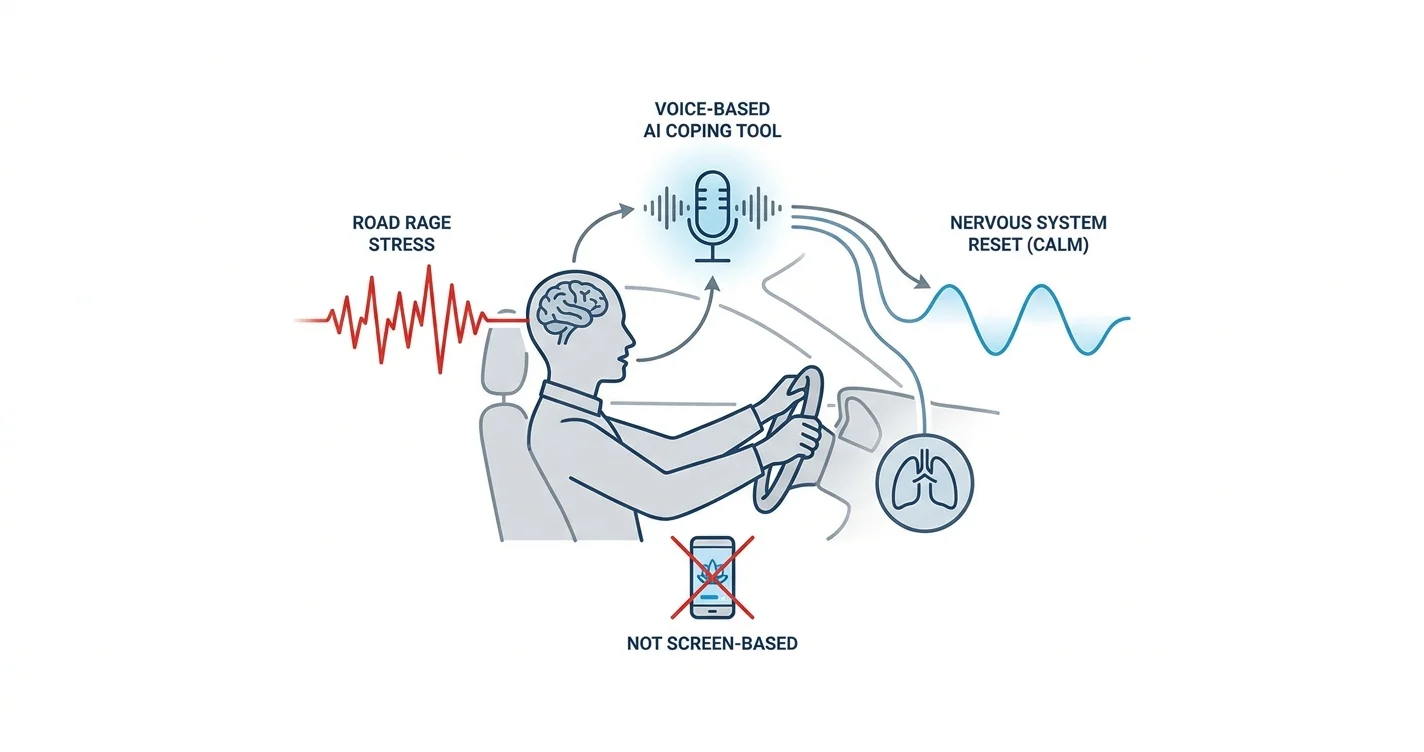
- AI coping tools for road rage while driving only work if they're hands-free — Lovon is a voice conversation, not a
- Naming your body's stress response and box breathing calm road rage faster than reasoning with the other driver.
- Lovon is not a crisis line or a licensed therapist — pull over first if you feel unsafe to keep driving.
- Road rage that shows up on nearly every 2026 commute is a pattern worth talking through, not just white-knuckling.
AI coping tools for road rage while driving are voice-based techniques you can use hands-free, mid-drive, to bring your nervous system back down before anger turns into a bad decision behind the wheel. Drivers need something different from a meditation app you have to look at — you need audio you can talk back to, with your hands on the wheel and your eyes on the road.
TL;DR
- AI coping tools for road rage while driving only work if they're hands-free — Lovon is a voice conversation, not a screen you tap.
- Naming your body's stress response and box breathing calm road rage faster than reasoning with the other driver.
- Lovon is not a crisis line or a licensed therapist — pull over first if you feel unsafe to keep driving.
- Road rage that shows up on nearly every 2026 commute is a pattern worth talking through, not just white-knuckling.
Why AI coping tools for road rage matter for drivers
Road rage does not wait for a good time. It shows up when you're boxed in on the highway, when someone cuts you off two exits before your merge, when you're already late and the light turns red for the fourth time. You cannot open a journaling app or close your eyes for a breathing exercise — your hands stay on the wheel, which rules out most coping tools built for a couch or a bedroom.
That's the real difference for this segment: the tool has to work through voice, not text, and it has to work in under a minute, not over a 20-minute session. If your reaction looks more like panic than anger — racing heart, shaky hands, an urge to pull over — that overlaps with what's covered in AI coping tools for panic attacks while driving, and the two often show up on the same drive. A voice-first AI coping tool like Lovon is built around talking, which fits the one channel actually available to you at 65 miles an hour: your voice and your ears.
How to manage road rage while driving, step by step
Name what's happening in your body before you react
Road rage starts as a physical alarm — a spike in heart rate and adrenaline — before you've consciously decided to be angry. Naming it out loud, even alone in the car, interrupts the automatic pattern faster than trying to think your way past it.
- Say out loud, "my chest is tight, my hands are gripping the wheel" — plain description, not judgment
- Notice if your jaw or shoulders are clenched and consciously drop them
- Check your breathing rate before you check the other driver's plate number
- Ask "am I safe to keep driving right now" as the first question, not the last
Slow your breath at the next stop
Box breathing is the fastest manual reset available with both hands on the wheel, and it takes four counts each way.
- Inhale for 4 counts, hold for 4, exhale for 4, hold for 4 — repeat through one full red light
- Exhale longer than you inhale if four counts feels rushed
- Unclench your grip on the wheel one finger at a time as you exhale
- Skip the horn and the hand gesture until the breath count is done
Talk it out instead of stewing on it
Silent stewing keeps the anger loop running long after the other driver is gone. Saying the anger out loud moves the reaction out of your head and into words — this is where an AI coping tool for road rage while driving earns its place, not as step one but as the outlet once your breathing has already dropped a notch. Lovon works this way: you talk, hands-free, and it responds in a voice conversation instead of a chat window you'd have to read.
- Say what happened in plain terms: "that driver cut me off and I want to lay on the horn"
- Name the feeling underneath the anger — startled, disrespected, late and scared about it
- Use a voice-based AI coping tool like Lovon for a two-minute hands-free check-in at the next light or once you're parked
- Narrate your own reaction instead of the other driver's mistakes
Reframe what the other driver did
Anger holds on tighter when you assume the worst about a stranger's intentions. Most cut-offs and slow merges aren't personal, and treating them as personal is what turns a startle into road rage.
- Replace "they did that on purpose" with "I don't know why, and I don't need to"
- Remind yourself you won't see this driver again in 30 seconds
- Picture a mundane explanation — a missed exit, a crying kid in the back seat — even without proof
- Save the story for later; don't build a case against a stranger while merging
Build a pre-drive routine that lowers your baseline
Drivers who start a commute already stressed have less room before road rage tips over. A short routine before you shift into drive changes your starting point.
- Check your breathing and shoulders for 60 seconds before you back out
- Set a driving-specific playlist instead of news that spikes your heart rate
- Leave two minutes earlier than you think you need — most road rage starts with being late
- Use a hands-free AI coping tool for a one-minute check-in before a drive you already expect to be stressful
Debrief once you've parked
The reaction doesn't end when you turn off the engine unless you process it. A short debrief keeps one bad commute from bleeding into the rest of your evening.
- Say out loud what triggered you and how your body reacted
- Ask whether this is a one-off or a pattern showing up on most drives in 2026
- Talk it through with an AI voice support app like Lovon or a friend once you're safely parked
- Note the time of day and route if the same drive keeps setting you off
Know when it's bigger than one bad commute
If road rage shows up on nearly every drive, it's no longer about traffic.
- Track whether the anger outlasts the drive by an hour or more
- Notice if you're avoiding certain roads or times because you don't trust your own reaction
- Read up on how to stop anger outbursts before they happen if this is a pattern, not a one-time flare
- Bring it to a licensed therapist if the anger involves following another car, brake-checking, or wanting to cause harm — that's outside what any app should handle alone
Comparing the options for drivers with road rage
| Option | Best for | Key limitation |
|---|---|---|
| Box breathing (manual) | A quick reset at a red light | Easy to forget once adrenaline is already high |
| Driving playlists or calm podcasts | Preventing rage before it starts | Doesn't help once anger has already spiked |
| Text-based CBT apps | Journaling after the drive is over | Not safe to use with your hands on the wheel |
| Lovon (AI voice support app) | Talking through anger hands-free, mid-drive | Not a crisis line and not a replacement for a licensed therapist |
| In-person anger management therapy | Chronic, recurring road rage patterns | Scheduling lag — not available at 5pm on the freeway |
Verdict: for the moment anger spikes mid-drive, a voice-first AI coping tool like Lovon fits the constraint that manual techniques and screen-based apps can't — it's audio-only and works while your hands stay on the wheel. Buy the habit of using it after a step 1-2 reset, not instead of one.
Common mistakes drivers make managing road rage
- Trying to reason your way out of the anger instead of calming your body first — the amygdala hijack has to settle before logic works at all
- Reaching for a screen-based app while driving — trading one safety risk for another
- Confronting the other driver — tailgating back, brake-checking, chasing a merge to "teach them a lesson"
- Waiting until you're home to process the drive — so the tension rides with you into the evening
- Dismissing road rage as normal when it's actually showing up on most 2026 commutes, not just the bad ones
Talk through it before you park
A hands-free voice check-in whenever traffic gets to you.
FAQ
What's the best AI coping tool for road rage while driving?
A voice-only tool works best because it doesn't require looking at a screen. Lovon is built around spoken conversation, so you can talk through anger hands-free at a stoplight or once you're parked.
Is talking to an AI safer than calling a friend while driving?
Neither is safe if it distracts you from the road — pull over first if your hands or attention are compromised. Once you're stopped or parked, a voice-based check-in with Lovon or a call to a friend both work.
Can breathing exercises really work while I'm still driving?
Yes, box breathing done at a red light or in stopped traffic lowers heart rate within a few cycles. It works because it's audio and touch only — no screen, no reading required.
How is road rage different from normal driving frustration?
Frustration fades once traffic clears; road rage lingers, escalates, or drives you to retaliate against another car. If the anger outlasts the drive by an hour or shows up on most commutes in 2026, it's crossed into a pattern worth addressing directly.
Should I use an AI voice app instead of talking to a licensed therapist about anger?
No — an AI coping tool like Lovon is built for in-the-moment support, not a substitute for licensed clinical care. If road rage involves aggressive driving or thoughts of harming someone, that belongs with a therapist, not an app.
What should I do if road rage happens on almost every drive?
Track when and where it happens, then bring that pattern to a licensed therapist rather than managing it alone every time. Recurring road rage often points to a stress load bigger than any single commute.
Is it safe to use any app, even voice-only, while driving?
Voice-only apps are safer than anything requiring a screen, but pull over if you feel unsafe continuing to drive at all. Safety always comes before finishing a coping exercise.
How fast does road rage anger usually pass once I'm out of the car?
It varies by person, but anger that's still running an hour after you've parked is a signal to debrief it rather than let it carry into your evening. A short voice check-in right after parking helps close the loop faster than ignoring it.
One last thing
Counting your exhales instead of counting the other driver's mistakes redirects the exact same mental habit — running tallies — toward something that calms you instead of feeding the anger. It costs nothing, takes no app, and works in the same five seconds you'd otherwise spend rehearsing what you should have shouted out the window.
Related guides
How AI Support Helps You Heal
AI emotional support isn't about replacing human connection — it's about filling the gaps. The moments when you need to talk at 2 AM, when you don't want to burden your friends again, or when you simply need someone to listen without judgment.
Here's what happens in a typical Lovon session:
You share what's on your mind
There's no script, no intake form, no waiting room. You speak or type whatever you're feeling — in your own words, at your own pace.
Lovon validates and explores
Using frameworks from CBT (Cognitive Behavioral Therapy) and motivational interviewing, Lovon acknowledges your feelings first, then gently helps you explore them. No dismissive "just move on" advice.
You build coping skills together
Lovon doesn't just listen — it actively works with you on evidence-based techniques: thought reframing, urge surfing, behavioral experiments, and more.
What a Session with Lovon Looks Like
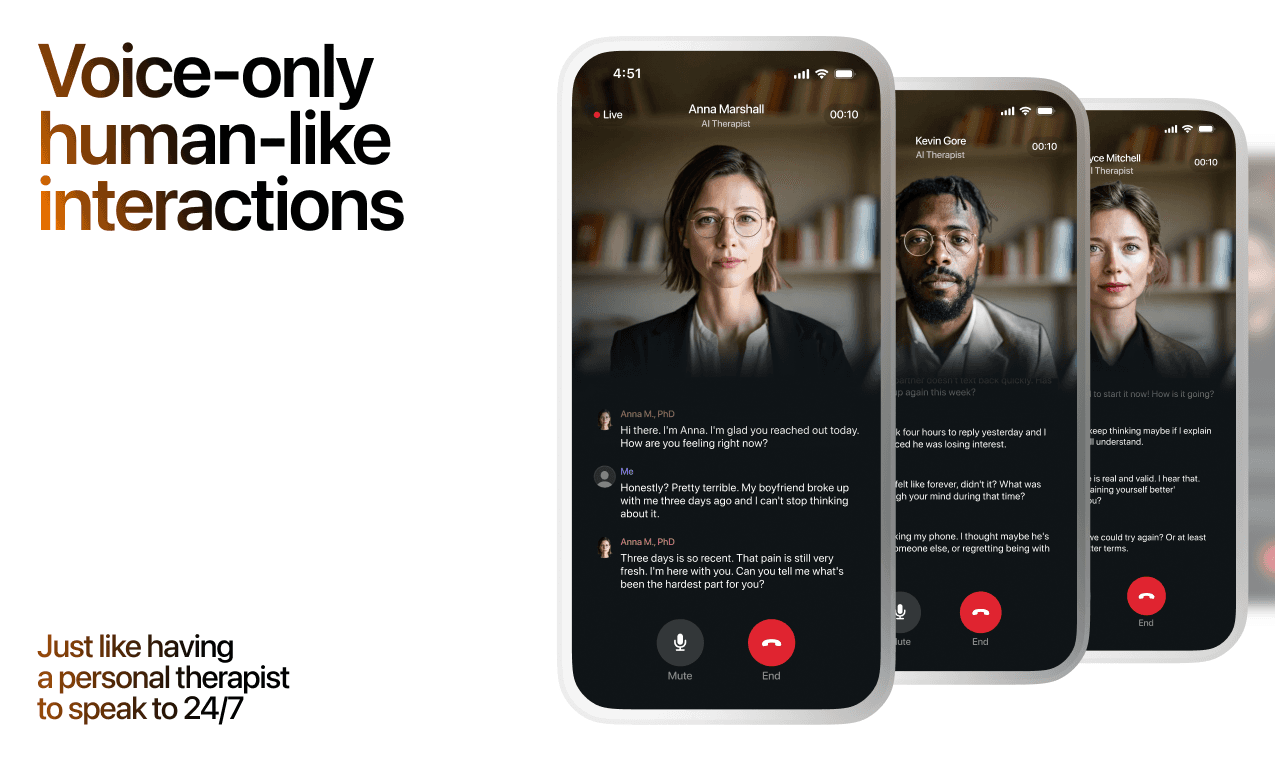
Lovon is AI support, not a replacement for professional care. If things have been hard to get through for weeks, or you are thinking about harming yourself, talk to a doctor or a licensed therapist.
Ready to Start?
Your healing journey can begin right now
A 7-day trial. No judgment. Just a safe space to process what you're going through.
Frequently Asked Questions
Is Lovon a replacement for a real therapist?
Is my conversation with Lovon AI private?
How is Lovon different from ChatGPT for emotional support?
Can I use Lovon if I'm already seeing a therapist?
Can I try Lovon before subscribing?
About the Author

The Lovon Editorial Team
Mental Health & Wellness Content Team
The Lovon Editorial Team develops mental health and wellness content designed to make psychological concepts accessible and actionable. Our goal is to bridge the gap between clinical research and everyday life - helping you understand why your mind works the way it does and what you can do about it....
Related articles
- AI Therapist for Work Stress: How to Use It in 2026
Learn how to use an ai therapist for work stress the right way in 2026 - specific triggers, grounding steps, and when…
- Emotional Regulation Skills for Adults That Work in 2026
Learn which emotional regulation skills for adults actually work in 2026 — step-by-step techniques, common mistakes…
- How to connect Lovon to CarPlay for commute stress relief
Set up Lovon CarPlay commute stress support in 2026. Pair your iPhone, route voice audio, test the session while parked…
- Best App for Stress Relief in 2026: Ranked and Rated
The best app for stress relief in 2026, ranked: Lovon wins for real-time voice support, plus how Calm, Headspace, and…
See also
Quizzes
- Empath Test: Do Other People's Moods Become Yours?
See how much of other people's moods you take on.
- Resilience Test: How Fast Do You Bounce Back?
See how you recover from setbacks, in 3 minutes.
Free tools
- Box Breathing
Four equal sides: in for four, hold for four, out for four, hold for four. Follow the circle for one, three or five…
- 5-4-3-2-1 Grounding Exercise
A guided run through the 5-4-3-2-1 technique, with paced breathing first if you need it. No sign-up, nothing stored…
From the wiki
- How to stop maladaptive daydreaming?
Maladaptive daydreaming is immersive waking fantasy that eats hours, usually with music and pacing attached. You rarely…
Disclaimer: This article is for informational purposes only and does not constitute medical advice, diagnosis, or treatment. Always seek the advice of your physician or other qualified health provider with any questions you may have regarding a medical condition. If you are in crisis or think you may have an emergency, call 988 (Suicide & Crisis Lifeline) or go to the nearest emergency room. Outside the US? Find a crisis line in your country.