
AI Relationship Coach for Chronic Illness Couples 2026
An ai relationship coach for couples facing chronic illness in 2026: what Lovon does, what it doesn't, and how to build a check-in habit that survives flare-ups.
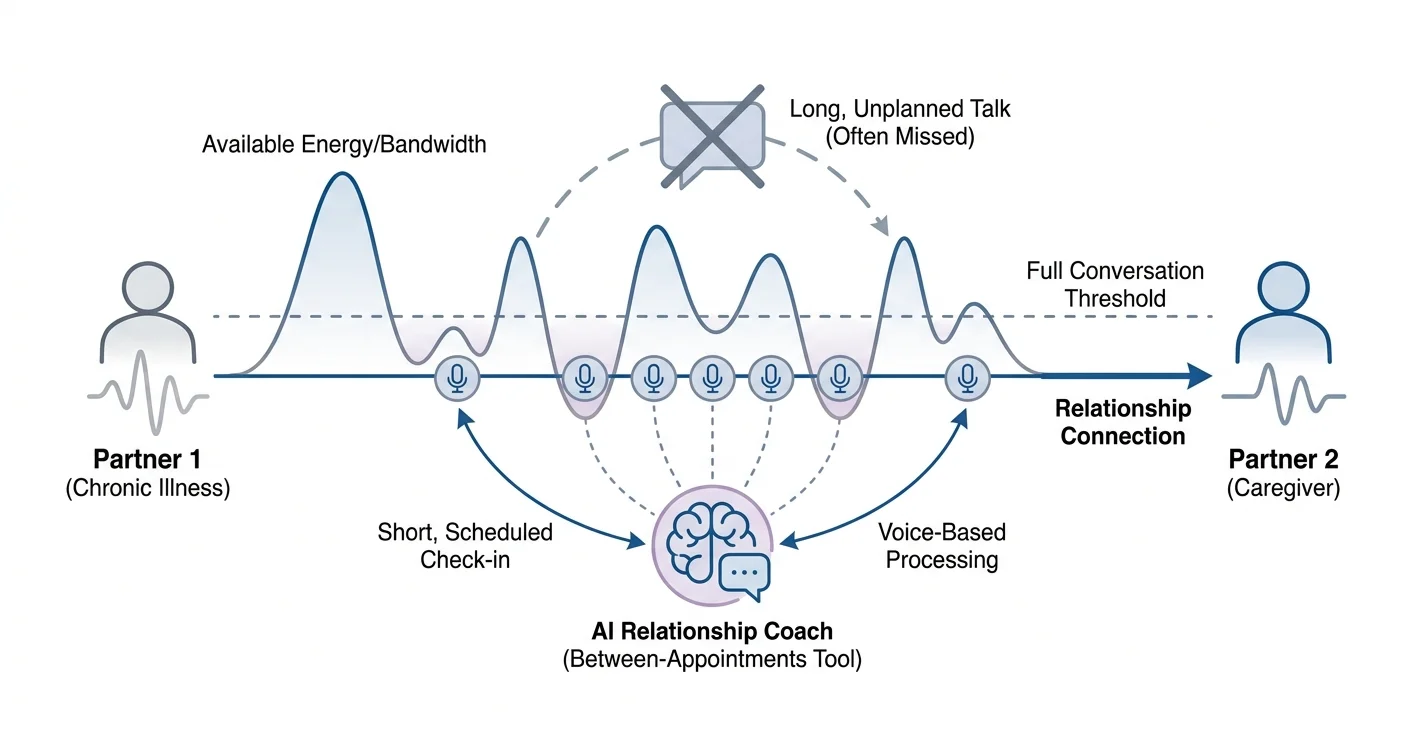

Key Takeaways
- An ai relationship coach for couples facing chronic illness works best as a between-appointments tool, not a
- Lovon gives couples a voice-based check-in they can use on a bad-symptom day when a scheduled session isn't realistic.
- Caregiver burnout, not the illness itself, is usually what breaks communication first in these relationships.
- Short, scheduled check-ins outperform long unplanned talks for couples managing fatigue or brain fog.
When one partner in a relationship is managing a chronic illness, the usual relationship advice stops applying — check-ins get canceled by flare-ups, and "just talk about it" ignores the exhaustion sitting between you. This guide covers how couples facing chronic illness use structured, on-demand coaching to keep communication steady when symptoms won't cooperate with a calendar.
TL;DR
- An ai relationship coach for couples facing chronic illness works best as a between-appointments tool, not a replacement for a couples therapist who knows the diagnosis.
- Lovon gives couples a voice-based check-in they can use on a bad-symptom day when a scheduled session isn't realistic.
- Caregiver burnout, not the illness itself, is usually what breaks communication first in these relationships.
- Short, scheduled check-ins outperform long unplanned talks for couples managing fatigue or brain fog.
Why AI relationship coaching matters for couples facing chronic illness
Couples managing a chronic condition don't have a communication problem in the way most relationship content assumes. They have a bandwidth problem. Pain, medication side effects, and appointment schedules eat the hours that used to go to talking things through, and by the time there's energy left, the moment for the conversation has passed.
That's a different starting point than "we don't communicate enough." It's "we don't have a reliable window to communicate in." A chronic pain and mental health resource can help the ill partner process what they're carrying, but the couple also needs a way to stay connected as a unit when energy is unpredictable. That's the gap an always-available coaching tool is built for — not to diagnose or manage the illness, but to catch the relationship conversation that keeps getting postponed.
Lovon is not a substitute for a couples therapist or your medical team, and it says so plainly. What it offers is a voice conversation you can have at 11pm after a bad day, or during a 12-minute gap between appointments, when scheduling a real session isn't going to happen this week.
Update your definition of a "good" conversation
For most couples, a good conversation is long, uninterrupted, and happens face to face. For a couple where one partner has a chronic illness, that definition sets you up to fail — long and uninterrupted rarely exists on a bad symptom day.
- Redefine success as 5-10 minutes of honest check-in, not a full sit-down
- Separate "illness logistics" talk (appointments, meds, symptoms) from "us" talk (how you're both feeling about the relationship)
- Agree in advance that either partner can pause a conversation without it meaning avoidance
- Use voice notes or short recorded check-ins on days when talking face to face is too much
- Track which times of day are consistently low-energy so you stop scheduling hard talks then
Address caregiver burnout before it shows up as resentment
The partner without the diagnosis often absorbs a second, invisible job: appointment coordination, emotional labor, physical caregiving, on top of their own life. That load builds quietly and then comes out sideways, as irritability or withdrawal, months before either person names it as burnout.
- Name caregiver fatigue out loud early, before it turns into resentment
- Build in recovery time for the well partner that isn't contingent on the ill partner having a "good day"
- Watch for signs of compassion fatigue — numbness, dread before caregiving tasks, guilt about needing a break
- Ask directly: "what's one thing I could take off your plate this week"
- Bring in outside support (family, a support group, respite care) instead of treating burnout as a private failure
A compassion fatigue checklist is worth reading even if you don't think you're the one struggling — burnout in the caregiving partner is one of the top reasons these relationships fracture, and it's rarely obvious from the inside.
This is also where an AI relationship coach for couples facing chronic illness earns its place: it gives the caregiving partner somewhere to unload frustration that isn't the sick partner, without needing to book anything or explain the whole backstory first.
Renegotiate roles as the illness changes what's possible
Roles that worked when you got together — who cooks, who handles finances, who initiates intimacy — often stop working once a chronic condition enters the picture, and nobody sits down to actually renegotiate them. They just quietly shift, and the shift breeds quiet resentment on both sides.
- List out the roles that have changed since the diagnosis, not the roles you assume are still in place
- Revisit the split every few months instead of assuming a one-time conversation fixes it permanently
- Separate "can't do it because of the illness" from "don't want to do it" — conflating the two causes fights
- Give the well partner permission to ask for role changes without guilt
- Check in on financial stress separately from caregiving stress; they compound but aren't the same conversation
Protect intimacy without making it another obligation
Fatigue, medication, and body image changes from chronic illness routinely affect physical intimacy, and couples often stop talking about it entirely rather than risk making a hard topic harder.
- Separate physical intimacy from emotional intimacy in your language — you can rebuild one without waiting on the other
- Talk about what's changed with curiosity instead of comparing it to "how things used to be"
- Ask what kinds of touch or closeness still feel good on low-energy days, rather than assuming the answer is none
- Bring the topic to a doctor or specialist if a treatment side effect is the main barrier
- Use a low-pressure evening check-in rather than raising intimacy mid-argument
For structured wording around this kind of hard conversation, AI relationship coach for couples communication walks through phrasing that keeps these talks from turning into blame.
Build a short daily or weekly check-in habit
Most couples in this situation don't need more advice — they need a repeatable habit that survives a bad week. A five-minute nightly check-in beats a two-hour "state of the relationship" talk that only happens once a quarter and always turns into a fight.
- Pick a fixed, low-effort time (after dinner, before bed) instead of "whenever we get to it"
- Ask two questions every time: how are you feeling physically, how are you feeling about us
- Keep it under 10 minutes on purpose — brevity is what makes it sustainable
- Use a voice check-in on nights when neither of you has the energy to talk out loud to each other
- Skip it guilt-free on genuinely bad days rather than forcing it and resenting the habit
This is the daily-habit layer where use an AI relationship coach daily becomes useful in practice — it's a place to process your side of the check-in privately first, so what you bring to your partner is clearer and less reactive.
Know when to bring in a couples therapist
An AI coaching tool handles day-to-day processing between appointments; it does not replace a couples therapist who understands the medical situation, and it should never be the only support for a relationship under sustained strain.
- If the same fight repeats for more than a few months, that's a signal for professional support, not more self-management
- Look for a couples therapist with experience in chronic illness or medical trauma specifically
- Bring your medical team into relationship conversations when treatment decisions are the actual source of conflict
- Treat an AI coach and a licensed therapist as complementary, not competing, options in 2026
Try a check-in before your next hard conversation
Talk through it by voice, on your schedule, before you bring it to your partner.
Comparing support options for couples facing chronic illness
| Option | Best for | Key limitation |
|---|---|---|
| AI voice coach (Lovon) | Daily processing between appointments, low-energy days | Not licensed clinical care; no medical guidance |
| Couples therapist (illness-specialized) | Deep-seated conflict, role renegotiation, medical trauma | Requires scheduling, cost, and availability |
| Chronic illness support group | Feeling less isolated, practical tips from peers | Group format, not tailored to your specific relationship |
| Self-guided books/workbooks | Structured frameworks you can revisit anytime | No real-time feedback or personalization |
Verdict: Lovon works best as the daily layer between real support, not as the whole plan. Couples who pair it with an illness-aware therapist for the deeper work tend to get more out of both.
Common mistakes couples facing chronic illness make
- Treating every hard conversation as urgent. Not every issue needs to be resolved tonight, especially on a flare-up day — some things can wait for a better window.
- Letting the caregiving partner's needs disappear. The well partner's exhaustion gets deprioritized by default because it feels selfish to raise it, and that silence compounds over time.
- Skipping the role conversation because it feels petty. Chores and logistics sound small next to a diagnosis, but unspoken resentment over who does what erodes trust just as fast as bigger issues.
- Waiting for a "good day" that never lines up for both partners. Perfect timing rarely exists in these relationships; a short imperfect check-in beats an indefinitely postponed perfect one.
- Going silent on intimacy instead of renegotiating it. Avoidance reads as rejection even when it's really about fatigue or pain.
FAQ
What is an AI relationship coach for couples facing chronic illness?
It's a voice-based coaching tool couples use between real conversations or therapy sessions to process frustration, plan a hard talk, or check in when energy is too low for a full discussion. It supplements support, it doesn't replace a couples therapist or medical team.
Can an AI coach replace couples therapy when one partner is chronically ill?
No. An AI coach like Lovon handles daily processing and check-ins, but a couples therapist with chronic-illness experience is better suited for deep-seated conflict, role renegotiation, or medical trauma that keeps repeating.
How often should couples facing chronic illness check in with each other?
A short daily or near-daily check-in, five to ten minutes, works better than infrequent long talks. Short and consistent beats rare and exhaustive when energy is unpredictable.
Is caregiver burnout common in relationships with chronic illness?
Yes, it's one of the most common reasons communication breaks down in these relationships. It builds quietly through unspoken emotional and logistical labor before it surfaces as irritability or withdrawal.
How do you talk about intimacy changes caused by chronic illness?
Separate physical intimacy from emotional closeness in the conversation, and raise it during a calm moment rather than mid-conflict. Curiosity about what still feels good works better than comparing to how things used to be.
When should a couple renegotiate roles after a chronic illness diagnosis?
Revisit the division of chores, finances, and caregiving every few months rather than assuming one conversation settles it permanently. Symptoms and treatment change over time, and roles need to change with them.
Does Lovon give medical advice about chronic illness?
No. Lovon is built for emotional support and relationship coping, not medical guidance, and it's explicit that it doesn't replace a licensed clinician or your medical team.
One last thing
The couples who hold up best under chronic illness aren't the ones with the fewest hard days — they're the ones who stopped waiting for the perfect moment to talk and built a habit that survives the bad ones. A five-minute check-in on a rough night, done consistently through 2026, beats a two-hour conversation you keep postponing until things calm down. They rarely calm down on schedule.
Related guides
How AI Support Helps You Heal
AI emotional support isn't about replacing human connection — it's about filling the gaps. The moments when you need to talk at 2 AM, when you don't want to burden your friends again, or when you simply need someone to listen without judgment.
Here's what happens in a typical Lovon session:
You share what's on your mind
There's no script, no intake form, no waiting room. You speak or type whatever you're feeling — in your own words, at your own pace.
Lovon validates and explores
Using frameworks from CBT (Cognitive Behavioral Therapy) and motivational interviewing, Lovon acknowledges your feelings first, then gently helps you explore them. No dismissive "just move on" advice.
You build coping skills together
Lovon doesn't just listen — it actively works with you on evidence-based techniques: thought reframing, urge surfing, behavioral experiments, and more.
What a Session with Lovon Looks Like
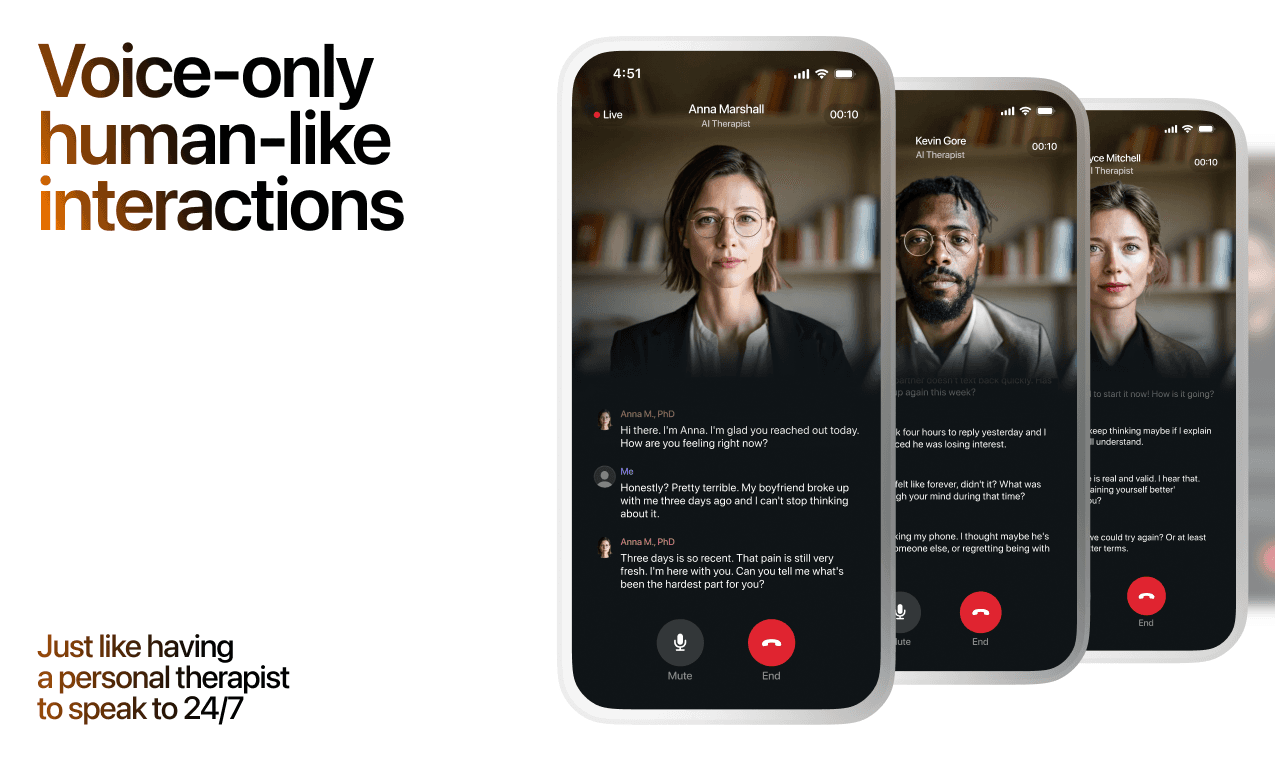
Lovon is AI support, not a replacement for professional care. If things have been hard to get through for weeks, or you are thinking about harming yourself, talk to a doctor or a licensed therapist.
Ready to Start?
Your healing journey can begin right now
A 7-day trial. No judgment. Just a safe space to process what you're going through.
Frequently Asked Questions
Is Lovon a replacement for a real therapist?
Is my conversation with Lovon AI private?
How is Lovon different from ChatGPT for emotional support?
Can I use Lovon if I'm already seeing a therapist?
Can I try Lovon before subscribing?
About the Author

The Lovon Editorial Team
Mental Health & Wellness Content Team
The Lovon Editorial Team develops mental health and wellness content designed to make psychological concepts accessible and actionable. Our goal is to bridge the gap between clinical research and everyday life - helping you understand why your mind works the way it does and what you can do about it....
Related articles
- Stop Fighting About Money in a Relationship (2026 Guide)
Learn how to stop fighting about money in a relationship with 7 steps for 2026: name the trigger, schedule talks, and…
- AI Life Coach for Relationship Goals 2026
The best AI life coach for relationship goals in 2026: voice-based, personalized sessions for communication, conflict…
- AI Relationship Advice for Communication Issues 2026
The best AI relationship advice tools for communication issues in 2026—compared on voice support, session structure…
- AI Relationship Coach for Dating App Burnout: Buy in 2026
Wiped out from swiping? See how an AI relationship coach for dating app burnout helps in 2026, what to look for, and…
See also
Quizzes
- Relationship Schema Test: Are Your Feelings Welcome?
See which belief edits what you share, in 3 minutes.
- Conflict Coordinates Test: What Your Fights Are Really About
Find what your fights are really about, in 3 minutes.
Free tools
- How to Communicate Better in a Relationship
Skip the tips. Give it the one sentence you keep trying to say that turns into a fight, in the words you actually used…
- What to Say When They Are Struggling
A chat, not a list. Tell the coach who this person is to you, what they are going through, and what you already said…
From the wiki
- What is a break in a relationship?
A break is a temporary, agreed pause in a relationship where both people expect to come back. In practice it usually…
Disclaimer: This article is for informational purposes only and does not constitute medical advice, diagnosis, or treatment. Always seek the advice of your physician or other qualified health provider with any questions you may have regarding a medical condition. If you are in crisis or think you may have an emergency, call 988 (Suicide & Crisis Lifeline) or go to the nearest emergency room. Outside the US? Find a crisis line in your country.