
Stop Fighting About Money in a Relationship (2026 Guide)
Learn how to stop fighting about money in a relationship with 7 steps for 2026: name the trigger, schedule talks, and break the pursuer-withdrawer cycle.

Key Takeaways
- Most couples aren't fighting about dollars, they're fighting about security and control -- name that first.
- Scheduled 20-minute money talks beat ambush conversations; timing changes the outcome more than wording does.
- If one partner shuts down mid-fight, that's stonewalling, not stubbornness, and it needs a different fix than 'talk
- A scarcity mindset and an abundance mindset read the same bank balance completely differently -- that gap is often
- Couples who separate the money talk from the money mindset stop fighting about money in a relationship within a few
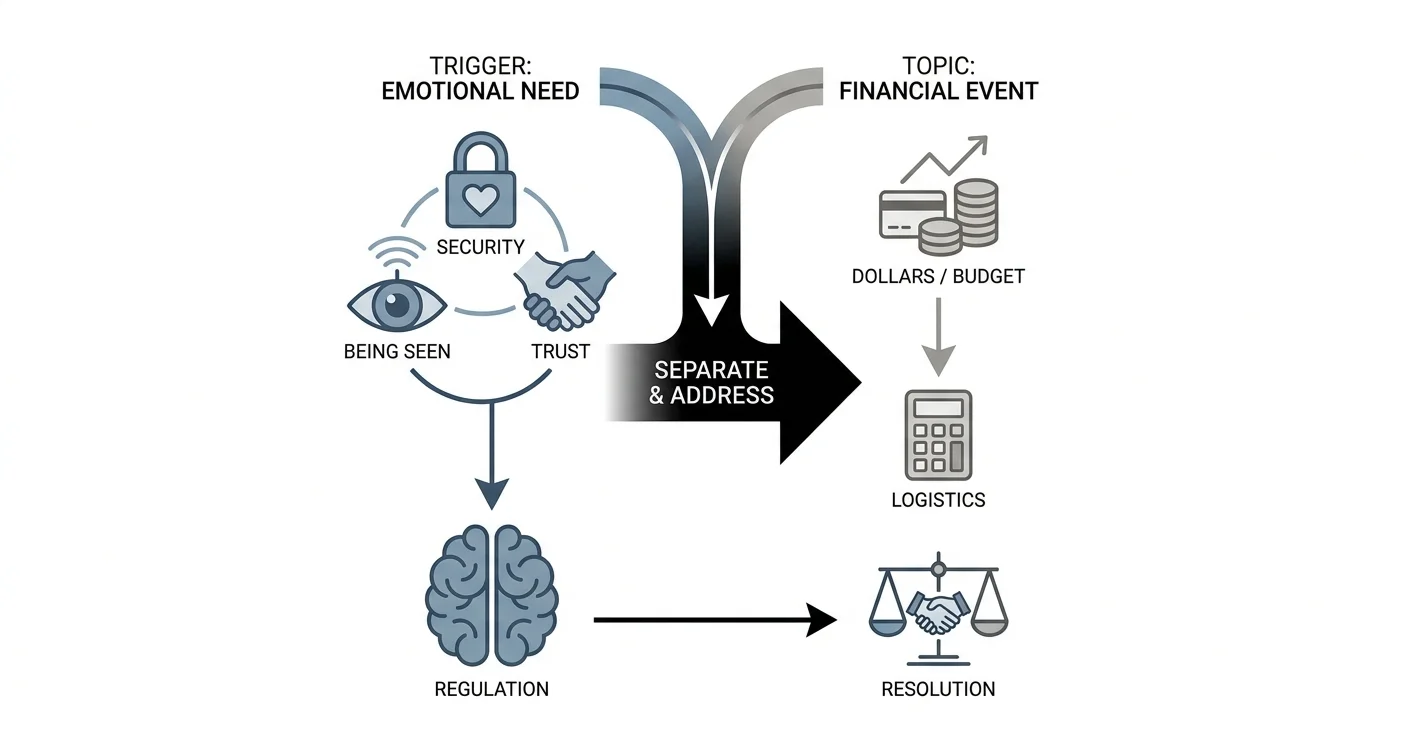
Money fights rarely start with money. They start with a bounced-back feeling of not being safe, not being seen, or not being trusted, and the argument just happens to use a credit card statement as the weapon. This guide breaks the pattern into steps you can run this week, not therapy theory you'll forget by Friday.
TL;DR
- Most couples aren't fighting about dollars, they're fighting about security and control -- name that first.
- Scheduled 20-minute money talks beat ambush conversations; timing changes the outcome more than wording does.
- If one partner shuts down mid-fight, that's stonewalling, not stubbornness, and it needs a different fix than 'talk it out.'
- A scarcity mindset and an abundance mindset read the same bank balance completely differently -- that gap is often the real fight.
- Couples who separate the money talk from the money mindset stop fighting about money in a relationship within a few structured conversations, per relationship-pattern research summarized across 2026 clinical resources.
Why this matters
Money disagreements are the second most cited source of relationship conflict in most couples' therapy intake data, right behind communication itself -- and the two are tangled together more than people realize. When you're broke and scared, or one partner earns more and feels entitled to more say, the fight isn't logistical. It's about power, safety, and whether you trust each other's judgment.
A lot of couples try to fix this with a better budget spreadsheet. That misses the point. The spreadsheet doesn't fix the moment one partner feels dismissed and the other feels micromanaged. If your money conversations keep spiraling into old grievances, the pattern underneath is worth naming before you touch a single number -- start with whether either of you is operating from a scarcity mindset instead of an abundance one, because that lens shapes every dollar conversation you have in 2026 and beyond.
What you'll need
- 20-30 uninterrupted minutes, scheduled, not ambushed
- A notebook or shared doc for numbers, not memory
- Both people's actual account access or statements, no guessing
- A calm-down plan for when the conversation gets hot
- Optional: a private space to talk through your own reactions before or after the conversation, which is where an AI voice companion like Lovon's can help you rehearse what you actually want to say
The steps
1. Separate the trigger from the topic
Before you talk numbers, figure out what actually spiked your heart rate. Was it the amount, or was it the feeling that your partner acted without you? Write down the emotion in one sentence: "I felt controlled" or "I felt judged" or "I felt scared we're behind."
This matters because couples who skip straight to solutions end up re-litigating the same argument every month. Name the feeling first, out loud or on paper, and the conversation that follows gets shorter. Common mistake: starting the talk with "you spent" instead of "I felt" -- that framing alone determines whether your partner gets defensive in the first ten seconds.
2. Schedule the talk, never ambush it
Pick a specific day and time this week, ideally when neither of you is hungry, exhausted, or mid-scroll on a bank app. Ambush conversations -- the kind that start with "can we talk about the credit card" right after dinner -- trigger a fight-or-flight response before either of you says a real sentence.
A scheduled 20-minute slot, twice a month, outperforms spontaneous blowups almost every time because both partners arrive regulated instead of reactive. Set a timer. Common mistake: letting the talk run past 30 minutes -- fatigue turns problem-solving into rehashing.
3. Use one voice at a time, literally
One person talks about their financial worry for two minutes uninterrupted. The other repeats back what they heard before responding. This isn't a gimmick -- it's the single fastest way to stop a money conversation about how to stop fighting about money in a relationship from turning into two monologues.
Say "what I heard you say is..." before you defend yourself. It slows the exchange down enough that both people feel heard instead of out-argued. Common mistake: using the repeat-back step to sneak in a rebuttal -- that defeats the entire point.
4. Name your money mindset out loud
Someone raised on financial instability often defaults to hoarding or panic-checking balances. Someone raised with more cushion might spend more freely and not understand why that reads as reckless to their partner. Neither is wrong; they're running different operating systems.
Say it plainly: "I check the account every day because growing up we ran out." That single sentence reframes years of "nagging" as fear, and years of "carelessness" as a different kind of upbringing. Couples who skip this step keep fighting about the same $40 purchase for years.
5. Watch for the pursuer-withdrawer flip
One partner brings up money and pushes for a decision now. The other goes quiet, changes the subject, or leaves the room. That's not indifference -- it's the pursuer-withdrawer pattern showing up with a dollar sign attached, and it escalates every time the pursuer pushes harder and the withdrawer retreats further.
Break it by agreeing on a signal -- a word or hand gesture -- that means "I need five minutes, I'm not leaving the conversation." That single agreement stops more fights than any budgeting app. Common mistake: treating the withdrawal as proof your partner doesn't care, which usually isn't true.
6. Handle shutdown without escalating
If your partner goes silent, stares at the wall, or gives one-word answers mid-money-talk, pushing harder rarely works. That's a nervous system in shutdown, not a partner ignoring you on purpose, and the fix is handling a partner who shuts down during conflict with a pause, not pressure.
Say "let's take 15 minutes and come back to this" instead of repeating the question louder. Pressure during shutdown extends the shutdown; space shortens it. Common mistake: interpreting silence as agreement and moving forward on a decision anyway.
7. End every talk with one concrete decision
Close with one action item, written down: "We're moving $200 into savings on the 1st" or "We're checking in again in two weeks." Vague endings like "let's just be better about this" produce zero behavior change and guarantee a repeat fight.
One decision per talk keeps momentum without overwhelming either partner. Common mistake: trying to solve every financial issue in one sitting -- that's how 20-minute talks become two-hour arguments.
Practice the hard conversation first
Talk it through with Lovon's AI voice companion before you bring it to your partner.
Troubleshooting
- The talk always turns into a fight within five minutes. You're skipping step one. Name the feeling before the number, every single time.
- One partner always ends up crying or shutting down. Shorten the session to 15 minutes and split it into two shorter talks per week instead of one long one.
- You agree in the moment but nothing changes. You're skipping the concrete-decision close. Write the action item where you'll both see it -- a shared note, a calendar reminder.
- The same argument resurfaces every few months. The underlying mindset gap (scarcity vs. abundance) was never addressed, only the symptom.
- Your partner refuses to schedule a talk at all. Ask for five minutes to name one worry, not a full financial audit -- lower the ask before raising the stakes.
- You feel resentful before the conversation even starts. That resentment is data. Process it privately first so you're not detonating it mid-talk.
Tools and resources
- A shared budgeting doc or app, updated weekly, not from memory
- A recurring calendar block for the money talk, protected like any other appointment
- Structured communication steps for the weeks when money isn't the only thing on the table
- Boundaries around spending decisions that both partners agree to in writing, not just verbally
- Lovon's AI voice sessions, for rehearsing what you want to say before the real conversation or decompressing after a hard one
What to do next
If money fights are one symptom of a bigger communication breakdown, don't stop here. Work through the full 9-step guide to communicating better in a relationship next -- the money talk gets easier once the underlying communication pattern is fixed.
FAQ
How do you stop fighting about money in a relationship?
You stop by separating the emotional trigger from the dollar amount, scheduling short talks instead of ambushing each other, and ending every conversation with one concrete decision. Most couples fight about the feeling behind the money, not the number itself.
Why do couples fight about money so much?
Money fights are usually about security, control, or trust, not the actual dollars. Two people raised with different financial upbringings often carry opposite instincts around spending and saving, which surfaces as conflict.
What is the pursuer-withdrawer pattern in money arguments?
It's when one partner pushes to resolve a money issue immediately while the other retreats or goes silent, and the pushing makes the withdrawal worse. Naming the pattern out loud and agreeing on a pause signal breaks the cycle.
How often should couples talk about finances?
A short, scheduled 20-minute check-in twice a month works better than sporadic long talks. Consistency lowers the emotional stakes of each individual conversation.
What do you do when your partner shuts down during a money talk?
Pause the conversation instead of pushing harder -- shutdown is a nervous system response, not agreement or disinterest. Offer a specific time to come back to it, like 15 minutes, rather than dropping the topic entirely.
Is it normal to fight about money in a healthy relationship?
Occasional disagreement is normal; the pattern matters more than the frequency. If disagreements stay respectful and end with a decision, that's healthier than avoiding the topic altogether.
Can an AI therapist help with money conflict in a relationship?
An AI voice therapist can help you process the emotional charge before or after a money talk and rehearse how to raise a concern calmly. It works alongside the conversation with your partner, not as a substitute for it.
What's the difference between a scarcity mindset and an abundance mindset in money fights?
A scarcity mindset treats every dollar spent as a threat to safety, while an abundance mindset assumes there will be enough. Couples with mismatched mindsets often mistake each other's instincts for carelessness or control.
One last thing
The couples who stop fighting about money in a relationship rarely do it by earning more or spending less. They do it by catching the pursuer-withdrawer flip within the first sixty seconds of a talk, before either partner's nervous system fully locks into fight or flight. That single catch, repeated over a few months in 2026, does more than any budget ever will.
Related guides
How AI Support Helps You Heal
AI emotional support isn't about replacing human connection — it's about filling the gaps. The moments when you need to talk at 2 AM, when you don't want to burden your friends again, or when you simply need someone to listen without judgment.
Here's what happens in a typical Lovon session:
You share what's on your mind
There's no script, no intake form, no waiting room. You speak or type whatever you're feeling — in your own words, at your own pace.
Lovon validates and explores
Using frameworks from CBT (Cognitive Behavioral Therapy) and motivational interviewing, Lovon acknowledges your feelings first, then gently helps you explore them. No dismissive "just move on" advice.
You build coping skills together
Lovon doesn't just listen — it actively works with you on evidence-based techniques: thought reframing, urge surfing, behavioral experiments, and more.
What a Session with Lovon Looks Like

When to Seek Professional Help
AI support is a valuable tool, but it's not a replacement for professional care. Please consider reaching out to a licensed therapist if you experience any of the following:
- Persistent thoughts of self-harm or suicide
- Inability to perform daily activities (work, eating, sleeping) for more than 2 weeks
- Turning to alcohol or substances to cope
- Intense anger or desire to harm your ex-partner
- Complete emotional numbness that doesn't improve over time
Crisis Resources (US): If you're in immediate danger, call 988 (Suicide & Crisis Lifeline) or text HOME to 741741 (Crisis Text Line). Available 24/7, free, and confidential.
Outside the US? Find a crisis line in your country
Ready to Start?
Your healing journey can begin right now
A 7-day trial. No judgment. Just a safe space to process what you're going through.
Frequently Asked Questions
Is Lovon a replacement for a real therapist?
Is my conversation with Lovon AI private?
How is Lovon different from ChatGPT for emotional support?
Can I use Lovon if I'm already seeing a therapist?
Can I try Lovon before subscribing?
About the Author

The Lovon Editorial Team
Mental Health & Wellness Content Team
The Lovon Editorial Team develops mental health and wellness content designed to make psychological concepts accessible and actionable. Our goal is to bridge the gap between clinical research and everyday life - helping you understand why your mind works the way it does and what you can do about it....
Related articles
- AI Relationship Coach for Reconnecting After Separation
Lovon's AI relationship coach for reconnecting after separation lets you rehearse tough messages by voice in 2026, not a…
- AI Relationship Coach for Newlyweds: 2026 Verdict
The best ai relationship coach for newlyweds in 2026 is voice-based and available on demand. See picks, what to avoid…
- AI Relationship Coach for Open Relationships (2026)
Lovon's AI relationship coach for open relationships handles jealousy check-ins and boundary rehearsal in 2026 — see…
- Is couples therapy worth it if one partner refuses?
Is couples therapy worth it if one partner refuses? Individual support can help you decide what to do, but it cannot…
See also
Quizzes
- Am I Sabotaging My Relationship? 12-Question Quiz
Find the move you reach for, in 2 minutes.
- Is My Relationship Healthy? 15-Question Check-In
Check your relationship health in 3 minutes.
Free tools
- Conflict Script Builder
Pick the situation and what you want out of it, and get three lines you can say out loud: an opener, a response for when…
- How to Reconnect With Your Partner
Nothing is wrong enough to name, which is why it has gone unaddressed. Tell it what it looks like now and roughly when…
From the wiki
- What does clingy mean in a relationship?
Clingy is what people call behavior that asks for more contact or reassurance than the other person wants to give…
Disclaimer: This article is for informational purposes only and does not constitute medical advice, diagnosis, or treatment. Always seek the advice of your physician or other qualified health provider with any questions you may have regarding a medical condition. If you are in crisis or think you may have an emergency, call 988 (Suicide & Crisis Lifeline) or go to the nearest emergency room. Outside the US? Find a crisis line in your country.