
How to Get Over Your First Love, Even Years Later
How to get over your first love: why it hits harder than later breakups, how to separate the person from the era, and what to do when they reappear.

Key Takeaways
- First love hits hard because it happens while your identity is still forming, packs many firsts into one person, and is often the first big loss you have faced.
- Getting over it means separating the person from the era and grieving who you were back then, not erasing the memory.
- Thinking about a first love years later is common and often says more about your life now, like loneliness or a distant relationship, than about them.
Yes, you can get over your first love, though you will probably never forget them, and forgetting is not the goal. First love is hard to get over because it happens while you are still becoming yourself, it packs a dozen firsts into one person, and it is often the first real loss you have ever had to survive. Getting over it means separating the person from the time of your life they belonged to, grieving who you were back then, and letting the memory become part of your story instead of the yardstick for every relationship after it.
Why is first love so hard to get over?
People who say "you were just kids" are skipping over what actually happened. A first love tends to hit harder than later breakups for a few specific reasons.
It was your first template for romantic love
Before your first love, romance was something from movies and other people's lives. Then it was yours: what it feels like to be someone's person, how a partner shows they care, what a fight sounds like and how it ends. That relationship becomes the reference point your mind quietly uses for everything after it.
Your attachment patterns started long before that, with the people who raised you. First love is usually the first time you see those patterns play out with a partner, which is why it can feel like it rewired you. If you have never looked at your own pattern, the attachment style quiz is a good place to start.
It happened while you were becoming you
Memory research has a name for why that stretch of life stays so vivid. When older adults look back, the years from roughly 10 to 30 give them the most memories, the most vivid ones, and the ones they rate as most important. It is also where most people's favorite music, films, and books come from. Psychologists call this the reminiscence bump.[1] One explanation is that this is when identity takes shape. In one study, people wrote short "I am..." statements about themselves and then recalled memories linked to each one. The memories clustered around the time that part of their identity first appeared.[2]
A first love usually lands right inside that window, so it is not stored as "someone I dated." It is filed next to the year you found the music you still love and started to guess what kind of adult you might become. That is why a song from that summer can still knock the wind out of you.
It packed a dozen firsts into one person
First kiss. First "I love you." Maybe the first time you had sex, the first trip without your parents, the first time someone chose you out of everyone. When one person is attached to that many landmarks, they show up every time you revisit any of them.
It was probably your first big loss
The first time your heart breaks, you have no proof that you will survive it. Later breakups hurt, but part of you knows from experience that the floor comes back. The first one gives you no such reassurance, so it can feel endless.
It often comes with being told it does not count. Researchers who study teenage relationships have pushed back on the old assumption that they are trivial and short-lived, arguing that they matter for how young people develop.[3] Hearing "it was just puppy love" does not make it hurt less. It mostly makes you grieve alone.
It made your world bigger, so losing it made your world smaller
New relationships expand your sense of self: new people, new places, new interests, a new way of seeing yourself. Across three studies, researchers found that the more a relationship had expanded someone's sense of self, the more that sense of self shrank after the breakup.[4] A first love is often the most expanding relationship a person ever has, because almost everything about it is new. When it ends, it can feel like a whole room of your life has been locked.
First heartbreak as a teen, in your 20s, or later
The same loss lands differently depending on when it happens.
| When it happened | What makes it hard | What helps most |
|---|---|---|
| In high school | You still see them in the same hallways and group chats, you cannot move away, and adults may shrug it off | One adult who takes it seriously, a plan for the hardest spots at school, and less time on their profile |
| In college or your early 20s | You built your first adult life together, often with shared plans: a city, an apartment, a future | Making your next big decisions on your own terms, so your adult life stops feeling co-signed by them |
| Later in life | It may be the first time you felt this at all, or the first relationship you could live openly | Knowing that the capacity to love like that is yours. It did not leave with them |
If your first real love came at 35, after a marriage that never felt like this, or after coming out, the fear is often "that was my one chance." It was not. You found out you can feel that way, and that knowledge stays with you.
How to get over your first love
The general breakup advice still applies, and how to get over a breakup covers the first days and weeks in detail. These steps are about what makes a first love different.
Separate the person from the era
Take a page and draw a line down the middle. On one side, write what you miss about them. On the other, write what you miss about that time: being 19, living ten minutes from your best friends, no rent, summer nights with nowhere to be. For many people the second list is longer. Part of what you are mourning is a chapter of your life, and no one could give that back to you, including them.
Grieve the version of you that existed then
You may miss who you were in that relationship as much as the person: braver, more open, willing to drive two hours to see someone for one evening. Name that version of yourself. Then ask which parts you want back. Openness and spontaneity were not a gift from your ex. They were yours, and you can practice them again with new people and in new places.
Give the story an ending
First loves often end without a clean reason. Someone moved away for college, you grew in different directions, it faded over a long summer. Without an ending, your mind keeps writing new ones at 2 a.m. Write the ending yourself in a letter you never send: what it meant, what hurt, what you wish you had said, and goodbye. The unsent letter to your ex walks you through it.
Stop using them as the measuring stick
A new partner will not feel like your first love, because nothing will ever feel first again. Calmer is not the same as less. If you catch yourself comparing someone's third month to your first love's highlight reel, tell yourself: "That is a memory from when everything was new. This is a real person I am getting to know now." Compare new people to what you need, not to who came first.
Turn down social media and mutual friends
A survey of 464 people found that those who kept checking an ex's Facebook page reported more distress about the breakup, more longing for the ex, and less personal growth.[5] Mute or unfollow them, hide them from your photo memories, and stop looking up who they are dating now. If you share a hometown friend group, tell one or two friends: "I'm not ready to hear about her yet. Can you not bring her up for a while?"
Make the memory safe to visit instead of trying to erase it
You cannot delete a first love from your memory, and fighting every thought of them tends to keep them on your mind. Aim for a memory that no longer pulls you under: you think of them, feel a small ache or even something warm, and go back to your day. A guided practice like the letting go meditation helps you sit with the memory without getting lost in it.
There is no set number of weeks or months for this. What matters is the trend: the memory shows up less often and hurts less when it does. For why heartbreak can hurt physically and what helps it mend, how to heal a broken heart goes deeper.
When you still think about your first love years later
This is very common, and it does not automatically mean you are still in love. Often it means something in your life right now is reaching back.
In a series of studies on nostalgia, researchers found that low mood was a common trigger, with loneliness standing out, and that feeling nostalgic tended to lift people's mood and make them feel more connected to others.[6] So a wave of thoughts about your first love during a lonely winter or a rough stretch at work may be your mind reaching for a time you felt wanted and alive. It is often more about now than about them.
The same goes if you are in a relationship. A study that followed people in relationships over six months found that when their relationship quality dropped, their longing for an ex went up.[7] If your first love keeps showing up while your current relationship feels distant, look at the distance directly instead of treating the thoughts as proof you picked the wrong person.
Here is a rough way to tell a memory from an open wound.
More like a memory:
- You think of them now and then, usually when something reminds you
- You feel warmth, a small ache, or not much, and it passes
- You hope they are doing well, or you honestly do not know how they are
More like something unfinished:
- You check their profile regularly or know what they did last weekend
- You compare every partner to them, and everyone loses
- You replay specific conversations and rewrite how they should have gone
- You would drop a lot if they texted tonight
If you lean toward the second list, the Am I Over My Ex? quiz gives you an honest read, and why do I miss my ex looks at what the missing is really made of. If you cannot tell whether you miss them or just miss not being alone, the Do I Miss My Ex or Am I Just Lonely? quiz helps you separate the two. When the thoughts loop for hours, how to stop thinking about someone has techniques for breaking the cycle.
When your first love comes back into your life
They usually come back in one of three ways.
On social media
An engagement post, a baby announcement, a photo of them happy with someone new. The jolt can be strong even if you had not thought about them in years, because what you lose in that moment is a "maybe" you did not know you were still carrying. Let yourself feel it, then mute or unfollow if you need to. You do not have to like the post.
At a wedding, a reunion, or back home for the holidays
Decide ahead of time how you want it to go. A short, warm line works: "It's really good to see you. I hope things are going well." Know how long you will stay in the conversation and have an easy way out: "I'm going to grab a drink. Good seeing you." If you can, bring a friend who knows the history. Feeling shaky on the drive home is normal and does not mean anything has to change.
When they message you
"Hey, I was just thinking about you" after six years can feel like a door opening. Before you answer, ask yourself what you actually want from this, then pick a reply that matches:
- Friendly, door closed: "Hey, good to hear from you. I hope you're doing well."
- No reply: a complete answer too, especially if you are still healing or in a relationship.
- Genuinely open: "It's nice to hear from you. Want to get coffee sometime and catch up properly?"
If either of you is in a relationship, be honest with yourself about what reconnecting would mean before anything starts. The how to respond to "I miss you" tool helps you find words that match what you mean. If you are seriously wondering about trying again, the Should I Get Back With My Ex? quiz looks at how things ended, not just how they felt.
Is "the one that got away" real?
Sometimes, yes. Two people can be right for each other at the wrong time, and some people do reconnect with a first love years later and make it work.
More often, the story has been edited. Research on regret found that, over the long run, people regret what they did not do more than what they did.[8] A first love that ended before it had the chance to become ordinary tends to sit in that "did not do" column. It never had to survive rent, chores, boredom, or a move across the country. It has no bad chapter, because that chapter was never written.
Try this test. Write a realistic version of the next five years with them, starting tomorrow. Not the movie version: who they are now (which you mostly do not know), where you would live, what you would argue about. If the fantasy only works while it stays vague, it is a longing for a feeling, not a plan with a person. If you are both single and you truly still wonder, one honest, low-pressure conversation beats years of what-ifs. Just go in knowing you are meeting who they are now, not who they were at 19.
If you were the one who left
Leaving your first love brings its own grief, mixed with guilt. You can miss someone you chose to leave, and missing them does not mean you made a mistake. People change fast in those years, and someone has to say it first.
If you hurt them badly, by cheating, disappearing, or ending it cruelly, a short apology can help, but only if it is for them and you expect nothing back. For example: "I've thought about how I ended things, and I'm sorry. You deserved better than that. You don't need to reply." Do not use it to reopen the relationship or to get forgiveness on your schedule. If you mostly need to get the guilt out, put it in a letter you keep.
When it is more than heartbreak
A first heartbreak is not an illness, but for some people it can tip into something heavier, especially in the teen years. In a study of nearly 1,500 older teenagers, a recent romantic breakup was linked to a higher chance of a first episode of major depression.[9]
Talk to a doctor, a licensed therapist, or a school counselor if for weeks you cannot sleep or eat properly, cannot keep up with school or work, or cannot enjoy anything at all, or if the sadness keeps getting heavier instead of lighter. If you are a teenager, telling a parent or another adult you trust is a strong first step, even if it feels awkward.
If you are having thoughts of hurting yourself or of not wanting to be here, call or text 988 in the US right now, or tell someone near you.
What your first love leaves you with
In a study of college students who had recently been through a breakup, people listed on average five kinds of personal growth they thought would help their future relationships.[10] First love often teaches the most, because it is where you learned so much of it for the first time: that you are capable of loving that much, what it feels like to be treated well or badly, and what you will not settle for next time. Getting over it means keeping what it taught you and letting the rest become a memory.
Part of what keeps a first love stuck is that it rarely gets said out loud, because people assume you should be over it by now. If it is still on your mind, say it to your Lovon coach, an AI relationship coach you talk to by voice, and work out what you are really holding onto: the person, the era, or the version of you who loved them.
How AI Support Helps You Heal
AI emotional support isn't about replacing human connection — it's about filling the gaps. The moments when you need to talk at 2 AM, when you don't want to burden your friends again, or when you simply need someone to listen without judgment.
Here's what happens in a typical Lovon session:
You share what's on your mind
There's no script, no intake form, no waiting room. You speak or type whatever you're feeling — in your own words, at your own pace.
Lovon validates and explores
Using frameworks from CBT (Cognitive Behavioral Therapy) and motivational interviewing, Lovon acknowledges your feelings first, then gently helps you explore them. No dismissive "just move on" advice.
You build coping skills together
Lovon doesn't just listen — it actively works with you on evidence-based techniques: thought reframing, urge surfing, behavioral experiments, and more.
What a Session with Lovon Looks Like
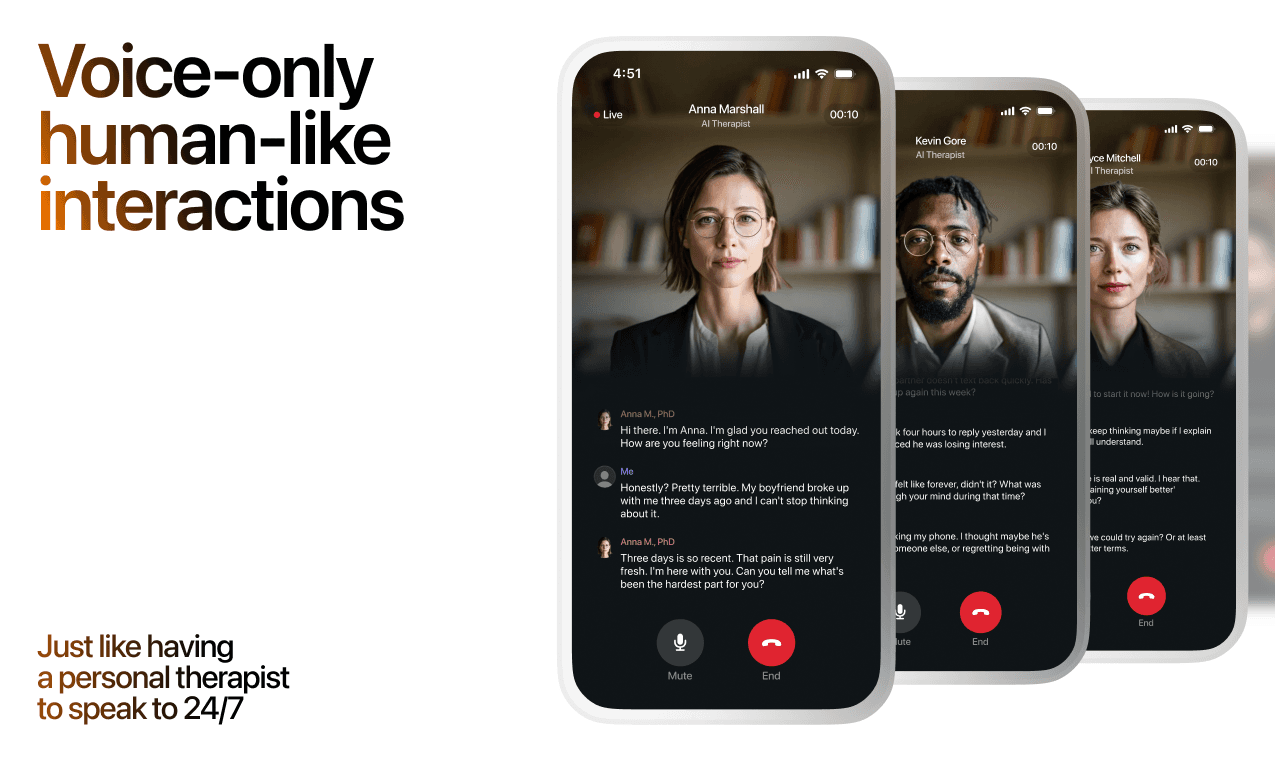
Lovon is AI support, not a replacement for professional care. If things have been hard to get through for weeks, or you are thinking about harming yourself, talk to a doctor or a licensed therapist.
Ready to Start?
Your healing journey can begin right now
A 7-day trial. No judgment. Just a safe space to process what you're going through.
Frequently Asked Questions
Can you ever get over your first love?
Why is first love so hard to get over?
How do you forget your first love?
Is it normal to still think about your first love years later?
How long does it take to get over your first love?
Should I reach out to my first love?
Is your first love always your strongest love?
Why do I think about my first love when I am happy in my relationship?
Sources
About the Author
The Lovon Editorial Team
Mental Health & Wellness Content Team
The Lovon Editorial Team develops mental health and wellness content designed to make psychological concepts accessible and actionable. Our goal is to bridge the gap between clinical research and everyday life - helping you understand why your mind works the way it does and what you can do about it....
Related articles
- Should I Break Up With Him Quiz: Honest 2026 Check
An honest should i break up with him quiz that scores real patterns, not moods. Get a clear verdict in 2 minutes and…
- 12 Evidence-Based Steps to Get Over Someone You Love
Heartbreak after a breakup and the struggle with letting go overwhelm many people. We wish there were a magic spell that…
- How to Break Up With Someone You Live With: Scripts and Plan
How to break up with someone you live with: what to sort out first, what to say, where to sleep tonight, house rules…
- How to Let Go of Someone You Love & Move On Gracefully
Letting go of someone you love is one of the hardest things. Sometimes you may feel okay, but then you walk down the…
See also
Quizzes
- Am I a Rebound? Quiz: Signs of a Rebound Relationship
Read the rebound signs honestly, in 3 minutes.
- Will My Ex Come Back? An Honest Quiz on the Signs
Read the real signs, honestly, in 3 minutes.
Free tools
- Breakup Message Writer
A chat for saying it once. Tell it how long it has been and why now, and get a message you could actually send, plus the…
- Breakup Meditation
For when it's over and it still hurts. Seven minutes of slow breathing, noticing where the breakup sits in your body…
From the wiki
- How to leave a toxic relationship?
Leaving a toxic relationship is rarely a decision problem — you usually know. What stops you is that the pull toward…
Disclaimer: This article is for informational purposes only and does not constitute medical advice, diagnosis, or treatment. Always seek the advice of your physician or other qualified health provider with any questions you may have regarding a medical condition. If you are in crisis or think you may have an emergency, call 988 (Suicide & Crisis Lifeline) or go to the nearest emergency room. Outside the US? Find a crisis line in your country.