
How to Heal a Broken Heart: Why It Hurts and What Helps
How to heal a broken heart after a breakup, a betrayal or love that was never returned: why heartbreak physically hurts, and a daily practice that helps.

Key Takeaways
- Heartbreak can feel physical because rejection draws on some of the same brain regions as physical pain, though the brain patterns for the two are not identical.
- Self-compassion, rebuilding your own sense of who you are, an honest view of what went wrong, and putting the pain into words all have research behind them.
- Broken heart syndrome, or takotsubo cardiomyopathy, is a real heart condition, so chest pain or shortness of breath means calling 911, not waiting it out.
A broken heart heals through time plus a few specific things you do with that time: speaking to yourself kindly instead of harshly, rebuilding the parts of your life that were wrapped around the other person, and slowly changing the story that keeps the longing alive. The ache is real. Rejection and loss draw on some of the same brain systems as physical pain, which is why being heartbroken can sit in your chest like an injury.
This guide is about the heart itself: why it hurts, the kinds of loss that break it, and what helps it mend. If you need a day-by-day plan for the first weeks after a breakup, that lives in how to get over a breakup.
Why a broken heart physically hurts
People who are heartbroken rarely describe it as only sad. They describe a weight on the chest, a stomach that drops when a name comes up, and a body that is exhausted but will not sleep. Researchers have spent two decades asking whether "it hurts" is more than a metaphor.
What the brain research found
In an early brain-imaging study, people played a simple ball-tossing game inside a scanner until the other players stopped throwing the ball to them. Being left out increased activity in the anterior cingulate cortex, a region also involved in how distressing physical pain feels, and the more active it was, the more upset people said they were.[1]
A later study recruited people who had recently gone through a breakup they did not want. In the scanner, they looked at a photo of their ex while thinking about being rejected, and in another part of the session they felt painful heat on the arm. Looking at the ex activated regions that usually handle the bodily, sensory side of physical pain, and those regions overlapped with the ones the heat activated.[2]
The honest caveat
It is tempting to read that second study as "heartbreak hurts exactly like a burn," and that goes too far. When some of the same researchers came back to the question with finer pattern-matching methods in 60 people, the brain patterns for heat pain and for looking at an ex turned out to be distinct. A pattern trained to recognize one could not recognize the other, even inside regions that both experiences activate.[3] The fair summary is that heartbreak and physical pain share neighborhoods in the brain, not the same signal.
For you, that means two things. Your pain is not imaginary or dramatic: it is a real, whole-body response to losing someone. And it is not damage. A broken heart needs care, people, and time to rewire the habits that were built around another person.
Broken heart syndrome is something else
Broken heart syndrome is a real heart condition. Its medical name is takotsubo cardiomyopathy, also called stress cardiomyopathy: the heart muscle suddenly weakens, usually after intense emotional or physical stress, and the symptoms can look like a heart attack. In an international registry of 1,750 patients, about 90 percent were women, their average age was about 67, and physical triggers such as an illness or surgery were more common than emotional ones like grief or a shock.[4] It is diagnosed and treated in a hospital, and it can be serious. The everyday ache of heartbreak is not this, but you cannot reliably tell the difference from the inside. If you have chest pain, chest pressure, or shortness of breath, call 911 now and do not wait to see whether it is "just" grief.
Heartbreak is not only about breakups
Plenty of people looking up how to heal a broken heart never had an official relationship. The loss is real either way, and each kind has its own sticking point.
Love that was never returned
Unrequited love hurts in a particular way, because there is no ending to point to. A study that compared people's own accounts of unrequited love found it was distressing for both sides. The people doing the loving often believed the attraction had been mutual, felt they had been led on, and said the rejection was never made clear, while the people who said no felt guilty about causing the hurt.[5]
If that sounds familiar, part of healing is making the ending definite yourself, since it may never be made definite for you. "They are not choosing me, and I am allowed to stop waiting" is a complete sentence. There is more on this in how to get over someone you never dated.
Betrayal
When the heartbreak comes from cheating or a serious lie, you lose the person and also the past you thought you lived. Your mind replays old memories looking for the clues you missed. That is your mind trying to make the story make sense again, not proof that you are obsessed. Healing here means grieving the relationship you believed you had, separately from deciding what to do about the person. How to get over being cheated on covers that in detail.
A situationship ending
No title, no anniversary, and you still cannot breathe properly when they go quiet. Grief researchers call loss that the people around you do not recognize as loss disenfranchised grief. When friends shrug because "you weren't even together," the hurt has nowhere to go. You do not need permission to grieve something that never had a label. If you are still not sure what it was, this guide to situationships helps put words to it.
A friend breakup
Losing a close friend can hurt as much as losing a partner, and there is almost no script for it: no breakup talk, little sympathy, sometimes only a slow fade. Why friendship breakups hurt and how to heal goes deeper on that one.
When you still love the person who broke it
Still loving someone is not a failure to heal. Love does not switch off on command, and it does not have to vanish before you can feel better. Healing means the love loses its grip on your days. If you keep asking yourself why you still miss them, why do I miss my ex breaks down what is going on.
What actually mends a broken heart
Time matters, but time on its own is not the whole answer to how to mend a broken heart. What helps is what you do with the time, and four things have research behind them.
1. Treat yourself like someone you love
The voice in your head after heartbreak is often brutal: you were stupid, you should have seen it coming, nobody will want you now. It feels like honesty. It works like keeping the wound open.
In a study of 109 adults going through divorce, each person talked for four minutes about their separation, and judges rated how much self-compassion they showed. The researchers defined self-compassion as three things: kindness toward yourself, a sense that other people go through this too, and a steady, balanced view of your own feelings. People who showed more of it found that the divorce intruded less on their emotional life at the start of the study, and the difference held up to nine months later.[6] It was one study, about divorce rather than dating, and the authors themselves say it needs to be replicated.
Those three parts turn into three sentences you can say to yourself:
- Kindness: "Of course this hurts. It mattered to me."
- Shared humanity: "So many people have felt exactly this, and they got through it."
- Balance: "This is a very bad week. It is not the rest of my life."
If the words will not come, the self-love meditation walks you through it in a few minutes.
2. Rebuild the "me" that got folded into "us"
Relationships merge lives: shared friends, shared plans, even a shared sense of who you are. When it ends, the part of you that lived inside the relationship goes missing too. Across three studies, people's sense of who they were became less clear after a breakup, and that loss of clarity predicted how distressed they felt.[7]
That clarity can come back. In a study of 210 recently separated young adults, those who answered detailed questions about their breakup at four visits over nine weeks regained more of their sense of self than those who only came at the start and the end, and the regained clarity went along with less loneliness and fewer "we" words.[8]
Try writing three short lists:
- Things I liked or did before them that went quiet.
- Things I only did because of them and can let go of.
- One thing I want now that has nothing to do with them.
Put one item from the first or third list on your calendar this week. And notice how often you still say "we" about your life. It drops as you come back to yourself.
3. Change the story, then change the channel
Longing feeds on an edited memory: the best weekend, the way they looked at you, the future you had planned. In a study of people still upset about a breakup, three strategies were tested right before people looked at a photo of their ex. Thinking about the ex's negative qualities lowered love feelings but made people feel worse in the moment. Distraction lifted their mood but did not change the love. Accepting the love feelings as they were changed neither, though all three strategies reduced how strongly the photo grabbed their attention.[9]
So use two tools for two different jobs:
- When the longing is loud, reread an honest list of what was not working, what you gave up, and how you felt on the bad days. Keep it in your phone notes. It will sting a little, and that is how it loosens the pull.
- When your mood is the problem, change the channel to something that needs your hands or your full attention. More on how below.
4. Give the pain words
Heartbreak that stays unspoken tends to loop. In a study of 145 college students after a breakup, some were randomly assigned to write openly about their feelings about it and others to write in a detached way about impersonal topics. The detached writers had a short-term rise in tension, fatigue, and cold-like symptoms, and the expressive writers did not.[10]
You do not need a perfect method. Write for 15 minutes about what happened and how it felt, without editing, for a few days in a row. Or write the letter you will never send: the unsent letter to your ex gives you a structure and a safe place to put it. Saying it out loud, to a friend or into a voice memo, counts too.
How to distract yourself from heartbreak without burying it
Distraction is a real tool for your mood, as long as you use it on purpose for the hardest hours and not as a wall against ever feeling anything.
- Pick things that take your full attention. Scrolling does not count: it tends to lead straight to their profile.
- Use your body: a walk somewhere new, a swim, a class where someone tells you what to do next.
- Be around people, even in low-stakes ways: a trivia night, helping a friend move.
- Give the grief its own appointment (the practice below), so the rest of the day does not have to carry it.
A 15-minute daily practice for a broken heart
Heartbreak leaks into everything when it has nowhere to go. A short practice at the same time each day gives it somewhere. Pick a fixed time that is not right before bed.
Check in with your body (2 minutes)
Sit down and notice where the heartbreak is today: chest, throat, stomach. Put a hand there. Breathe in for a count of four and out for a count of six, a few times. You are not trying to make the feeling leave, only to stop bracing against it.
Say the three sentences (2 minutes)
Kindness, shared humanity, balance. Say them out loud if you can: "Of course this hurts. Other people have felt this and come through it. Today is hard, and today is not forever." Change the words until they sound like you.
Write it out (8 minutes)
Pick one prompt and write without stopping. What do I miss most today? What am I still hoping for? What will I not miss? What did this teach me about what I need? Some days you will cry. That is the practice working, not failing.
Do one thing that is yours (3 minutes)
Choose one small thing from your "me" list and do it or schedule it: text a friend you drifted away from, sign up for the class, play the music they never liked. Small counts.
Then close the notebook and leave the heartbreak there until tomorrow. If you would rather listen than write, try the breakup meditation in place of the first two steps.
What slows a broken heart down
A few habits feel like coping and quietly keep the wound open:
- Waiting for closure from them. An apology or explanation may never come, and if it does, it rarely lands the way you imagined. Closure you give yourself is the kind you can count on.
- Forcing yourself to hate them. Anger is often part of grief, and it can be healthy. Trying to turn love into hate on a schedule usually keeps them at the center of your thoughts.
- Turning the breakup into a verdict on you. "I am unlovable" is a feeling that comes with heartbreak, not a fact it proved.
- Rushing a replacement. Someone new can feel like relief, but it does not grieve the old loss for you, and it can make the next goodbye heavier.
The feelings tend to move in rough stages that loop back on themselves, so a bad week after a good one is normal. The stages of a breakup maps them out.
How to know your heart is healing
Healing is uneven, so judge it by the trend over weeks, not by any single day. Signs your heart is mending:
- The ache comes in waves with real gaps between them, instead of sitting on you all day.
- A song, a street, or their name costs you a few minutes instead of the whole evening.
- Food tastes like food again, and you can laugh without feeling guilty about it.
- You can tell the story of what happened without your voice cracking every time.
- You say "I" about your plans more often than "we."
- You no longer need them to understand, apologize, or come back in order to feel okay.
- Bad days still happen, and you stop reading them as proof you are back at the start.
For a read that is more honest than your mood on any given night, the am I over my ex quiz takes about two minutes. For small, everyday things that hold you up while your heart mends, from sleep to food to your phone, see self-care after a breakup.
When heartbreak needs more than time
You cannot force yourself to stop being heartbroken, but the weight should slowly get lighter. Talk to a doctor or a licensed therapist if, after several weeks, any of these are true:
- It is not getting any lighter, or it is getting heavier.
- You cannot keep up with work, school, eating, or basic care.
- The numbness has spread to everything, not only the relationship.
- You are drinking or using something every day to get through it.
- The loss has stirred up older grief or trauma that you cannot put back down.
- You are having panic attacks.
These can be signs of depression or anxiety, and both respond well to the right help.
If you are having thoughts of hurting yourself or of not wanting to be alive, call or text 988 in the US right now.
Heartbreak often needs to be said out loud more times than feels fair to ask of your friends. When it is late and the ache is back, say it to your Lovon coach, starting with exactly where your heart is today.
How AI Support Helps You Heal
AI emotional support isn't about replacing human connection — it's about filling the gaps. The moments when you need to talk at 2 AM, when you don't want to burden your friends again, or when you simply need someone to listen without judgment.
Here's what happens in a typical Lovon session:
You share what's on your mind
There's no script, no intake form, no waiting room. You speak or type whatever you're feeling — in your own words, at your own pace.
Lovon validates and explores
Using frameworks from CBT (Cognitive Behavioral Therapy) and motivational interviewing, Lovon acknowledges your feelings first, then gently helps you explore them. No dismissive "just move on" advice.
You build coping skills together
Lovon doesn't just listen — it actively works with you on evidence-based techniques: thought reframing, urge surfing, behavioral experiments, and more.
What a Session with Lovon Looks Like
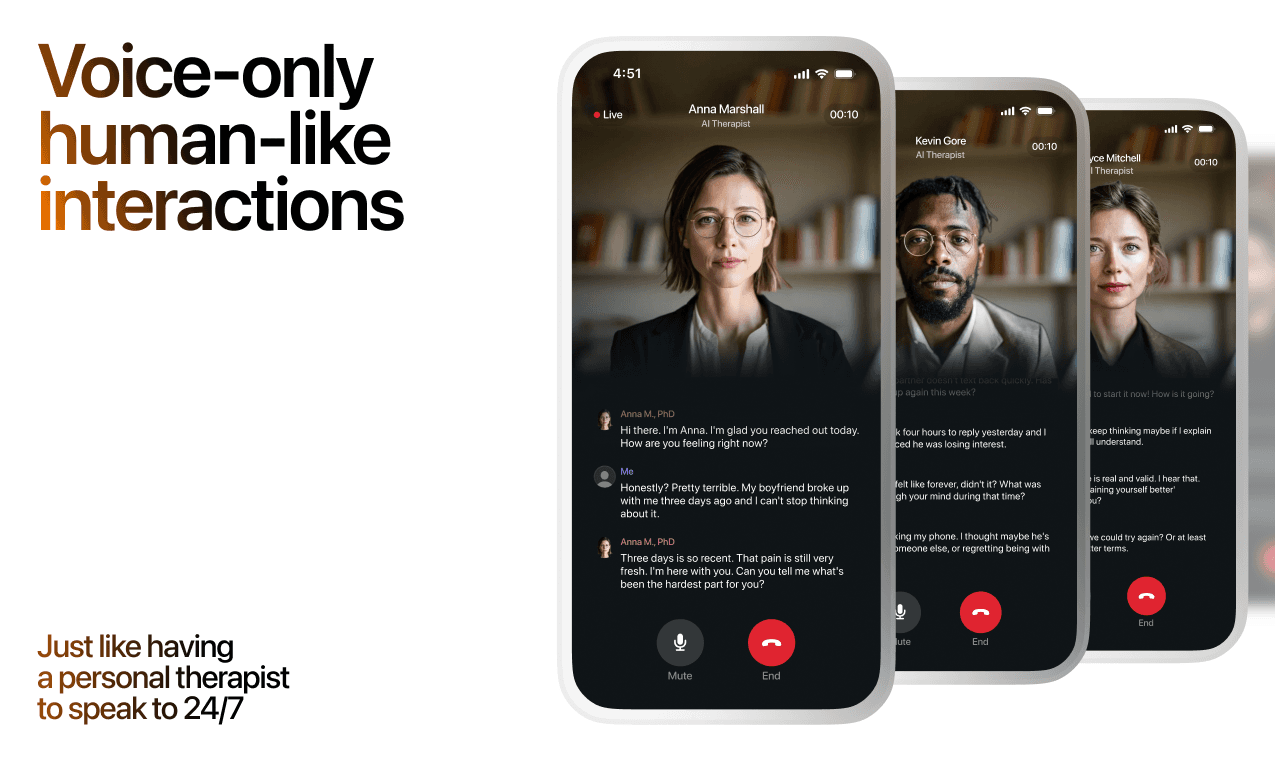
Lovon is AI support, not a replacement for professional care. If things have been hard to get through for weeks, or you are thinking about harming yourself, talk to a doctor or a licensed therapist.
Ready to Start?
Your healing journey can begin right now
A 7-day trial. No judgment. Just a safe space to process what you're going through.
Frequently Asked Questions
What is the medical name for broken heart syndrome?
How do you overcome a broken heart?
How do you distract yourself from heartbreak?
Can a broken heart actually hurt physically?
How long does it take to heal a broken heart?
How do you heal a broken heart if you still love them?
Can you be heartbroken without a breakup?
Sources
About the Author
The Lovon Editorial Team
Mental Health & Wellness Content Team
The Lovon Editorial Team develops mental health and wellness content designed to make psychological concepts accessible and actionable. Our goal is to bridge the gap between clinical research and everyday life - helping you understand why your mind works the way it does and what you can do about it....
Related articles
- Should I Break Up With My Girlfriend? Signs It's Time To Break Up
Many of us believe a relationship will last forever. But at some point, you might start asking yourself a difficult…
- How to Rebuild Trust After Cheating: 2026 Step Guide
How to rebuild trust after cheating in 2026: 7 concrete steps, common mistakes, and a realistic timeline for couples…
- Cope With a Breakup When You Still Love Them (2026)
How to cope with a breakup when you still love them in 2026: set no-contact, process urges out loud, and rebuild…
- 12 Evidence-Based Steps to Get Over Someone You Love
Heartbreak after a breakup and the struggle with letting go overwhelm many people. We wish there were a magic spell that…
See also
Quizzes
- Love Addiction Test: Free 12-Question Self-Check
See how much of your life one person is taking.
- Should I Break Up With My Boyfriend? 12-Question Quiz
Twelve questions on whether the doubt has settled.
Free tools
- How to Respond to a Breakup Text
A chat for the minutes after a breakup text arrives and you have no idea how to respond. Paste what they sent and say…
- Write a Letter to Someone You Lost
Tell it who they were to you and what you never got to say, and it writes the letter back in your words. No account, no…
From the wiki
- What is a break in a relationship?
A break is a temporary, agreed pause in a relationship where both people expect to come back. In practice it usually…
Disclaimer: This article is for informational purposes only and does not constitute medical advice, diagnosis, or treatment. Always seek the advice of your physician or other qualified health provider with any questions you may have regarding a medical condition. If you are in crisis or think you may have an emergency, call 988 (Suicide & Crisis Lifeline) or go to the nearest emergency room. Outside the US? Find a crisis line in your country.