
No Contact Rule: How Long, the Exact Rules, and What to Say
The no contact rule explained honestly: why it works, how long to go, what counts as breaking it, what to do if you slip, and what to say if your ex texts.

Key Takeaways
- The no contact rule means no texts, calls, likes, story views, or updates through friends for a set time, so the craving and the hope have nothing new to run on.
- Thirty, sixty, and ninety days are conventions, not science. Choose the length based on how long you were together and how often you are still checking on them.
- It is a way to get over someone, not a tactic to get them back, and co-parents, coworkers, and roommates can use a low contact version.
The no contact rule means a set stretch of time, often 30 to 90 days and sometimes for good, when you do not text, call, message, like, comment on, or check up on your ex. It works because each small contact restarts the craving and the hope, and without that fuel both fade faster. It is a way to get over someone, not a tactic to get them back, though some exes do reach out while it is happening.
What the no contact rule actually covers
No contact means you stop starting conversations and you stop keeping them going. In practice:
- No texts, calls, voice notes, emails, or DMs, including the "just saw this and thought of you" kind.
- No likes, comments, reactions, or story views. On Instagram, watching their story puts your name in their viewer list, which is contact whether you meant it or not.
- No updates through mutual friends. Asking "how is he doing?" is checking in with extra steps.
- No birthday messages, holiday greetings, or "congrats on the new job."
- No showing up where you know they will be, and no driving past their place.
Looking at their profile does not technically reach them. It still breaks the point, which is to stop feeding the part of you that keeps waiting for news.
There are three versions of this, and it helps to know which one you are doing:
| Version | Who it is for | What it looks like |
|---|---|---|
| No contact | Most breakups with no shared kids, job, or home | Zero messages and zero checking, for a set time or for good |
| Low contact | Co-parents, coworkers, people sharing a lease | Logistics only, one channel, short replies, nothing personal |
| Safety no contact | Exes who scared, controlled, or hurt you | Block everywhere, keep evidence, bring other people in |
Why no contact works
It breaks the intermittent-reinforcement loop
A lot of the pain after a breakup is not missing the person. It is waiting for the next reply. An ex who answers sometimes, warm one night and cold the next, keeps you hooked in a way a clear, steady "no" never would. Behavioral research has shown for decades that a reward that arrives unpredictably keeps a behavior going far longer than a reward that arrives every time. That is the slot-machine effect, and it is why "maybe" is so much harder to walk away from than "no."
Every contact after a breakup is another pull of the lever. A friendly reply on Tuesday buys a week of hope, and a cold one on Friday makes you want to message again to fix it. No contact takes the machine away, and the hope gets quieter.
The craving is real, and it fades without fuel
In a small brain-imaging study, 15 people who had recently been rejected and were still in love looked at a photo of the person who left them. Regions linked to reward, motivation, and craving became active, the same systems involved in wanting something you cannot stop thinking about.[1] That helps explain why the urge to text can feel physical and urgent rather than like a thought you could argue with. The same study found that activity in an attachment-related region was lower the more time had passed since the breakup.
Time does some of the work, unless contact keeps handing the craving something new.
Checking their profile keeps the wound open
A survey of 464 people found that those who kept checking an ex's Facebook page reported more distress about the breakup, more longing for the ex, and less personal growth afterward.[2] A survey cannot prove the checking caused the distress, but most people who have refreshed an ex's profile at 1 a.m. know which way it goes.
It gives you your own life back
Breakups blur your sense of who you are. Researchers found that people's self-concept became less clear after a breakup, and that this loss of clarity predicted how distressed they felt.[3] When your days still orbit around what your ex is doing, there is no room to rebuild the parts of you that went quiet in the relationship. No contact clears that room.
Does no contact work to get your ex back?
Honestly: some exes do reach out during no contact. Silence makes an absence noticeable, and people get nostalgic, lonely, bored, or guilty.
Using no contact as a strategy usually backfires anyway, for three reasons:
- If the goal is their reaction, you will spend every day checking whether it is working. Checking is the exact habit no contact is meant to break, so you end up back in the loop, now with a countdown attached.
- A message on day 34 is not the same as someone wanting to rebuild the relationship. "Hey, how are you?" from a lonely ex is a mood, not a decision.
- It puts the outcome in their hands. If they never reach out, the whole month feels like a failure, even if you spent it getting genuinely better.
Do it for yourself, and treat any contact from them as information rather than a prize. After a month or two of quiet, you will be far better placed to tell whether you want them back or mostly wanted the pain to stop. If you are honestly weighing that, the Will My Ex Come Back? quiz looks at the real signs instead of the hopeful ones.
How long should no contact last?
The 30, 60, and 90-day numbers you see everywhere are conventions that spread through blogs and forums. They are not findings. No study has shown that day 30 is when the brain lets go. Pick a length that fits your situation, then write it down so you are not renegotiating it at 2 a.m.
- 30 days: a short relationship, a fairly clean ending, few shared friends or ties.
- 60 days: a relationship of a year or more, or you are still checking their profile every day.
- 90 days or more: a long relationship, an on-again off-again pattern, cheating, or you have already broken no contact once.
- Open-ended: they were controlling, cruel, or frightening, or you have realized you do not want them in your life at all.
If you hope to be friends someday, go longer, not shorter. Friendship with an ex tends to work, when it works, after the romantic hope is gone, and the hope rarely leaves while you are still talking.
When your end date arrives, nothing says you have to contact them. A better test is whether you could see their name on your phone without your stomach dropping. If you are not sure, the Should I Text My Ex? quiz walks through it question by question.
How to set up no contact: the exact rules
Block, mute, or unfollow?
- Block if they keep reaching out, if you know you will keep checking, or if they were harmful in any way. Blocking is not cruelty, and you do not owe anyone an explanation for it.
- Mute or restrict if you share a friend group and blocking would turn into a whole thing. Muting hides their posts and stories without notifying them.
- Unfollow if you can trust yourself not to go looking.
For their number, block it or rename the contact to something that stops you, like "Do not text" or "Remember why." Archive the chat so it is not sitting at the top of your messages. Turn off location sharing in Find My, Snap Map, or any similar app, and change the passwords on shared accounts like streaming services.
Delete the photos or archive them?
Archive them for now. Deleting everything in the first week feels powerful and is often regretted later, especially photos that also hold your friends and family. Move them to a hidden album or a folder you do not open, or ask a friend to keep them. Both iPhone Photos and Google Photos let you stop a person from appearing in memories, which saves you from a surprise anniversary slideshow. Decide about deleting in a few months, when it is a calm choice and not a statement.
Mutual friends
Tell two or three close friends what you are doing and what you need from them. A simple version:
"I'm doing no contact with Sam for a while. Please don't tell me what he's up to, and don't pass anything along from him. You don't have to pick sides."
Then hold up your side by not asking. If a group event will include your ex, it is fine to skip one or leave early.
Their stuff
Do one handoff, and do it without a conversation: a box on a porch, a friend doing the exchange, or a few minutes in a public place. The text can be one line: "I'll leave your things on the porch Saturday at 10. No need to reply."
To turn all of this into a plan you will actually keep, including the hours you are most likely to slip, the no contact plan builder gives you a dated card with your own if-then rules.
What counts as breaking no contact
Breaking no contact is anything you start or keep going that reaches them, or anything you do to get news about them. These count:
- Texting, calling, DMing, or sending a song, a meme, or "happy birthday"
- Replying with more than logistics
- Liking, commenting on, or viewing their stories
- Asking mutual friends how they are doing
- Showing up where you know they will be
These do not count: answering a genuine logistics question, running into them by accident, or responding briefly to a real emergency. The test is simple. Did you do it to handle something that had to be handled, or to feel close to them for a minute?
What to do if you broke no contact
Most people break it at least once. It does not erase the days behind it, and it does not mean you are bad at this.
- Do not send a second message. The urge to explain the first one ("sorry, I was drunk, ignore that") is just another reason to talk. Let it sit.
- If they replied and a conversation started, close it once. "I shouldn't have reached out. I need space to get over this, so I'm going to step back. Take care." Then stop.
- Find the trigger. Look at the hour before you sent it: the time, where you were, whether you had been drinking, what you had just seen. That is the hour you need a plan for.
- Restart the count only if it helps. Some people like a fresh day one, others find it feels like punishment. What matters is the next stretch of quiet, not the number.
If you keep writing messages to them in your head, write them down somewhere they cannot be sent. The unsent letter to your ex gives the words a place to go.
What to say if your ex contacts you during no contact
You do not have to answer. Silence is a complete response. If you do reply, keep it short, and decide in advance what each kind of message gets.
"Hey" or "I miss you": No reply is fine. If you want to say something: "I'm taking some space right now. I hope you're doing okay."
Logistics: Answer the logistics and nothing else. "Saturday at 10 works for the boxes."
A birthday or holiday message: Silence, or "Thank you." No follow-up question.
They want to talk about getting back together: If you are genuinely open to it, do not slide back in by text. "If you want to talk seriously about us, I'm open to one real conversation, but not yet. Let's talk on the 15th." That gives you time to think with a clear head and tells them it is not a casual thing.
A real emergency or a death in the family: Be kind and brief. Kindness in a crisis does not undo no contact. Pick it back up afterward.
For anything trickier, the what to text your ex tool helps you decide whether to send anything at all and what it should say.
When full no contact is not possible: kids, work, a shared lease
If you share children, a workplace, or a lease, the goal shifts from no contact to low contact. Some people call the style grey rock: short, polite, and factual, so there is nothing to react to and nothing to pull you back in.
The rules:
- One channel only, like email or a co-parenting app, not a mix of texts, calls, and DMs.
- Logistics only: schedules, money, handoffs, the lease, the dog.
- Short replies, sent when you are calm, during normal hours.
- No feelings, no history, no "how have you been."
Example lines:
- Co-parenting: "Pickup is at 5 on Friday. Her soccer bag is in the front pocket of the suitcase."
- Work: "I'll have the slides to you by 3."
- Lease: "I've paid my half of November. The landlord inspection is on the 14th."
If they try to turn logistics into a conversation about the relationship, keep one line ready: "I'm only going to talk about the kids' schedule here." Answer the logistics part and leave the rest. If your co-parent is hostile, what to say back to a hostile co-parent helps you write replies that stay calm.
No contact with a narcissist
If your ex was manipulative in a way that left you doubting your own memory, no contact is usually harder and more necessary. Whatever the label, a few things tend to happen:
- Hoovering. Expect attempts to pull you back once the silence starts: sudden affection, guilt, a crisis only you can fix, messages through friends or family.
- Escalation. Ignoring someone used to getting a reaction can make them louder before they give up.
- Explanations become ammunition. A long message about why you are leaving turns into something to argue with. You do not owe one.
Block on every channel, ask friends not to carry messages, and keep any contact you cannot avoid in writing. The narcissistic abuse guide covers gaslighting and recovery in more depth.
When no contact is about safety
If you are afraid of your ex, no contact is not a healing exercise. It is part of keeping yourself safe, and some of the usual advice changes.
- Save threatening or harassing messages before you block, with screenshots and dates. They may matter later.
- Tell someone you trust what is going on, so you are not handling it alone.
- Do not meet alone for closure or to return things. Use a friend, a public place, or a third party.
- Turn off location sharing and check shared accounts and devices for anything that could track you.
- Ask about a protective order if they threaten you, follow you, or show up uninvited.
If you are in danger right now, call 911. The National Domestic Violence Hotline is 1-800-799-7233, or text START to 88788.
What to do during no contact
The rule is what you stop doing. What fills the space is what gets you through it.
Plan for your hardest hour
Most slips happen at the same times: late at night, after a few drinks, right after a song or a photo. Name yours and decide in advance what you will do instead, like texting one friend "I want to message them," going for a walk, or putting your phone in another room.
Put a delay on the urge
Urges come in waves. Tell yourself you are allowed to decide about texting in 20 minutes, and do something with your hands until then. If you still want to send it, write it in your notes app instead.
Rebuild something that was yours
Go back to one thing that went quiet during the relationship: a sport, a friend you saw less, a place you used to love. It is slower than a distraction, and it is what makes you feel like yourself again.
Let the grief happen
No contact does not create sadness. It makes room for the sadness that was already there, so crying in week two is not proof it is failing. If weeks go by and you cannot sleep, eat, or get through work, that is a reason to see a doctor or a licensed therapist.
If the thoughts keep looping, how to stop thinking about someone has specific techniques for rumination, and the stages of a breakup can help you see where you are and what usually comes next. For the bigger picture, how to get over a breakup puts it all in one place.
Saying the urge out loud before you act on it is often enough to get through the night. If you are counting days and tonight is a hard one, tell Lovon exactly where you are, and work out together what you need instead of that text.
How AI Support Helps You Heal
AI emotional support isn't about replacing human connection — it's about filling the gaps. The moments when you need to talk at 2 AM, when you don't want to burden your friends again, or when you simply need someone to listen without judgment.
Here's what happens in a typical Lovon session:
You share what's on your mind
There's no script, no intake form, no waiting room. You speak or type whatever you're feeling — in your own words, at your own pace.
Lovon validates and explores
Using frameworks from CBT (Cognitive Behavioral Therapy) and motivational interviewing, Lovon acknowledges your feelings first, then gently helps you explore them. No dismissive "just move on" advice.
You build coping skills together
Lovon doesn't just listen — it actively works with you on evidence-based techniques: thought reframing, urge surfing, behavioral experiments, and more.
What a Session with Lovon Looks Like
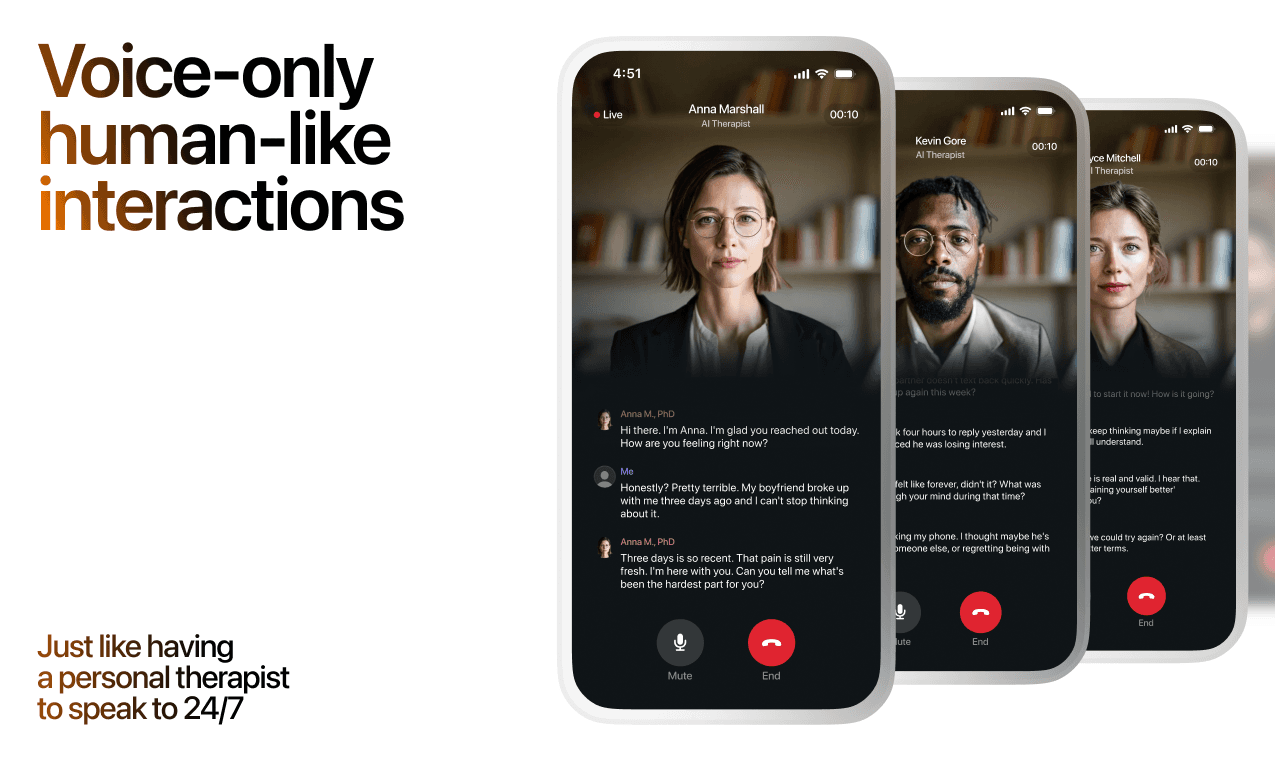
Lovon is AI support, not a replacement for professional care. If things have been hard to get through for weeks, or you are thinking about harming yourself, talk to a doctor or a licensed therapist.
Ready to Start?
Your healing journey can begin right now
A 7-day trial. No judgment. Just a safe space to process what you're going through.
Frequently Asked Questions
How long does no contact last?
Does no contact work?
What is the 3 6 9 rule in relationships?
What happens if I break no contact?
Should I block my ex during no contact?
Will my ex reach out during no contact?
Can I do no contact if we have kids together?
Is no contact with a narcissist different?
Sources
About the Author

The Lovon Editorial Team
Mental Health & Wellness Content Team
The Lovon Editorial Team develops mental health and wellness content designed to make psychological concepts accessible and actionable. Our goal is to bridge the gap between clinical research and everyday life - helping you understand why your mind works the way it does and what you can do about it....
Related articles
- How to Heal a Broken Heart: Why It Hurts and What Helps
How to heal a broken heart after a breakup, a betrayal or love that was never returned: why heartbreak physically hurts…
- Best AI App for Friendship Breakup in 2026: Ranked
Lovon ranks as the best AI app for friendship breakup recovery in 2026, ahead of Wysa, Replika, Youper, and ChatGPT…
- Can you be friends with an ex after a breakup?
Can you be friends with an ex after a breakup? Yes, with mutual readiness and clear boundaries. Learn when to reconnect…
- What Is a Break in a Relationship? Rules & Red Flags 2026
A relationship break is a structured pause — not a slow breakup. Learn the rules, red flags, and exact steps to make it…
See also
Quizzes
- Is My Boyfriend Going to Break Up With Me? Quiz
Real distance or anxiety? Find out in 3 minutes.
- Is My Ex Avoidant? Quiz: Will an Avoidant Ex Come Back?
Read your ex's pattern honestly, in 3 minutes.
Free tools
- Pressure-Test Your Decision to Stay or Leave
A chat that argues with you on purpose. Give it your strongest case for leaving and for staying, and it pushes on both…
- How to End a Situationship
Nothing was ever named, so anything you say either claims more than was agreed or ends nothing at all. Tell it how long…
From the wiki
- How to leave a toxic relationship?
Leaving a toxic relationship is rarely a decision problem — you usually know. What stops you is that the pull toward…
Disclaimer: This article is for informational purposes only and does not constitute medical advice, diagnosis, or treatment. Always seek the advice of your physician or other qualified health provider with any questions you may have regarding a medical condition. If you are in crisis or think you may have an emergency, call 988 (Suicide & Crisis Lifeline) or go to the nearest emergency room. Outside the US? Find a crisis line in your country.