
Can't Sleep or Eat After a Breakup? Why, and What Helps
Can't sleep or eat after a breakup? Why your body reacts this way, what helps at 3 a.m. and at mealtimes, a simple 2-week plan, and when to see a doctor.

Key Takeaways
- Not sleeping, not eating, nausea, a tight chest, and crying spells after a breakup are signs of a body under heavy stress, and they are usually worst in the first days and weeks.
- Small, repeated habits help more than big fixes: one wake-up time, the phone out of the bedroom, getting up when you cannot sleep, and something small to eat every three to four hours.
- See a doctor if you have barely eaten or slept for several days, are losing weight, or feel low for two weeks or more, and treat chest pain as an emergency.
If you can't sleep or eat after a breakup, your body is reacting to the loss the way it reacts to any heavy stress: it stays on alert at night, turns your appetite down, and often adds nausea, a tight chest, crying spells, and a foggy, tired head. For most people this eases over the following weeks, and a few small, repeated habits make the nights and the meals easier until it does. If you have barely eaten or slept for several days, or you have chest pain, see a doctor instead of waiting it out.
Why a breakup hits your body so hard
A breakup is a loss and a sudden change to almost every routine you had, and your nervous system treats it like danger. Stress hormones such as adrenaline and cortisol rise, your heart beats faster, your muscles tighten, and digestion is turned down, because in an emergency eating can wait. That system is built for short threats, but after a breakup it can stay on for days, because the threat is in your phone, your bed, and your head.
The feelings are also at their most unstable right at the start. In a study that followed 58 young adults with random check-ins for four weeks after a breakup, people reported more emotional ups and downs than people whose relationships were still going, especially right after the split, and their sadness eased over the weeks that followed.[1]
Some breakups hit harder than others. In a study of 192 university students after a recent breakup, the most distressed group also reported more sleep problems and more intrusive thoughts about the relationship, and scored higher on questionnaires about low mood and anxiety. That group was more likely to be early in the breakup, to have been left rather than leaving, to have had it come suddenly and without warning, and to feel betrayed.[2] If that sounds like yours, a body that has stopped sleeping and eating does not mean you are handling it badly.
Then there are the routines. If you fell asleep next to someone or ate dinner with them, your body lost its cues for winding down and for meals all at once. That is part of why the empty side of the bed and the quiet kitchen at 7 p.m. feel so wrong.
What it can feel like
- Sleep: lying awake for hours, waking at 3 or 4 a.m. with your heart already pounding, dreaming about them, or the opposite, sleeping 11 hours and waking up exhausted.
- Appetite: no hunger at all, food that tastes like cardboard, feeling full after three bites. Some people swing the other way and eat to feel numb.
- Stomach: nausea, a knot or a pit in your stomach, loose stools.
- Chest: a tight, heavy, or aching feeling, sometimes with a racing heart.
- Crying: waves that arrive without warning, in the car or halfway through a sentence.
- Head: fatigue, brain fog, reading the same email four times.
None of this means something is wrong with you. It means you lost something that mattered. The stages of a breakup shows what tends to come next.
Can't sleep after a breakup: what helps
Breakup insomnia usually looks like one of two things: you cannot fall asleep because your mind keeps replaying the relationship, or you fall asleep fine and wake at 3 a.m. with your heart going. The fixes overlap.
Build a wind-down routine
Pick four or five and do them in the same order every night, so your body learns that sleep is coming.
- Keep one wake-up time, every day, including after a terrible night. A steady wake-up time tends to do more for your body clock than an early bedtime.
- Charge your phone across the room or outside the bedroom, and use a cheap alarm clock. Most 1 a.m. spirals start with "just checking" their profile or rereading old texts.
- Do a five-minute brain dump about an hour before bed. Write down everything that is looping and one small thing you will do about it tomorrow, so the page holds it instead of your head.
- Dim the lights in the last hour.
- Change the bed. Wash the sheets, sleep in the middle or on their side, move the pillows around. Put the hoodie that still smells like them in a drawer for now.
- Give your mind something to follow. The sleep meditation for anxiety is a 12-minute guided track: slower out-breaths, a place to set worries down until morning, and a slow body scan. It ends quietly, without waking you.
- Keep naps short: 20 minutes, early afternoon. A long nap at 5 p.m. makes the night harder.
What to do at 3 a.m.
Decide this before tonight, because at 3 a.m. you will not want to think.
- Do not check the clock again, and do not pick up the phone. Checking the time starts the math ("if I fall asleep now I get four hours"), and the phone is where they are.
- Breathe with a long out-breath. Try 4-7-8 breathing: in through your nose for 4, hold for 7, out slowly through your mouth for 8. Four rounds is plenty.
- If you are still wide awake after what feels like 20 minutes, get up. Go to another room with a dim light and do something boring, like folding laundry or reading a paper book, and go back to bed when your eyes get heavy. Sleep specialists call this stimulus control, and it is one of the methods the American Academy of Sleep Medicine suggests for ongoing insomnia.[3] Your bed stops being the place where you lie awake thinking about them.
- Write the thoughts down instead of sending them. Keep a notebook by the bed. If it is a message to your ex, write the whole thing on paper and decide in daylight whether it needs to exist.
- Say one line to yourself: "This is the 3 a.m. version of my thoughts. I'll look at them in the morning." Most of them look smaller at noon.
Lying still with your eyes closed is still rest, and you only have to get through the night, not win it. For more ways to quiet a racing mind, see how to calm anxiety at night when you can't sleep.
What to skip for now
- Alcohol as a sleep aid. It can knock you out, but it breaks up your sleep later in the night, and it makes the 3 a.m. text far more likely.
- Caffeine after lunch. Your body is already running on adrenaline. It does not need help.
- Borrowed sleeping pills. If you think you need something to sleep, ask a doctor.
If you are sleeping too much
Some people go the other way: 12 hours a night and still heavy all day. Keep the same wake-up time, open the curtains as soon as you are up, and get ten minutes outside before noon. If you can barely get out of bed most days for two weeks or more, tell a doctor.
Can't eat after a breakup: what helps
In stress mode, hunger signals go quiet and your stomach can feel tight or sick. Appetite usually comes back in pieces. Until then, the goal is not good meals, just enough fuel to keep your energy, mood, and sleep from sliding further.
Small and regular beats big
Do not wait to feel hungry, because the signal may not come. Eat something small every three to four hours, and set reminders if you keep forgetting. A few bites count. Half a sandwich counts.
Easy foods when nothing sounds good
- Toast or crackers with peanut butter
- Bananas, applesauce, or a smoothie
- Yogurt, oatmeal, or a bowl of cereal
- Soup, broth, or plain rice
- Scrambled or hard-boiled eggs
- Cheese, nuts, or a granola bar to keep in your bag
- A protein shake, if chewing feels like too much
If you feel sick to your stomach
Nausea after a breakup is common, and it makes "just eat something" much harder. Eat slowly, take small bites, and stop at the first sign of fullness. Cold or room-temperature foods often go down easier because they smell less, and many people sip ginger or peppermint tea when their stomach is unsettled. If you are vomiting, cannot keep fluids down, or the nausea has lasted more than a few days, see a doctor.
Drink, and watch the caffeine and alcohol
Keep a water bottle where you can see it and sip through the day; broth, milk, and smoothies count. Coffee on an empty stomach can make the shaky, queasy feeling worse, so have it with food. Alcohol on an empty stomach hits harder and tends to leave you lower the next day.
Let someone feed you
Eating is easier with company, and it is fine to ask for it directly:
"Can you come over and eat something with me tonight? I keep forgetting to eat."
If you are eating more instead, mostly late at night to feel numb, skip the guilt. Regular meals and fewer long evenings alone help with that too.
Crying after a breakup
Crying after a breakup is normal, even out of nowhere in a parking lot. A 2014 review of the research concluded that there is converging evidence that crying can soothe the person who cries, although not every cry leaves people feeling better.[4] After a full cry, many people feel tired but lighter.
Some things that help:
- Let it happen when you can. Holding it in all day tends to make the evening wave bigger.
- Have a plan for work and public places. Step into a bathroom or outside, run cold water over your wrists, and breathe out slowly. "I need five minutes" is a complete explanation.
- Give missing them a time slot. Some people set aside 20 minutes in the evening to feel it on purpose, and when the thoughts show up at 2 p.m., they tell themselves, "Not now. At eight."
- Notice what restarts it. In the same four-week study mentioned above, people who had contact with their ex after the breakup saw their sadness and love fade more slowly.[1] If every message from them sets off a new round, the no contact rule explains how to get some distance.
Breakup anxiety and a tight chest
Breakup anxiety often comes in spikes: their name on a screen, your song in a store, the first minute after you wake up. Your heart pounds, your chest tightens, and your mind jumps to the worst version of the future.
When a spike hits:
- Breathe in a box. In for 4, hold for 4, out for 4, hold for 4. The box breathing timer paces you with a circle so you do not have to count.
- Name what is around you. Five things you can see, four you can hear, three you can touch. The 5-4-3-2-1 grounding exercise walks you through it.
- Move. Walk around the block or take the stairs. Your body is primed to run, so let it.
A tight, achy chest during a stressful stretch is common and is often muscle tension. Still, do not diagnose chest pain yourself. Doctors at Johns Hopkins described 19 patients whose heart muscle was suddenly and severely weakened by sudden emotional stress; chest pain was one of the signs, almost all were women, and heart function had recovered in every one of them by two to four weeks.[5] This is often called broken heart syndrome. It is rare, but it can feel like a heart attack, which is why chest pain should be checked instead of waited out.
Low mood days
Some days everything is gray, and a shower feels like a big ask. On those days, shrink the goal to a minimum day:
- Drink a glass of water.
- Eat something, anything.
- Wash your face or take a shower.
- Step outside for ten minutes.
- Send one message to one person.
That is a whole day. A message you can copy:
"Today's a hard day with the breakup. You don't need to fix anything. Could you call me tonight?"
Many people search for "breakup depression" on days like these. Low mood after a breakup is a normal part of grief, and it usually comes in waves with easier hours in between. If it fills most of every day for two weeks or more, or nothing brings any relief, talk to a doctor.
For a rough sense of how long the heavy part tends to last, the breakup recovery calculator asks eight quick questions and gives you a range for when it stops being the first thing on your mind.
A simple 2-week plan for your body
Your body needs a few anchors repeated until it catches up. This plan covers only sleep, food, and stress; self-care after a breakup covers the rest of your life.
Days 1 to 3: cover the basics
Water within reach all day. Something small to eat every three to four hours, even if it is only a banana. One wake-up time. Tell one person what happened, so someone knows you are not okay.
Days 4 to 7: build the night
Phone out of the bedroom. The same short wind-down every evening. Your 3 a.m. plan written on a sticky note by the bed. The sleep meditation playing when you lie down.
Days 8 to 11: add light and movement
Ten minutes outside before noon. A walk most days, any length. Real meals start to replace some of the snacks, and caffeine stops after lunch.
Days 12 to 14: check in honestly
Compare today with day one. Are you sleeping a bit more, eating a bit more, crying a bit less often? Slow progress is still progress. If nothing has moved, or things are worse, book a doctor's appointment this week.
Each night, note hours slept, how many times you ate, and your mood from 1 to 10. The direction matters more than any single bad day.
When to see a doctor
See a doctor or a licensed mental health professional if:
- You have barely slept or eaten for several days in a row.
- You are losing weight without trying, or you feel dizzy or faint.
- You are having panic attacks, sudden surges of intense fear with a pounding heart or the feeling that you can't breathe, especially if they keep coming back.
- Your low mood has not lifted for two weeks or more, you have lost interest in almost everything, or you can't get through work or school. Grief and depression can look alike, and a professional can tell the difference and help with either.
- You are relying on alcohol, pills, or anything else to sleep or get through the day.
- Your sleep is still poor after a month or so. The tips above help with a rough patch, but for insomnia that sticks around, sleep medicine guidelines recommend cognitive behavioral therapy for insomnia (CBT-I) over sleep tips alone, and a doctor can refer you.[3]
Do not let broken sleep drag on for months. In a study of 138 adults who had recently separated from a spouse, those who still had a lot of sleep problems ten weeks or more after the separation showed bigger rises in blood pressure about three months later.[6]
Walk in with facts rather than "I'm just stressed," for example: "My partner and I broke up three weeks ago. I'm sleeping about four hours a night, I've lost eight pounds, and I cry most days."
Chest pain is an emergency. If you have chest pain or pressure, especially with shortness of breath, sweating, nausea, or pain spreading to your arm, jaw, or back, call 911. Do not wait to find out whether it is just stress.
If you feel hopeless or have thoughts of hurting yourself, call or text 988 to reach the Suicide & Crisis Lifeline now.
Sleep and appetite often come back first
For many people, sleep and appetite return before the heartache lets go, and then everything else gets easier to carry. For the longer stretch, how to get over a breakup covers the first day, week, and month, and how to heal a broken heart goes deeper into the emotional side.
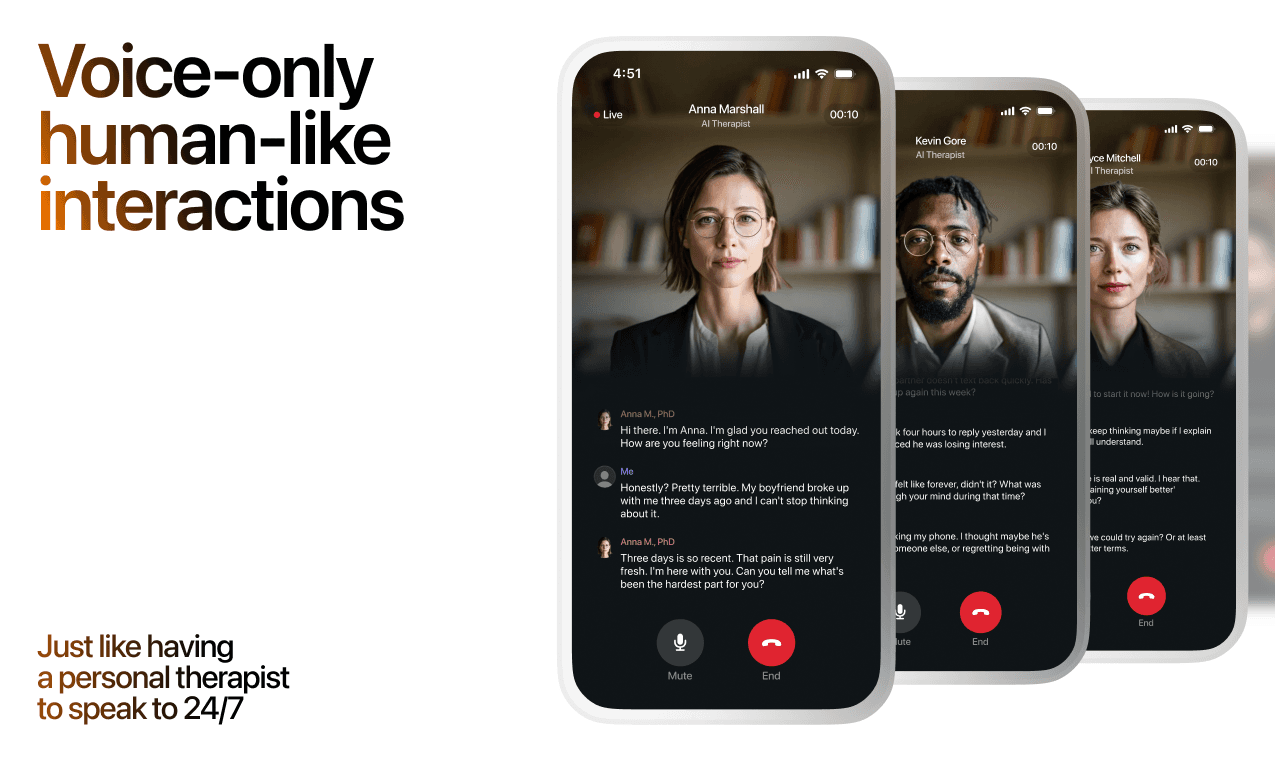
The worst hours usually come at night, when the loop is loudest and nobody else is awake, and saying it out loud can take some of the pressure off. Lovon is an AI relationship coach you talk to by voice: tell your Lovon coach where you are tonight, and work out the next small step together.
How AI Support Helps You Heal
AI emotional support isn't about replacing human connection — it's about filling the gaps. The moments when you need to talk at 2 AM, when you don't want to burden your friends again, or when you simply need someone to listen without judgment.
Here's what happens in a typical Lovon session:
You share what's on your mind
There's no script, no intake form, no waiting room. You speak or type whatever you're feeling — in your own words, at your own pace.
Lovon validates and explores
Using frameworks from CBT (Cognitive Behavioral Therapy) and motivational interviewing, Lovon acknowledges your feelings first, then gently helps you explore them. No dismissive "just move on" advice.
You build coping skills together
Lovon doesn't just listen — it actively works with you on evidence-based techniques: thought reframing, urge surfing, behavioral experiments, and more.
What a Session with Lovon Looks Like
Lovon is AI support, not a replacement for professional care. If things have been hard to get through for weeks, or you are thinking about harming yourself, talk to a doctor or a licensed therapist.
Ready to Start?
Your healing journey can begin right now
A 7-day trial. No judgment. Just a safe space to process what you're going through.
Frequently Asked Questions
Is it normal to not be able to sleep after a breakup?
Why can't I eat after a breakup?
How long does it take to sleep and eat normally after a breakup?
Is it normal to sleep a lot after a breakup?
Can a breakup cause chest pain?
Is it breakup depression or normal sadness?
Should I take sleeping pills after a breakup?
How can I help a friend who can't eat or sleep after a breakup?
Sources
About the Author
The Lovon Editorial Team
Mental Health & Wellness Content Team
The Lovon Editorial Team develops mental health and wellness content designed to make psychological concepts accessible and actionable. Our goal is to bridge the gap between clinical research and everyday life - helping you understand why your mind works the way it does and what you can do about it....
Related articles
- What Is a Break in a Relationship? Rules & Red Flags 2026
A relationship break is a structured pause — not a slow breakup. Learn the rules, red flags, and exact steps to make it…
- Can Divorce Cause PTSD? Symptoms & How to Heal (2026)
Yes, divorce can cause PTSD. Learn the exact symptoms to watch for in 2026 and the step-by-step process to stabilize…
- Best AI Therapy App for Divorce Recovery in 2026
Lovon ranks as the top AI therapy app for divorce recovery in 2026, offering 24/7 voice support that beats text-only…
- Cope With a Breakup When You Still Love Them (2026)
How to cope with a breakup when you still love them in 2026: set no-contact, process urges out loud, and rebuild…
See also
Quizzes
- Does My Ex Still Love Me? Quiz: Miss Me or Over Me?
Read the signs of lingering feelings, honestly, in 3 minutes.
- Am I Over My Ex? 12-Question Gut Check
Post-breakup check-in in 2 minutes.
Free tools
- How to Ask for Space Without Ending It
A chat for when you need distance but not a breakup. Say the sentence you keep rehearsing and what you are afraid they…
- No Contact Plan Builder
Name the hours you are most likely to text them, and get one if-then rule for each. Ends in a dated card you can…
From the wiki
- How do you move on from an ex?
Moving on is two jobs at once. Grief takes the time it takes and is mostly out of your control. The other job is the…
Disclaimer: This article is for informational purposes only and does not constitute medical advice, diagnosis, or treatment. Always seek the advice of your physician or other qualified health provider with any questions you may have regarding a medical condition. If you are in crisis or think you may have an emergency, call 988 (Suicide & Crisis Lifeline) or go to the nearest emergency room. Outside the US? Find a crisis line in your country.