
How to Manage Exam Anxiety Before a Big Test (2026)
How to manage exam anxiety before a big test in 2026: 7 steps, breathing techniques, and what to do when your mind goes blank mid-exam.
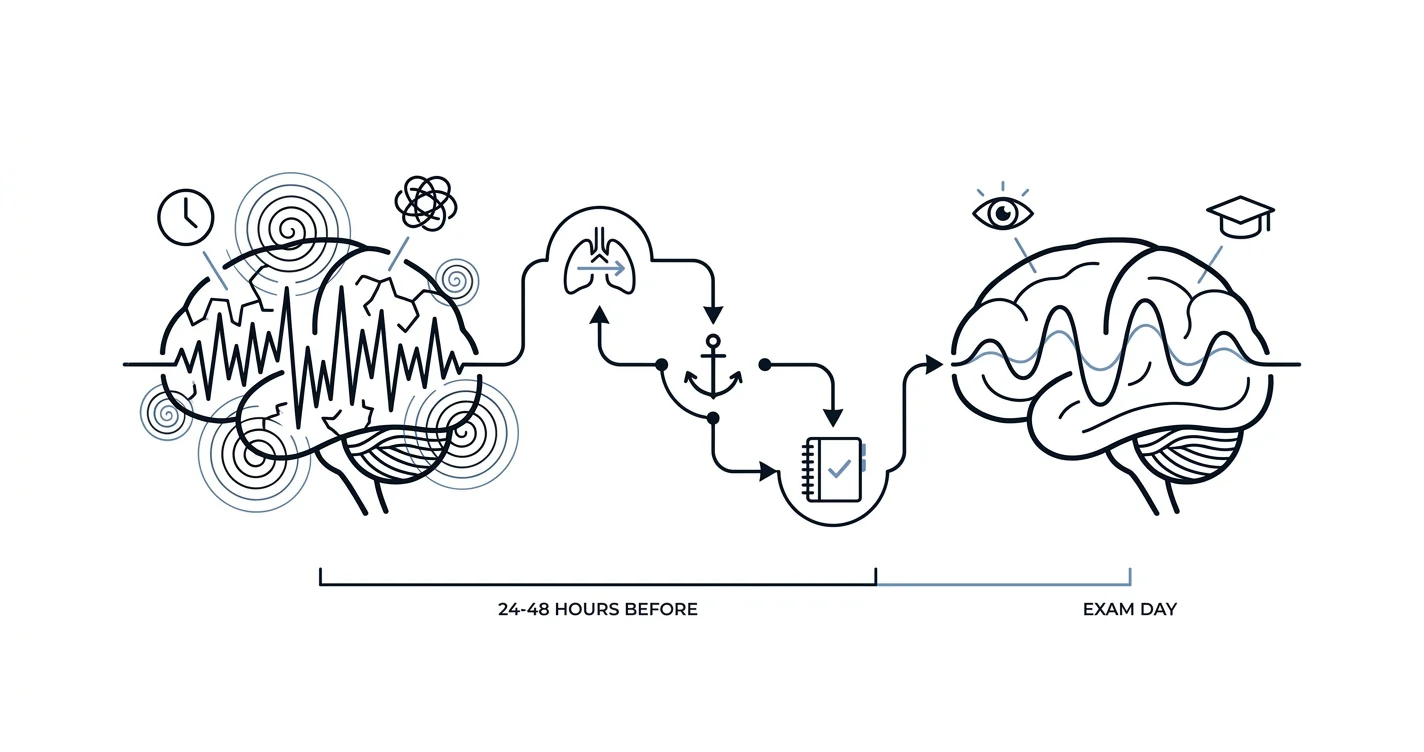

Key Takeaways
- How to manage exam anxiety before a big test starts with breath control, not last-minute cramming.
- Naming the worst-case scenario out loud for 60 seconds cuts its grip faster than pushing it away.
- A 10-minute voice check-in the night before gives you a coping plan you can actually use at your desk.
- Skipping sleep to cram raises anxiety symptoms more than an extra hour of review helps in 2026 test prep.
Exam anxiety hits the same way for almost everyone: tight chest, racing thoughts, a mind that goes blank right when you need it most. This guide gives you a step-by-step plan for how to manage exam anxiety before a big test, not just deep-breathing platitudes.
TL;DR
- How to manage exam anxiety before a big test starts with breath control, not last-minute cramming.
- Naming the worst-case scenario out loud for 60 seconds cuts its grip faster than pushing it away.
- A 10-minute voice check-in the night before gives you a coping plan you can actually use at your desk.
- Skipping sleep to cram raises anxiety symptoms more than an extra hour of review helps in 2026 test prep.
Why this matters
Exam anxiety isn't a character flaw — it's your nervous system misreading a test as a threat to survival. The same stress response that helps you sprint from danger floods your body with cortisol and adrenaline before an exam, and that flood is what makes your hands shake and your thoughts scatter.
Left unmanaged, exam anxiety doesn't just feel bad. It measurably lowers performance because working memory gets hijacked by worry instead of the material you studied. The good news: the physical response is predictable, which means it's also trainable. You can read more on coping tools for exam anxiety if you want the deeper mechanics behind why this happens.
What you'll need
- 15-20 minutes of quiet time the night before and 5-10 minutes the morning of
- A notebook or notes app to write down your worst-case scenario (yes, on purpose)
- A quiet space to practice one breathing pattern until it's automatic
- Something to anchor your senses — cold water, a textured object, or a specific scent
- Optional: a private space to talk through your nerves out loud, whether that's to a friend, a journal, or an AI voice session with Lovon before bed
None of this requires special equipment. It requires repetition, starting at least 24-48 hours before the exam, not 20 minutes before you walk in.
The steps
1. Name the specific fear, not the general dread
"I'm anxious about the exam" is too vague for your brain to solve. Write down the actual sentence running in your head — "I'll blank on the essay question" or "I'll run out of time on section two."
This matters because vague dread keeps circling with no landing point, while a named fear can be checked against evidence. Ask yourself: has this actually happened before, and if it did, what did you do? Most students find the specific fear has a specific, boring counter-argument.
Common mistake: trying to talk yourself out of feeling anxious instead of identifying what the anxiety is actually about.
2. Breathe before you try to think clearly
Trying to reason your way out of panic while your body is still flooded with adrenaline doesn't work — the body has to come down first. Box breathing (inhale 4 counts, hold 4, exhale 4, hold 4) for three to five rounds lowers heart rate enough to let rational thought back online.
Do this the moment you notice a tight chest or shallow breathing, not after the anxiety has already peaked. For the full technique with pacing cues, see these breathing exercises for anxiety.
Common mistake: taking one or two deep breaths and expecting it to fix a full anxiety spike — three to five rounds is the minimum for a measurable shift.
3. Ground yourself in the room you're actually in
Anxiety pulls your attention into a future that hasn't happened yet. Grounding pulls it back to the present, where the exam hasn't started and nothing has gone wrong yet.
A fast version: name 5 things you can see, 4 you can touch, 3 you can hear, 2 you can smell, 1 you can taste. It takes under 90 seconds and works in a hallway right before you walk into the room. Full step-by-step versions are in these grounding techniques for anxiety.
Common mistake: doing this silently in your head when overwhelmed — saying it under your breath activates more of the sensory shift.
4. Rehearse the worst case on paper, once
Sit down the night before and write out exactly what happens if the worst-case scenario occurs. You fail the exam — then what? You retake it, you talk to a professor, you adjust your schedule. Writing the full chain, including the recovery, drains the scenario of its power because it stops living as an unresolved threat.
Do this once, not on a loop. If you notice yourself replaying the worst case over and over instead of once with a resolution, that's catastrophizing, and it needs a different tool — covered in troubleshooting below.
5. Build a 20-minute pre-test routine and repeat it every time
Your nervous system responds to repetition. A consistent sequence — same breathing pattern, same grounding phrase, same short walk — tells your body "this is the routine before a test," not "this is a threat."
Start the routine 90 minutes before the exam, not 10. Rushed prep adds a second stressor on top of exam anxiety itself.
6. Talk it through out loud the night before
Anxiety that stays in your head tends to loop. Saying it out loud — to a person, a voice memo, or a structured conversation — forces it into a linear sequence your brain can actually process and close.
This is where a short check-in helps. Lovon is built for exactly this kind of moment: a voice conversation you can have at 11pm when no one else is awake, walking through what's making you anxious and what your plan is for the morning. It's not a replacement for a therapist or your school's counseling office, but it's available when nothing else is.
Talk through exam nerves tonight
Have a voice conversation with Lovon before test day, anytime.
7. Walk in with one anchor phrase, not ten strategies
When anxiety spikes mid-exam, you won't remember a checklist. You'll remember one short phrase if you've practiced it: "Breathe, then read the question again" works better than trying to recall five techniques at once.
Pick this phrase during your practice sessions, not on exam morning. Verdict: this seven-step sequence works because it targets the body first and the thoughts second — trying to think your way calm before your body settles rarely holds.
Troubleshooting
Your mind goes blank the second the exam starts. This is a stress response, not a knowledge gap — do one round of box breathing at your desk before writing anything, even if it costs you 60 seconds.
Your heart races and won't settle even after breathing. Extend the exhale longer than the inhale (4 in, 6-8 out) — a longer exhale activates the parasympathetic system more directly than equal counts.
You keep replaying the worst-case scenario on a loop. That's catastrophizing, not problem-solving, and it needs interruption rather than more thinking time — see how to stop worst-case thinking for the specific technique to break the loop.
You didn't sleep the night before. Don't try to cram in the missing hours with caffeine and more review — prioritize 20 minutes of grounding and breathing over squeezing in extra material; sleep debt affects recall more than one extra study hour helps.
Physical symptoms show up mid-test — shaky hands, sweating, nausea. These are adrenaline symptoms, not signs you're failing. Name them silently ("this is adrenaline, it will pass in a few minutes") and keep moving through the exam rather than stopping to analyze them.
You feel anxious for days leading up to the exam, not just the morning of. That's a longer pattern worth addressing directly rather than waiting for test day — daily anxiety this persistent benefits from a routine, not a one-time fix.
Tools and resources
- A written worst-case scenario exercise, done once, 24-48 hours ahead
- A practiced breathing pattern (box breathing or 4-6-8) you've rehearsed at least five times before test day
- A grounding technique you can do silently in a hallway or bathroom stall
- A voice check-in the night before, whether that's a person or an AI conversation through Lovon
- A single anchor phrase chosen in advance, not improvised under pressure
What to do next
Exam anxiety rarely shows up alone — it often overlaps with broader patterns like catastrophizing, perfectionism, or general high-functioning anxiety that shows up outside of test season too. If any of the steps above felt familiar beyond exams, it's worth looking at the underlying pattern rather than just the symptom.
FAQ
What is the fastest way to calm exam anxiety right before a test?
Three to five rounds of box breathing (4 counts in, hold 4, out 4, hold 4) is the fastest reliable method, because it lowers heart rate enough for rational thought to return within a few minutes. Pair it with a 5-4-3-2-1 grounding exercise if your mind is still racing after breathing alone.
Is exam anxiety the same as a panic attack?
Exam anxiety and a panic attack share symptoms like a racing heart and shallow breathing, but a panic attack is typically more intense and can occur without a specific trigger. If symptoms include chest pain, dizziness, or a feeling of losing control that doesn't ease with breathing, treat it as a panic attack and use grounding techniques immediately.
How long before a test should I start managing exam anxiety?
Start 24-48 hours ahead with the worst-case scenario exercise and breathing practice, not the morning of the exam. Techniques you've practiced only once under pressure are far less reliable than ones rehearsed several times beforehand.
Does pulling an all-nighter help with exam anxiety?
No — sleep loss raises anxiety symptoms and impairs memory recall more than an extra hour of review typically helps. A 20-minute grounding and breathing routine on limited sleep outperforms cramming through the night.
Can talking through exam nerves out loud actually help?
Yes, because anxiety that stays only in your head tends to loop without resolution, while saying it out loud forces it into a linear sequence you can process and close. This can be a conversation with a friend, a voice memo, or a structured check-in like a voice session with Lovon the night before.
What should I do if my mind goes blank during the exam?
Stop writing, do one round of box breathing at your desk, then reread the question from the start. A blank mind mid-exam is a stress response, not a sign you don't know the material, and it typically passes within a minute of slowing your breathing.
Is exam anxiety a sign of a bigger mental health issue?
Not necessarily — situational anxiety tied to a specific event like a test is common and different from a persistent anxiety disorder. If the anxiety shows up daily regardless of exams, or interferes with sleep and eating for weeks at a time, that pattern is worth addressing on its own.
Do grounding techniques work for test anxiety specifically?
Yes, grounding techniques work for test anxiety because they redirect attention from an imagined future outcome back to the present moment, which interrupts the anxiety spiral. A quick version — naming five things you see, four you touch, three you hear — takes under 90 seconds and can be done at your desk.
One last thing
The worst-case scenario exercise feels counterintuitive the first time you try it — most people expect writing out failure to make anxiety worse. It does the opposite for most students, because an unresolved fear takes more mental energy to suppress than a fear you've already walked through to its (survivable) end.
Related guides
How AI Support Helps You Heal
AI emotional support isn't about replacing human connection — it's about filling the gaps. The moments when you need to talk at 2 AM, when you don't want to burden your friends again, or when you simply need someone to listen without judgment.
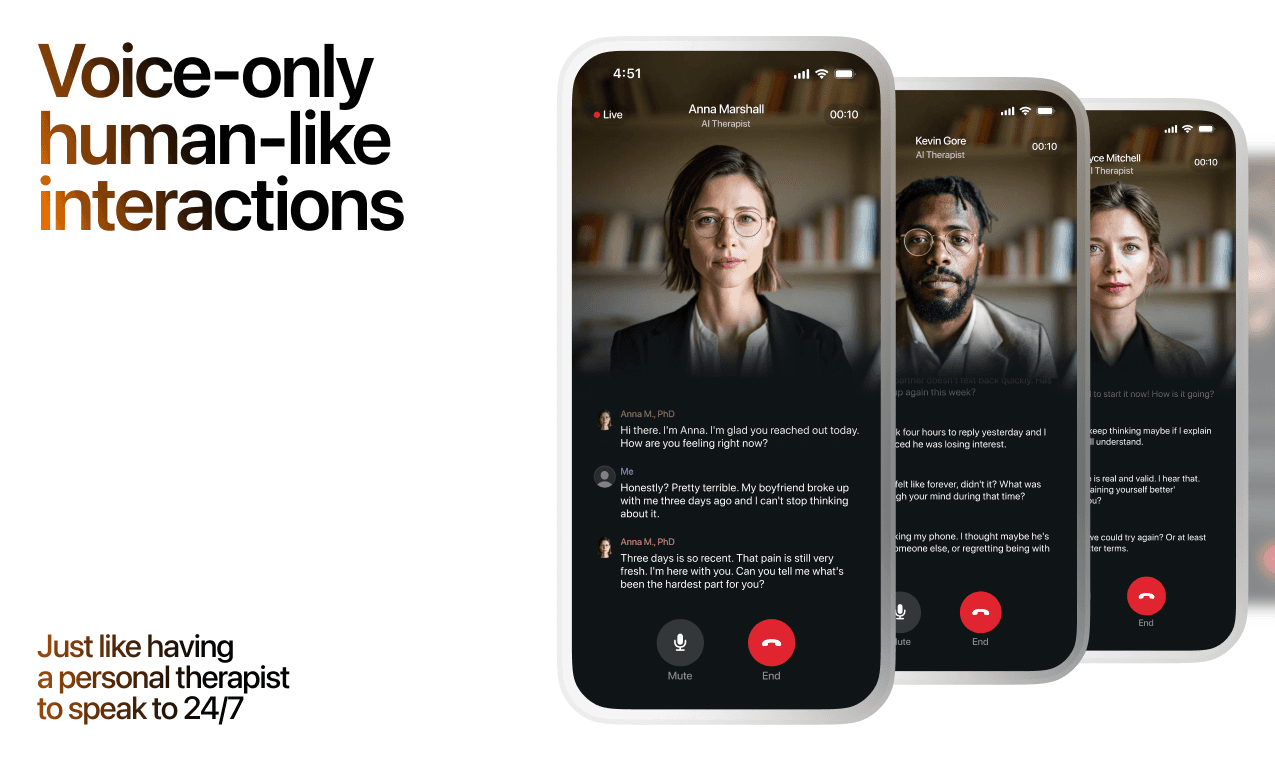
Here's what happens in a typical Lovon session:
You share what's on your mind
There's no script, no intake form, no waiting room. You speak or type whatever you're feeling — in your own words, at your own pace.
Lovon validates and explores
Using frameworks from CBT (Cognitive Behavioral Therapy) and motivational interviewing, Lovon acknowledges your feelings first, then gently helps you explore them. No dismissive "just move on" advice.
You build coping skills together
Lovon doesn't just listen — it actively works with you on evidence-based techniques: thought reframing, urge surfing, behavioral experiments, and more.
What a Session with Lovon Looks Like
When to Seek Professional Help
AI support is a valuable tool, but it's not a replacement for professional care. Please consider reaching out to a licensed therapist if you experience any of the following:
- Persistent thoughts of self-harm or suicide
- Inability to perform daily activities (work, eating, sleeping) for more than 2 weeks
- Turning to alcohol or substances to cope
- Intense anger or desire to harm your ex-partner
- Complete emotional numbness that doesn't improve over time
Crisis Resources (US): If you're in immediate danger, call 988 (Suicide & Crisis Lifeline) or text HOME to 741741 (Crisis Text Line). Available 24/7, free, and confidential.
Outside the US? Find a crisis line in your country
Ready to Start?
Your healing journey can begin right now
A 7-day trial. No judgment. Just a safe space to process what you're going through.
Frequently Asked Questions
Is Lovon a replacement for a real therapist?
Is my conversation with Lovon AI private?
How is Lovon different from ChatGPT for emotional support?
Can I use Lovon if I'm already seeing a therapist?
Can I try Lovon before subscribing?
About the Author
The Lovon Editorial Team
Mental Health & Wellness Content Team
The Lovon Editorial Team develops mental health and wellness content designed to make psychological concepts accessible and actionable. Our goal is to bridge the gap between clinical research and everyday life - helping you understand why your mind works the way it does and what you can do about it....
Related articles
- Mindfulness for Anxiety: Techniques That Work in 2026
The best mindfulness techniques for anxiety in 2026 — body scan, 4-6 breathing, and 5-4-3-2-1 grounding — with…
- Freeze Response: Why You Shut Down Under Stress (2026)
The freeze response shuts down your body and mind under stress. Learn the exact nervous system mechanism and 7 steps to…
- Can an AI voice app actually calm you down?
Yes, AI voice apps calm acute anxiety spikes fast through paced voice conversation. See how it works, its limits, and…
- AI Coping Tools for Anxiety 2026: What Actually Works
AI coping tools for anxiety compared for 2026: box breathing, grounding, and PMR ranked with clear verdicts on what to…
See also
Quizzes
- Guilt Test: Is Your Guilt Doing Its Job?
See whether your guilt repairs or just hurts.
- Defense Mechanisms Test: Which Ones Do You Use Most?
See what your defenses do with hard feelings, in 3 minutes.
Free tools
- Words of Encouragement for Him When He Is Struggling
Words of encouragement for him that fit what he is actually going through, for when your usual lines are not landing…
- Vent to an AI
Need to vent and there is nobody to call, or nobody you want to tell? Type it here. You are talking to an AI listener…
From the wiki
- How to stop maladaptive daydreaming?
Maladaptive daydreaming is immersive waking fantasy that eats hours, usually with music and pacing attached. You rarely…
Disclaimer: This article is for informational purposes only and does not constitute medical advice, diagnosis, or treatment. Always seek the advice of your physician or other qualified health provider with any questions you may have regarding a medical condition. If you are in crisis or think you may have an emergency, call 988 (Suicide & Crisis Lifeline) or go to the nearest emergency room. Outside the US? Find a crisis line in your country.