
How to Get Over Being Cheated On and Trust Again
How to get over being cheated on: why it hurts more than a breakup, how to stop replaying it, what to say to the person who cheated, and how to trust again.

Key Takeaways
- Being cheated on hurts differently from an ordinary breakup because it rewrites the past: you grieve the relationship and also the story you thought you were living.
- The replaying, the checking and the comparing are normal reactions to a shock, and they ease faster once you stop investigating and stop treating the affair as a verdict on your worth.
- The practical steps matter as much as the emotional ones: get tested for STIs if they had other partners, tell a few people the truth, and keep contact with the person who cheated short.
Getting over being cheated on means grieving two losses at once: the relationship, and the version of the past you thought you were living. What helps most is to stop investigating, put the blame where it belongs without letting anger run your days, get an STI test if they had other partners, and keep contact with the person who cheated short and on your terms. The replaying does fade, usually over months rather than weeks, and faster once you stop feeding it.
Why being cheated on hurts differently from a normal breakup
In an ordinary breakup you lose the future you were planning. When you were cheated on, you lose the past as well. The weekend away, the nights they "worked late," the time they said you were the only one who really got them: every memory becomes a suspect, and you find yourself going back through months or years trying to work out what was real.
A few other things usually come with it:
- Humiliation. Other people may have known before you did, or the person they cheated with may be someone you know.
- Doubting your own judgment. "How did I not see it?" can hurt as much as the cheating itself.
- A body in shock. Not sleeping, not eating, shaking, a sick drop in your stomach when your phone buzzes. This is common in the first weeks.
- Two feelings at once. You can be disgusted by what they did and still miss them badly at 11 p.m. Missing them does not mean you should go back.
It counts even if nothing physical happened. Months of secret messages and late-night confiding hurt too, and emotional cheating explains where that line usually sits.
For the basics that help after any heartbreak, see how to heal a broken heart. This page is about the parts specific to betrayal.
Why you keep replaying it, and why to stop investigating
The replaying is your mind trying to make it make sense
Intrusive images are one of the most common things people describe after finding out: picturing them together, hearing the words from the texts you read, running the timeline again in the shower. Your mind treats the betrayal like a threat it missed and keeps searching the past for the moment it should have noticed. In the first weeks this is normal, and it eases as the shock wears off, unless you keep feeding it new material.
The detective work keeps the wound open
Almost everyone does some detective work: rereading the messages, scrolling through location history, studying the other person's photos. It feels like protection. If you know everything, you can never be fooled again.
It does not work that way. Each new detail becomes a new image to replay, and no amount of information will make the cheating make sense, because the missing piece is a choice someone else made. Every hour spent investigating is an hour still organized around them.
There are a few things you have a fair reason to know:
- Whether it is over, and roughly how long it went on
- Whether they had sex with anyone else, and whether it was protected, because that is about your health
- Who else knows
- Whether shared money was spent on it
Most other details, like what was said about you or exactly what happened in bed, hurt more than they help. If you are still not sure whether anything happened, the Am I Being Cheated On? quiz sorts the real signs from the anxious ones.
How to stop investigating
Write your questions down, then ask once
Use the short list above. Ask once, in one conversation or one message, and accept that some answers will be incomplete. When a new question shows up at 2 a.m., write it down and ask yourself in the morning whether the answer would change anything you are going to do.
Close the doors you keep walking through
Mute or block the person they cheated with everywhere. Move the screenshots you keep rereading into a folder you do not open. Turn off location sharing with your ex. In your weakest hour, put your phone in another room.
Give the replaying a time slot
Give the thoughts twenty minutes in the early evening: write down everything you are thinking. When the replay starts at other times, tell yourself "not now, at six," and go back to what you were doing. If an urge to check hits anyway, wait ten minutes before acting on it. Urges come in waves.
For more ways to quiet a looping mind, see how to stop thinking about someone.
Self-blame and comparing yourself to the other person
Whose choice it was
Almost everyone who has been cheated on asks what they did wrong. Maybe the relationship really did have problems, like too much fighting or two people who had stopped talking. You can look at your part in those later. They still did not make the cheating happen. Someone unhappy in a relationship can say so, ask for help, or leave. Cheating was the option they picked.
A sentence worth saying out loud, more than once:
"The relationship had problems, and some of them were mine. The cheating was their choice."
How you explain it to yourself matters. In a study of 232 college students who had recently been cheated on, the more people blamed themselves or their partner for it, the more depression, anxiety and distress they reported, and among women that distress went along with more behavior that put their health at risk.[1] A survey cannot prove that blame causes the distress, but it fits what many people find: the question of whose fault it was keeps the wound open whichever way you answer it. At some point "whose fault" has to give way to "what now."
The comparison trap
Then there is the other person. You may catch yourself studying their photos, comparing bodies, ages, jobs. The comparison is rigged. An affair runs on secrecy and novelty, with none of the ordinary parts of a life together: no bills, no dishes, no bad mornings. You are measuring your real relationship against a side story built to feel exciting. The person they cheated with says more about what your ex was looking for, and willing to hide, than about you.
Protecting your sense of your own worth is practical, not a nice extra. Another paper by the same researchers, again with 232 people who had recently been cheated on, found that self-esteem worked like a buffer: for people with higher self-esteem, blaming thoughts about the cheating were less tied to stress, and that stress was less tied to depression and anxiety.[2]
You do not have to feel great to rebuild it. Spend time with people who knew you before this relationship, and do one small thing each day that you are good at. When you catch yourself ranking yourself against the other person, name it, "comparing again," and do something else.
Anger, and what to do with it
Anger often arrives after the shock, sometimes weeks later, and its strength can be frightening. It is not a character flaw. It is the part of you that knows a line was crossed. It needs somewhere to go:
- Move it through your body: a hard run, a fast walk, lifting, anything that leaves you physically tired.
- Say it out loud to someone who can hear it without rushing to calm you down.
- Write down every word you would never send. The unsent letter to your ex is built for exactly this.
Things that usually make it worse, even when they feel deserved:
- Posting about it publicly, or exposing them at work or to their family
- Tracking down the person they cheated with to confront them
- Sleeping with someone to even the score
The problem is not that your ex deserves protection. Each one keeps you tied to them, and you are the one who lives with it afterward. If the person they cheated with has a partner and you are wondering whether to tell them, wait until the first rush of anger passes, and decide for reasons you would still stand behind in a year.
Take care of your health, including an STI test
If your partner had sex with someone else, it is reasonable to get tested for sexually transmitted infections, even if you feel fine and they say they were careful. Many STIs cause no symptoms at all, and you cannot know the other person's history. Getting tested does not mean something is wrong. It means you get to know instead of wonder.
You can go to your doctor, an urgent care clinic or a sexual health clinic, and the CDC's Get Tested finder lists confidential testing sites near you, including low-cost ones. You do not need to tell the whole story. One sentence is enough:
"My partner had sex with someone else, and I'd like to be tested for whatever makes sense."
Some infections take a while to show up on a test, so the clinic may suggest testing again in a few weeks or months. Until then, use condoms with any partner.
Shock also does strange things to sleep and appetite, and drinking to get through the evenings makes the mornings worse. Aim for the basics: something small to eat three times a day, water, a walk outside, a regular bedtime. If sleep or eating has fallen apart, can't sleep or eat after a breakup has specific steps.
Telling people and handling mutual friends
You do not owe anyone the whole story, and you do not have to protect your ex's reputation either. Decide who gets what.
Your two or three closest people get the truth, because carrying someone else's secret on top of your own hurt is exhausting:
"Something happened and I need you to just listen tonight. My partner cheated on me. I don't need advice yet."
Everyone else gets a short version:
"We broke up. I don't want to go into it, but I'm okay."
Mutual friends get a boundary, not a request to take sides:
"You don't have to choose. I'd just rather not hear about them or what they're up to for a while."
If a friend knew about the affair and did not tell you, that can feel like a second betrayal. You are allowed to ask once, "Did you know?", and to take some distance while you decide what that friendship is now.
If you have children, tell them what is changing for them, like where they will sleep and when they will see each parent, and keep the affair itself between the adults. If you might get back together, go easy on how much you tell family. People who love you often stay angry long after you have forgiven.
Handling contact with someone who cheated on you
You may feel you cannot move on until they explain everything. Waiting for that usually keeps you stuck. Many people who cheat cannot give a clear reason, and the reasons they do give rarely help. You do not need a full confession to move on. You need enough to make your own decisions, and you probably have that already. Closure is something you build on your side, not something they hand over.
If you have ended things, keep contact to what has to be handled, like the lease, belongings or the kids: short, polite, factual, in writing. The no contact rule explains how to set that up, including a low contact version for people who share a home or children.
Lines for ending the conversations you do not want to have:
- When they want to explain: "I don't need more details. I know enough to make my decision."
- When they push for forgiveness: "I'm not ready to talk about forgiveness, and I may never be. Please stop asking."
- When they turn it around on you: "I'm not going to argue about whose fault it was. I'm ending this conversation now."
- When they want to stay friends: "I can't be friends with you. Please only contact me about the apartment."
- When the messages will not stop: "I've said what I needed to say. I won't be replying to anything else about this."
- If the person they cheated with contacts you: "I'm not going to discuss this with you." Then block.
If you want one last conversation, decide what you need from it before you go: two or three questions, a public place or a phone call, and an end time. Leave when you reach it, even if it feels unfinished. It probably will.
If a conversation ever turns into threats, or you feel afraid of them, stop meeting in person, keep everything in writing, and tell someone you trust what is going on.
If you are thinking about staying
Not everyone who is cheated on leaves, and staying is not weakness. The question is not whether cheating is forgivable in general. It is what has happened since you found out:
- Has the affair ended completely, with no "just friends" contact?
- Did they tell you the truth when you asked, or only what you could already prove?
- Do they take responsibility without pointing at your flaws?
- Can they sit through your questions and your bad days without getting impatient?
The Should I Forgive Cheating? quiz walks through these signs and what each pattern usually means. If you are married, how to save your marriage covers what rebuilding after a betrayal takes, and a couples counselor who works with infidelity can help with the hardest conversations. If you already broke up and are now wondering about going back, the Should I Get Back With My Ex? quiz helps you check whether anything has actually changed.
Forgiving and getting back together are two separate decisions. You can forgive someone for your own peace and still not return to them.
When it needs a professional
Being cheated on can hit harder than people around you expect. In one small study of 50 women, those who had recently gone through a husband's infidelity or a threat that the marriage would end were six times more likely to be diagnosed with a major depressive episode than women in equally unhappy marriages who had not.[3] Needing help after this is not weakness.
It is worth seeing a licensed therapist, ideally one who works with infidelity and betrayal, or your doctor, if:
- the intrusive images are still there most days after several months
- you cannot sleep, eat or work properly for weeks at a time
- you are drinking or using something every day to get through it
- the anger is still waking you up, or spilling onto people who did nothing wrong
- you have panic attacks, or feel numb and far away from your own life
If you are having thoughts of hurting yourself, call or text 988 in the US right now, or tell someone near you what is going on.
How to trust again in a future relationship
Being cheated on resets your alarm system. A new partner is not your cheating ex, but for a while, one who replies late or tilts their phone away may set off a wave of the old dread. That reaction is learned, and it is not always intuition. Sometimes it is an echo.
One question helps tell them apart: "Is something happening now, or does this remind me of then?" A real pattern, like caught lies or stories that do not line up, deserves to be taken seriously. One late reply deserves a breath and some time.
When you start dating again:
- Tell a new partner once things are getting serious, not on the first date: "I was cheated on in my last relationship. I'm not asking you to prove anything. If I go quiet when plans change last minute, that's where it comes from, and I'll tell you."
- Judge them by consistency over months: words that match actions, plans they keep, hard truths they tell you before you find out.
- Do not swap trust for surveillance. Checking someone's phone may calm you for an evening, but it teaches you to keep checking.
If you want to see how much the last relationship is shaping the way you trust, the trust issues test looks at where you are guarded and why.
Whether you found out last night or months ago, saying it out loud is often what slows the replaying. Tell Lovon what happened in your own words and work out together what you need next, whether that is sleep, a boundary, or a plan for the conversation you are dreading.
How AI Support Helps You Heal
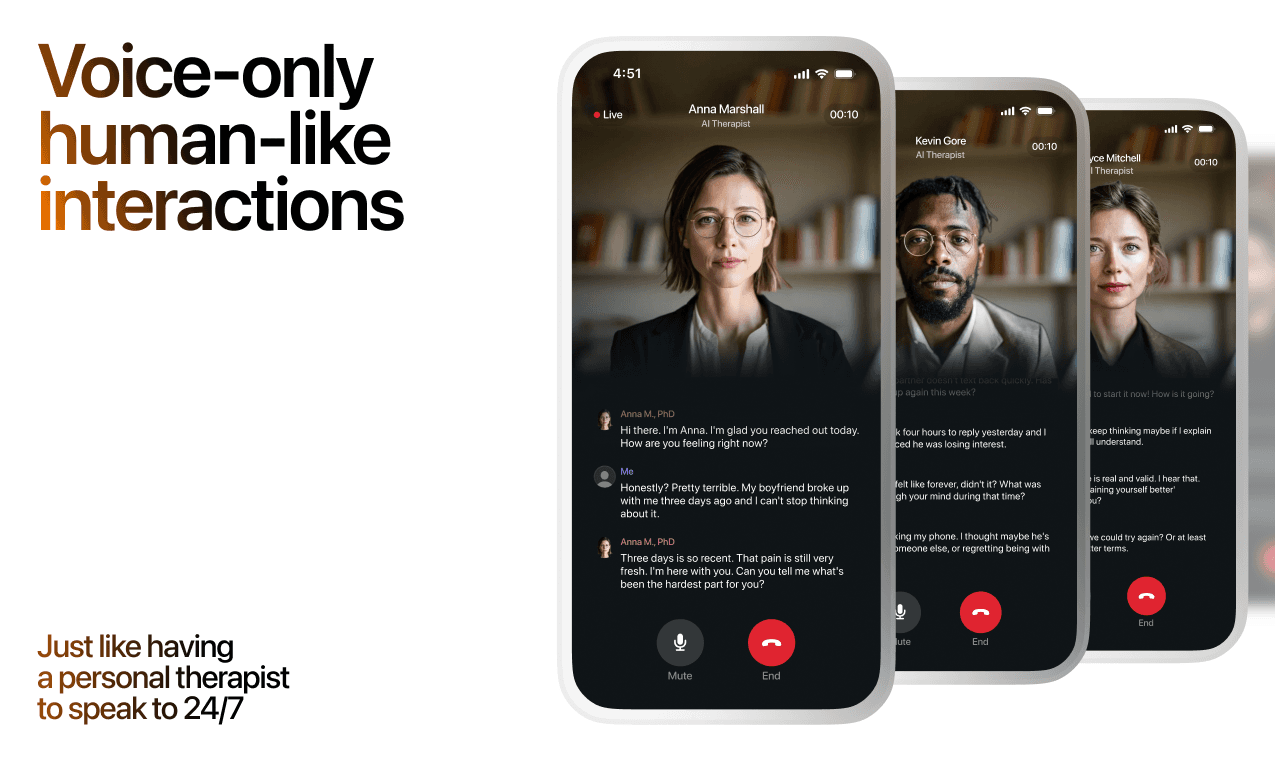
AI emotional support isn't about replacing human connection — it's about filling the gaps. The moments when you need to talk at 2 AM, when you don't want to burden your friends again, or when you simply need someone to listen without judgment.
Here's what happens in a typical Lovon session:
You share what's on your mind
There's no script, no intake form, no waiting room. You speak or type whatever you're feeling — in your own words, at your own pace.
Lovon validates and explores
Using frameworks from CBT (Cognitive Behavioral Therapy) and motivational interviewing, Lovon acknowledges your feelings first, then gently helps you explore them. No dismissive "just move on" advice.
You build coping skills together
Lovon doesn't just listen — it actively works with you on evidence-based techniques: thought reframing, urge surfing, behavioral experiments, and more.
What a Session with Lovon Looks Like
Lovon is AI support, not a replacement for professional care. If things have been hard to get through for weeks, or you are thinking about harming yourself, talk to a doctor or a licensed therapist.
Ready to Start?
Your healing journey can begin right now
A 7-day trial. No judgment. Just a safe space to process what you're going through.
Frequently Asked Questions
How do I get over someone who cheated on me if I still love them?
How do you heal after being cheated on?
How do you get over cheating in a relationship if you stay together?
How long does it take to get over being cheated on?
Why can't I stop overthinking after being cheated on?
Was it my fault that they cheated?
Should I get tested for STIs after being cheated on?
Will I be able to trust someone again after being cheated on?
Sources
About the Author

The Lovon Editorial Team
Mental Health & Wellness Content Team
The Lovon Editorial Team develops mental health and wellness content designed to make psychological concepts accessible and actionable. Our goal is to bridge the gap between clinical research and everyday life - helping you understand why your mind works the way it does and what you can do about it....
Related articles
- How to Stop Obsessing Over Someone: Effective Strategies for Letting Go
It is a deeply painful experience when you cannot stop thinking about someone. It takes over all your thoughts.
- Relationship Anxiety: Signs, Causes, Fixes (2026)
Relationship anxiety explained: signs, causes like anxious attachment, and coping tools that work in 2026. Practical…
- Self Care After a Breakup: 40 Things That Actually Help
Self care after a breakup that actually helps: 40 specific things for sleep, food, people, your phone and your mind, a…
- AI Relationship Coach for Trust Issues (2026)
Find the best AI relationship coach for trust issues in 2026. Lovon offers voice-based, personalized sessions 24/7 — no…
See also
Quizzes
- Trustworthy Person Test: Can People Count on You?
Follow-through, honesty and discretion, in 3 minutes.
- Jealousy Test: 3 Dimensions (Thoughts, Feelings, Checking)
See which part of jealousy runs hottest, in 3 min.
Free tools
- How to Stop Being Jealous in a Relationship
Two very different people search this, and advice that assumes either one is wrong half the time. This sorts what you…
- How to Forgive Someone Who Hurt You
Forgiving, reconciling, and deciding it was fine are three different things, and they get merged. Tell it what happened…
From the wiki
- What is cheating in a relationship?
Cheating is a breach of the agreement you and your partner made about who else gets your body, your attention and your…
Disclaimer: This article is for informational purposes only and does not constitute medical advice, diagnosis, or treatment. Always seek the advice of your physician or other qualified health provider with any questions you may have regarding a medical condition. If you are in crisis or think you may have an emergency, call 988 (Suicide & Crisis Lifeline) or go to the nearest emergency room. Outside the US? Find a crisis line in your country.