
ADHD and Procrastination: Why It Happens (2026 Guide)
ADHD and procrastination linked to dopamine and task-initiation gaps, not laziness. Get the 2026 step-by-step fix: body doubling, 2-minute starts, and more.

Key Takeaways
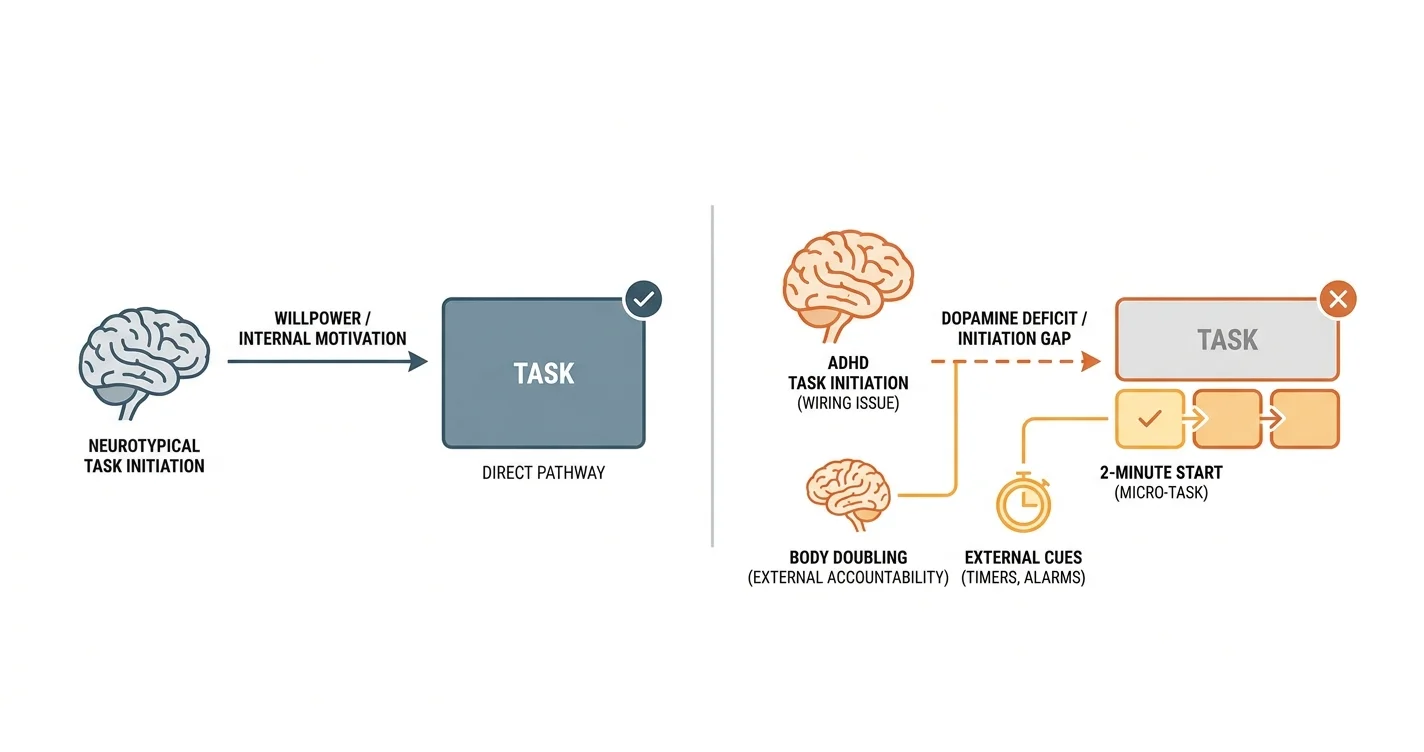
- ADHD and procrastination link back to dopamine and task-initiation deficits, not laziness — treat it as a wiring issue.
- Body doubling and 2-minute starts beat willpower for ADHD task paralysis — use them daily.
- Rejection sensitive dysphoria often masks itself as procrastination — naming it changes the fix.
- Lovon's AI voice therapy gives ADHD adults a same-day place to talk through stuck patterns between sessions.
ADHD and procrastination aren't a willpower problem — they're a brain-wiring problem, and the fix looks different from what works for neurotypical procrastination. This guide breaks down why the ADHD brain stalls on tasks and gives you a step-by-step system to get moving in 2026.
TL;DR
- ADHD and procrastination link back to dopamine and task-initiation deficits, not laziness — treat it as a wiring issue.
- Body doubling and 2-minute starts beat willpower for ADHD task paralysis — use them daily.
- Rejection sensitive dysphoria often masks itself as procrastination — naming it changes the fix.
- Lovon's AI voice support gives ADHD adults a same-day place to talk through stuck patterns between sessions.
Why this matters
Procrastination in ADHD isn't about not caring. It's an executive function breakdown at the exact moment a task needs to start — a gap researchers call the intention-action gap.
For someone with ADHD, the brain's dopamine system underreacts to tasks that aren't urgent, novel, or interesting. That means a task can matter deeply and still get skipped, over and over, while the person beats themselves up for it. The shame spiral that follows often does more damage than the missed deadline itself.
Understanding adhd and procrastination as a neurological pattern instead of a character flaw is the first real intervention. Everything below builds on that reframe.
What you'll need
- A timer (phone timer works fine) — you'll use it in nearly every step
- One task, broken down to its smallest possible first move
- A body double: a person, a call, or an app session where someone else is present while you work
- 10 minutes of quiet time to plan your day, ideally the night before
- Somewhere to externalize your to-do list — sticky note, whiteboard, or app, not just your head
- Optional: a voice-based outlet like an AI voice therapy session to talk through the emotional weight behind a stuck task
The steps
1. Name the real barrier before you plan a fix
ADHD procrastination has more than one cause, and the fix only works if it matches the cause. Ask yourself: is this task boring, is it emotionally loaded, is it unclear what step one even is, or are you afraid of doing it wrong?
A task that's unclear needs breakdown. A task that's emotionally loaded — like a call you're dreading — needs a different approach entirely, often tied to rejection sensitive dysphoria, where the fear of criticism freezes you before you start.
Common mistake: treating every stalled task the same way. A generic "just start" pep talk does nothing for a fear-based freeze.
2. Shrink the task to under 2 minutes
The ADHD brain resists tasks that feel big, vague, or far from a reward. Break the task down until the first move takes less than 2 minutes — "open the document," not "write the report."
Set a timer for exactly 2 minutes and commit only to that first move. Momentum, not motivation, is what gets ADHD brains through the initiation wall.
Expected outcome: most people who complete the 2-minute version keep going past the timer. Common mistake: starting with a step that's still too big, like "finish the first section," which resets the same freeze.
3. Add a body double for anything you've stalled on twice
Working alongside another person — in the same room, on a video call, or in a co-working app — cuts task avoidance sharply for ADHD adults because it adds external accountability the internal system can't generate on its own.
Schedule a 25-minute body-doubling block. Tell the other person what you're working on out loud before you start; saying it out loud activates commitment in a way silent intention doesn't.
Common mistake: picking a body double who also has ADHD and no structure — you'll co-regulate into distraction instead of focus.
4. Build external time cues into the task
ADHD time blindness means "I'll do it later" often means never, because the ADHD brain doesn't feel future deadlines as real until they're seconds away. Replace internal time estimates with external ones: a visible countdown timer, a calendar block with an alarm, or a phone reminder at the exact minute you need to start.
Set the alarm for the start time, not the due date. Starting is the hard part; the due date alarm arrives too late to help.
Expected outcome: tasks tied to a specific alarm get started roughly on time far more often than tasks tied to a vague "today" deadline.
5. Attach a reward that lands immediately
Dopamine-driven brains respond to immediate reward, not distant payoff. A performance review six months away doesn't move you; a coffee break right after this one task does.
Pick a small reward you actually want and give it to yourself the moment the task is done — not after three more tasks. Stack it directly onto the task: finish the email, then take the walk.
Common mistake: using a reward that's also a distraction risk, like "I'll check my phone for 5 minutes," which often eats the next hour.
6. Build a repeatable start-of-day routine
Decision fatigue makes procrastination worse as the day goes on, so front-load your hardest task into a routine you don't have to think about. A consistent ADHD routine removes the "when do I start" decision entirely.
Pick one fixed time each day — same hour, same order of operations — and protect it for your most avoided task. Repetition over 2-3 weeks in 2026 turns the routine into a default instead of a daily negotiation.
Expected outcome: the task stops requiring a decision each morning; it just happens at the fixed slot.
7. Debrief the emotional residue, not just the task list
Chronic procrastination in ADHD builds shame that compounds over time and makes the next task harder to start. Left unaddressed, that shame becomes its own barrier, separate from the original task.
At the end of each day, spend a few minutes naming what got stuck and why, without judgment attached. Talking it through out loud — with a person, or with an AI voice therapist session — surfaces the emotional pattern faster than journaling alone for a lot of people.
Common mistake: skipping this step because the task list looks fine on paper while the internal shame keeps building underneath it.
Troubleshooting
- You start the 2-minute version and immediately stop again. The task is still too big — break it down one more level, or the barrier is emotional, not structural (go back to step 1).
- Body doubling isn't helping. Change the format — a silent co-working call instead of a chatty one, or vice versa. Some ADHD brains need conversation to stay engaged, others need pure silence.
- You keep missing the alarm because you snooze it. Move the alarm's physical location — across the room, not next to the bed or desk, so silencing it requires standing up.
- The reward isn't motivating anymore. Rotate rewards every couple of weeks; novelty matters more than the reward itself for ADHD dopamine response.
- The routine falls apart after a bad week. One missed day isn't a failed system — restart the next day at the same fixed time rather than waiting for "a fresh start" on Monday.
- Shame spirals are getting worse, not better. That's a sign the emotional layer needs direct attention, not another productivity hack — ADHD emotional dysregulation tools address this directly.
Tools and resources
- A visible timer or countdown app for the 2-minute start method
- A body-doubling app, scheduled call, or coworking space
- A wall calendar or app with alarms tied to start times, not due dates
- AI life coach for ADHD goal setting if you need structure around bigger multi-week goals
- A voice-based outlet for the emotional debrief step, since talking a stuck pattern out loud surfaces it faster than typing it
What to do next
Once the daily system holds for a couple of weeks, the next problem to tackle is usually sleep — ADHD brains that fight bedtime end up more procrastination-prone the next day from sheer fatigue. Read the guide on ADHD sleep problems once the procrastination system above is running.
FAQ
Is ADHD procrastination the same as regular procrastination?
No. ADHD procrastination stems from dopamine-driven task-initiation deficits, while typical procrastination is usually a time-management or motivation issue. That's why willpower-based fixes fail for ADHD brains and structural fixes like body doubling work better.
What's the best technique to stop ADHD procrastination?
Shrinking the task to a 2-minute first move works best because it bypasses the initiation barrier instead of fighting it. Pair it with an external alarm set for the start time, not the deadline, for the strongest results.
Does rejection sensitive dysphoria cause procrastination?
Yes, RSD often disguises itself as procrastination when a task carries fear of criticism or failure. Naming the fear directly, rather than treating it as a time-management problem, is what actually moves the task forward.
How long does it take to fix ADHD procrastination patterns?
Most people see the start-of-day routine become automatic after 2-3 weeks of consistent repetition at the same fixed time. Emotional patterns tied to shame usually take longer and benefit from ongoing support.
Does body doubling actually work for ADHD?
Yes, working alongside another person adds external accountability that the ADHD brain's internal system doesn't generate on its own. A 25-minute co-working block is a reasonable starting length in 2026.
Can an AI therapist help with ADHD procrastination?
An AI voice therapy session can help you talk through the shame and avoidance behind a stalled task between other forms of support. Lovon is built for this kind of on-demand emotional processing, not a replacement for licensed ADHD treatment.
Why do ADHD adults procrastinate on easy tasks?
Task difficulty isn't the trigger — boredom and lack of immediate reward are. An easy task with no urgency or interest gets the same dopamine underreaction as a hard one.
What time of day is best to tackle ADHD procrastination?
Front-loading the most avoided task into a fixed morning slot works better than scheduling it for later, since decision fatigue makes initiation harder as the day goes on.
One last thing
The detail most people miss: procrastination and hyperfocus come from the same wiring. The same dopamine system that stalls on a boring task will lock in for hours on something novel — read ADHD hyperfocus to learn how to redirect that same intensity toward the tasks you're currently avoiding, instead of fighting it.
Related guides
How AI Support Helps You Heal
AI emotional support isn't about replacing human connection — it's about filling the gaps. The moments when you need to talk at 2 AM, when you don't want to burden your friends again, or when you simply need someone to listen without judgment.
Here's what happens in a typical Lovon session:
You share what's on your mind
There's no script, no intake form, no waiting room. You speak or type whatever you're feeling — in your own words, at your own pace.
Lovon validates and explores
Using frameworks from CBT (Cognitive Behavioral Therapy) and motivational interviewing, Lovon acknowledges your feelings first, then gently helps you explore them. No dismissive "just move on" advice.
You build coping skills together
Lovon doesn't just listen — it actively works with you on evidence-based techniques: thought reframing, urge surfing, behavioral experiments, and more.
What a Session with Lovon Looks Like
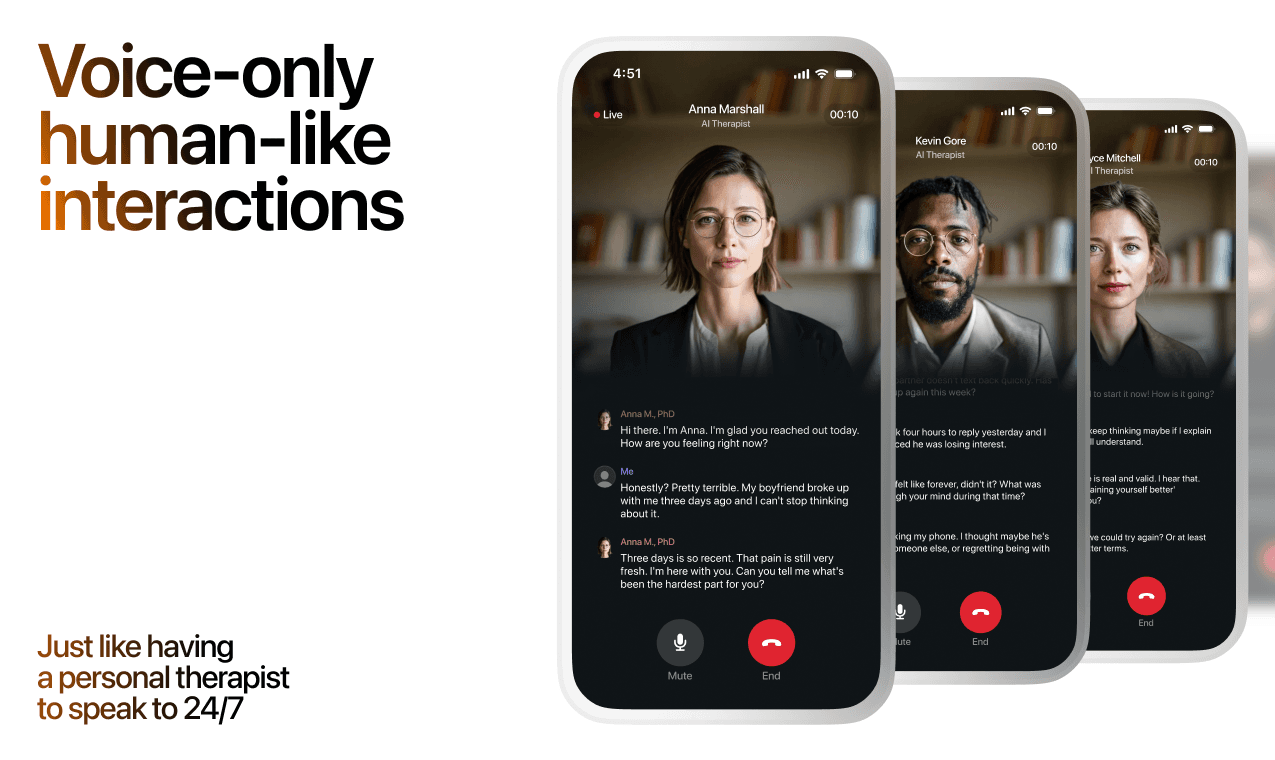
Lovon is AI support, not a replacement for professional care. If things have been hard to get through for weeks, or you are thinking about harming yourself, talk to a doctor or a licensed therapist.
Ready to Start?
Your healing journey can begin right now
A 7-day trial. No judgment. Just a safe space to process what you're going through.
Frequently Asked Questions
Is Lovon a replacement for a real therapist?
Is my conversation with Lovon AI private?
How is Lovon different from ChatGPT for emotional support?
Can I use Lovon if I'm already seeing a therapist?
Can I try Lovon before subscribing?
About the Author

The Lovon Editorial Team
Mental Health & Wellness Content Team
The Lovon Editorial Team develops mental health and wellness content designed to make psychological concepts accessible and actionable. Our goal is to bridge the gap between clinical research and everyday life - helping you understand why your mind works the way it does and what you can do about it....
Related articles
- ADHD with Comorbid Anxiety and Depression Cycles Affecting Self-Esteem
Living with ADHD becomes exponentially more challenging when anxiety and depression enter the picture. For many people…
- Best AI App for Focus and Productivity in 2026: Ranked
The best AI app for focus and productivity in 2026, ranked: Notion AI overall, Focusmate for accountability, Lovon for…
- ADHD — Emotional Costs of Undiagnosed Cases Including Rejection Sensitivity Dysphoria and Chronic Loneliness
Living with undiagnosed ADHD creates an invisible emotional burden that extends far beyond difficulty focusing or…
- Best AI App for ADHD in Women in 2026: Lovon Wins
Compare the best AI apps for ADHD in women in 2026 — Lovon, Tiimo, Focusmate, Habitica, Woebot, and Forest — ranked by…
See also
Quizzes
- Emotion Regulation Test: Can You Bring a Feeling Down?
See how your feelings rise and settle, in 3 minutes.
- Coping Style Test: How Do You Actually Handle Stress?
See how you really cope under stress, in 3 minutes.
Free tools
- What to Say to Someone Who Is Grieving
Get sentences that fit this person and this week, not a list of things people say at funerals. Describe who they lost…
- Write a Condolence Message for This Person
Get one condolence message written for your situation instead of a list of a hundred to choose from. Tell it who died…
From the wiki
- Why do I keep dreaming about the same person?
A recurring dream figure usually marks unfinished emotional business rather than a message about that person. Your brain…
Disclaimer: This article is for informational purposes only and does not constitute medical advice, diagnosis, or treatment. Always seek the advice of your physician or other qualified health provider with any questions you may have regarding a medical condition. If you are in crisis or think you may have an emergency, call 988 (Suicide & Crisis Lifeline) or go to the nearest emergency room. Outside the US? Find a crisis line in your country.