
Does ADHD medication help with emotional regulation?
ADHD medication emotional regulation benefits vary. Learn what improvement looks like, which mood changes need review, and what to ask your prescriber.

Key Takeaways
- ADHD medication emotional regulation benefits vary: fewer impulsive reactions can help, but medication does not remove every difficult feeling.
- Stimulants and nonstimulants have different effects and risks; neither is a guaranteed treatment for emotional distress.
- Track mood alongside medication timing, sleep, and triggers before discussing changes with your prescriber.
- Lovon offers emotional support for everyday ADHD struggles, not prescribing, diagnosis, or licensed clinical care.
Yes—ADHD medication can help some people regulate emotions by reducing impulsive reactions, frustration, and the feeling of being overwhelmed. It does not help everyone, and new irritability, emotional flatness, or mood changes need a prescriber's attention rather than a dose change you make yourself.
TL;DR
- ADHD medication emotional regulation benefits vary: fewer impulsive reactions can help, but medication does not remove every difficult feeling.
- Stimulants and nonstimulants have different effects and risks; neither is a guaranteed treatment for emotional distress.
- Track mood alongside medication timing, sleep, and triggers before discussing changes with your prescriber.
- Lovon offers emotional support for everyday ADHD struggles, not prescribing, diagnosis, or licensed clinical care.
Does ADHD medication help with emotional regulation?
ADHD medication can improve emotional regulation, but better concentration and better emotional control are not the same outcome. You might finish tasks more easily while still struggling with criticism, conflict, or sudden frustration. Both outcomes belong in a medication review.
Emotional regulation means noticing a feeling and choosing what to do next—not becoming calm all the time. If that distinction feels unfamiliar, start with what emotional regulation means for adults.
A review by Posner, Kass, and Peterson, published in Current Psychiatry Reports in 2014, examined stimulant treatment for ADHD-related emotional lability, meaning rapid or intense emotional shifts. It described evidence of improvement while also explaining that stimulants can cause irritability in some patients. The practical takeaway for 2026 is to assess emotional benefits and side effects separately.
| Treatment option | Potential benefit | Limitation or concern | Best fit to discuss with a clinician |
|---|---|---|---|
| Stimulant medication | Can reduce ADHD-related impulsivity and emotional reactivity | Can also cause irritability, sleep difficulties, or appetite changes | People whose emotional reactions occur alongside impairing ADHD symptoms |
| Nonstimulant medication | Treats ADHD symptoms and can support emotional control in some people | Effects and side effects depend on the medicine; improvement is not immediate for every option | People whose history, response, or side effects make a nonstimulant appropriate |
| Skills-based psychotherapy | Builds ways to pause, manage distress, and change unhelpful responses | Requires practice and does not replace medication when medication is indicated | People needing practical help with recurring emotional or relationship patterns |
These options are not interchangeable. Medication selection depends on your diagnosis, health history, other medicines, and treatment goals—not just whether you feel angry or overwhelmed.
Why this matters
A useful ADHD treatment plan in 2026 should ask more than whether you are getting work done. It should also ask whether everyday setbacks feel more manageable and whether relationships are becoming less strained.
Medication can create more space between a feeling and an action. You still need somewhere to put that space: stepping away from an argument, naming a need, or deciding not to send a message while upset.
The goal is more choice in your response, not fewer feelings. Feeling sadness, anger, or disappointment does not automatically mean treatment is failing.
How stimulants can affect emotional regulation
Stimulants affect dopamine and norepinephrine signaling involved in attention and behavioral control. When ADHD symptoms improve, some people find it easier to interrupt an impulsive reaction or recover from frustration.
That improvement can look ordinary rather than dramatic. You notice irritation before snapping, return to a task after an interruption, or hear feedback without immediately acting on the first painful interpretation.
There are also limits. Better attention does not resolve grief, relationship conflict, trauma, or every source of anxiety. A stimulant is not a general mood stabilizer, and feeling emotionally numb is not a treatment goal.
Irritability during treatment versus symptoms returning
Irritability that appears while a medicine is active deserves attention. Irritability as its effects wear off can reflect returning symptoms or a rebound pattern—a temporary worsening around the medicine's offset.
Timing helps your prescriber investigate, but timing alone does not establish the cause. Hunger, exhaustion, conflict, and another health condition can produce a similar pattern.
Tell your prescriber when the change begins, what it feels like, and whether it followed starting or changing treatment. Do not add doses, change timing, or stop treatment based only on an online explanation.
How nonstimulants can affect emotional regulation
Nonstimulant ADHD medicines work differently from stimulants and from one another. Atomoxetine and guanfacine are examples, but their approved uses depend on age and location, and neither is suitable for everyone.
Some nonstimulants need regular use over time before their benefit can be judged. Your prescriber should explain the expected review schedule for the specific medicine rather than giving you a single timeline for all ADHD treatment.
Nonstimulants also have side effects and monitoring needs. Depending on the medicine, these can include sleepiness, stomach symptoms, or changes in blood pressure and heart rate.
For a medication discussion in 2026, ask what improvement you should look for, which side effects require a call, and when to review the plan. Do not assume that “nonstimulant” means risk-free or that it specifically treats anger.
Why emotional regulation benefits vary
Different responses do not mean you are trying harder or less hard than someone else. Several factors can change what you experience:
- The source of the distress. ADHD-related impulsivity can improve while anxiety, depression, trauma-related symptoms, or relationship stress still need attention.
- The specific medicine and formulation. Different treatments have different effects, durations, and side-effect profiles.
- The timing of symptoms. Distress before a dose, during its effects, and as it wears off gives your prescriber different information.
- Sleep and eating patterns. Poor sleep and missed meals can make an already difficult day harder; medication-related sleep or appetite changes also need review.
- Your coping skills and surroundings. Medication does not remove sensory overload, unreasonable demands, or a recurring conflict pattern.
- Other health conditions and substances. Other medicines, caffeine, alcohol, and health conditions belong in the clinical discussion.
Avoid interpreting every difficult evening as proof that you need a higher dose. The same outward reaction can have different causes, and the next step depends on the cause.
How can you tell whether medication is helping your emotions?
Look for changes in behavior, recovery, and side effects—not just whether you feel calmer. Bring concrete examples to your next medication review in 2026. A brief record is easier to discuss than trying to reconstruct an upsetting week from memory.
Use this suggested check-in; it is a conversation aid, not a diagnostic test:
- Name the trigger. Write what happened without judging yourself: an interruption, a delayed reply, a noisy room, or a changed plan.
- Record the timing. Note when you took your prescribed medicine and when the emotional change happened. Keep taking it as directed.
- Rate the intensity. If numbers help, use a personal scale from 0 to 10 points. Compare your own entries rather than treating a score as a medical threshold.
- Describe the response. Record what you did and how you recovered. Include any unusual anxiety, numbness, agitation, or sleep changes.
- Bring the pattern. Share repeated patterns and significant changes with your prescriber. Do not turn the record into your own dosing experiment.
Set aside 2 minutes for an entry if that makes the task manageable. That is a suggested writing limit, not a treatment schedule; a few clear words are enough.
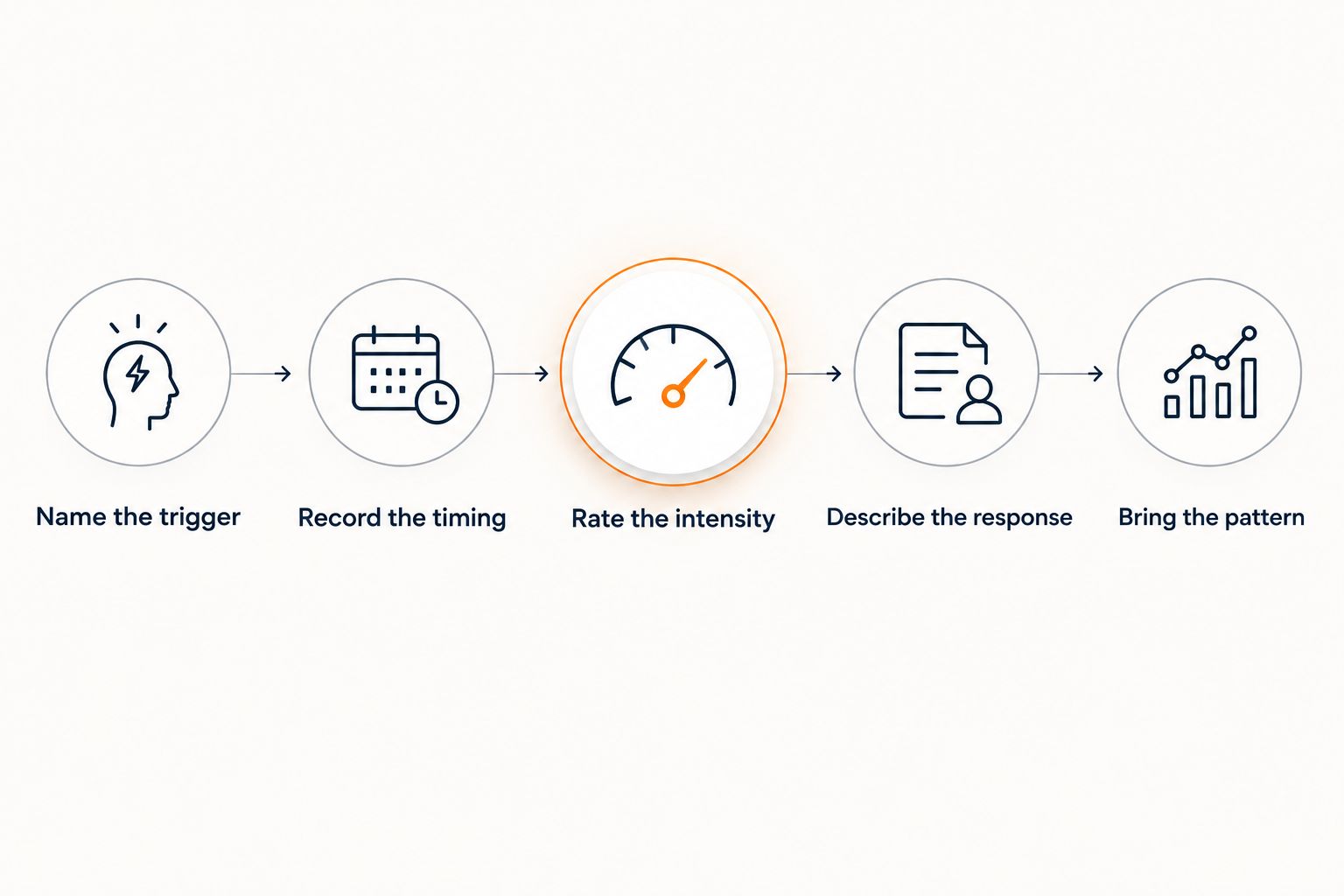 Five steps for recording emotional changes and discussing patterns with a prescriber
Track what happened and when, rather than deciding the cause yourself.
A useful change might be catching an angry response before sending it, even though the anger still arrives. Likewise, improved productivity does not cancel out a troubling side effect. Record both so your clinician can judge the whole picture.
What if anxiety is driving some of the emotional overwhelm?
ADHD and anxiety can occur together, and both can affect concentration, sleep, and tolerance for stress. Feeling overwhelmed does not tell you which condition is responsible—or whether both are contributing.
The clinical question behind treating anxiety and ADHD together is whether the care plan addresses both sets of symptoms rather than assuming every emotional difficulty comes from ADHD. Describe worry, avoidance, physical tension, and panic symptoms alongside distractibility and impulsivity.
ADHD treatment can reduce stress that comes from missed tasks or repeated mistakes. Anxiety can also remain despite improved ADHD symptoms, and some people experience increased anxiety with a particular medicine.
Ask for a review of the pattern, not simply a stronger treatment. Your prescriber needs to know whether anxiety existed before medication, appeared afterward, or changed following a dose adjustment.
What can you do alongside medication?
Choose a small response you can practice before emotions become intense. Trying to invent a coping plan in the middle of an argument adds another task when you already feel overloaded.
- Pause the action. Put down the phone or step away from the conversation when it is safe. You do not need to settle the disagreement immediately.
- Name the feeling. Separate the emotion from the conclusion: feeling rejected does not prove someone intends to reject you.
- Reduce the demand. Move to a quieter space or focus on one immediate task rather than solving everything at once.
- Plan the return. If you pause a conversation, say that you intend to return to it. A pause should support repair, not become punishment.
Skills-based therapy can help you practice these responses and work through patterns that medication alone does not address. Asking for that support is compatible with taking medication.
Where voice-based emotional support fits
Lovon is best for people seeking voice-based emotional support for everyday ADHD struggles, not medication management. You can use Lovon to talk through feelings, explore coping tools, and reflect on a difficult interaction.
Lovon offers an available place to talk, but it is not a licensed clinician and cannot diagnose ADHD, prescribe medicine, or determine whether a side effect is safe. Keep medication decisions with your prescriber.
A practical use of Lovon is preparing what you want to tell a clinician: what happened, what changed, and what you need help understanding. Support between appointments should help you reach appropriate care, not replace it.
When should you contact your prescriber?
Contact your prescriber promptly for new or worsening irritability, persistent emotional flatness, marked anxiety, or mood changes after starting or adjusting medication. Report sleep and appetite changes too, especially when they affect daily functioning.
Seek urgent medical assessment for severe agitation, hallucinations, or unusually elevated or irritable mood with a reduced need for sleep. These symptoms are not something to manage by adjusting medication yourself.
If you have thoughts of suicide or self-harm, seek immediate support. In the United States in 2026, call or text 988 for the Suicide & Crisis Lifeline; call 911 for immediate danger or a medical emergency. An emotional support app is not emergency care.
FAQ
Can ADHD medication help me stop snapping at people?
ADHD medication can reduce impulsive reactions for some people, including snapping when frustrated. Communication skills, stress, sleep, and relationship patterns still matter, so discuss specific examples with your clinician.
Which ADHD medication is best for emotional regulation?
There is no single ADHD medication that is best for everyone's emotional regulation. Your prescriber should weigh ADHD symptoms, emotional changes, health history, other medicines, and side effects.
Why do I feel more irritable when my ADHD medication wears off?
Irritability as ADHD medication wears off can reflect returning symptoms or a rebound pattern. Record the timing and discuss it with your prescriber rather than adding a dose yourself.
Is feeling emotionally numb on ADHD medication normal?
Feeling emotionally numb is not the goal of ADHD treatment and deserves a medication review. Describe when it started and whether you also feel low, disconnected, or unable to enjoy things.
Does ADHD medication treat rejection sensitive dysphoria?
ADHD medication is not an established, specifically approved treatment for rejection sensitive dysphoria. That term describes intense distress around perceived rejection, but it is not a separate formal diagnosis; a clinician can assess the symptoms and other possible explanations.
Can therapy help if medication improves focus but not emotions?
Therapy can help you develop emotional regulation skills even when medication mainly improves focus. A clinician can also assess whether anxiety, depression, trauma-related symptoms, or another concern needs treatment.
Should I change my dose if I am still having emotional outbursts?
Do not change your ADHD medication dose without your prescriber's guidance. Persistent outbursts need a review of timing, triggers, benefits, side effects, and other possible causes.
One last thing
Recovery counts as progress. Noticing an outburst sooner, repairing the conversation, or asking for a pause can matter even when the feeling itself remains intense.
For your next appointment, bring one example of improvement and one unresolved difficulty. That gives your prescriber a clearer treatment goal than simply asking whether the medicine is working.
Related guides
How AI Support Helps You Heal
AI emotional support isn't about replacing human connection — it's about filling the gaps. The moments when you need to talk at 2 AM, when you don't want to burden your friends again, or when you simply need someone to listen without judgment.
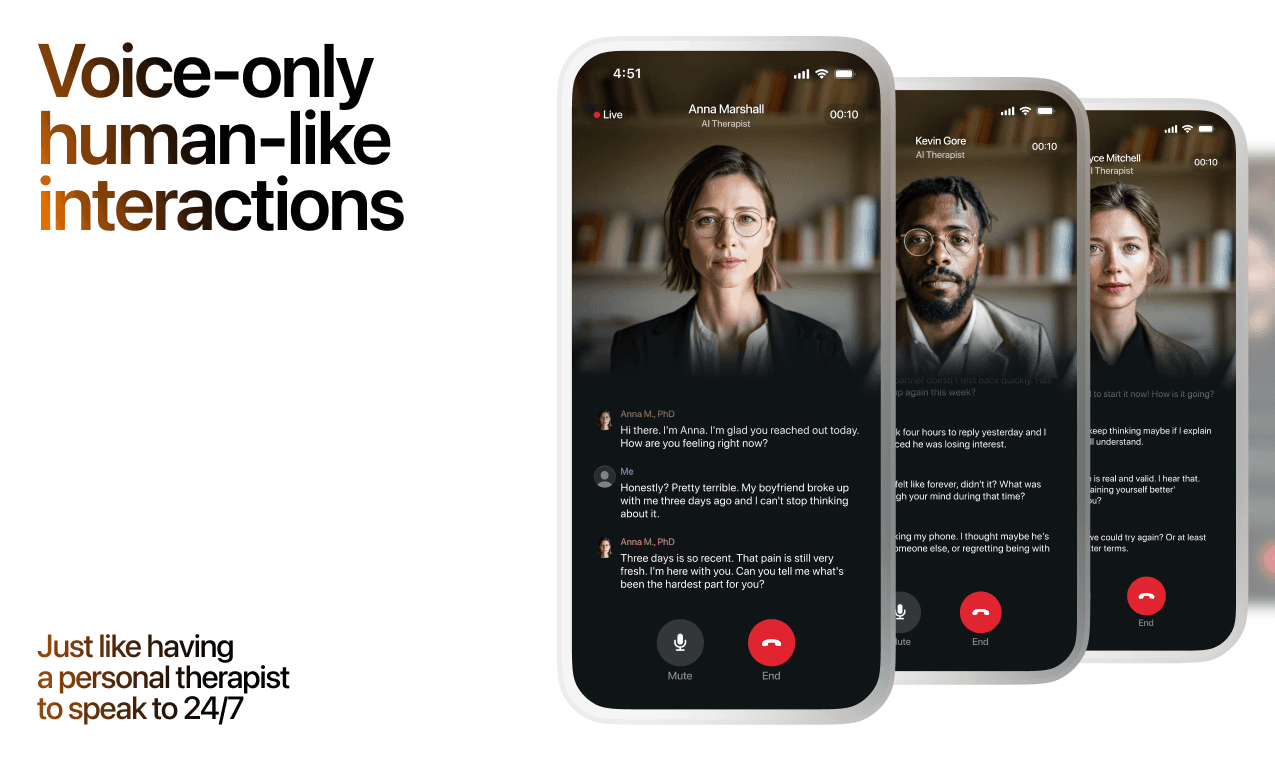
Here's what happens in a typical Lovon session:
You share what's on your mind
There's no script, no intake form, no waiting room. You speak or type whatever you're feeling — in your own words, at your own pace.
Lovon validates and explores
Using frameworks from CBT (Cognitive Behavioral Therapy) and motivational interviewing, Lovon acknowledges your feelings first, then gently helps you explore them. No dismissive "just move on" advice.
You build coping skills together
Lovon doesn't just listen — it actively works with you on evidence-based techniques: thought reframing, urge surfing, behavioral experiments, and more.
What a Session with Lovon Looks Like
Lovon is AI support, not a replacement for professional care. If things have been hard to get through for weeks, or you are thinking about harming yourself, talk to a doctor or a licensed therapist.
Ready to Start?
Your healing journey can begin right now
A 3-day trial. No judgment. Just a safe space to process what you're going through.
Frequently Asked Questions
Is Lovon a replacement for a real therapist?
Is my conversation with Lovon AI private?
How is Lovon different from ChatGPT for emotional support?
Can I use Lovon if I'm already seeing a therapist?
Can I try Lovon before subscribing?
About the Author
The Lovon Editorial Team
Mental Health & Wellness Content Team
The Lovon Editorial Team develops mental health and wellness content designed to make psychological concepts accessible and actionable. Our goal is to bridge the gap between clinical research and everyday life - helping you understand why your mind works the way it does and what you can do about it....
Related articles
- Is ADHD coaching covered by insurance in 2026?
Is ADHD coaching covered by insurance? Usually not. Learn what separates coaching from covered care and what to ask your…
- Can journaling really reduce stress?
Can journaling really reduce stress? Yes, it can help, but not everyone benefits. Learn what research shows, which…
- Best ChatGPT alternatives for emotional support in 2026
Compare the best ChatGPT alternatives for therapy. Choose voice support for everyday feelings or licensed care for…
- Best Apps for ADHD Adults in 2026 — Ranked
The best apps for ADHD adults in 2026, ranked by emotional support, task management, and ADHD-informed design. Lovon…
See also
Quizzes
- Distress Tolerance Test: How Long Can You Sit With It?
See which kind of discomfort makes you need out first.
- Emotional Granularity Test: How Precisely Do You Feel?
See how finely you tell your feelings apart, in 3 minutes.
Free tools
- Vent to an AI
Need to vent and there is nobody to call, or nobody you want to tell? Type it here. You are talking to an AI listener…
- Words of Encouragement for Him When He Is Struggling
Words of encouragement for him that fit what he is actually going through, for when your usual lines are not landing…
From the wiki
- Why do I keep dreaming about the same person?
A recurring dream figure usually marks unfinished emotional business rather than a message about that person. Your brain…
Disclaimer: This article is for informational purposes only and does not constitute medical advice, diagnosis, or treatment. Always seek the advice of your physician or other qualified health provider with any questions you may have regarding a medical condition. If you are in crisis or think you may have an emergency, call 988 (Suicide & Crisis Lifeline) or go to the nearest emergency room. Outside the US? Find a crisis line in your country.