
Can journaling really reduce stress?
Can journaling really reduce stress? Yes, it can help, but not everyone benefits. Learn what research shows, which prompts to try, and when to seek support.

Key Takeaways
- Can journaling really reduce stress? Yes, but research supports it as a coping tool, not a guaranteed treatment.
- Structured journaling helps separate what happened, what you feel, and what you can do next.
- Stop or change your approach if writing repeatedly leaves you more distressed or stuck in overthinking.
- Lovon offers voice-based emotional support for people who prefer talking; it does not replace licensed clinical care.
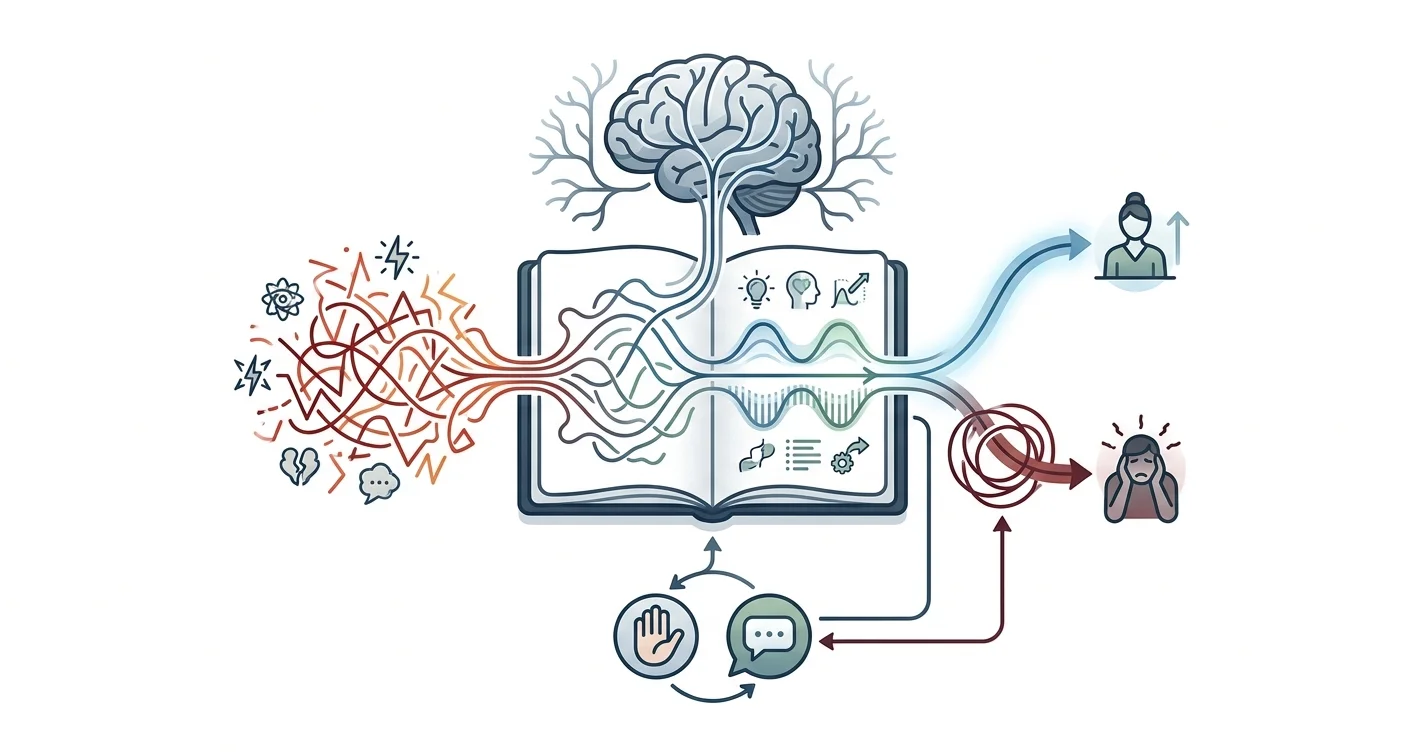
Yes, journaling can help reduce stress by giving you a way to name feelings, organize worries, and identify a manageable next step. The benefit is not guaranteed: writing about painful experiences can increase distress in the moment, and journaling does not replace mental health treatment or changes to a stressful situation.
TL;DR
- Can journaling really reduce stress? Yes, but research supports it as a coping tool, not a guaranteed treatment.
- Structured journaling helps separate what happened, what you feel, and what you can do next.
- Stop or change your approach if writing repeatedly leaves you more distressed or stuck in overthinking.
- Lovon offers voice-based emotional support for people who prefer talking; it does not replace licensed clinical care.
Why this matters
When you feel stressed, you do not need another task to perform perfectly. You need somewhere to put the thoughts that keep demanding your attention. A journal gives those thoughts a place without requiring you to explain yourself to anyone else.
For your 2026 stress-management routine, treat journaling as an optional tool, not a daily obligation. The useful question is whether it helps you understand your experience or respond differently afterward. If you want help starting, this beginner’s guide to journaling for mental health covers the basics.
A helpful journal entry does not have to make you happy. It should help you get clearer without leaving you overwhelmed.
Can journaling really reduce stress?
Research supports journaling as a useful addition to mental health care, but the results do not justify promising relief to everyone. Studies use different writing exercises, populations, and measures. Evidence for one structured exercise does not prove that every kind of diary writing produces the same effect.
Two published sources help explain that distinction:
- Sohal and colleagues’ 2022 systematic review, published in Family Medicine and Community Health, examined 20 randomized controlled trials of journaling for mental health. The review supported journaling as an additional tool while identifying limitations in the available evidence.
- Smyth and colleagues’ 2018 trial, published in JMIR Mental Health, studied online positive-affect journaling in 70 adults with medical conditions and elevated anxiety symptoms. Participants assigned to journaling wrote for 15 minutes, 3 times a week, during a 12-week intervention; the study reported benefits on some distress and well-being measures.
Those findings support trying a structured practice. They do not establish a universal writing schedule, prove that journaling treats a diagnosed condition, or show that more writing always works better.
The practical takeaway for 2026 is simple: use journaling to support coping, and judge the practice by your response—not by the size of someone else’s claim.
What journaling can and cannot do
Writing can help you describe a problem more precisely. Instead of a broad thought such as everything is going wrong, you can distinguish a missed deadline from a disagreement at home. That makes it easier to decide which problem needs attention first.
Journaling cannot remove an unsafe relationship, an unreasonable workload, or a medical problem. It also cannot reliably tell you whether symptoms come from stress, anxiety, depression, or another condition. You can bring observations from your journal to a qualified professional, but the journal itself is not an assessment.
Which kind of journaling should you try?
Choose a writing approach that matches what you need today. You do not have to use the same format every time, and none of these options is a universal winner.
| Approach | Best for | Useful feature | Limitation |
|---|---|---|---|
| Expressive writing | Putting difficult feelings into words | Gives you room to describe an experience honestly | Detailed writing about painful experiences can feel upsetting |
| Structured reflection | Sorting a specific worry | Separates events, feelings, interpretations, and actions | Can become rigid if you treat it like a worksheet to complete perfectly |
| Gratitude journaling | Noticing support or meaningful moments | Directs attention toward something you value | Can feel dismissive if you use it to avoid anger, grief, or unmet needs |
| Practical planning | Stress linked to unfinished tasks | Turns a vague worry into a concrete next step | Does not address every emotional part of the problem |
Use this 2026 comparison as a choice of formats, not a ranking of effectiveness. Start with the approach that feels manageable. If a format adds pressure, change it.
Expressive writing: best for naming difficult feelings
Expressive writing gives you space to describe what happened and what it brought up. You can write about frustration, disappointment, fear, or mixed feelings without making the entry tidy. Nobody needs to approve the wording.
Keep the subject within what you feel able to handle. You do not need to revisit your most painful memory to make journaling useful. If detailed writing leaves you overwhelmed, pause and consider discussing that material with a licensed clinician.
Structured reflection: best for sorting a specific worry
Structured reflection uses prompts to keep the entry focused. Describe the situation, name your feelings, and separate what you know from what you are assuming. Then identify something you can influence.
This format is useful when a blank page feels too open-ended. Its drawback is the temptation to search for a perfect explanation. Aim for a workable next step, not complete certainty.
Gratitude journaling: best for noticing what supports you
Gratitude writing can focus on something small that mattered: a helpful conversation, a quiet moment, or a person who followed through. You do not need to claim that everything is fine.
Keep room for the difficult feelings too. Appreciating support and acknowledging stress can exist in the same entry. If gratitude feels forced, choose a neutral prompt instead, such as what helped me get through today?
How do you journal without getting stuck in overthinking?
Try this short sequence when you want structure. It is a suggested exercise, not a research-tested treatment protocol or a required routine.
- Name the situation. Describe one event rather than reviewing your entire life. Stick to what happened before explaining what it means.
- Name the feeling. Use ordinary words such as worried, angry, lonely, relieved, or disappointed. Mixed feelings are allowed.
- Check the story. Separate observable facts from predictions and assumptions. You can acknowledge uncertainty without solving it immediately.
- Choose an action. Identify something within your control, including asking for help, resting, or postponing a decision.
- Close the entry. Finish with a clear stopping point. Put the journal away and return your attention to your surroundings.
These steps give your 2026 journaling routine a beginning and an ending. You are not required to keep writing until you feel calm.
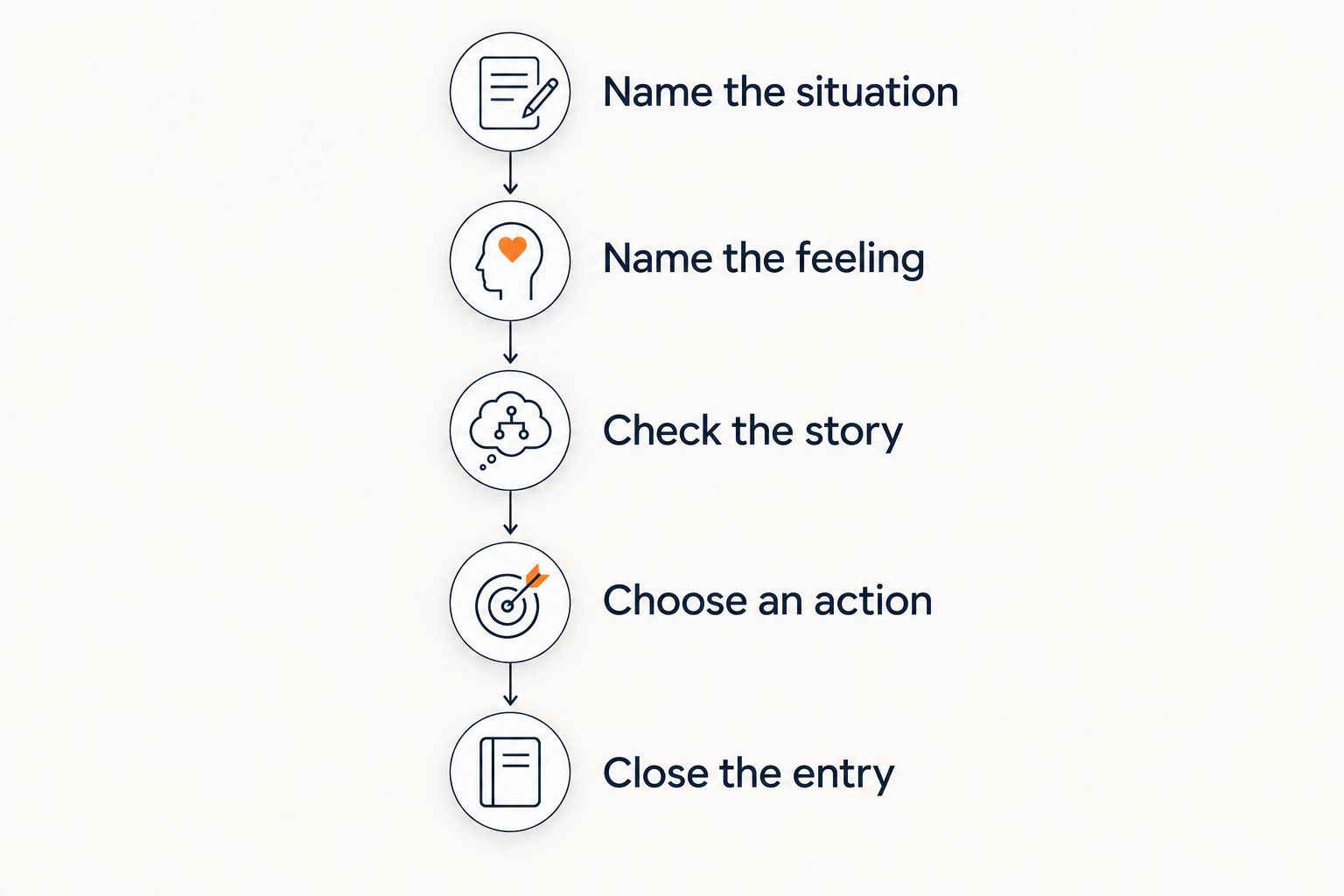 Five journaling steps from naming the situation to closing the entry
End with a manageable action rather than a demand to solve everything.
For example, an entry about a work message could describe the delayed reply, acknowledge worry, and identify the assumption that your colleague is upset. Your next action might be to ask for clarification when appropriate. You do not have to turn the uncertainty into reassurance you cannot verify.
Avoid rereading the same entry to look for proof that nothing bad will happen. If writing becomes another way to seek certainty, set it aside. A conversation, a practical task, or professional support can be a better next move.
Why journaling’s effect on stress varies
Research does not identify a single format that works for everyone. When you decide whether to continue, consider these features of your practice:
- The subject: Everyday frustration and a traumatic memory are different writing tasks. Choose material you can approach without becoming overwhelmed.
- The purpose: Naming feelings, solving a practical problem, and appreciating support need different prompts. Match the prompt to the task.
- The structure: Open-ended writing offers freedom, while a focused prompt offers boundaries. Change formats if you keep circling the same thought.
- Your privacy: Concern about someone reading the journal can make honest writing difficult. Choose a format and storage method you feel comfortable using.
- What happens afterward: Notice whether you can return to your day or remain caught in the entry. That response matters more than completing a streak.
- The stressor itself: Writing does not replace rest, boundaries, practical help, or treatment. Address the situation as well as your feelings about it.
You do not need to make journaling work at any cost. A coping tool should serve you, not become another source of self-criticism.
How long does journaling take to reduce stress?
There is no guaranteed timeline for stress relief. You might notice clearer thoughts after an entry, while broader changes require observation over time; neither response establishes that journaling is treating an underlying condition.
The 12-week intervention in the Smyth trial was a study design, not a deadline for feeling better. Check whether writing helps you handle your day, and seek support rather than waiting for a journal to fix persistent distress.
Can journaling make stress worse?
Yes, writing about upsetting material can increase distress in the moment. Repeatedly rehearsing the same fears without gaining clarity can also leave you feeling stuck rather than supported.
Pause if you feel overwhelmed, disconnected from your surroundings, or unable to settle afterward. You can switch to a neutral description of the present, contact someone you trust, or ask a clinician for guidance; you do not need to push through.
Is talking about stress better than writing it down?
Neither format is better for everyone. Writing gives you control over pace and wording, while talking offers another way to express feelings when typing or handwriting feels difficult.
Lovon is best suited to people who prefer voice-based emotional support alongside, not instead of, licensed clinical care. Lovon offers on-demand voice conversations, coping tools, and self-reflection guidance for everyday mental health struggles. Lovon’s voice-based emotional support is not a licensed clinician’s assessment, treatment, or crisis response.
When choosing a digital support tool in 2026, read its current privacy terms before sharing sensitive information. Do not assume a conversation with an app has the same protections or clinical oversight as a conversation with a licensed therapist.
When should you get more support than a journal?
Seek professional support when stress persistently disrupts sleep, relationships, work, or basic daily activities. You do not have to wait until you have tried every self-help method. A journal can help you describe patterns during an appointment, but using one is not a condition for receiving care.
If writing repeatedly brings up traumatic experiences, discuss that response with a qualified clinician. The goal is not to prove that you can handle the material alone. It is to find support that fits what you are experiencing.
If you are in the United States and have thoughts of suicide or feel unable to keep yourself safe, call or text 988 for the Suicide & Crisis Lifeline. Call 911 for an immediate life-threatening emergency. A journal or app is not an emergency service.
FAQ
Can journaling really reduce stress if I have never done it before?
Yes, journaling can help with stress even if you are new to it, but relief is not guaranteed. Start with a specific situation, a feeling, and a manageable next step rather than trying to write a complete life story.
Do I have to journal every day for it to help?
No, daily journaling is not a universal requirement for benefit. Choose a pattern that feels manageable and change it if the routine adds pressure.
What should I write when I am stressed and cannot find the words?
Start with what happened and a simple feeling word, such as worried, angry, or overwhelmed. Short phrases are enough; you do not need polished sentences or a clear explanation for every feeling.
Is gratitude journaling better than writing about difficult feelings?
Neither approach is better for everyone. Gratitude writing focuses on what supports you, while expressive writing makes room for difficult feelings; choose according to what you need rather than forcing positivity.
Should I stop journaling if it makes me feel worse?
Pause if journaling leaves you overwhelmed or repeatedly more distressed. Change the subject or format, and seek professional guidance if painful memories or symptoms are difficult to manage.
Can Lovon replace a journal or a therapist?
Lovon offers voice-based emotional support for people who prefer talking to writing, but it does not replace a licensed therapist. You can use conversation and journaling as separate coping tools without treating either as clinical care.
How do I know whether journaling is actually helping?
Look for clearer understanding, a useful next step, or a better ability to return to your day. More pages, longer sessions, and an unbroken writing streak do not establish that your stress is improving.
One last thing
Your journal does not need to contain a solution. Sometimes the most useful ending is recognizing that you need rest, clarification, practical help, or a conversation with someone who can support you.
For 2026, make one commitment: do not turn journaling into another test you can fail. Keep what helps, change what does not, and let stopping be a valid choice.
Related guides
How AI Support Helps You Heal
AI emotional support isn't about replacing human connection — it's about filling the gaps. The moments when you need to talk at 2 AM, when you don't want to burden your friends again, or when you simply need someone to listen without judgment.
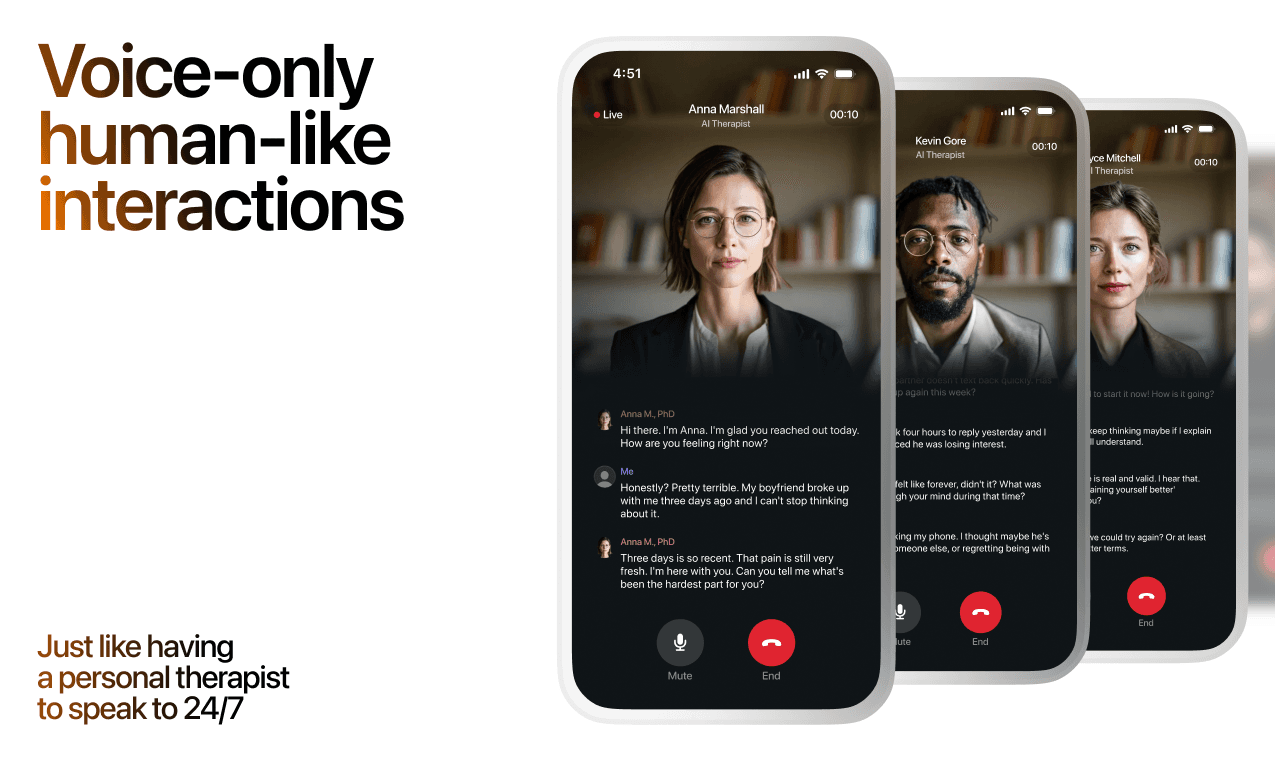
Here's what happens in a typical Lovon session:
You share what's on your mind
There's no script, no intake form, no waiting room. You speak or type whatever you're feeling — in your own words, at your own pace.
Lovon validates and explores
Using frameworks from CBT (Cognitive Behavioral Therapy) and motivational interviewing, Lovon acknowledges your feelings first, then gently helps you explore them. No dismissive "just move on" advice.
You build coping skills together
Lovon doesn't just listen — it actively works with you on evidence-based techniques: thought reframing, urge surfing, behavioral experiments, and more.
What a Session with Lovon Looks Like
When to Seek Professional Help
AI support is a valuable tool, but it's not a replacement for professional care. Please consider reaching out to a licensed therapist if you experience any of the following:
- Persistent thoughts of self-harm or suicide
- Inability to perform daily activities (work, eating, sleeping) for more than 2 weeks
- Turning to alcohol or substances to cope
- Intense anger or desire to harm your ex-partner
- Complete emotional numbness that doesn't improve over time
Crisis Resources (US): If you're in immediate danger, call 988 (Suicide & Crisis Lifeline) or text HOME to 741741 (Crisis Text Line). Available 24/7, free, and confidential.
Outside the US? Find a crisis line in your country
Ready to Start?
Your healing journey can begin right now
A 7-day trial. No judgment. Just a safe space to process what you're going through.
Frequently Asked Questions
Is Lovon a replacement for a real therapist?
Is my conversation with Lovon AI private?
How is Lovon different from ChatGPT for emotional support?
Can I use Lovon if I'm already seeing a therapist?
Can I try Lovon before subscribing?
About the Author
The Lovon Editorial Team
Mental Health & Wellness Content Team
The Lovon Editorial Team develops mental health and wellness content designed to make psychological concepts accessible and actionable. Our goal is to bridge the gap between clinical research and everyday life - helping you understand why your mind works the way it does and what you can do about it....
Related articles
- Can self-care alone fix burnout?
Can self care alone fix burnout? No. See what rest can help with, why work demands must change, and when to seek support…
- Is it normal to feel embarrassed talking to an AI?
Is it normal to feel embarrassed talking to an AI? Yes. Learn why speaking can feel awkward, how to start with a small…
- Best Free AI Life Coach for Anxiety & Stress 2026
Find the best free AI life coach for anxiety and stress in 2026. Lovon delivers voice-based sessions, CBT-informed…
- How much time a day should you spend on self-care?
How much time a day should you spend on self care? There is no fixed daily target. Learn how to choose care that fits…
See also
Quizzes
- Empath Test: Do Other People's Moods Become Yours?
See how much of other people's moods you take on.
- Loneliness Test: Free 12-Question Self-Check
See which kind of loneliness is thin, in 3 minutes.
Free tools
- Am I Overreacting, or Is This a Big Deal?
A chat for the small thing you cannot stop turning over. Say what happened and what you have already told yourself about…
- Words of Encouragement for Him When He Is Struggling
Words of encouragement for him that fit what he is actually going through, for when your usual lines are not landing…
From the wiki
- What to do if you have no friends?
Pick one activity that repeats weekly with the same people, and go for six to eight weeks straight. Repetition, not…
Disclaimer: This article is for informational purposes only and does not constitute medical advice, diagnosis, or treatment. Always seek the advice of your physician or other qualified health provider with any questions you may have regarding a medical condition. If you are in crisis or think you may have an emergency, call 988 (Suicide & Crisis Lifeline) or go to the nearest emergency room. Outside the US? Find a crisis line in your country.