
Enmeshment Trauma: How to Untangle It in 2026
Enmeshment trauma explained: signs, causes, and 6 steps to rebuild your sense of self in adult relationships. Practical guidance for 2026, no jargon.

Key Takeaways
- Enmeshment trauma comes from a childhood role where your emotions existed to manage a parent's, not your own.
- Guilt after saying no to family is the clearest adult symptom of enmeshment trauma, not a personality flaw.
- Untangling enmeshment trauma means naming the pattern, then rebuilding a self separate from a caregiver's moods.
- Lovon's AI voice therapy gives you a place to rehearse boundary language before you use it on family calls.
- Codependency and enmeshment overlap but aren't the same thing - check which one actually describes you.
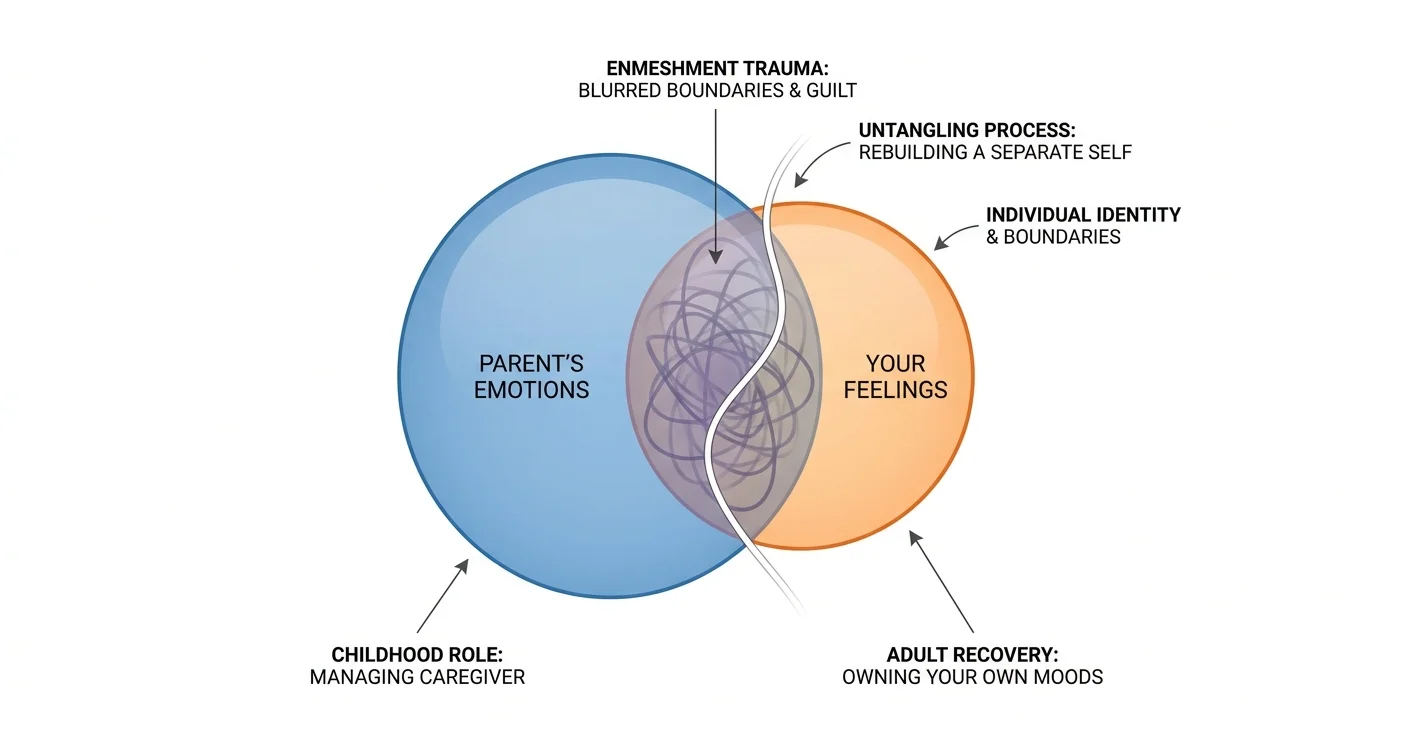
Enmeshment trauma happens when a parent or caregiver blurred the line between your feelings and theirs, and it shows up now as guilt every time you want space, say no, or make a choice that isn't about someone else first.
TL;DR
- Enmeshment trauma comes from a childhood role where your emotions existed to manage a parent's, not your own.
- Guilt after saying no to family is the clearest adult symptom of enmeshment trauma, not a personality flaw.
- Untangling enmeshment trauma means naming the pattern, then rebuilding a self separate from a caregiver's moods.
- Lovon's AI voice support gives you a place to rehearse boundary language before you use it on family calls.
- Codependency and enmeshment overlap but aren't the same thing - check which one actually describes you.
Why this matters
Enmeshment trauma doesn't look like abuse from the outside. It looks like closeness. A mother who calls three times a day, a father who needs you to agree with his version of every family conflict, a household where your mood was never fully your own because someone else's mood set the temperature.
The cost shows up later, in 2026, in your adult relationships. You over-explain simple decisions. You feel responsible for a partner's bad day. You can't identify what you want to eat, watch, or do because you spent childhood reading a parent's face for the answer instead. That's not oversensitivity - it's a trained pattern, and the signs of enmeshment in relationships usually trace back to one household dynamic repeating itself with new people.
What you'll need
- 20-30 minutes of uninterrupted time, ideally when you're not already activated by a family conflict
- A notes app or journal - this work is verbal and written, not just mental
- A short list of your current close relationships (partner, parent, sibling, best friend)
- Willingness to sit with guilt without immediately fixing it
- Optionally, a private space to talk this through out loud - Lovon's AI voice support works well here because you can say the uncomfortable part before you say it to the person involved
The steps
1. Name the pattern instead of just feeling it
Enmeshment trauma stays powerful as long as it's invisible. Write one sentence: "In my family, my job was to ______." Common answers: keep the peace, manage a parent's sadness, agree with everyone, never need anything. Naming it turns a vague, lifelong ache into a specific, workable pattern. Skipping this step is the most common mistake - people jump straight to "setting boundaries" without knowing what boundary they're actually missing.
2. Trace it back to a role, not a person
Ask who needed you to play that role and why. Was a parent anxious, depressed, or without a partner of their own to lean on? Enmeshment usually formed because an adult filled an adult-sized emotional gap with a child. This isn't about blame - it's about accuracy. If toxic parent patterns match what you're describing, that context makes the guilt you feel now easier to challenge.
3. Separate whose feeling belongs to whom
Practice a simple filter before you react: "Is this my emotion, or am I absorbing someone else's?" If your partner is stressed and you instantly feel responsible for fixing their mood, that's the enmeshment reflex firing. The goal isn't to stop caring - it's to notice the automatic ownership before you act on it.
4. Say one boundary sentence out loud, before you need it
Rehearse a specific line: "I can't talk about this tonight, I'll call tomorrow." Say it alone, in the mirror or into a voice app, five times. Rehearsal matters because enmeshment trauma makes real-time boundary-setting feel like betrayal - your nervous system needs the sentence to feel familiar before it feels safe. Setting healthy relationship boundaries works better as a rehearsed skill than a spontaneous one.
5. Expect the guilt wave, and let it pass without acting on it
The first few times you hold a boundary, guilt will spike hard - sometimes harder than the actual conflict. That's expected, not a sign you did something wrong. Set a timer for ten minutes and just notice the guilt without reversing your decision. It fades. Acting on it every time is how enmeshment gets re-installed in adulthood.
6. Build one identity marker that has nothing to do with the enmeshed relationship
Pick something small - a hobby, a friend group, a routine - that exists only for you. Enmeshment trauma erodes the sense that you exist separately from the person you're enmeshed with. A single independent thread, held consistently through 2026, rebuilds that separateness faster than any single conversation will.
Talk through it before you say it out loud
Rehearse the hard conversation with Lovon's AI voice support first.
Troubleshooting
- Guilt spikes so hard you cave within a day. Shorten the boundary instead of dropping it - "not tonight" instead of "not ever." Small, consistent wins beat one dramatic stand.
- A parent responds with silence or anger. That reaction is data, not proof you were wrong. Enmeshed systems push back hardest right when a boundary starts working.
- Your partner mirrors the old dynamic. If you picked someone who needs the same caretaking role you played as a kid, that's not a coincidence - it's the pattern repeating with a new cast.
- You feel selfish for wanting privacy. Selfishness and self-preservation get confused in enmeshed households on purpose. Wanting a closed door isn't cruelty.
- The boundary works for a week, then quietly erodes. Old patterns don't disappear after one conversation. Expect to reinforce the same boundary multiple times through 2026 before it holds without effort.
Tools and resources
- A short daily check-in: "Whose feeling am I carrying right now?"
- A written script for the boundary sentence you rehearse most often
- Lovon's AI voice support for talking through a specific family scenario before it happens, especially useful late at night when the guilt spiral hits and no one else is available
- A trusted friend who didn't grow up in your family system, to reality-check what feels "normal"
What to do next
Once the pattern is named, the next confusion usually shows up as: is this enmeshment, or is it just codependency? They overlap but aren't identical - enmeshment starts as a family structure, codependency is often the adult relationship habit that grows out of it. Working through both gives you the fuller picture instead of half of it.
FAQ
What is enmeshment trauma exactly?
Enmeshment trauma is the lasting effect of growing up in a family where personal boundaries between you and a caregiver were blurred or absent. It shows up in adulthood as guilt over independence, difficulty knowing your own preferences, and feeling responsible for other people's emotions.
Is enmeshment trauma the same as codependency?
No, though they're closely related. Enmeshment describes the childhood family structure, while codependency describes the adult relationship pattern that often develops from it - you can have one without a full diagnosis of the other.
What are the signs of enmeshment trauma in adults?
Common signs include guilt after saying no, difficulty identifying your own wants, over-responsibility for a partner's mood, and anxiety when you're physically or emotionally separate from a parent. These patterns usually date back to a specific childhood role.
Can enmeshment trauma be healed without cutting off family?
Yes. Healing enmeshment trauma is about building a separate sense of self, not necessarily ending the relationship. Many people keep the relationship intact while changing the amount of emotional responsibility they carry inside it.
How long does it take to heal from enmeshment trauma?
There's no fixed timeline, but most people notice the guilt response softening after several months of consistent boundary practice. Full identity separation from an enmeshed caregiver can take longer, often more than a year of steady work.
Does enmeshment trauma cause anxiety in relationships?
It often does. When you grow up managing a caregiver's emotions, you can carry that hypervigilance into adult partnerships, scanning a partner's mood the same way you scanned a parent's.
Is enmeshment trauma the same in every family?
No. It can come from an anxious parent, a parentified role after a divorce, a household with substance use, or a caregiver without their own emotional support system. The shape differs, but the core pattern - your feelings existing to manage theirs - stays the same.
Can talking to an AI therapist help with enmeshment trauma?
AI voice support like Lovon can give you a low-stakes place to rehearse boundary conversations and process guilt between real sessions, though it isn't a replacement for licensed clinical care if the trauma is severe.
One last thing
The guilt you feel setting a boundary with an enmeshed parent is usually stronger than the guilt you'd feel over an actual wrongdoing - and that mismatch is the tell. If the feeling is bigger than the offense, you're not being selfish, you're just unlearning a role that was never yours to hold in the first place.
Related guides
How AI Support Helps You Heal
AI emotional support isn't about replacing human connection — it's about filling the gaps. The moments when you need to talk at 2 AM, when you don't want to burden your friends again, or when you simply need someone to listen without judgment.
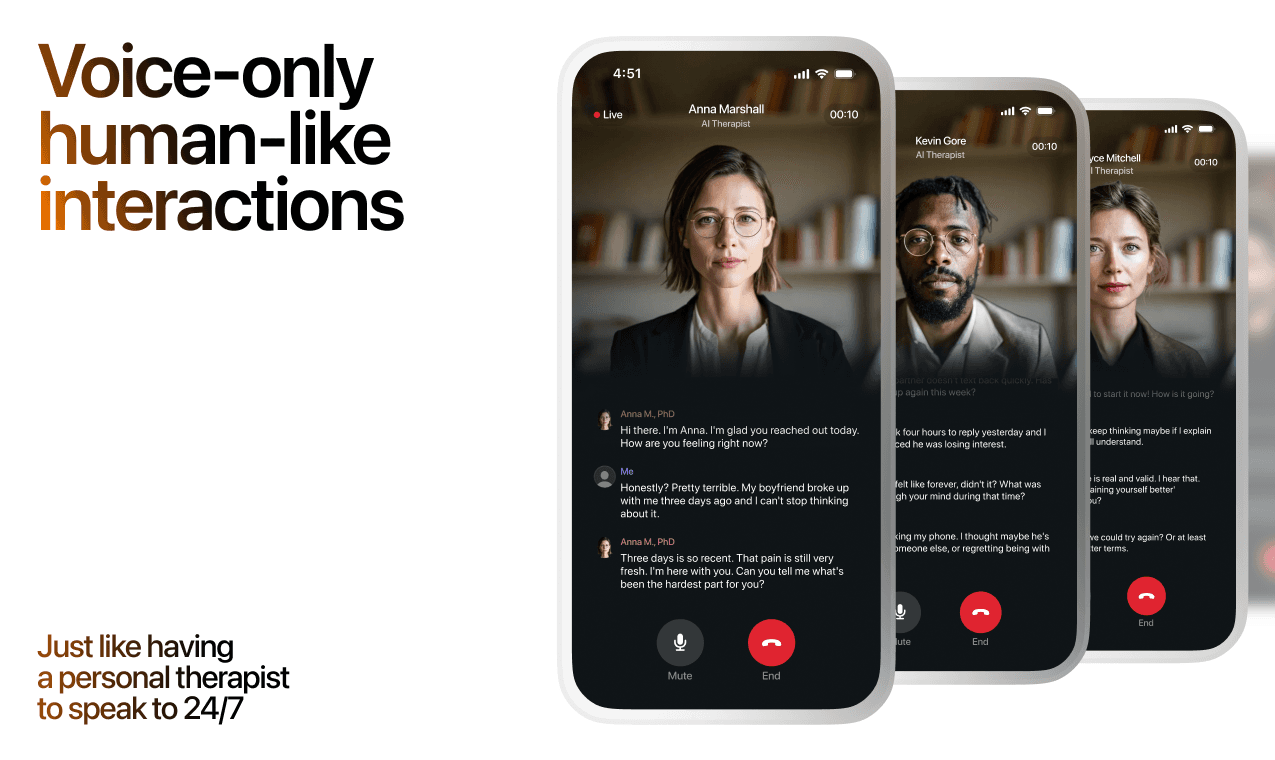
Here's what happens in a typical Lovon session:
You share what's on your mind
There's no script, no intake form, no waiting room. You speak or type whatever you're feeling — in your own words, at your own pace.
Lovon validates and explores
Using frameworks from CBT (Cognitive Behavioral Therapy) and motivational interviewing, Lovon acknowledges your feelings first, then gently helps you explore them. No dismissive "just move on" advice.
You build coping skills together
Lovon doesn't just listen — it actively works with you on evidence-based techniques: thought reframing, urge surfing, behavioral experiments, and more.
What a Session with Lovon Looks Like
Lovon is AI support, not a replacement for professional care. If things have been hard to get through for weeks, or you are thinking about harming yourself, talk to a doctor or a licensed therapist.
Ready to Start?
Your healing journey can begin right now
A 7-day trial. No judgment. Just a safe space to process what you're going through.
Frequently Asked Questions
Is Lovon a replacement for a real therapist?
Is my conversation with Lovon AI private?
How is Lovon different from ChatGPT for emotional support?
Can I use Lovon if I'm already seeing a therapist?
Can I try Lovon before subscribing?
About the Author
The Lovon Editorial Team
Mental Health & Wellness Content Team
The Lovon Editorial Team develops mental health and wellness content designed to make psychological concepts accessible and actionable. Our goal is to bridge the gap between clinical research and everyday life - helping you understand why your mind works the way it does and what you can do about it....
Related articles
- AI Therapy for Adult Children of Alcoholics (2026)
AI therapy for adult children of alcoholics in 2026: what to look for, what to avoid, and where Lovon's voice check-ins…
- Best AI apps for foster parents in 2026
Compare the best AI apps for foster parents. Choose Lovon for adult emotional support, plus tools for planning and…
- AI Relationship Coach for Sibling Relationships: Yes in 2026
Lovon's AI relationship coach for sibling relationships offers 24/7 voice support for favoritism, guilt, and…
- AI Support App for Caregiver Burnout: 2026 Verdict
The best ai support app for caregiver burnout in 2026 is Lovon, offering voice-based AI support available 24/7 without…
See also
Quizzes
- Self-Control Test: Where Does Your Willpower Slip?
See where your willpower slips, in 3 minutes.
- Empath Test: Do Other People's Moods Become Yours?
See how much of other people's moods you take on.
Free tools
- What to Say When They Are Struggling
A chat, not a list. Tell the coach who this person is to you, what they are going through, and what you already said…
- What to Say Back to a Hostile Co-Parent
A chat, not a form. Paste the message your ex sent about the kids, say what actually has to be decided, and you get a…
From the wiki
- Why do I have no friends?
Usually nothing is wrong with you. Adult friendship runs on proximity and repetition, and most people lose both at once…
Disclaimer: This article is for informational purposes only and does not constitute medical advice, diagnosis, or treatment. Always seek the advice of your physician or other qualified health provider with any questions you may have regarding a medical condition. If you are in crisis or think you may have an emergency, call 988 (Suicide & Crisis Lifeline) or go to the nearest emergency room. Outside the US? Find a crisis line in your country.