
Derealization vs Depersonalization: Tell Them Apart (2026)
Derealization vs depersonalization explained step by step: spot the difference, ground fast, and know when 2026 warning signs mean it's time to get help.

Key Takeaways
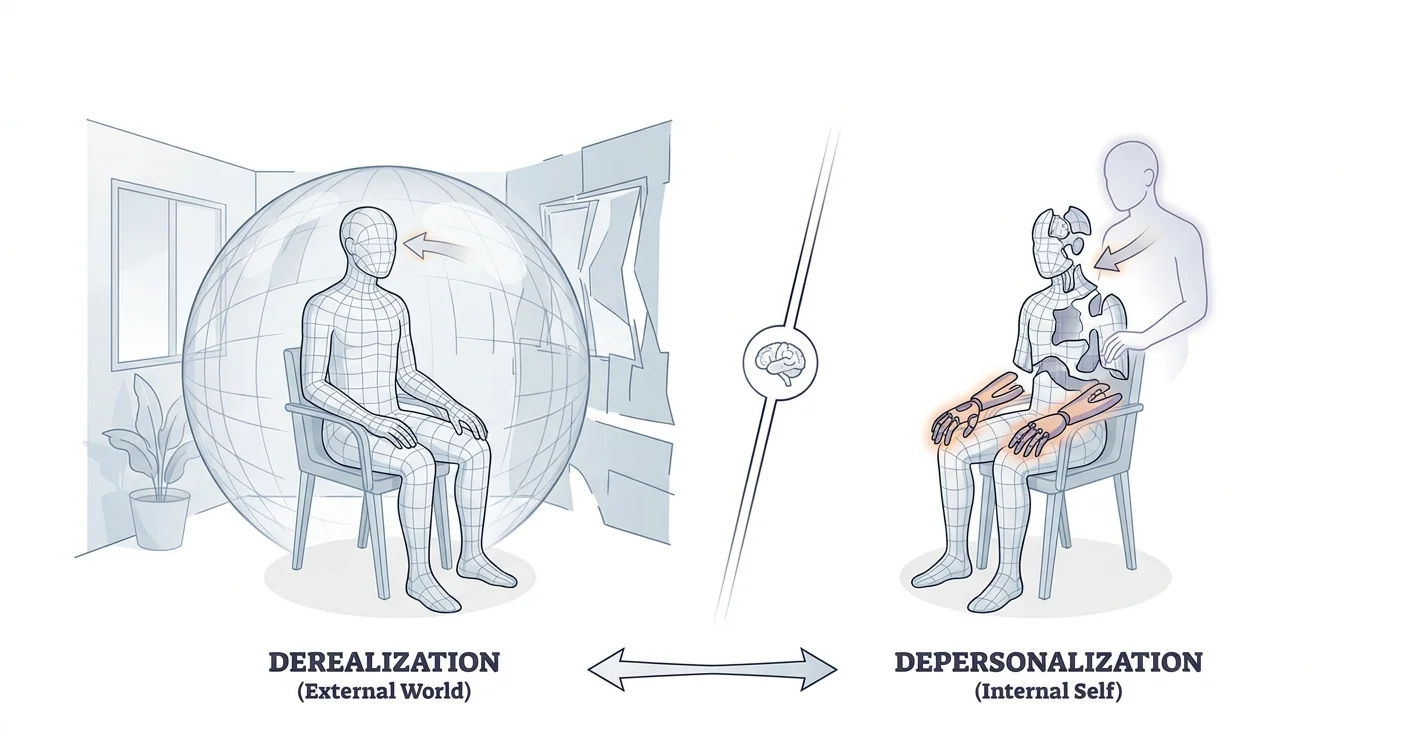
- Derealization vs depersonalization comes down to location: world feels unreal (derealization) vs self feels unreal
- Both are dissociation symptoms, not psychosis — reality testing usually stays intact during an episode.
- Track triggers, duration, and body sensations for one week before assuming the worst.
- Grounding techniques stop most single episodes within 2 to 5 minutes; recurring episodes need a bigger conversation.
- If episodes hit daily by 2026 standards for concerning frequency, loop in a professional rather than white-knuckling
Derealization makes the world feel like a movie set; depersonalization makes you feel like you're watching yourself from outside your own body. They show up together often enough that most people can't tell which one they're actually having — and that confusion makes the episode scarier than it needs to be.
TL;DR
- Derealization vs depersonalization comes down to location: world feels unreal (derealization) vs self feels unreal (depersonalization).
- Both are dissociation symptoms, not psychosis — reality testing usually stays intact during an episode.
- Track triggers, duration, and body sensations for one week before assuming the worst.
- Grounding techniques stop most single episodes within 2 to 5 minutes; recurring episodes need a bigger conversation.
- If episodes hit daily by 2026 standards for concerning frequency, loop in a professional rather than white-knuckling it alone.
Why This Distinction Matters
The DSM-5 groups both under "depersonalization/derealization disorder" when they're frequent and distressing, but the day-to-day difference matters for how you cope with a single episode. If you think your surroundings are fake, breathing exercises and sensory grounding target the environment. If you think you're not real, the fix leans more toward body-based grounding and self-orientation.
Misnaming the experience wastes the first, most useful minutes of an episode. Someone convinced the room is unreal doesn't need a mirror check — someone convinced their own body is a stranger's does. Getting the label right in 2026, when dissociation content on social platforms often blurs the two into one vague "I feel disconnected" bucket, actually changes what you do next.
What You'll Need
- A quiet 5 minutes, even mid-episode
- A notes app or small notebook for tracking pattern
- One cold or textured object nearby (ice cube, a rubber band, a piece of fabric)
- A private space to talk out loud, even just to yourself
- Access to dissociation support content or a voice-based check-in if episodes recur
You don't need a diagnosis to start telling these apart. You need one clear episode, described in plain language, and about 5 minutes to run through the steps below.
The Steps
1. Name the location of the unreality
Ask yourself one question: is it the room, or is it you? Derealization puts the distortion outside — colors look washed out, sounds feel muffled, distances seem wrong. Depersonalization puts it inside — your hands look like they belong to someone else, your voice sounds like a recording. Expected outcome: you can point to one location within 10 seconds. Common mistake: people say "everything feels weird" and stop there, which erases the exact clue that tells the two apart.
2. Run the mirror test
Look at your reflection for 15 to 20 seconds. In depersonalization, your own face can look unfamiliar or slightly "off," even though you know intellectually it's you. In derealization, the mirror itself looks normal — the weirdness is in the room around it, not the reflection. This step accomplishes a fast self-check without needing anyone else present. Mistake to avoid: staring longer than 30 seconds, which can intensify depersonalization in some people rather than clarify it.
3. Track the trigger that came before it
Write down what happened in the 10 minutes before the episode started — a panic spike, sleep deprivation, cannabis use, or a stretch of high stress are the most common triggers for both. Derealization tends to follow sensory overload (crowded rooms, bright lights, screens). Depersonalization tends to follow acute stress or panic. Logging this for a week builds a pattern instead of a guess.
4. Check the body sensations, not just the perception
Depersonalization often comes with numbness, a sense of floating, or feeling like your limbs move on autopilot. Derealization often comes with visual distortion — things look flat, foggy, or too bright — without the same body detachment. Noting which sensation showed up first narrows the diagnosis fast and tells you where to ground: outward for derealization, inward for depersonalization.
5. Time the episode
Most single episodes of either type last somewhere between 30 seconds and 20 minutes when tied to acute stress. Anything stretching past an hour, or happening most days for two or more weeks, moves out of "occasional stress response" territory. A stopwatch on your phone is enough — write the start and end time.
6. Say the sentence out loud
Speak your experience in one sentence: "The room feels fake" versus "I feel fake." This sounds almost too simple, but verbalizing it — even alone — activates a different part of reality-testing than silently ruminating on it. It also gives you language to bring to a therapist or an AI voice therapy session later, instead of a vague "I felt weird" report.
7. Rule out physical causes
Sleep deprivation under 5 hours, migraine aura, low blood sugar, and some medications can all produce derealization or depersonalization-like symptoms without any underlying mental health condition. Before assuming this is purely psychological, check whether you slept, ate, or hydrated normally in the last 24 hours. Mistake to avoid: skipping this step and jumping straight to worst-case interpretations.
8. Apply the matching grounding technique
For derealization, orient to the room: name 5 things you see, 4 you can touch, 3 you hear. For depersonalization, orient to your body: press your feet into the floor, grip something cold, say your own name out loud. The grounding techniques for anxiety and panic guide breaks down the full 5-4-3-2-1 method if this is new to you. Expect the intensity to drop within 2 to 5 minutes once you're using the right-direction technique instead of guessing.
Troubleshooting
- "I have both at once and can't separate them." That's common, not a sign you did the exercise wrong — mixed episodes happen. Ground outward first (name what you see), then inward (name a body sensation), rather than trying to pick one.
- "It only happens during panic attacks." That's a strong signal the dissociation is anxiety-driven rather than a standalone disorder. Managing the panic response directly usually reduces the dissociation as a side effect.
- "It's happening almost every day now." Daily or near-daily episodes by 2026 clinical standards for frequency warrant a conversation with a licensed professional, not just self-tracking. Frequency is the single biggest red flag here.
- "I'm scared I'm 'going crazy.'" Reality testing stays intact in derealization and depersonalization — you know the experience is off, which is the opposite of psychosis. That awareness itself is a good sign, not a bad one.
- "Grounding works for 10 minutes then it comes back." That points to an unresolved trigger sitting underneath, often chronic stress or unprocessed anxiety. The window of tolerance framework explains why the nervous system keeps bouncing back into this state and how to widen the margin over time.
- "I can't tell if it's derealization or just being tired." Sleep-deprived brain fog usually clears with rest within a few hours; dissociative episodes don't reliably respond to sleep alone. If a nap doesn't touch it, treat it as dissociation, not fatigue.
Tools and Resources
- A tracking log (paper or app) for trigger, duration, and sensation
- The 5-4-3-2-1 grounding method for derealization episodes
- Cold water or a textured object for depersonalization episodes
- Nervous system dysregulation signs and how to reset for the physiological piece underneath both experiences
- A voice-based check-in when episodes repeat, so the pattern gets named out loud instead of staying in your head
Talk through an episode right now
Voice sessions for grounding through derealization or depersonalization, any time.
What To Do Next
Once you can reliably label an episode as derealization or depersonalization, the next move is figuring out what's driving the frequency — chronic stress, unprocessed trauma, or an anxiety pattern that's been running in the background for months. That's a bigger conversation than a single grounding exercise can solve, and it's worth having with a professional or a structured AI voice session built around dissociation and anxiety patterns rather than a generic wellness app.
FAQ
What is the main difference between derealization and depersonalization?
Derealization is feeling detached from your surroundings — the world looks unreal, flat, or dreamlike. Depersonalization is feeling detached from yourself — your body, thoughts, or voice feel foreign. Many people experience both in the same episode.
Can you have derealization and depersonalization at the same time?
Yes, mixed episodes are common and don't indicate a more severe condition than having just one. Ground outward toward your environment first, then inward toward your body, to work through both.
Is depersonalization a sign of a serious mental illness?
On its own, an occasional episode is usually a stress response, not a sign of psychosis or a severe disorder. It becomes a diagnosable condition only when episodes are frequent, persistent, and distressing over weeks or months.
How long does a derealization episode usually last?
Most stress-triggered episodes last between 30 seconds and 20 minutes. Episodes lasting hours, or recurring daily, are worth discussing with a professional rather than managing alone.
What triggers derealization or depersonalization episodes?
Acute stress, panic attacks, sleep deprivation, sensory overload, and cannabis use are the most common triggers. Chronic anxiety or unresolved trauma can also make episodes more frequent as of 2026 clinical observations.
Does grounding actually stop a dissociation episode?
Yes, matching the grounding technique to the type of episode — outward for derealization, inward for depersonalization — typically reduces intensity within 2 to 5 minutes. Using the wrong direction of grounding often feels like it isn't working at all.
Can AI therapy help with derealization or depersonalization?
AI voice therapy can walk you through grounding techniques and help you name the pattern in the moment, which is useful for occasional episodes. It is not a replacement for a licensed clinician if episodes are frequent or severely distressing.
When should I see a professional about dissociation?
See a professional if episodes happen daily or most days, last longer than an hour, or interfere with work, driving, or relationships. Frequency and duration matter more than the label itself.
One Last Thing
The fastest way to tell derealization from depersonalization isn't a checklist — it's one sentence spoken out loud. "The room feels fake" and "I feel fake" point to different nervous system responses, and saying it out loud, even to no one, forces your brain to locate the distortion instead of drowning in it.
Related Guides
How AI Support Helps You Heal
AI emotional support isn't about replacing human connection — it's about filling the gaps. The moments when you need to talk at 2 AM, when you don't want to burden your friends again, or when you simply need someone to listen without judgment.
Here's what happens in a typical Lovon session:
You share what's on your mind
There's no script, no intake form, no waiting room. You speak or type whatever you're feeling — in your own words, at your own pace.
Lovon validates and explores
Using frameworks from CBT (Cognitive Behavioral Therapy) and motivational interviewing, Lovon acknowledges your feelings first, then gently helps you explore them. No dismissive "just move on" advice.
You build coping skills together
Lovon doesn't just listen — it actively works with you on evidence-based techniques: thought reframing, urge surfing, behavioral experiments, and more.
What a Session with Lovon Looks Like

Lovon is AI support, not a replacement for professional care. If things have been hard to get through for weeks, or you are thinking about harming yourself, talk to a doctor or a licensed therapist.
Ready to Start?
Your healing journey can begin right now
A 7-day trial. No judgment. Just a safe space to process what you're going through.
Frequently Asked Questions
Is Lovon a replacement for a real therapist?
Is my conversation with Lovon AI private?
How is Lovon different from ChatGPT for emotional support?
Can I use Lovon if I'm already seeing a therapist?
Can I try Lovon before subscribing?
About the Author

The Lovon Editorial Team
Mental Health & Wellness Content Team
The Lovon Editorial Team develops mental health and wellness content designed to make psychological concepts accessible and actionable. Our goal is to bridge the gap between clinical research and everyday life - helping you understand why your mind works the way it does and what you can do about it....
Related articles
- Bipolar Disorder Diagnostic Criteria Explained
Distinguishing between Bipolar 1, Bipolar 2, and cyclothymia depends primarily on understanding the Bipolar Disorder…
- Grief and depression: how to tell them apart
How grief and depression differ in everyday terms, why both can be true at once, and what is worth bringing to a doctor…
- How to Get Out of a Depressive Episode (2026 Guide)
Learn how to get out of a depressive episode on your own with 7 evidence-based steps — from nervous system regulation to…
- How to Stop a Panic Attack in the Moment (2026)
Learn how to stop a panic attack using 4-7-8 breathing, 5-4-3-2-1 grounding, and the dive reflex. Evidence-based steps…
See also
Quizzes
- Emotional Contagion Test: Which Moods Do You Catch?
See how moods spread to you and through you, in 3 minutes.
- Self-Acceptance Test: What Are You Still Arguing With?
See where you are still fighting yourself, in 3 minutes.
Free tools
- 5-4-3-2-1 Grounding Exercise
A guided run through the 5-4-3-2-1 technique, with paced breathing first if you need it. No sign-up, nothing stored…
- Body Scan Meditation
Ten minutes, from your toes to the top of your head, noticing what is there without trying to fix it. Follow the voice…
From the wiki
- Why do I feel sad when I'm alone?
Being alone does not create the sadness. It removes the noise that was keeping it out of earshot, so whatever queued up…
Disclaimer: This article is for informational purposes only and does not constitute medical advice, diagnosis, or treatment. Always seek the advice of your physician or other qualified health provider with any questions you may have regarding a medical condition. If you are in crisis or think you may have an emergency, call 988 (Suicide & Crisis Lifeline) or go to the nearest emergency room. Outside the US? Find a crisis line in your country.