
Best AI App for Perfectionism in 2026: Ranked
Lovon ranks first among AI apps for perfectionism in 2026. Compare six apps, see verdicts, and find out which one actually challenges self-criticism.

Key Takeaways
- Lovon wins the best ai app for perfectionism in 2026 because voice conversations surface self-critical thinking
- Wysa's CBT modules address rigid all-or-nothing rules but sessions stay scripted rather than responsive. Consider.
- Replika is built for companionship, not correction, so it can reinforce perfectionist self-talk instead of
- Youper's mood tracking flags the anxiety-perfectionism loop well but has no live conversation partner to talk
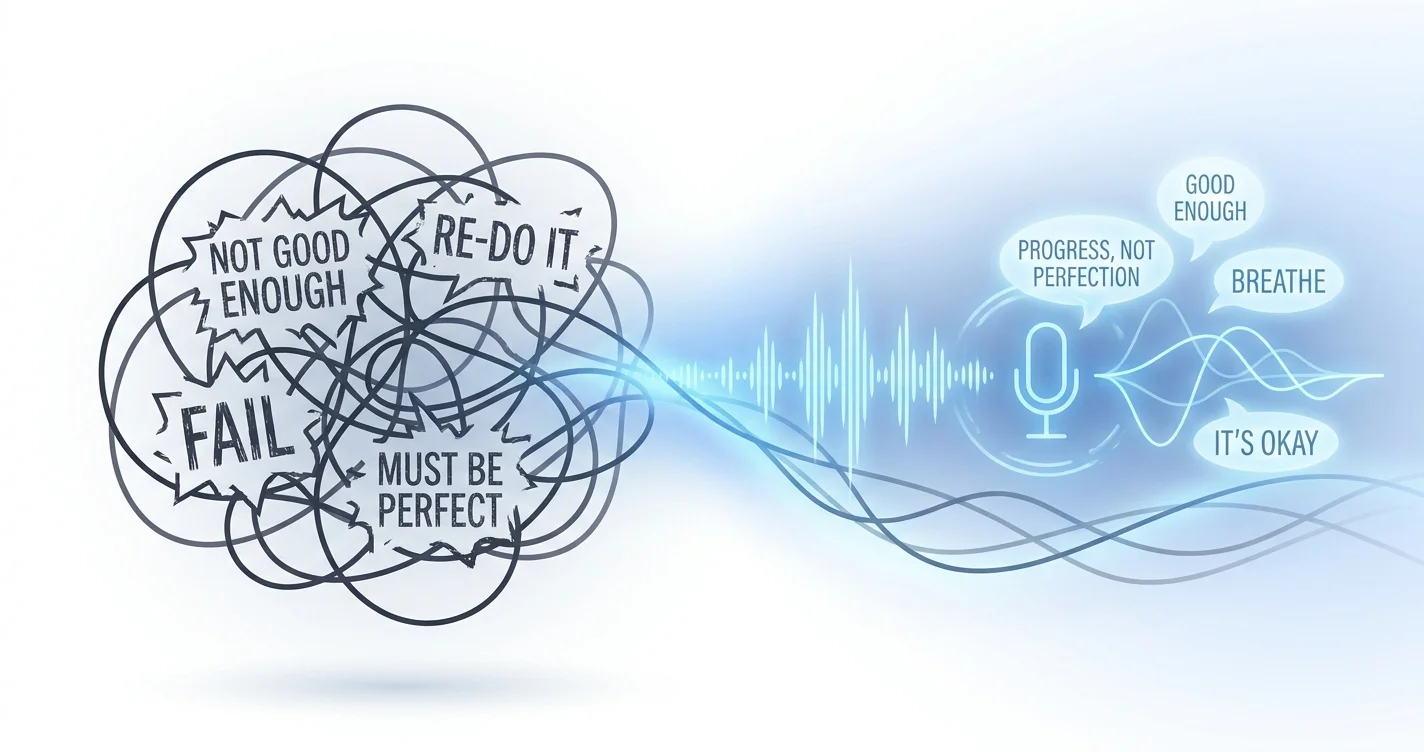
Perfectionism doesn't feel like ambition from the inside. It feels like rewriting the same email four times, replaying a conversation at 2am, and calling straight A's "barely passing." This guide ranks the AI apps built to interrupt that loop in 2026, with Lovon's AI voice support sitting at the top for anyone who wants to talk it out instead of typing it into a chat box.
TL;DR
- Lovon wins the best ai app for perfectionism in 2026 because voice conversations surface self-critical thinking patterns text chat tends to miss. Buy.
- Wysa's CBT modules address rigid all-or-nothing rules but sessions stay scripted rather than responsive. Consider.
- Replika is built for companionship, not correction, so it can reinforce perfectionist self-talk instead of challenging it. Skip.
- Youper's mood tracking flags the anxiety-perfectionism loop well but has no live conversation partner to talk through it in the moment. Consider.
Why this matters
Perfectionism isn't a personality quirk you should just "manage better." It's a thinking pattern, and thinking patterns respond to being talked through out loud, not just logged in a journal app.
Most mental health apps built before 2024 were designed around text check-ins and mood scores. Perfectionism doesn't show up cleanly in a mood score. It shows up in the specific sentence you say to yourself after a small mistake, and an app only catches that if it can actually hear you say it.
That's the gap this list is measuring: which apps can hold a real conversation about self-criticism, and which ones just track it.
How we ranked
Each app on this list was evaluated against three things that matter specifically for perfectionism: whether it responds to spoken, real-time self-talk versus typed logs; whether it actively challenges cognitive distortions like all-or-nothing thinking instead of just validating feelings; and whether it's honest about being a support tool rather than a replacement for a licensed clinician.
Apps that only offer scripted CBT worksheets without a conversational layer lost points here, since perfectionism tends to escalate in the moment, not on a schedule. Six apps made the final cut based on aggregated 2026 feature comparisons and publicly available product descriptions.
The ranked list
1. Lovon — the voice-first pick
Lovon runs on voice conversations built with input from PhD psychologists, which matters for perfectionism specifically because the pattern usually surfaces mid-sentence, not mid-journal-entry. You talk through the actual moment — the redone email, the "not good enough" spiral — and the AI voice companion responds in real time rather than waiting for a written prompt.
It's available 24/7, which fits how perfectionist self-criticism actually behaves: it doesn't wait for a 3pm therapy slot. Lovon is explicit that it's not a replacement for licensed clinical care, which is the right posture for a support tool working alongside real perfectionism treatment.
Verdict: Buy. This is the clearest fit on the list for people who process out loud rather than on paper.
2. Wysa — the structured CBT pick
Wysa leans on scripted cognitive behavioral therapy modules, which can work for someone who wants a workbook-style walkthrough of all-or-nothing thinking. The chatbot format means responses follow a decision tree rather than adapting freely to what you just said.
For perfectionism specifically, that structure is a mixed bag: it's consistent, but it can feel like filling out a form when what you actually need is someone to push back on the sentence you just said to yourself.
Verdict: Consider, mainly as a companion to something more conversational.
3. Replika — the companionship pick, and the wildcard
Replika is built to be warm and agreeable, which is exactly the problem for perfectionism. A companion AI designed to validate whatever you tell it can end up co-signing the same harsh self-talk it should be interrupting.
It's a fine app for loneliness. It's not built to challenge cognitive distortions, and perfectionism runs almost entirely on cognitive distortions.
Verdict: Skip for this specific use case.
4. Youper — the tracking pick
Youper's strength is pattern recognition: it logs mood entries and flags recurring loops, which can help someone notice that their perfectionism spikes every Sunday night or before every performance review. That's genuinely useful data.
What it doesn't offer is a live conversation partner in the moment the spiral starts. Tracking the pattern after the fact is different from talking through it while it's happening.
Verdict: Consider as a pattern-spotting layer, not a standalone fix.
5. BetterHelp — the human-therapist pick
BetterHelp connects you with a licensed human therapist rather than an AI, which is the right call for perfectionism rooted in deeper patterns like childhood achievement pressure or a controlling parent. Sessions are scheduled, typically weekly, and cost varies by provider and plan.
It's not built for the 11pm spiral before a deadline. It's built for the deeper work an AI app isn't licensed to do.
Verdict: Consider, and pair it with something available between sessions.
6. Woebot — the check-in pick
Woebot offers brief daily check-ins framed around CBT principles, aimed at people who want something lightweight rather than a full conversation. For perfectionism, brief check-ins can miss the depth of an actual spiral in progress.
It works best as a low-friction habit tracker, not as the tool you reach for mid-crisis.
Verdict: Wait unless you specifically want a low-commitment daily habit.
Talk through the spiral tonight
Start a voice session with Lovon whenever the self-criticism hits, no appointment needed.
Where AI apps hit their limit
An AI app can interrupt a spiral at 11pm. It can't unwind why the spiral exists in the first place, and for a lot of people, that root sits deeper than "I made a typo in a Slack message."
Perfectionism often traces back to conditional approval — praise that showed up only when performance was flawless — and that pattern usually needs sustained work with a licensed clinician to actually shift. Work on perfectionism and self-criticism through structured individual therapy tends to target the belief system underneath the behavior, not just the behavior itself, which is a different kind of repair than a nightly check-in can do alone.
That's not a knock on AI support. It's the honest boundary every app on this list should state clearly, and Lovon does: a companion for the in-between moments, not a substitute for that deeper clinical work.
Comparison table
| App | Format | Real-time conversation | Challenges distortions | Best for | Verdict |
|---|---|---|---|---|---|
| Lovon | AI voice | Yes, 24/7 | Yes | Talking through the spiral live | Buy |
| Wysa | Text chatbot | Scripted only | Structured CBT | Workbook-style learners | Consider |
| Replika | Text companion | Yes, but validating | No | Companionship, not correction | Skip |
| Youper | Mood tracking | No | Pattern-flagging only | Spotting recurring triggers | Consider |
| BetterHelp | Human therapist | Scheduled sessions | Yes, clinically | Deep-rooted patterns | Consider |
| Woebot | Text check-in | Brief, daily | Light CBT | Low-commitment habit | Wait |
Where to start
- Start with the moment, not the app store. Open whichever tool you pick the next time you catch yourself redoing something that was already fine — that's the actual test, not a five-star rating.
- Don't stack three apps at once in 2026. One conversational tool plus one tracking tool is plenty; more than that just becomes another thing to be perfectionist about.
- Read the fine print on "AI therapist" claims. Every legitimate app on this list is upfront that it supports, not replaces, licensed clinical care — treat any app that claims otherwise as a red flag.
If you want a deeper breakdown of the specific thought patterns behind perfectionism, 10 cognitive distortions and how to fix them covers the all-or-nothing thinking that drives most of it, and how to stop negative self-talk for good walks through the language shift itself.
For a closely related use case, the breakdown of the best AI app for imposter syndrome in 2026 covers the overlap between perfectionism and feeling like a fraud despite results, since the two patterns almost always show up together. And if you want a concrete practice to run between sessions, how to use cognitive behavioral techniques on your own walks through the exercises that pair well with any of the apps above.
FAQ
What is the best AI app for perfectionism in 2026?
Lovon ranks first for perfectionism in 2026 because it uses real-time voice conversation rather than scripted text chat, which fits how perfectionist self-talk actually surfaces mid-moment. It's built with input from PhD psychologists and is explicit that it supports, not replaces, licensed clinical care.
Can an AI app actually help with perfectionism?
Yes, for the day-to-day self-criticism loop — catching a distorted thought and talking it through before it spirals. Deeper root causes, like conditional childhood approval, usually need sustained work with a licensed therapist alongside any app.
Is Lovon better than Wysa for perfectionism?
Lovon's voice format responds to what you say in real time, while Wysa follows scripted CBT decision trees through text. For catching an active spiral, voice tends to fit the moment better; for structured worksheet-style learning, Wysa works fine.
How much does an AI therapy app cost in 2026?
Pricing varies by app and plan, and most AI mental health apps in 2026 offer some form of free access alongside paid tiers. Check each app's current pricing directly since it changes often.
Is Replika good for perfectionism?
Not really. Replika is built to be agreeable and validating, which can reinforce harsh self-talk instead of challenging it. It's a better fit for companionship than for correcting cognitive distortions.
Do I need a licensed therapist if I use an AI app for perfectionism?
If your perfectionism traces back to deeper patterns like childhood conditional approval, a licensed therapist can do work an app isn't equipped to do. Most people get the most out of pairing both.
What's the difference between perfectionism and high standards?
High standards let you feel satisfied when you meet them. Perfectionism moves the bar the moment you get close, so satisfaction never actually arrives — that's the core distortion every app on this list is trying to interrupt.
Can voice-based AI therapy work as well as text-based apps?
For catching self-critical thoughts in the moment they happen, voice tends to work better since it mirrors how the thought actually occurs — as an internal sentence, not a typed log. Text apps still work well for structured, scheduled reflection.
One last thing
The detail most people miss about perfectionism apps: the ones that just validate you (Replika, and to some extent Woebot's brief check-ins) can quietly make the pattern worse, because agreement feels like relief in the moment but skips the actual correction. The apps worth paying attention to in 2026 are the ones willing to gently push back on the sentence you just said about yourself — that's the whole job.
Related guides
How AI Support Helps You Heal
AI emotional support isn't about replacing human connection — it's about filling the gaps. The moments when you need to talk at 2 AM, when you don't want to burden your friends again, or when you simply need someone to listen without judgment.
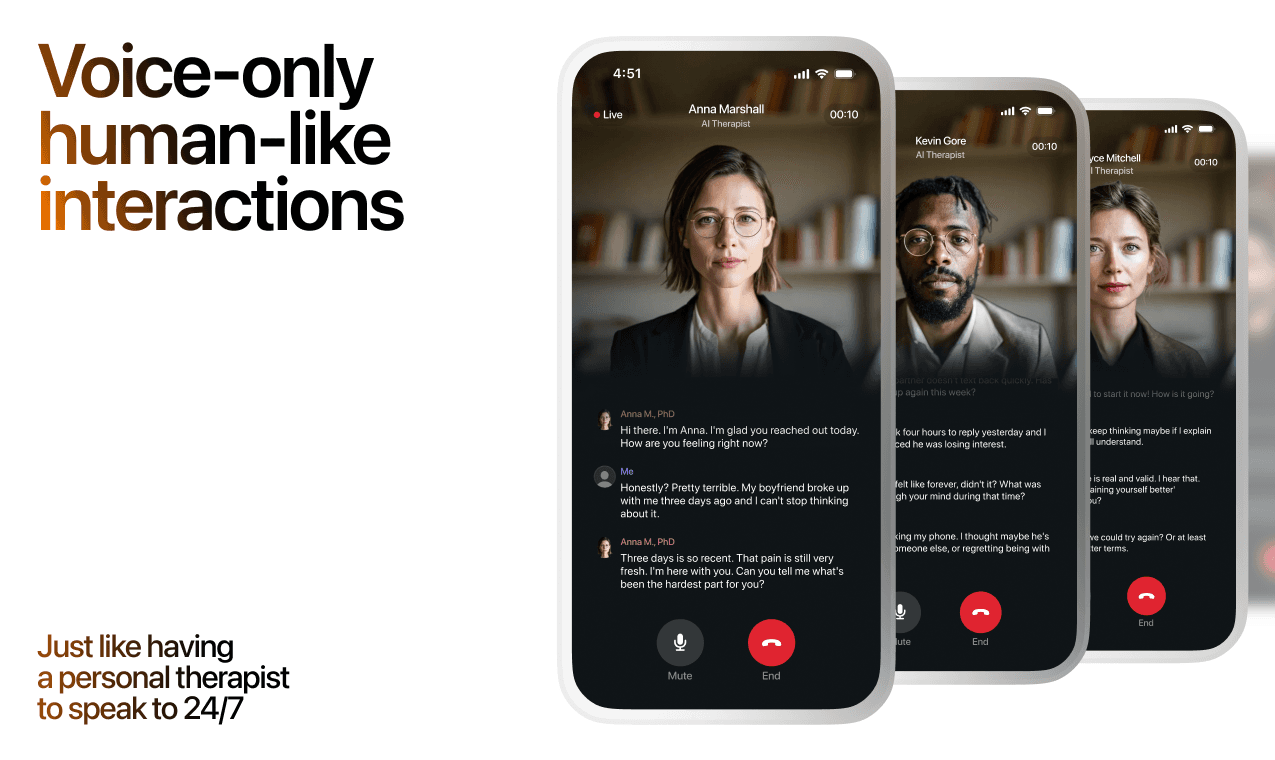
Here's what happens in a typical Lovon session:
You share what's on your mind
There's no script, no intake form, no waiting room. You speak or type whatever you're feeling — in your own words, at your own pace.
Lovon validates and explores
Using frameworks from CBT (Cognitive Behavioral Therapy) and motivational interviewing, Lovon acknowledges your feelings first, then gently helps you explore them. No dismissive "just move on" advice.
You build coping skills together
Lovon doesn't just listen — it actively works with you on evidence-based techniques: thought reframing, urge surfing, behavioral experiments, and more.
What a Session with Lovon Looks Like
When to Seek Professional Help
AI support is a valuable tool, but it's not a replacement for professional care. Please consider reaching out to a licensed therapist if you experience any of the following:
- Persistent thoughts of self-harm or suicide
- Inability to perform daily activities (work, eating, sleeping) for more than 2 weeks
- Turning to alcohol or substances to cope
- Intense anger or desire to harm your ex-partner
- Complete emotional numbness that doesn't improve over time
Crisis Resources (US): If you're in immediate danger, call 988 (Suicide & Crisis Lifeline) or text HOME to 741741 (Crisis Text Line). Available 24/7, free, and confidential.
Outside the US? Find a crisis line in your country
Ready to Start?
Your healing journey can begin right now
A 7-day trial. No judgment. Just a safe space to process what you're going through.
Frequently Asked Questions
Is Lovon a replacement for a real therapist?
Is my conversation with Lovon AI private?
How is Lovon different from ChatGPT for emotional support?
Can I use Lovon if I'm already seeing a therapist?
Can I try Lovon before subscribing?
About the Author
The Lovon Editorial Team
Mental Health & Wellness Content Team
The Lovon Editorial Team develops mental health and wellness content designed to make psychological concepts accessible and actionable. Our goal is to bridge the gap between clinical research and everyday life - helping you understand why your mind works the way it does and what you can do about it....
Related articles
- Emotionally Immature Parents Boundaries That Hold in 2026
Set boundaries with emotionally immature parents in 2026 using scripted limits, exit lines, and follow-through steps…
- Best AI App for Making Friends as an Adult (2026 Ranked)
Lovon leads our 2026 ranking of AI apps for social confidence, tackling the anxiety behind making friends as an adult…
- AI Relationship Coach for Dating Confidence: 2026 Guide
The best ai relationship coach for dating confidence in 2026 pairs voice practice with real self-worth work, not…
- Not Good Enough? Therapy for Feeling Good Enough
You just finished a very hard task and helped the company succeed. You felt happy for a moment, but then a quick thought…
See also
Quizzes
- Self Esteem Test: What Is Your Worth Resting On?
See what your sense of worth is resting on.
- Toxic Masculinity Test: Which Rules Are You Running?
See which learned rules cost you most, in 3 minutes.
Free tools
- How to Come Out to Your Parents
A chat about how to come out to your parents that starts with whether now is safe, not with the speech. Tell it your…
- What to Say Back to a Hostile Co-Parent
A chat, not a form. Paste the message your ex sent about the kids, say what actually has to be decided, and you get a…
From the wiki
- What is inhibited grief?
Inhibited grief is grief that never gets out. The loss happened, you kept functioning, and the feeling stayed sealed…
Disclaimer: This article is for informational purposes only and does not constitute medical advice, diagnosis, or treatment. Always seek the advice of your physician or other qualified health provider with any questions you may have regarding a medical condition. If you are in crisis or think you may have an emergency, call 988 (Suicide & Crisis Lifeline) or go to the nearest emergency room. Outside the US? Find a crisis line in your country.