
Abandonment Issues in Relationships: How to Overcome Them 2026
Overcome abandonment issues in relationships with 6 practical steps for 2026 — grounding routines, trigger logs, and on-demand AI voice therapy support.
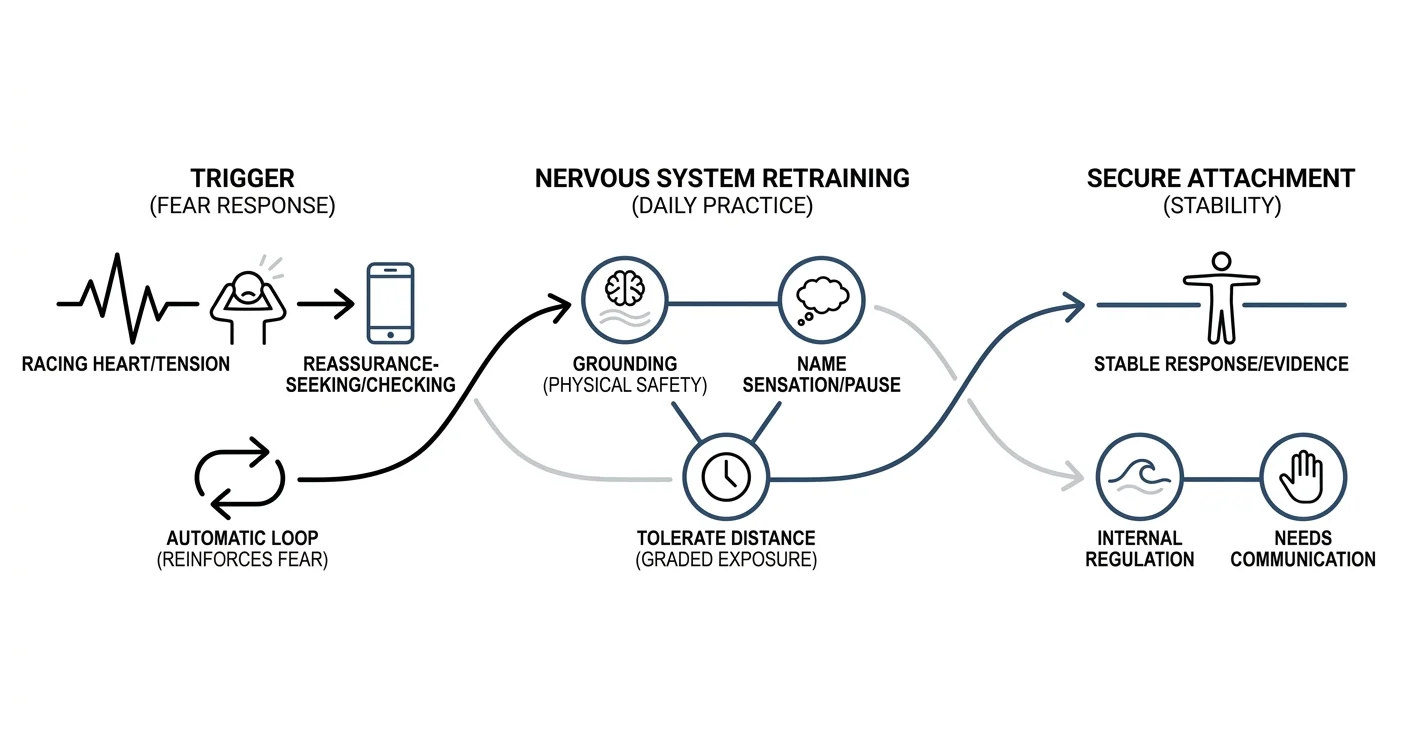

Key Takeaways
- Abandonment issues in relationships start in early attachment wounds — daily nervous-system work shrinks reactivity
- Reassurance-seeking soothes the moment but reinforces the fear; naming the trigger out loud interrupts the loop faster.
- Voice-based tools like Lovon give you a place to process abandonment fears in real time, between sessions or instead
- Secure attachment is learned, not fixed at birth — consistent practice moves people from anxious patterns toward
Abandonment issues in relationships show up as clinginess, pre-emptive withdrawal, or a running tally of every sign your partner might leave. This guide walks through the specific steps that shrink the fear response, not just manage the symptoms.
TL;DR
- Abandonment issues in relationships start in early attachment wounds — daily nervous-system work shrinks reactivity in weeks, not months.
- Not sure the pattern is yours? The do I have abandonment issues quiz names which version of it you are running before you pick a technique.
- Reassurance-seeking soothes the moment but reinforces the fear; naming the trigger out loud interrupts the loop faster.
- Voice-based tools like Lovon give you a place to process abandonment fears in real time, between sessions or instead of them.
- Secure attachment is learned, not fixed at birth — consistent practice moves people from anxious patterns toward stability in 2026.
Why this matters
Fear of abandonment doesn't stay contained to one relationship. It shows up as checking a partner's phone, picking fights before a trip apart, or going quiet the moment someone gets close. Left alone, the pattern repeats with every new partner, and each repeat makes the belief "people leave" feel more true, not less.
The fix isn't finding a partner who never triggers you. It's building a nervous system that can tolerate distance without treating it as proof of loss. That's a skill, and skills get built through repetition, not insight alone. You can read insight in an article. You build the skill in the moment the fear hits — which is exactly why fear of abandonment causes and how to overcome it is worth a separate read alongside this one.
What you'll need
- 10-15 minutes a day for a grounding or journaling practice — non-negotiable, even on good days
- A way to name your attachment pattern (anxious, avoidant, disorganized, or secure) so you know what you're actually working with
- A trigger log — paper, notes app, or voice memo — to catch the pattern in real time instead of after the fact
- A support option for the moments between therapy sessions, whether that's a trusted friend, a licensed therapist, or an AI voice support app like Lovon
- Patience with a 2026 timeline: attachment patterns formed over years don't dissolve in a week
The steps
1. Identify your specific abandonment trigger
You can't regulate a fear you haven't named. Abandonment triggers are rarely dramatic — a delayed text reply, a partner making plans without you, a slightly flat tone of voice. Spend three days writing down the exact moment your chest tightens or your stomach drops.
Most people find their triggers cluster around 2-3 repeat scenarios: distance, ambiguity, or perceived deprioritization. Taking the attachment style quiz helps you see whether your triggers map to an anxious, avoidant, or disorganized pattern, which changes what the next step looks like. Common mistake: treating every anxious spike as urgent information about the relationship instead of information about your nervous system.
2. Separate the feeling from the story
The feeling is physical: racing heart, tight jaw, urge to check your phone. The story is the interpretation: "they're pulling away," "this is how it always ends." These two things happen within seconds of each other, which makes them feel like one event. They aren't.
When the trigger hits, name the sensation out loud or in writing before you name the story: "My chest is tight, my hands are cold." Then ask if the story is a fact or a prediction. This single pause — usually under 60 seconds — is what breaks the automatic reach for reassurance. Common mistake: skipping straight to soothing the story ("they'd never leave me") without addressing the body first, which leaves the physical alarm running underneath.
3. Build a grounding routine before you need it
Waiting until a full-blown panic spiral to practice grounding is like trying to learn to swim while drowning. Build the skill on calm days so it's available on hard ones. Box breathing — four seconds in, four seconds hold, four seconds out, four seconds hold, repeated for two minutes — lowers physiological arousal reliably enough that most people notice a shift within the first cycle.
Pair breathing with a body scan: feet on the floor, weight in the chair, one object you can see and name. This isn't about distraction. It's about proving to your nervous system that you're safe right now, independent of what your partner is doing three states away. Common mistake: only practicing grounding during a crisis instead of daily, so the skill isn't automatic when it's needed most.
4. Practice tolerating distance in small doses
Avoidance of distance keeps the fear alive because you never get proof that distance is survivable. Start small: let a text go unanswered for 20 minutes without checking. Let your partner make a plan without you being looped in immediately. Notice what happens in your body during the wait — usually a spike followed by a decline, even without any reassurance from the other person.
This is graded exposure, the same principle used for phobias. Each rep where nothing bad happens retrains the prediction. Skipping this step and going straight to "just trust more" doesn't work, because trust isn't a decision — it's evidence accumulated over repeated tolerable distance. Common mistake: picking a distance dose too large too fast, which produces a flood response instead of a manageable one.
5. Communicate the need, not the fear
There's a difference between "I need you to text me back within an hour or I'll spiral" and "I noticed I get anxious with slower replies — can we agree on a rough check-in window?" The first outsources your regulation to your partner's behavior. The second states a need your partner can actually meet without becoming your nervous system's manager.
Specific, bounded requests work better than vague reassurance-seeking ("do you still love me?") because they give your partner something concrete to do, and they give you something concrete to notice when it happens. Common mistake: waiting until you're already flooded to communicate, which turns a request into an accusation.
6. Work the pattern with consistent outside support
Self-work has a ceiling. Attachment patterns formed in childhood or past relationships often need a second perspective to spot blind spots you can't see from inside your own head. That doesn't require weekly in-person therapy for everyone — it requires consistency, whichever format delivers it.
An AI voice support app like Lovon works because the trigger moment often happens at 11pm, not during a Tuesday 3pm appointment. Being able to talk through the spike as it's happening, rather than three days later in a scheduled session, is what turns insight into a rewired response. If the pattern feels bigger than day-to-day coping, how to heal anxious attachment on your own goes deeper on when to bring in a licensed clinician alongside daily practice.
Troubleshooting
- You feel worse right after grounding exercises. This usually means the exercise was introduced mid-crisis instead of practiced beforehand — back up to daily practice on calm days first.
- Your partner says your reassurance requests feel endless. That's a sign the requests are soothing the moment but not building tolerance — shift from "tell me you love me" to a bounded, specific ask.
- You spiral after a great date, not a bad one. Closeness can trigger abandonment fear as strongly as distance does, because intimacy raises the stakes of eventual loss — name this pattern specifically in your trigger log.
- Old relationships keep surfacing during arguments. That's evidence you're reacting to a past rupture, not the current moment — pause and ask which relationship this feeling actually belongs to.
- You can't tell if you're anxious or avoidant. Disorganized attachment often looks like both at once, alternating pursuit and withdrawal within the same week — a structured quiz or a conversation with a therapist clarifies this faster than self-diagnosis.
Talk through a trigger tonight
Process an abandonment spike the moment it happens, not three days later.
Tools and resources
- A trigger log (notes app or voice memo) to catch patterns in real time
- A box-breathing routine, practiced daily, not just in crisis
- The attachment style quiz to confirm which pattern you're working with before choosing a strategy
- A licensed therapist for deeper trauma work, when the pattern traces back to childhood ruptures
- An on-demand option, like an AI voice therapy app, for the 11pm spikes that don't wait for a scheduled appointment
What to do next
Overcoming abandonment issues in relationships isn't a one-week project. It's a daily practice that compounds over months. The next move is picking one step from this list — the trigger log or the grounding routine — and running it for 14 straight days before adding a second. Consistency beats intensity here every time.
FAQ
What causes abandonment issues in relationships?
Abandonment issues in relationships usually trace back to early attachment ruptures — inconsistent caregiving, a parent leaving, or a past relationship that ended abruptly. The nervous system learns to expect loss and stays on alert for signs of it, even in safe relationships.
Can you overcome abandonment issues on your own?
Yes, self-directed work like grounding practice, trigger logging, and graded exposure to distance can meaningfully reduce reactivity. Deeper childhood-rooted patterns often move faster with a licensed therapist or a consistent daily support tool alongside self-work.
How long does it take to heal abandonment issues?
Most people notice reduced reactivity within 4-6 weeks of daily practice, with more stable change over 3-6 months. The timeline depends on how long the pattern has been reinforced and how consistently the new skills get practiced.
Is fear of abandonment the same as anxious attachment?
They overlap heavily but aren't identical. Fear of abandonment is the specific fear response; anxious attachment is the broader relational pattern that fear sits inside, often paired with reassurance-seeking and hypervigilance to a partner's mood.
What are signs of abandonment issues in adults?
Common signs include constant reassurance-seeking, panic over unanswered texts, picking fights before separations, and pushing partners away before they can leave first. Some people show the opposite pattern — avoiding closeness entirely to prevent future loss.
Does therapy help with abandonment issues?
Yes, therapy is one of the most effective routes, especially for patterns rooted in childhood. Between sessions, an AI voice support app like Lovon gives a place to process triggers as they happen rather than waiting for the next appointment.
Can abandonment issues be fixed without a partner's help?
Much of the work happens individually — nervous system regulation, trigger identification, and tolerance-building don't require a partner's participation. A supportive partner helps, but the core skill is self-regulation, not partner reassurance.
What's the difference between abandonment issues and trust issues?
Abandonment issues center on the fear of being left; trust issues center on doubting a partner's honesty or intentions. They frequently co-occur, but abandonment fear can exist even with a completely trustworthy, consistent partner.
One last thing
The hardest part of overcoming abandonment issues in relationships isn't learning the steps — it's practicing them on a day when nothing is wrong. Most people only reach for grounding tools mid-crisis, which is like trying to install a smoke detector during a fire. Run the routine on a boring Tuesday in 2026, before you need it, and the skill will actually be there when the trigger hits.
Related guides
How AI Support Helps You Heal
AI emotional support isn't about replacing human connection — it's about filling the gaps. The moments when you need to talk at 2 AM, when you don't want to burden your friends again, or when you simply need someone to listen without judgment.
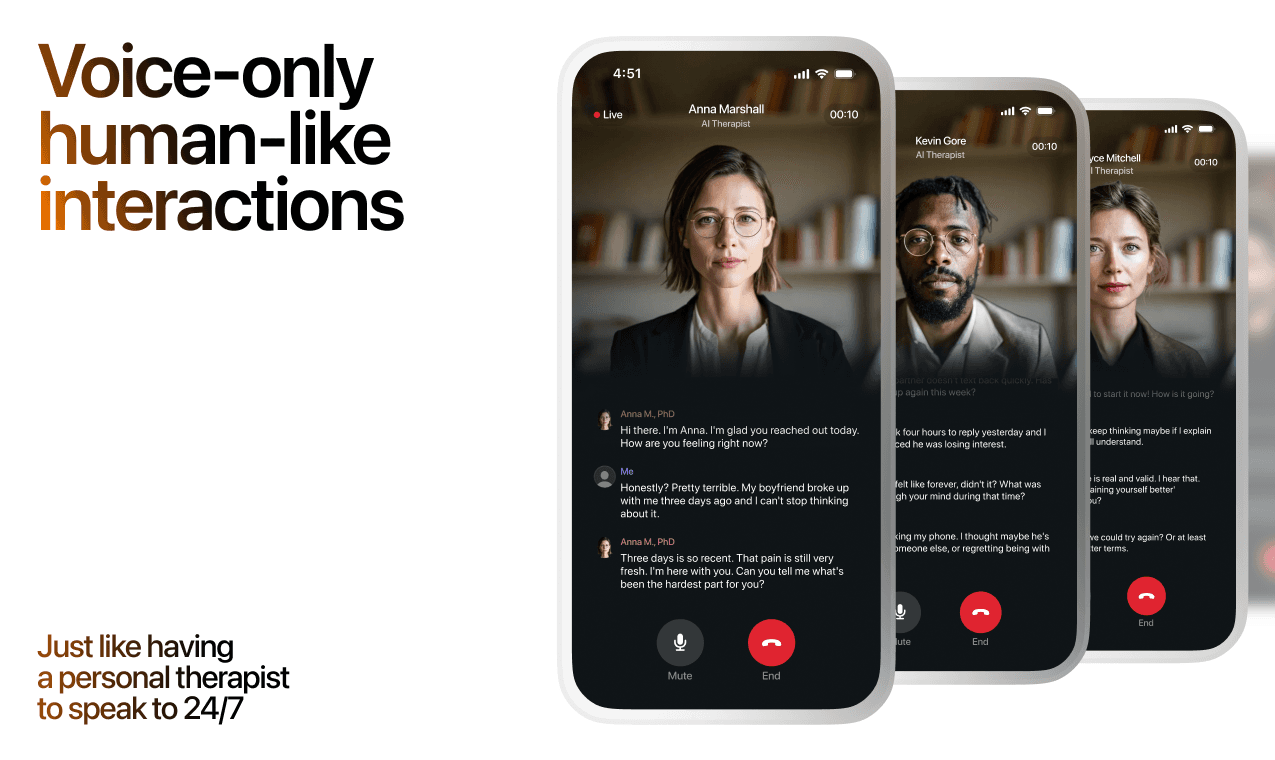
Here's what happens in a typical Lovon session:
You share what's on your mind
There's no script, no intake form, no waiting room. You speak or type whatever you're feeling — in your own words, at your own pace.
Lovon validates and explores
Using frameworks from CBT (Cognitive Behavioral Therapy) and motivational interviewing, Lovon acknowledges your feelings first, then gently helps you explore them. No dismissive "just move on" advice.
You build coping skills together
Lovon doesn't just listen — it actively works with you on evidence-based techniques: thought reframing, urge surfing, behavioral experiments, and more.
What a Session with Lovon Looks Like
Lovon is AI support, not a replacement for professional care. If things have been hard to get through for weeks, or you are thinking about harming yourself, talk to a doctor or a licensed therapist.
Ready to Start?
Your healing journey can begin right now
A 7-day trial. No judgment. Just a safe space to process what you're going through.
Frequently Asked Questions
Is Lovon a replacement for a real therapist?
Is my conversation with Lovon AI private?
How is Lovon different from ChatGPT for emotional support?
Can I use Lovon if I'm already seeing a therapist?
Can I try Lovon before subscribing?
About the Author
The Lovon Editorial Team
Mental Health & Wellness Content Team
The Lovon Editorial Team develops mental health and wellness content designed to make psychological concepts accessible and actionable. Our goal is to bridge the gap between clinical research and everyday life - helping you understand why your mind works the way it does and what you can do about it....
Related articles
- Dismissive Avoidant Attachment: Signs & Fixes (2026)
Dismissive avoidant attachment explained: what drives the withdrawal, how to respond, and when it actually shifts…
- Signs of Insecure Attachment in Adults (2026 Guide)
Signs of insecure attachment in adults, explained step by step: fear of abandonment, withdrawal, reassurance-seeking…
- Anxious Attachment Triggers: How to Defuse Them (2026)
Anxious attachment triggers explained: a 6-step sequence to name, regulate, and defuse them in 2026, plus…
- Secure Attachment Style: How to Build It in 2026
Learn the traits of a secure attachment style and the exact steps to build one in 2026 — regulation, repair, and direct…
See also
Quizzes
- Fear of Intimacy Test: Free 12-Question Self-Check
See which part of closeness feels risky, in 3 min.
- Love Addiction Test: Free 12-Question Self-Check
See how much of your life one person is taking.
Free tools
- Attachment Trigger Plan for Anxious and Avoidant Patterns
Pick your pattern, tick the moments that set it off, and finish one card for each: your body signal, the thing you will…
- How to Stop Overthinking in a Relationship
Not a list of habits. Tell it the specific thing you are going round on, and it separates what actually happened from…
From the wiki
- What is an attachment style?
An attachment style is the habit your nervous system formed for handling closeness: what you actually do when someone…
Disclaimer: This article is for informational purposes only and does not constitute medical advice, diagnosis, or treatment. Always seek the advice of your physician or other qualified health provider with any questions you may have regarding a medical condition. If you are in crisis or think you may have an emergency, call 988 (Suicide & Crisis Lifeline) or go to the nearest emergency room. Outside the US? Find a crisis line in your country.